Project 2 Thermal modeling of battery pack
Aim.
To simulate the thermal effects and compare life cycle performance at various temperatures, charge & discharge rates for a 10 cell series lithium ion battery model, using MATLAB.
Lithium ion battery are mostly used in electric vehicles we must know its charge and discharge rates to operate this batterys in efficient manner and with out damage when this batterys in operation this temperature of it must be kept in limit we simulate the thermal effect of this cell , by knowing the how much temp rise take place we can provide efficient cooling to the batterys so that the life cycle of the battery increases.
cells connected in series. This example shows how to simulate a battery pack consisting of multiple series-connected cells in an efficient manner. It also shows how a fault can be introduced into one of the cells to see the impact on battery performance and cell temperatures. For efficiency, identical series-connected cells are not just simply modeled by connecting cell models in series. Instead a single cell is used, and the terminal voltage scaled up by the number of cells.
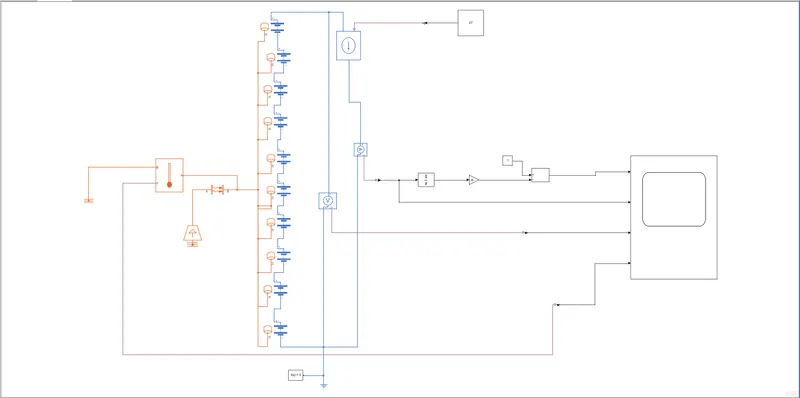
The battery performance parameters like Voltage, SOC has to be analysed at different temperatures.
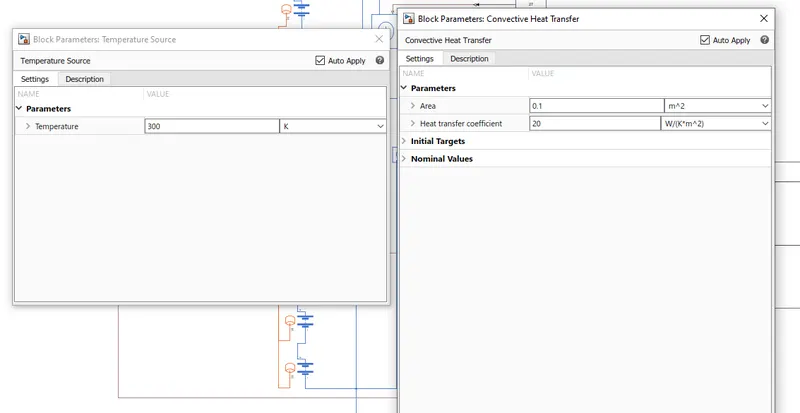
Temperature Source:
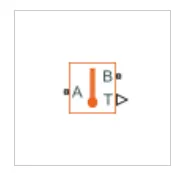
The Temperature Sensor block represents an ideal temperature sensor, that is, a device that determines the temperature differential measured between two points without drawing any heat.
Connections A and B are thermal conserving ports that connect to the two points where temperature is being monitored. Port T is a physical signal port that outputs the temperature differential value.
The block positive direction is from port A to port B. The measured temperature is determined as T = TA – TB.
Convective Heat Transfer:

This block models heat transfer in a thermal network by convection due to fluid motion. The rate of heat transfer is proportional to the temperature difference, heat transfer coefficient, and surface area in contact with the fluid.
state of charge estimation
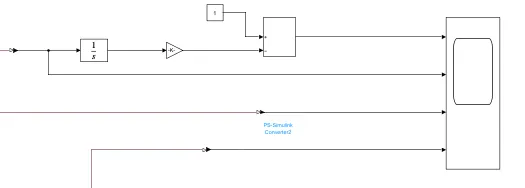
The Coulomb counting method measures the discharging current of a battery and integrates the discharging current over time in order to estimate SOC.
This estimates the battery SOC % using coulomb counting method. It takes current as the input and gives SOC% as output. Initial SOC of the battery is assumed to be 100% .
For comparison purpose only SOC of cell has considered. Since the cells are connected in series, there will be some difference in charging/ discharging of each cell.
The Simulink model of battery pack for lifecycle analysis is shown below. From [1], [2] and [3], we know that the terminal voltage and capacity of the battery will decrease and internal resistance will increase after specified number of cycles.
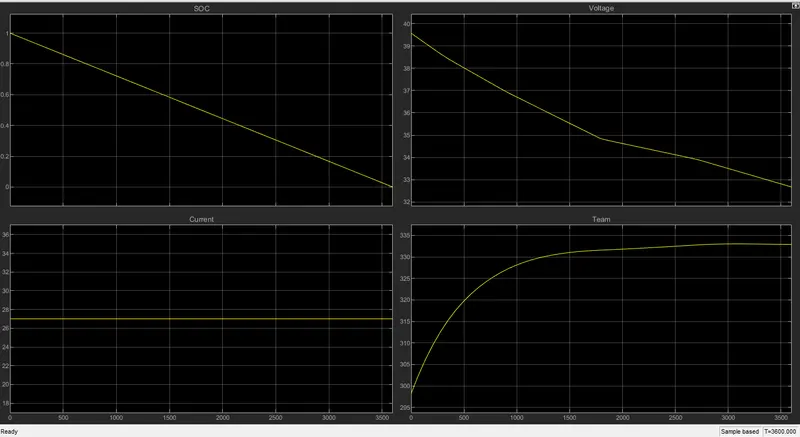
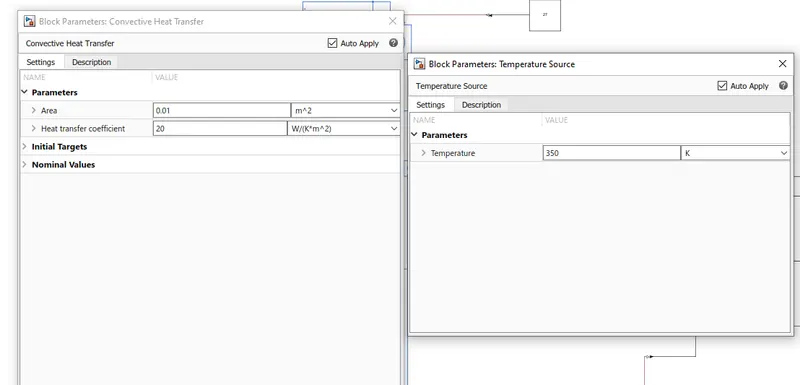
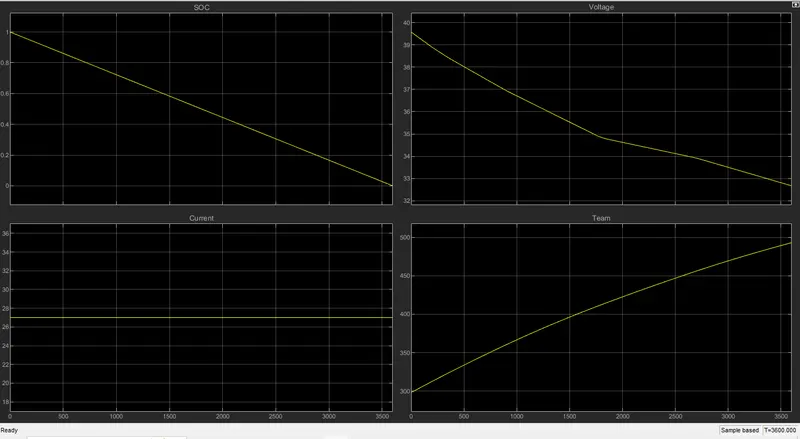
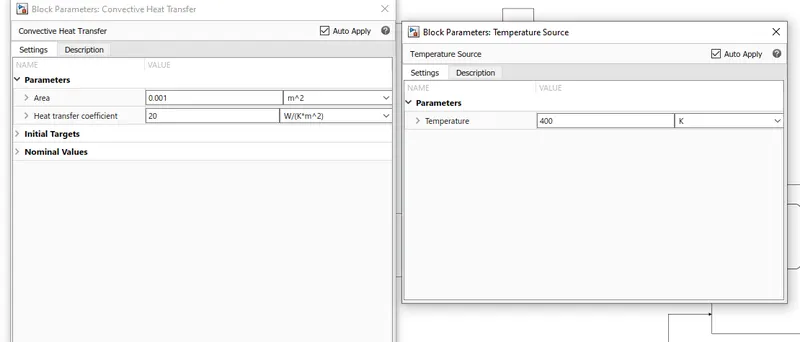
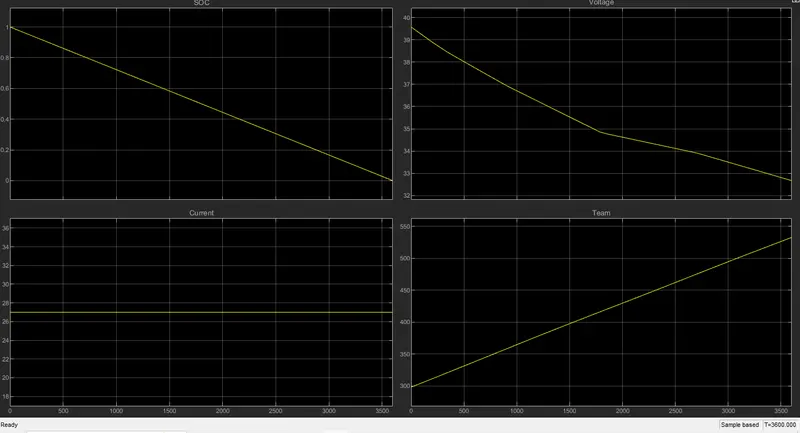
For a 10 cell series lithium ion battery model we simulate the thermal effects and compare life cycle performance at various temperatures, charge & discharge rates using MATLAB. results are as follows. we are simulating thermal effect on we give Cyclic Charge/ Discharge Profile to circuit the waveform you can see above results all conditions it is same.