Project 2 Thermal modeling of battery pack
EV BATCH - 16
Project 2 Thermal modeling of a battery pack
Thermal modeling of a battery pack: Today, conventional engines are being replaced by electric vehicles due to environmental concerns and concern about the exhaustion of fossil fuels. Li-ion cells are often used in EVs because of their high energy density. The thermal behavior of the batteries is crucial not only for safe operation but also for their capacity and life. Li-ion batteries are susceptible to high and low temperatures. Therefore, thermal management and heat prediction are essential to keep the temperatures of the energy storage system cells inside the optimal range of operation and assure safe and effective usage.
Aim: For a 10-cell series lithium-ion battery model, simulate the thermal effects and compare life cycle performance at various temperatures, and charge & discharge rates using MATLAB.
Objective:
- Build the thermal model of a battery pack in MATLAB Simulink
- Simulate the model to observe thermal effects on the battery pack
- Compare life cycle performance at various temperatures, and charge & discharge rates using MATLAB Simulink
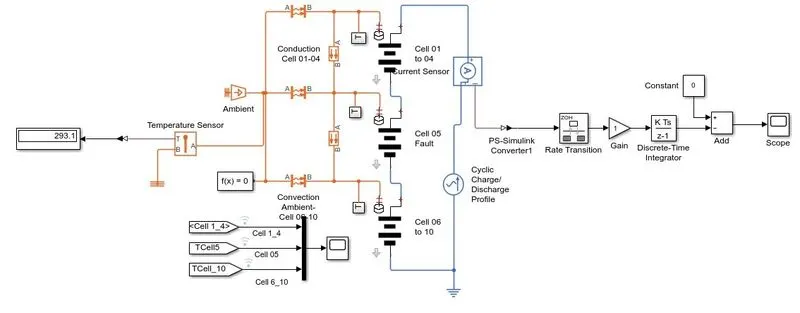
Simulink model:
Steps involved in modeling:
- The battery with fault inbuilt model is taken from MATLAB documentation
- There are 10 numbers of battery arranged in series and a scope is used to plot battery parameters.
- The model is connected to a temperature sensor and displayed to read the temperature data
- The current sensor block is used to read the current readings.
- The cell parameters and temperature data is plotted using two scopes
Simulink blocks used:
- Battery with fault inbuilt model
- Current sensor
- Add
- Discrete-time integrator
- Gain
- Rate transition
- Constant
- Display
- Scope
- Goto/From
Output plots:
As shown in the figure at temperature 293.1K fluctuation is there in cells 1 to 4, cell 5, and cell 6 1o 10. But cell 5 to 10 has
more distortion compared to other cells to fault is reflected.
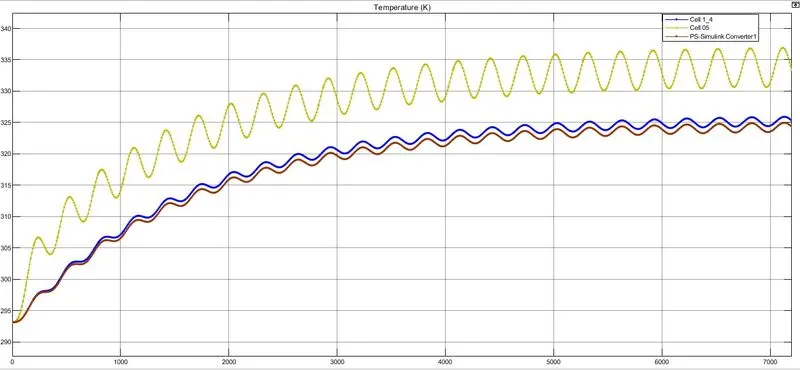
SOC plot and thermal behavior of the battery.
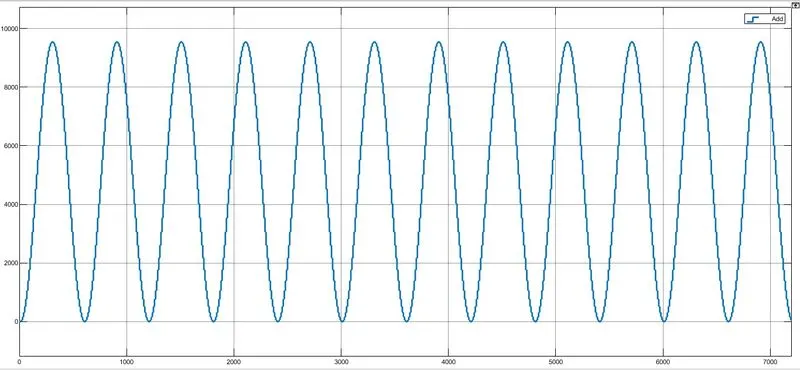
Cyclic Charging and discharging profile of battery pack.
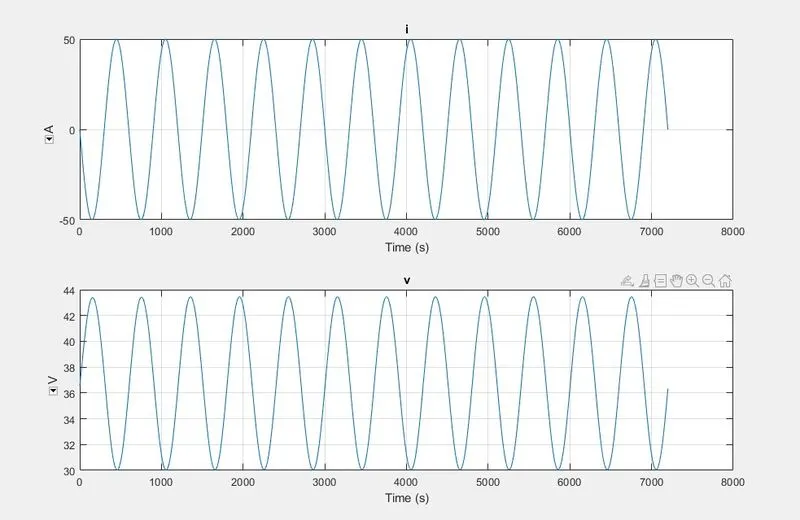
Peak current: 50A while discharging
Max Voltage: 43V , charging
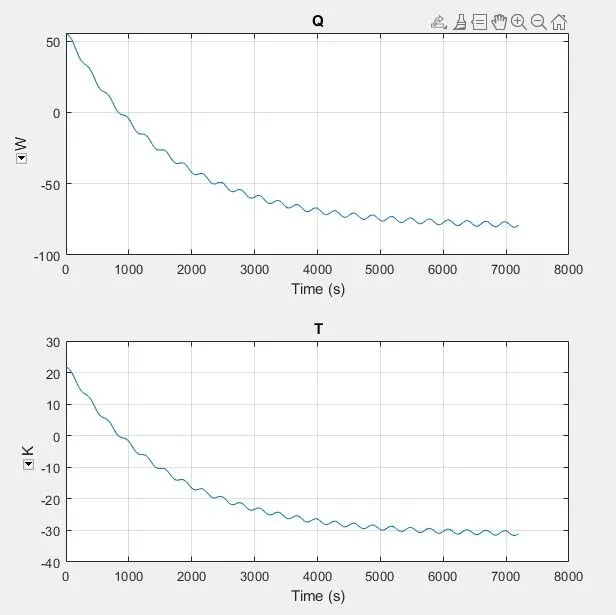
Heat flow rate vs temperature difference.
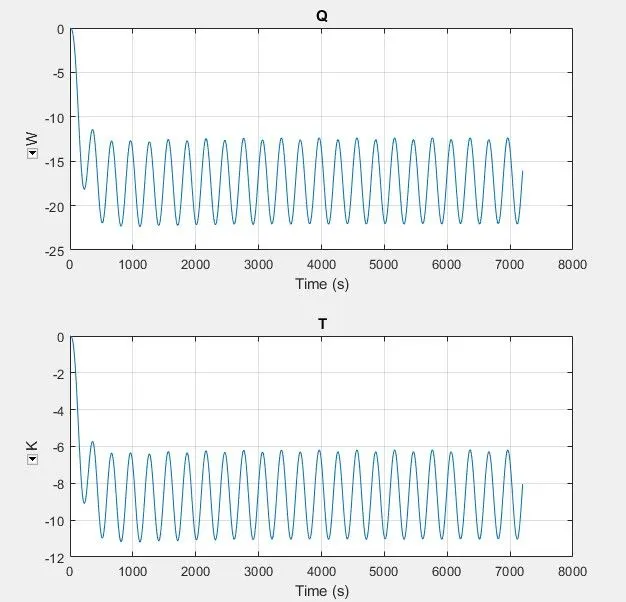
Heat flow rate and temperature.
Result/Conclusion:
The battery temperature conditions are very important for the battery to maintain its rated parameters of capacity, voltage, health, and SOC. The temperature difference caused changes in heat flow by conduction and convection as shown in the plots. The battery SOC will be lower when the temperature conditions are higher or lower than the specified temperature.