Project 2 Thermal modeling of battery pack
For a 10 cell series lithium ion battery model, simulate the thermal effects and compare life cycle performance at various temperatures, charge & discharge rates using MATLAB.
Let battery A ratings be adjusted to the ratings of 10 cells in series
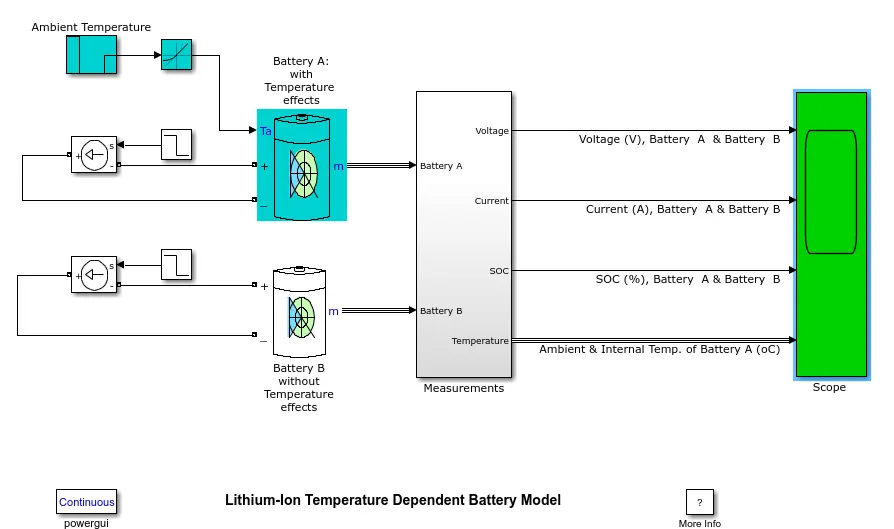
The demonstration shows the performance of the temperature dependent Lithium-Ion battery model (Battery A) when the ambient temperature is varied from 20 degrees C to -20 degrees C and then to 0 degrees C. Battery B represents the case where the effect of temperature is neglected. Start the Simulation and open the Scope to view all signals.
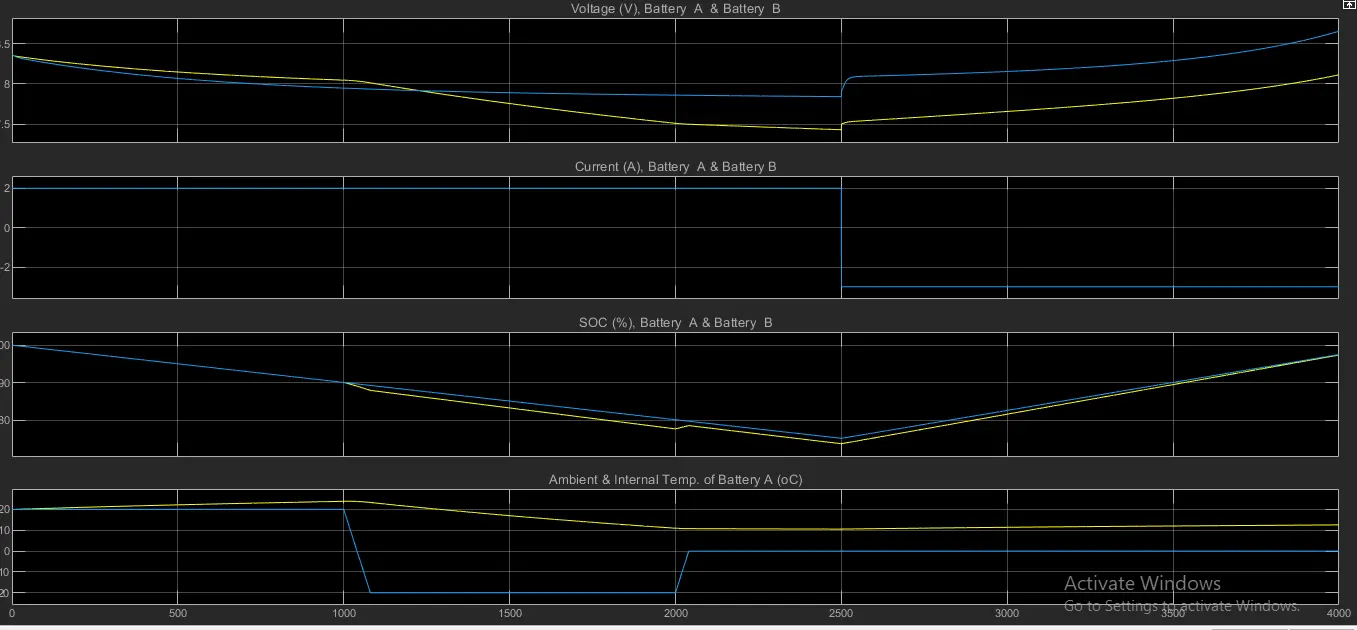
At t = 0 s, the Battery A and B are discharged with 2 A at ambient temperature of 20 degrees C.
At t = 150 s, the internal temperature has increased to its steady state value of 29.2 degrees due to heat losses from the discharge process. This causes the output voltage of Battery A to slightly increase, while battery B output voltage continues to decrease.
At t = 1000 s, the ambient temperature is decreased to -20 degrees C. This causes the output voltage of Battery A to greatly decrease as the internal temperature decreases rapidly. Also the SOC of Battery A decreases due to the reduction of battery capacity. The battery B output voltage continues to decrease slowly to its steady state voltage.
At t = 2000 s, the ambient temperature is increased from -20 degrees C to 0 degrees C. As the internal temperature increases, the output voltage of Battery A increases. Also, as the capacity increases, the SOC of Battery A increases. The Battery B output voltage remains constant to its steady state value.
At t = 2500 s, the Battery A and B are charged with 3 A at ambient temperature of 0 degrees C. This causes the internal temperature to increase due to heat losses during the charge process, which increases the charging voltage of Battery A. Afterwards, Battery A and B continue to charge up until fully charged
Simulation Results:
For life cycle performance at various temperatures
Circuit Description
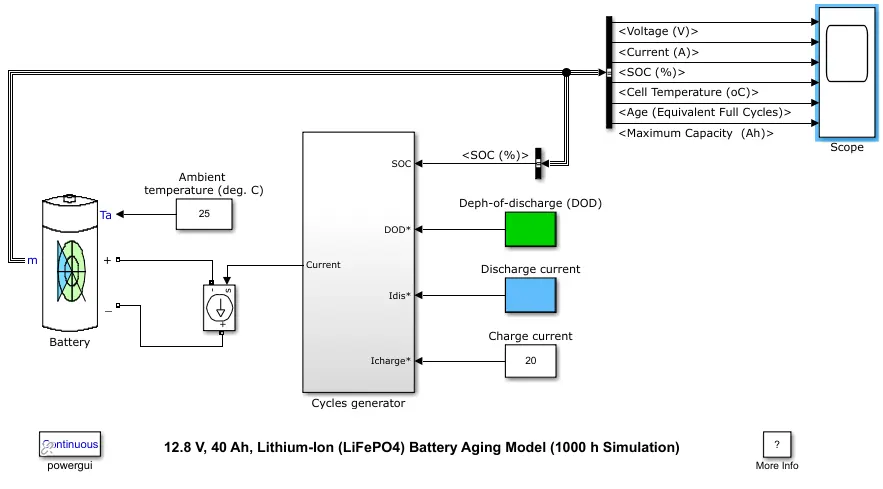
This demo illustrates the effect of aging (due to cycling) on the performance of a 12.8 V, 40 Ah Lithium-Ion battery model. The battery is submitted for 1000 hours, to several discharge-charge cycles at ambient temperature of 25 degrees C , and at various depths of discharge (DOD) and discharge rates. As observed from the Scope, the impact of DOD and discharge rate on the battery life is as expected. As the DOD or discharge rate increases, the battery ages rapidly, which quickly reduces the battery capacity.
Simulation
The demonstration shows the life cycle performance of a 12.8 V, 40 Ah, Lithium-Ion battery during shallow and deep discharges, at various discharge rates. At first, the battery is cycled to a DOD of 20 % at 0.5 C discharge rate. Afterwards, the DOD and discharge rate are increased to 80 % and 2 C, respectively. Start the Simulation and open the Scope to view all signals.
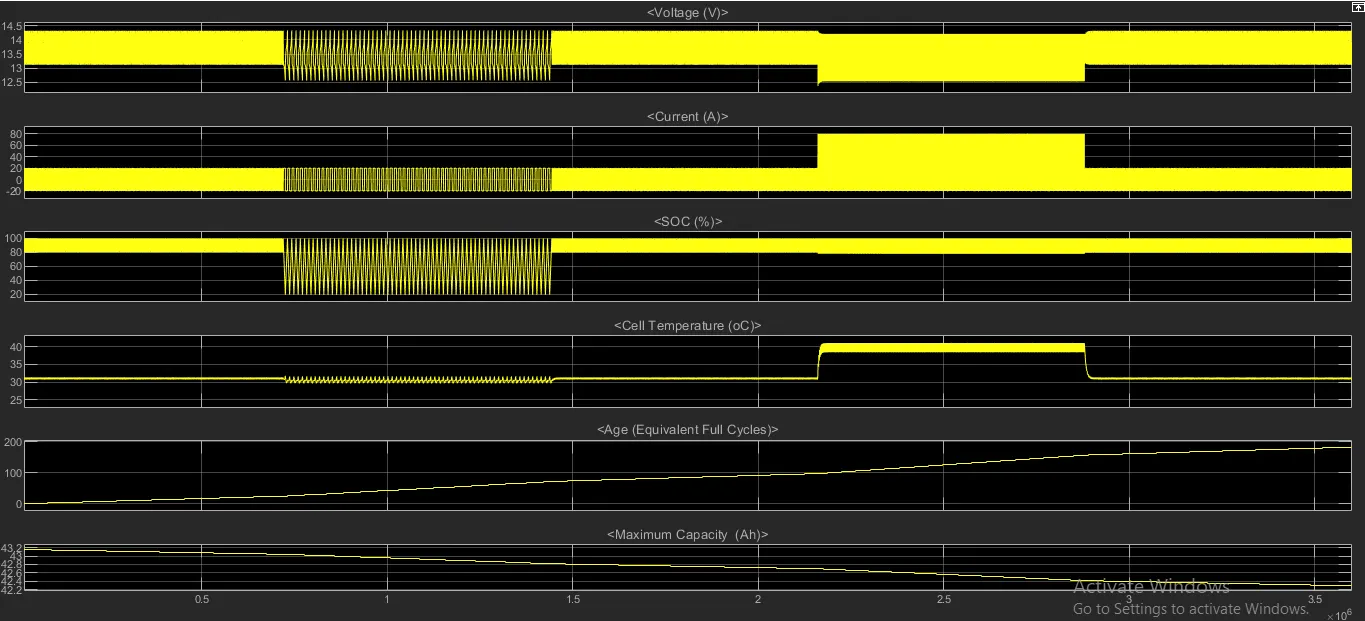
At t = 0 s, the battery cycling starts with a discharge current of 20 A (0.5 C-rate), at ambient temperature of 25 degrees C. The initial SOC is 100 %. The discharge goes on until the SOC reaches 80 % (DOD of 20%). Afterwards, the battery is charged to 100 % SOC with a charge current of 20 A. As this cycle is repeated, the battery age increases whereas its capacity decreases. The internal cell temperature also increases from 25 degrees C to 33 degrees C.
At t = 200 h, the battery is now discharged to 20 % SOC (DOD of 80 %) and charged to 100 % SOC. This cycle is repeated for another 200 hours. As observed, the battery age starts to increase rapidly.
At t = 400 h, the cycling DOD is brought back to 20 % for another 200 hours. This slows down the aging process of the battery.
At t = 600 h, the discharge current is increased to 80 A (2 C-rate). This causes the internal cell temperature to rise from 33 degrees C to 43 degrees C. As this cycle is repeated, the battery ages more rapidly, which quickly reduces the battery capacity.
At t = 800 h, the discharge current is brought back to 0.5 C-rate for another 200 hours, which slows down the aging process of the battery.