Project 2 - Supply and Demand Gap Analysis
Uber Supply and Demand Gap Analysis

Contents
- Aim
- Introduction
- Problem statement
- Methodology
- Analysis
- Insights
- Recommendations
- Conclusions
AIM
The objective is to identify and analyze the problems in Supply-Demand of Uber trips from City to Airport and vice-versa across various hours of the day and find out possible solutions to address the problem.
INTRODUCTION
In this paper, we are going to introduce the characteristics of Python. Python is a general-purpose, high-level programming language that is widely used in recent times. Its design philosophy emphasizes code readability, and its syntax allows programmers to express concepts in fewer lines of code than would be possible in languages such as C (Summerfield, Mark. Rapid GUI Programming with Python and Qt The language constructs enable the user to write clear programs on both a small and large scale The most important feature of Python being it supports multiple programming paradigms, including object-oriented, imperative, and functional programming or procedural styles. Python supports a dynamic type system and automatic memory management and has a large and comprehensive standard library. Once planning for a project is done then resources for that planning are required (demand) to get executed required (demand) and the resources that you expect to be available to meet those demands (supply). Analysis of the difference between these two is known as supply and demand gap analysis. After analysis, we can take action to minimize those gaps.
In this paper, we have taken a case study of UBER cabs. I will identify the root cause of the problem (i.e. cancellation and non-availability of cars) and then analyze the data and observations to give the solution for the same. As a result of our analysis, we should be able to present to the client the root cause(s) and possible hypotheses of the problem(s) and recommend ways to improve them.
PROBLEM STATEMENT
- Uber is facing a problem of driver cancellation and non-availability of cars leading to a loss of potential revenue
- Uber is an app-based transportation network and taxi company. In its airport rides in a particular city, many of its users face the problem of cancellation by the driver or non-availability of
- These very issues impact the business of Uber and it loses out on its Revenue.
METHODOLOGY
Initial Analysis: Understand the dataset given. Look through its structure, identify the datatypes of various columns, and get a basic idea of the dataset to proceed further.
Data Cleaning: Look out for visible data quality issues and rectify them. Check for blanks, and duplicate data, and convert certain columns to required datatypes.
Exploratory Data Analysis: Making use of R, carrying out various EDA operations like Univariate and Segmented Univariate analysis, and coming up with intuitive insights of the Supply-Demand problem.
Visualization: Make use of the ggplot2 package to plot various graphs with proper aesthetics and geometry, clearly displaying important insights.
ANALYSIS - 1
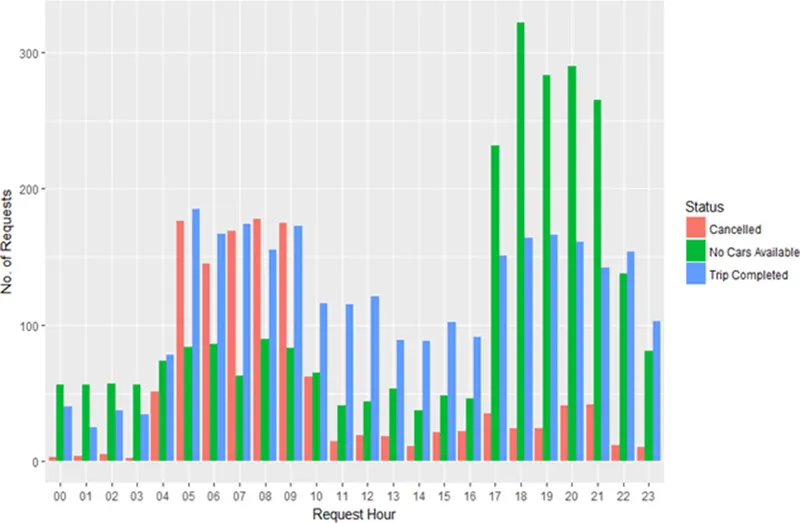
- In this plot, we see that the time slots between 00 to 9.00 and 17.00 to 21.00 are particularly busy with more demand.
- It is also seen that between 00 to the 9.00-time slot, there is more number of cancelled cabs.
- Between 17.00 to the 00-time slot, there are more number of “No Cars Available”.
ANALYSIS - 2
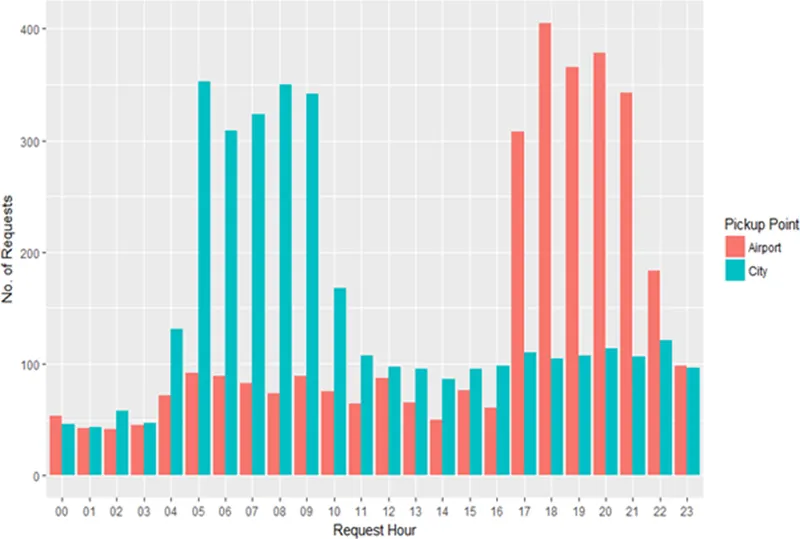
- From this plot, it is clear that between 00 the 9.00-time slot, there are
more several requests in the city.
- Between 17.00 to the 21.00-time slot, there are more number of requests from the Airport.
ANALYSIS — TIME SLOTS
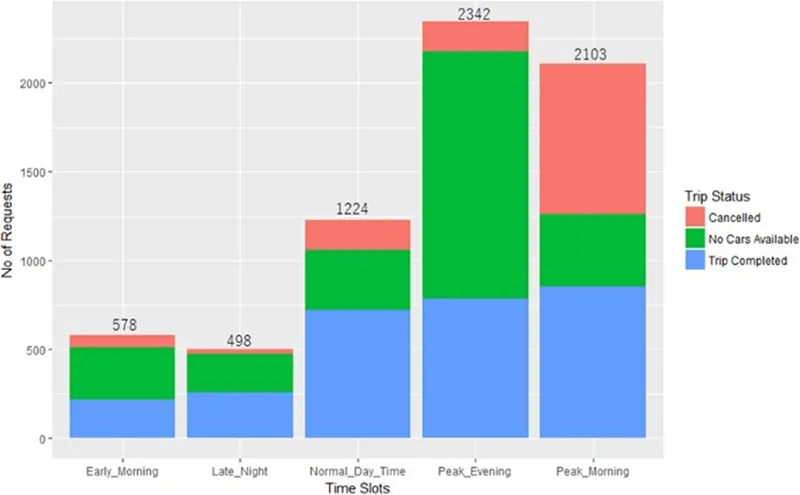
- To carry out further analysis, we create time slots based on the number of
- From our observations from previous plots, we notice that the times between 5.00 to 00 and 17.00 to 21.00 have high requests and hence are of our interest.
- We can make various time slots like:
0.00 to 5.00 — Early Morning
5.00 to 10.00 — Peak Morning
10.00 to 17.00 — Normal Day Time
17.00 to 22.00 — Peak Evening
22.00 to 0.00 — Late Night
- From the plot it is confirmed that in the Peak_Morning time slot, there are more canceled
Note - In the Peak_Evening time slot, there are more numbers of “No Cars Available”.
INSIGHT
- We observed that in the Peak Evening Slot where the demand for Airport to City trips is high, there is a maximum number of “No Cars Available” leading to a great Gap in Demand & Supply.
- Out of the Demand or Total Requests of 1800, the Supply or Trips Completed were only 373, with a high Gap of 1427.
RECOMMENDATION
1. Uber should provide higher monetary incentives for the driver taking a Peak Morning trip from City to Airport.
2. Setting targets for drivers to take up the City to Airport or Airport to City trips and then suitably rewarding them through lucky draw schemes, and gift Vouchers.
3. Incentivize Airport to City trips at night so that more drivers from the City reach the Airport thus increasing the availability of Cars.
4. Ask its drivers to not retire from services early in the Evening.
5. Conduct orientation classes for drivers and let them know about the insights obtained analysis of this problem so that the drivers know where to be and at what time of the Day.
CONCLUSIONS
Based on the data analysis performed, the following recommendation can be used by Uber to bridge the gap between supply and demand:-
1. For bridging the demand-supply gap from airport to city, making a permanent stand in the airport itself where the cabs will be available at all times and the incomplete requests can come down significantly.
2. Uber can provide some incentives to the driver who completes the trip from the city to the airport in the morning This might result in the driver not canceling the request from the city to airport trips.
3. Last but sure solution to bring down the gap is to increase the number of cabs in its fleet.

-----------------------------------------------------END---------------------------------------------------------------------