Project 2 - Supply and Demand Gap Analysis
Dataset: https://www.kaggle.com/datasets/hellbuoy/uber-supplydemand-gap
Aim:
The aim of this project is to analyse the supply and demand gap in the Uber system by exploring and interpreting the dataset provided. The project will provide insights into the factors responsible for the gap, and provide recommendations to bridge the gap.
Introduction:
Uber is a global transportation company that provides ride-hailing services to customers through its app-based platform. Uber has disrupted the traditional taxi industry by providing an innovative solution that connects riders with drivers in real-time, making it easier for people to get around. However, despite its popularity, the Uber system is not without its challenges. One of the most significant issues facing the Uber system is the supply and demand gap. This problem arises when the demand for Uber rides exceeds the supply of available drivers, resulting in longer wait times for customers and lost revenue for drivers.
Problem Statement:
The Uber system is facing a supply and demand gap that is negatively affecting the user experience and the revenue of drivers. The problem is multifaceted and requires a comprehensive analysis of the factors responsible for the gap.
Methodology:
The following steps were taken to analyse the supply and demand gap in the Uber system:
- Data Interpretation: The dataset provided was carefully analysed to understand the variables, their meanings, and the relationships between them.
- Data Exploration: Exploratory data analysis was carried out to gain insights into the data and identify patterns, trends, and outliers.
- Data Cleaning: The data was cleaned by removing missing values, duplicates, and outliers that could affect the accuracy of the analysis.
- Data Visualization: The data was visualized using charts and graphs to communicate insights and trends effectively.
Analysis:
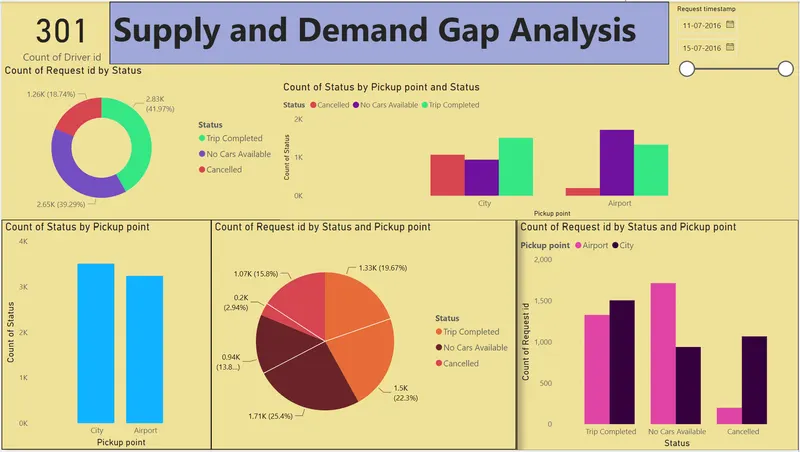
From the above Visualization find some interesting points that are mentioned below
- Almost 1327 trips are completed for Airport and 1504 trips are completed for City.
- For a total of 1713 trips, there is no Car Available for Airport trips and 937 trips with no car available for city trips.
- A total of 198 trips are cancelled for Airport and 1066 trips are cancelled for city trips.
- The Total of 301 Drivers are available in 2016.
- The total of 1706 trips are completed in day shift and 1125 trips are completed in night shift.
- Matrix table show the total percent of requests by status, shift and pic up point.
Insights:
The analysis of the data sheets reveals the following key insights:
- Non-availability of cars is a major contributor to the supply-demand gap.
- The visualization shows that the supply-demand gap is highest in the night shift.
- The number of cancelled rides is highest in day shift.
Recommendations:
Based on the insights obtained, the following recommendations are suggested:
- Uber should focus on improving driver retention rates and incentivizing drivers to stay online during peak hours.
- The company should implement dynamic pricing strategies to manage demand during peak hours and reduce waiting times for riders.
- Uber should invest in route optimization and driver training to reduce the time taken to complete a trip.
- Implement measures to reduce the number of cancelled rides, such as improving driver incentives and providing better training.
- Use predictive analytics to anticipate demand patterns and adjust supply accordingly.
Conclusions:
The supply and demand gap in the Uber system is a complex problem that requires a comprehensive analysis of the factors responsible for the gap. The insights obtained from the analysis provide valuable information that can be used to bridge the gap and improve the user experience. Uber’s supply and demand gap can be reduced by implementing various strategies such as increasing incentives for drivers, dynamic pricing, and targeted marketing campaigns. By implementing these recommendations, Uber can bridge the gap between supply and demand and improve customer satisfaction and driver earnings.