Project 2 - Measuring distance of an object using ultrasonic sensor (HC-SR04)
Abhinaya mam (Batch -19)
Overview of the Project:
In this project, the implementation of code for “Measuring distance of an object using ultrasonic distance sensor (HC-SR04)
Goals:
- Measuring the distance of an object using Ultrasonic Distance Sensor (HC-SR04)
- Usage of Input Capture Mode
Key Highlights of the Project:
- Measuring the distance travelled by the wave to the object and gets bounced back from the object to sensor.
- Measuring Pulse width using Input Capture Mode
Deliverables of this project:
- The distance travelled by a wave to the object for which we want to measure the distance using Ultrasonic Distance Sensor (HC-SR04).
- Measuring Pulse width using Input Capture Mode of Timer 1
Expected Outcomes:
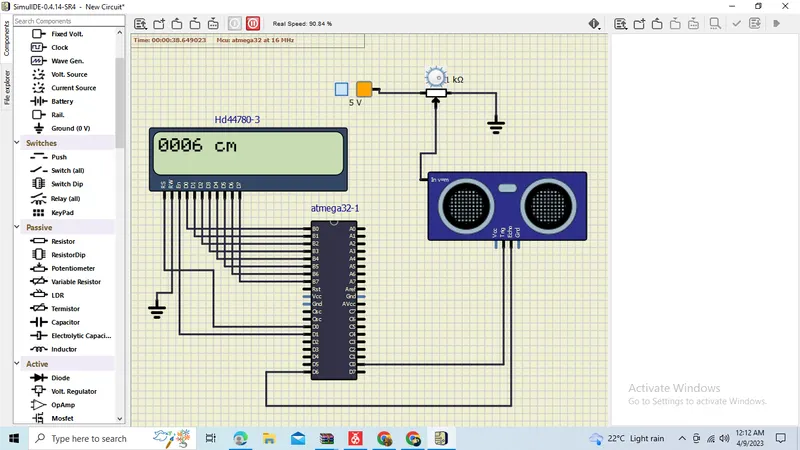
The students will get the Knowledge on Ultrasonic sensor (HC-SR04) to measure the distance travelled by wave to the object, the hardware connection of Atmega328p and HC-SR04 and how to use input capture mode of Timer1
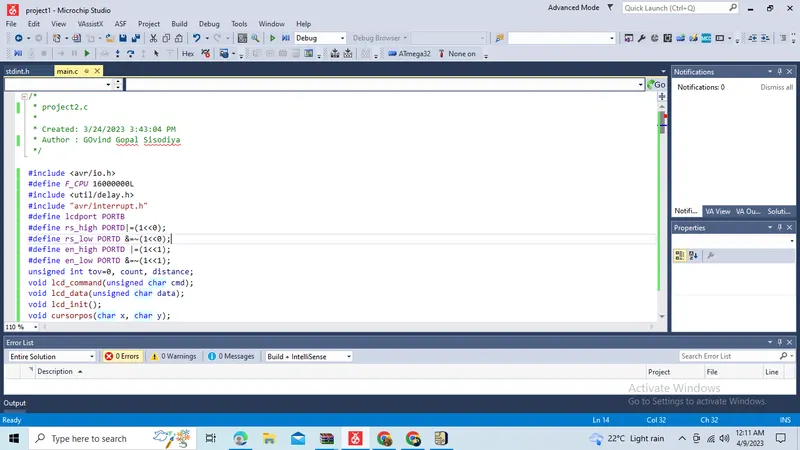
/*
* project2.c
*
* Created: 3/24/2023 3:43:04 PM
* Author : GOvind Gopal Sisodiya
*/
#include <avr/io.h>
#define F_CPU 16000000L
#include <util/delay.h>
#include "avr/interrupt.h"
#define lcdport PORTB
#define rs_high PORTD|=(1<<0);
#define rs_low PORTD &=~(1<<0);
#define en_high PORTD |=(1<<1);
#define en_low PORTD &=~(1<<1);
unsigned int tov=0, count, distance;
void lcd_command(unsigned char cmd);
void lcd_data(unsigned char data);
void lcd_init();
void cursorpos(char x, char y);
void lcd_out(char x, char y, char *str);
void lcd_print(char row, char coloumn, unsigned int value, int digits);
int main()
{
DDRB=0xff; // PORTB as output
DDRD|=(0<<6); //PORTD pin 6 as input from echo pin of sensor
DDRC |=(1<<0); // PORTC. 0 as output
sei(); // Enable global interrupt
lcd_init();
TCCR1A=0x00; //Normal mode
TIMSK|=(1<<2);
while(1)
{
PORTC |=(1<<0); //Trigger Sensor
_delay_us(10);
PORTC&=~(1<<0);
TCCR1B=0x41; // ICF Enable
TCNT1=0;
TIFR=(1<<ICF1);
TIFR=(1<<TOV1);
tov=0;
while((TIFR&(1<<ICF1))==0); // check time overflow condition
TCNT1=0;
TCCR1B=0x01;
TIFR=(1<<ICF1);
TIFR=(1<<TOV1);
tov=0;
while((TIFR&(1<<ICF1))==0);
count = ICR1+ (65535* tov); // calculate the time for time taken
distance=(unsigned int)count /932.87; //sensor data sheet formula
lcd_print(1,1,distance,4);
lcd_out(1,6,"cm");
}
}
ISR(TIMER1_OVF_vect)
{
tov++;
}
void lcd_cmd(unsigned char cmd)
{
lcdport=cmd;
rs_low;
en_low;
_delay_ms(1);
en_high;
}
void lcd_data(unsigned char data)
{
lcdport=data;
rs_high;
en_low;
_delay_ms(1);
en_high;
}
void lcd_init()
{
lcd_cmd(0x38);_delay_ms(5);
lcd_cmd(0x02);_delay_ms(5);
lcd_cmd(0x01);_delay_ms(5);
lcd_cmd(0x0c);_delay_ms(5);
lcd_cmd(0x06);_delay_ms(5);
lcd_cmd(0x80);_delay_ms(5);
lcd_cmd(0xc0);_delay_ms(5);
}
void cursorpos(char x, char y)
{
if((x<1||x>2)||(y<1||y>16))
{
x=1;
y=1;
}
if(x==1)
lcd_cmd(0x7f+y);
else
lcd_cmd(0xbf+y);
}
void lcd_out(char x, char y, char *str)
{
cursorpos(x,y);
while(*str)
{
lcd_data(*str);
str++;
}
}
void lcd_print(char row, char coloumn, unsigned int value, int digits)
{
unsigned int temp, unit, tens, hundred,thousand, million;
unsigned char flag=0;
if(row==0||coloumn==0)
{
cursorpos(1,1);
}
else
{
cursorpos(row,coloumn);
}
if(digits==5||flag==1)
{
million=value/10000+48;
lcd_data(million);
flag=1;
}
if(digits==4||flag==1)
{
temp=value/1000;
thousand=temp%10 +48;
lcd_data(thousand);
flag=1;
}
if(digits==3||flag==1)
{
temp=value/100;
hundred=temp%10 +48;
lcd_data(hundred);
flag=1;
}
if(digits==2||flag==1)
{
temp=value/10;
tens= temp%10 +48;
lcd_data(tens);
flag=1;
}
if(digits==1||flag==1)
{
unit=value%10 +48;
lcd_data(unit);
}
if(digits>5)
{
lcd_data('e');
}
}