Project 2
Using MATLAB/simulink and the drive cycle from the attached excel sheet, find-
- The max heat generation of the battery
- The SOC of the battery at 2 *104second of the battery operation
| Time | Time Step | Battery Current |
| 00:00.4 | 0.1 | -0.9632 |
| 00:00.5 | 0.2 | -0.952 |
| 00:00.6 | 0.3 | -0.9072 |
| 00:00.7 | 0.4 | -0.9632 |
| 00:00.8 | 0.5 | -1.0304 |
| 00:00.9 | 0.6 | -0.9632 |
| 00:01.0 | 0.7 | -1.0304 |
| 00:01.1 | 0.8 | -1.008 |
| 00:01.2 | 0.9 | -0.9856 |
| 00:01.3 | 1 | -0.9632 |
| 00:01.4 | 1.1 | -0.9184 |
| 00:01.5 | 1.2 | -0.9296 |
| 00:01.6 | 1.3 | -0.9296 |
| 00:01.7 | 1.4 | -0.9296 |
| 00:01.8 | 1.5 | -0.9184 |
| 00:01.9 | 1.6 | -0.9408 |
| 00:02.0 | 1.7 | -0.896 |
| 00:02.1 | 1.8 | -0.9072 |
| 00:02.2 | 1.9 | -0.9072 |
| 00:02.3 | 2 | -0.9408 |
| 00:02.4 | 2.1 | -0.9296 |
| 00:02.5 | 2.2 | -0.9296 |
| 00:02.6 | 2.3 | -0.9968 |
| 00:02.7 | 2.4 | -0.9968 |
| 00:02.8 | 2.5 | -0.9408 |
| 00:02.9 | 2.6 | -0.9408 |
| Battery resistance | 2 milli ohm |
Consider the battery resistance is 0.5 mOhm, delta time is 0.1 and entropic factor is 2
Theroy:
Heat Generation:-
Large battery packs are used in electric vehicles. Heat is generated when the battery pack is being used. Therefore, it is necessary to predict battery heat generation.Operating temperature of lithium-ion battery is an important factor influencing the performance of electric vehicles. During charging and discharging process, battery temperature varies due to internal heat generation, calling for analysis of battery heat generation rate. The generated heat consists of Joule heat and reaction heat, and both are affected by various factors, including temperature, battery aging effect, state of charge (SOC), and operation current. In this article, a series of experiments based on a power-type lithium manganese oxide/graphite battery was implemented under different conditions. The parameters for Joule heat and reaction heat are determined, and the Joule heat, reaction heat as well as total heat generation rate is detailed and analyzed considering the influence of temperature, aging, SOC, and current. In order to validate the accuracy of heat generation rate, a lumped battery heat transfer model is applied to calculate the temperature variation, and the estimated temperature variation shows good correspondence with experimental results under different currents and aging conditions. Due to its simplicity, the temperature variation estimation method is suitable for real time applications.
What factors affect the generated heat in a battery?
The generated heat consists of Joule heat and reaction heat, and both are affected by various factors, including temperature, battery aging effect, state of charge (SOC), and operation current.
Controlling heat build up in EVs:
Battery thermal management is a huge challenge in electric vehicles. In addition to increasing the risk of fire, high temperatures can have a direct influence on range. By efficiently controlling EV temperature levels, battery range can be maximized.
Just like internal-combustion engine vehicles, when an electric power train works harder, it gets hotter. Therefore, EVs require effective, efficient and durable cooling systems. Heat management can have a major impact on not only the components within a vehicle, but also its overall performance.
Importance of Thermal Management for EVs?
TMS is generally used for batteries operating under a high discharge rate, and especially for a large- scale battery pack that requires a long life cycle (>10 years) and is pricy to replace.
The factors that are traditionally considered in the TMS trade-off analysis include energy efficiency, capital costs, ease of operation, maintenance requirements, and reliability. Cold plate and thermoelectric devices are not recommended for use in commercial systems, owing to their high thermal resistance and low coefficient of performance, respectively.
Battery Thermal Runaway in Electric Vehicles:
Calculations:
To find the maximum heat generation of the battery.
Given ;
Battery resistance = 0.5 mohm
Entropic factor = 2
delta time = 0.1
Currrent = -0.896.....(from the drive cycle )
Formula:
Maximum Heat Generated = Joule Heat + Entropic Heat
Now, Joule heat = i^2 X r X t
= (-0.896)^2 X 0.5 x 120 sec
Joule heat = 48 mJ
Therefore,
Maximum Heat Generated = 48 mJ + 2 mJ
Maximum Heat Generated = 50 mJ
Thermal runaway begins when the heat generated within a battery exceeds the amount of heat that is dissipated to its surroundings.
What causes the battery to overheat which leads to thermal runaway?
1. Ambient Temperature
2. Age of the Battery
3. Float Charging Voltage
4. Overcharging
Approaches to Minimize Thermal Runaway
The reduction of the Thermal Runway hazard can be fulfilled on three levels-
1. First: improve the intrinsic safety of anti-TR properties by material modification;
2. Second: set passive defense against the practical abuse conditions and develop an early warning algorithm before TR;
3. Third: postpone or inhibit the secondary hazard, such as Thermal Runway propagation, to win sufficient time for the passenger to escape from the EV after the accident.
Formula:
Heat Generation = Joule Heat + Entropic Heat
Joule Heat = i^2 X r X t
Where, t = time (sec/hr)
i = battery current (A)
r = resistance (mohm)
Joule heating, also known as ohmic heating, is used to directly heat water with electric current.
Joule heating is sometimes also referred to as ohmic heating or electrical resistance heating. It refers to the method of heating electrolyte-filled water by exposing it directly to electrical current.
The entropic coefficient of a lithium-ion battery cell is used to calculate the reversible heat of a battery during operation, which is a nonnegligible part of the battery thermal modeling.
SOC % (State Of Charge) of a Battery pack:The SOC is the measurement of the amount of charge remaining on a battery. It represents the ratio of the current capacity of the battery to its nominal capacity after a period of use or long-term shelving, which also indicates the maximum amount of power that can be stored in the battery. The SOC is calculated as a percentage: when it’s at 0, it means the battery is completely discharged.
When the SOC is at 100, it means the battery is completely full.
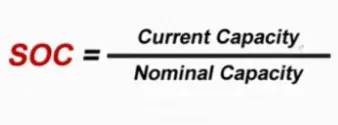
Absolute Charge State:-There is also what’s called an absolute charge state, which is a reference value calculated from the fixed capacity value when the cell is manufactured. The absolute SOC of a new fully charged battery is 100% while an aged battery, even if fully charged, cannot reach 100% in different charge and dis- charge situations.
Influencing Factors:-Most SOC estimations require precise data measurements, whether it is the chemistry of the cell (type of electrolyte), its operating conditions, or the variables of the cell (voltage, current), etc., thus being suitable only in the laboratory and not in real applications. The SOC of a battery is a combination of voltage, charge/discharge current and internal resistance parameters to estimate its size. These parameters are also affected by a variety of uncertainties such as battery aging, temperature changes and usage status.
Accurate SOC estimations reflect important information, such as battery performance, remaining battery life, etc., which ultimately leads to efficient management and utilization of battery power and energy. In addition, SOC estimation can be used to regulate battery life degradation, explosions or fires due to battery over-discharge and overcharge, as well as aging and permanent damage to the battery cell structure. Therefore, the SOC indicator on a BMS is vital for user convenience, as well as the efficiency, safety and life of the battery.
A.The max heat generation of the battery
Maximum current in drive cycle=-0.896 at 2 minutes its equaly 120 minutes.
Maximum heat generated =Imax^2*RBat*Time
=(-0.896)(-0.896)*2 miliohm*120
=192.676 mili joule
Entropic heat is twice that of joule heat
Total heat generated=Joule heat + Entropic heat
=192.676 mili + 2(192.676 mili)
=74.248 mili joules.
Average heat is calcukated by taking the average value of current and time
Average value of time =1929 / 26
=74.19 seconds.
Average value of current = -24.7184 / 26
= -0.9507.
Joule heat generated = IsquarsquarR*t
= -0.9507*-0.9507*2 mili*74.19 sec
= 134.11 mili joule.
Total heat generated = joule heat + Entropy heat
= 134.11 mili + 2 (134.11)
= 0.402 mili joule.
B.The SOC of the battery at 2 *104second of the battery operation
The SoC refers to the State of Charge of the battery, which is the capacity percent left in the battery which can be used. It a very improtent thing which teles about the battery status which helps in using the battery in a proper manner.
The SoC can be measued in different ways. Some of them are listed below
- Voltage Translation Method (VT)
- Coulamb counting method (CC)
- Combination of VT and CC
The VT and CC has its own advantages ad disadvantages so to get accurate value we have to use the Combination of VT and CC.
Voltage Translation Method (VT):
It is measued by Open Circut Voltge of the battery and compared it with the Data sheet of the battery and SoC is estimated. It cannot used while the battery is in operation.
Coulamb counting method (CC):
It is calculated by the formula
SoC = total charge input / Max capacity of the battery
Total charge input = charge current * time (H)
Or
Z(t) = Z(0) - 1/Cn ∫ Ni*i(t) dt with thw limits of 0 to t
where, Cn = Battery Nominal Capacity
Z(t) = State of charge
i(t) = Instantansous cell current
t = time
Ni = coulomb efficiency
Z(0) = initial state of charge
+ for discharging
- for charging
Due to Faid in the battery capacity over the time it shows error
Combination of VT and CC:
To avoid the calculation of SoC both the Voltage Translation Method (VT) and Coulamb counting method (CC) are used combinedly.
Simulation:

The Battery specifications are taken as shown below
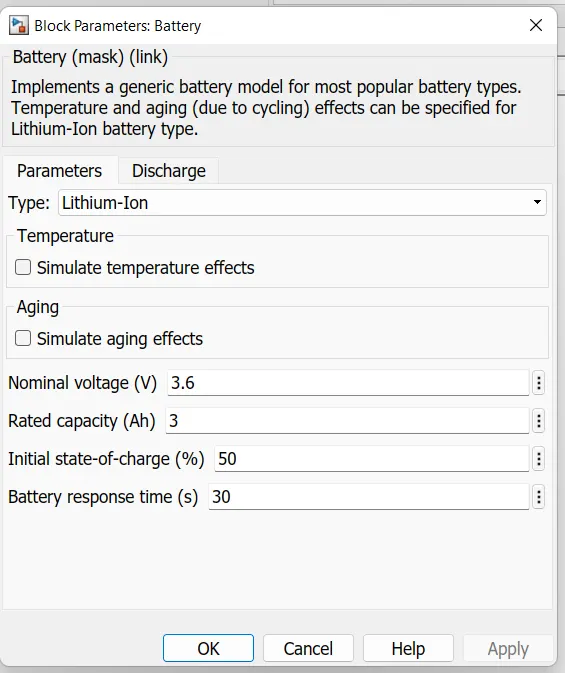
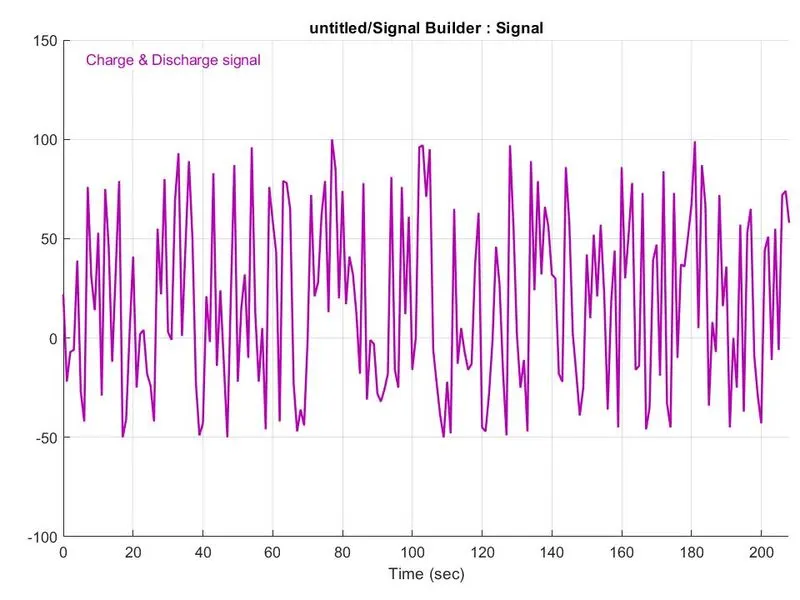
Charge and Discharge command or Siganal to run the Constant Currnet source, so that the current will flow in and out according to the signal. + signal to chagrge and - for discharge. The total time for the run is taken as 2*104 = 208 sec
The Current signal is taken with the time of 0 to 208 sec with 1 sec step as
22 -22 -7 -6 39 -27 -42 76 31 14 53 -29 75 46 -12 33 79 -50 -41 3 41 -25 2 4 -18 -24 -42 55 22 80 3 -1 69 93 1 46 89 50 -23 -49 -43 21 -2 83 -14 24 -13 -50 21 87 -22 15 32 -10 96 13 -22 5 -46 76 59 43 -42 79 78 65 -23 -47 -36 -44 -1 72 21 28 62 79 13 100 85 20 74 17 41 32 12 -18 78 -31 -1 -3 -28 -32 -26 -18 81 -16 -25 76 12 61 -16 0 96 97 71 95 -6 -23 -39 -50 -22 -48 65 -13 5 -7 -16 -13 37 63 -45 -47 -28 -1 46 27 -17 -49 97 56 1 -25 -11 -47 89 24 79 32 66 56 32 30 -18 -22 86 58 2 -18 -39 -25 42 10 52 21 57 22 -36 18 44 -45 86 30 52 78 -16 -14 73 -46 -35 39 47 -19 84 -33 -45 73 -10 37 36 51 67 99 5 87 67 -34 8 -7 72 16 36 -45 0 -25 57 -37 53 65 -9 -29 -43 44 51 -11 55 -6 72 74 58
Graph:
Result and Conclusion:
1. The max heat generation of the battery
The Max heat generated in which the current flowing in and out i.e., charge and discharge due to internal resistance and chemical reaction during charging and discharging of the battery the heat is generates of 2.0006823936 Jouls
2. The SOC of the battery at 2 *104second of the battery operation:
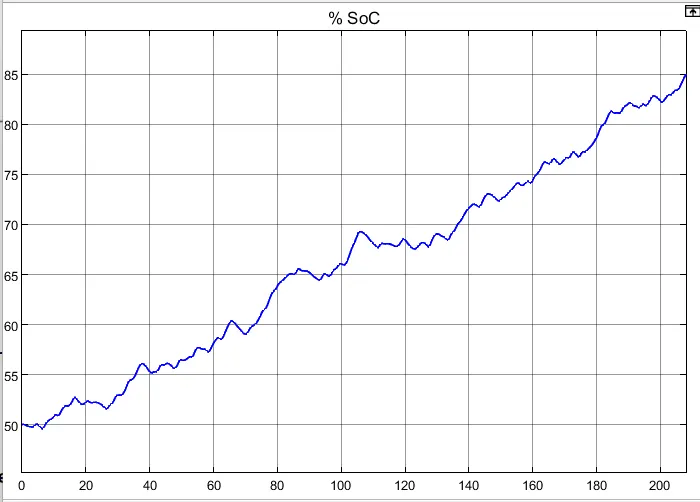
Initially the battery SoC is taken as 50% so it started and according to the current signal i.e., charge and discharge, if the charhing happens the battery SoC is increasing and when it is discharging SoC is decreasing.
Conclusion:
1. Internal heat generation during the operation of a battery is a critical concern. If batteries get too hot, they can rupture or explode. And Lithium and Lithium-ion cells/batteries can catch on fire when they rupture, creating even more of a safety hazard.
2. Here, Maximum heat generated in a battery pack is 50 mJ.
3. Accurate SOC estimations reflect important information, such as battery performance, remaining battery life, etc., which ultimately leads to efficient management and utilization of battery power and energy.
4. Estimated SOC% of a battery pack is 91.8% and 96.4% for 2 different drive cycle.