Project 2
Aim: To calculate the water current forces, centrifugal forces, wave forces, snow loads, temperature loads, and Barge Impact load for the bridge structure shown and analyze the structure in Staad Pro.
Given Data:
- The maximum crest elevation for the wave is 3 m.
- The deck of the slab is supported by four I Girders. Each I Girder is 1.6 m in height with a top and bottom flange width of 2m. The thickness of the flange and web is 0.3m.
- constant r = 5. Assume Cva = 3. The Storm elevation = 8.5m.Cr = 0.4.
- The high flood level is 4 m above the Bottom of the foundation level. The span of the bridge is 10 m.
- The mean velocity of the river is 2.5 m/s.
-
The width of the carriageway is 9 m.
-
The bridge is subjected to a live load of Class 70R tracked vehicle and the radius of curvature in the bridge is 2 m.
-
The design speed of the vehicles is 50 km/hr.
-
The size of the Pier is 1.2 x 1.2 m.
-
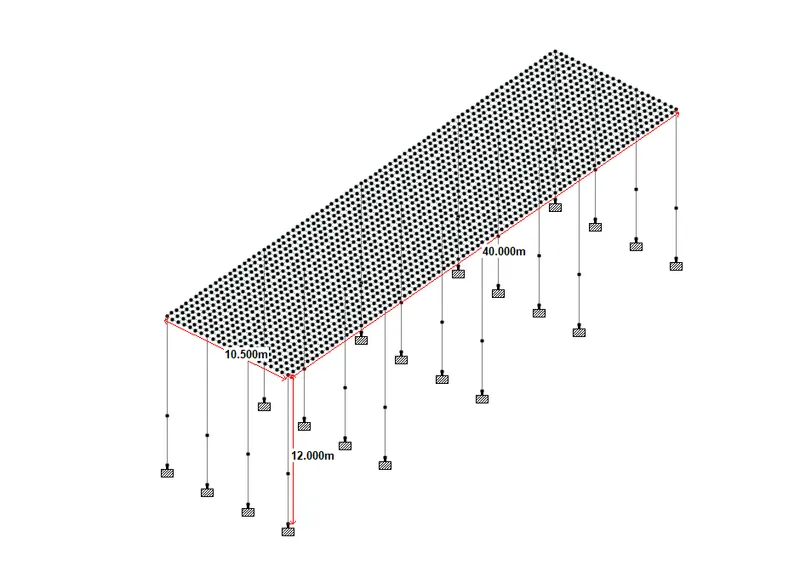
The width of the deck slab is 10.5m and the thickness of deck slab is 1.5 m. The deck of the bridge is flat with B <30 degrees. The depth of accumulation of snow is 1250 mm.
-
The Deadweight tonnage of the Panamax vessel is 25000 DWT. The Ship can accommodate a maximum of 1500 containers. Each container is of standard 6.1 TEU.
Solution:
Water Current Load Calculation:
Maximum Velocity = SQRT(2) X Mean velocity of the river
=SQRT(2) X 2 =2.83 m/s
Water Current Force = 52 x K x V^2
Pier is of square shape, K=1.5
Water current force = 52 x 1.5 x 2.83 ^2 = 625 kg/m2 = 6.25 kN/m2
As the size of the pier is 1.2 m, the Uniformly varying load to be applied = 6.25 x1.2 =7.5 kN/m
Centrifugal force calculation:
For class 70R tracked vehicle,
Weight of 70R tracked vehicle (W) = 700 kN.
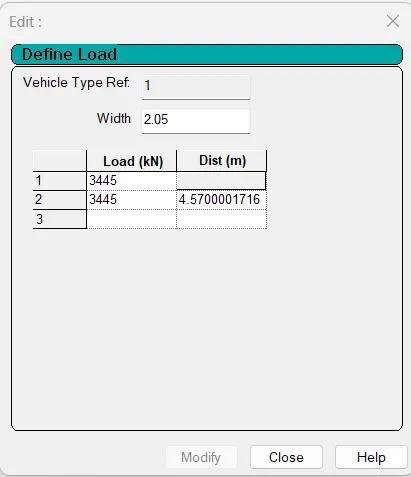
Centrifugal load (C) = WV^2/127R = 700 x (50)^2/(127*2)= 6890 kN
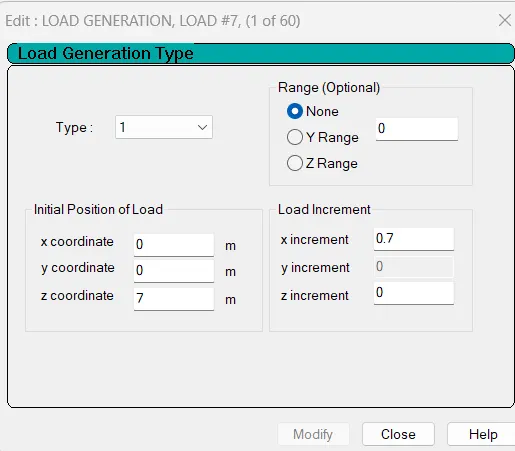
The above-calculated load will be applied as a double axle moving load with each axle load as (6890/2=3445 kN) in staad pro.
Wave force calculation:
Δz,h = η,max - Centroid of I-Girder= 3 -(1.6/2) = 2.2 m
Δz,v = η,max - depth of I-Girder= 3 -1.6 = 1.4 m
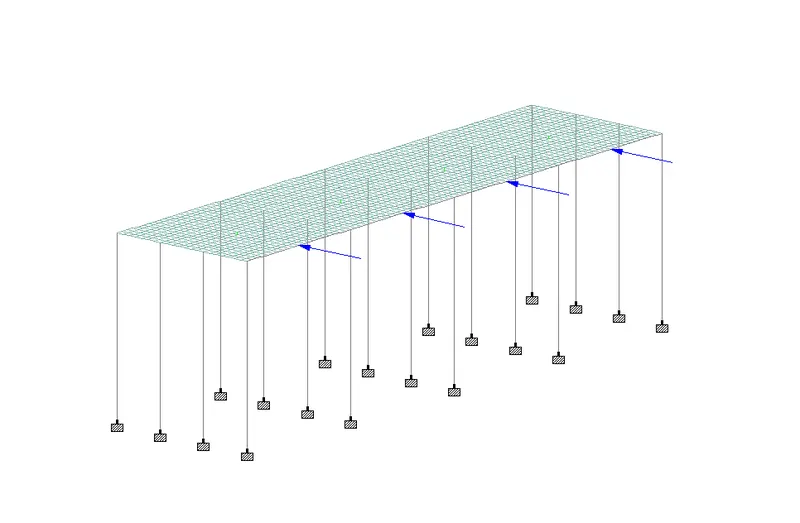
Horizontal load,Fh =γw x Δz,h x Ah = 10 x2.2 x(10x1.5)=330 kN
(Ah= Bridge span x (thickness of deck))
Vertical load,Fv = γw x Δz,v x Av = 10 x 1.4 x(9x1.6/2)=100.8 kN
(Av= Bridge deck width x (depth of I girder/2))
Maximum Horizontal load = (1+Cr(N-1))Cva x Fh=(1+0.4x(4-1))x3x330 =2178 kN
Maximum Vertical load =Cva x Fv = 3 x 100.8 = 302.4 kN
Snow load calculation:
Consider the density of snow as 9 kN/m3.
As the slope of the deck is less than 30 degrees, so shape coefficient is 0.8 m.
Total snow load to be considered on top of bridge deck = (depth of accumulation of snow)x(density of snow)x(shape coefficient)
=1.25 x 9 x 0.8 =9 kN/m2
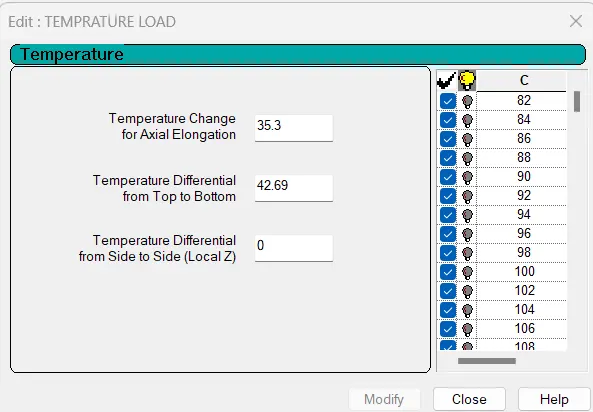
Temperature loads calculation:
Consider the location as Delhi,
As per IRC 6, Annexure F, the Maximum and minimum temperatures at Delhi are 48.4 & -2.2 degrees celcius.
As the difference between maximum & minimum temperature is more than 20 degree celcius,
Effective temperature differnece = (48.4-(-2.2))/2 + 10=25.3 + 10 =35.3 degree celcius
Thermal expansion coefficient for concrete= 11.27 x 10^(-6)
Modulus of Elasticity of Concrete = 5000 x sqrt(40)
Stress due to Temperature = α x △T x E = 11.27 x 10^(-6) x 35.3 x 5000 x sqrt(40) =12.58 kN/m2
Maximum Permissible stress = (2/3) x Modulus of rupture of concrete =(2/3)* 0.7 * sqrt(40) =2.95 kN/m2
So it will be ensured that the stress to be encountered in the bridge deck shall not exceed 2.95 kN/m2.
Temperature to be applied in Staad pro as a load case:
The temperature at the Top =48.4 degree
The temperature at the Bottom =(2.1/17.8)*48.4 =5.71 degree (The ratio is taken from IRC 6,Figure 16A)
Temperature difference from top to bottom = 48.4 -5.71 =42.69 degree.
Barge Impact load calculation:
Consider the barge speed as 60 km/h.(16.67 m/s)
Barge Collision Energy = KE = 500 x Ch x W x V^2
= 500 x 1.25 x 25000 x 16.67 ^2 =4342014063 N .m
Barge Impact Depth,
aB= 3100 x ( [1 + 1.3 x 10(-7) x KE]^0.5 - 1)
=70616 mm
Which is more than 100 mm,
So Barge Collision Impact Force (PB) = 6.0 x 10^6 + 1600 x (aB) = 118985600 N =118985.6 kN
Modeling in Staad Pro.
With the given data, the Staad model is prepared.
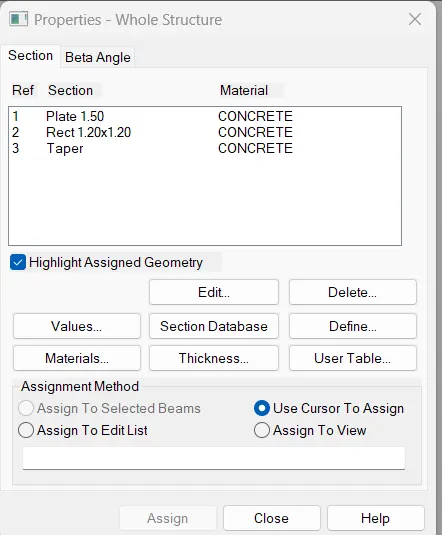
Properties of Pier, Girder, and deck have been assigned.
Load application:
i)Water current load
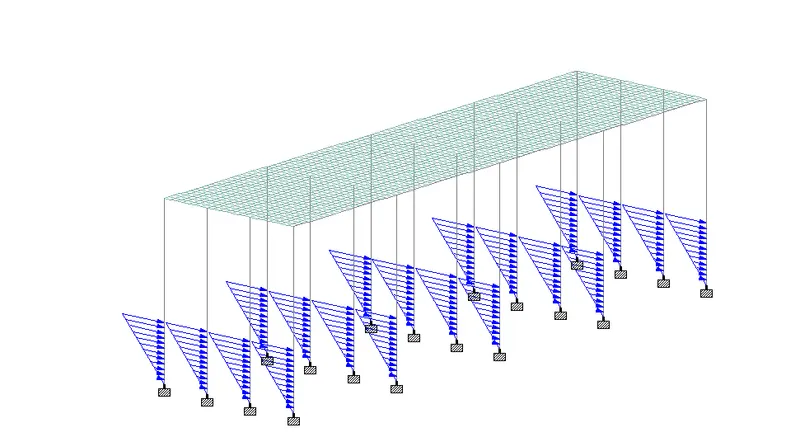
ii)Wave load
iii)Snow load
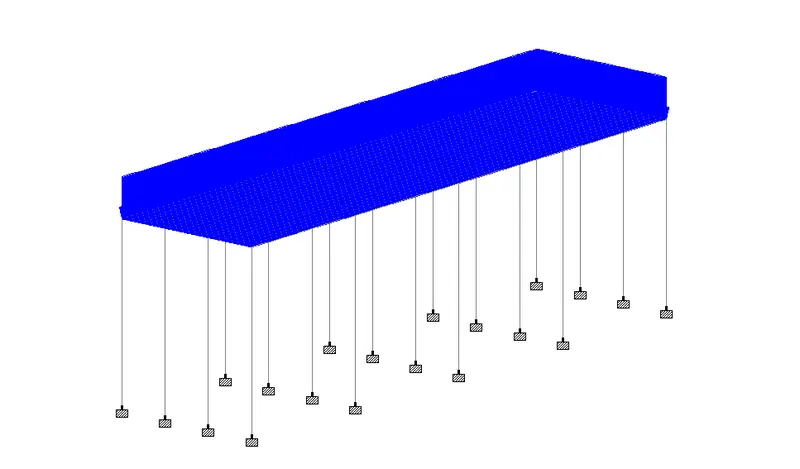
iv)Temperature load
v) Barge Impact Load
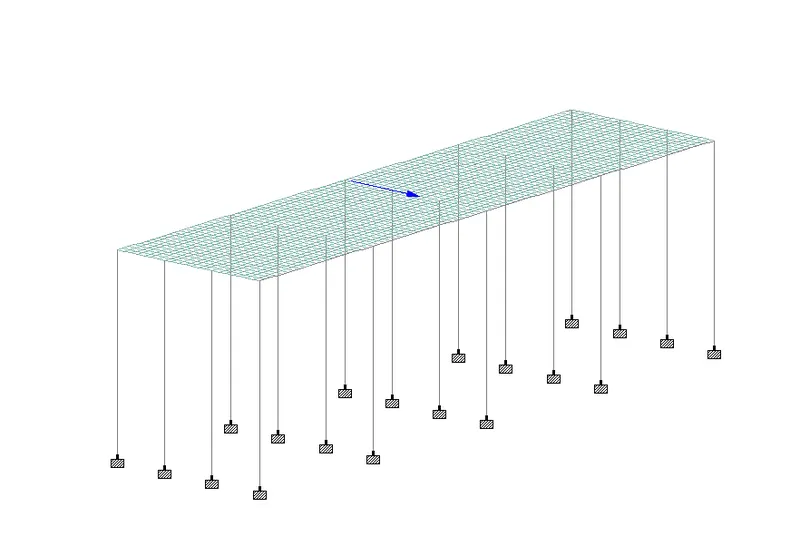
vi) Centrifugal load
Results:
i)Water current load
The maximum bending moment observed in the pier = 35.525 kN.m
The maximum bending moment observed in the girder = 1.033 kN.m
The maximum bending moment observed in the deck slab = 6.127 kN.m/m
ii)Wave load
The maximum bending moment observed in the pier = 2920 kN.m
The maximum bending moment observed in the girder = 519.297 kN.m
The maximum bending moment observed in the deck slab = 3162 kN.m
iii)Snow Load
The maximum bending moment observed in the pier = 31.76 kN.m
The maximum bending moment observed in the girder = 85.487 kN.m
The maximum bending moment observed in the deck slab = 44.3 kN.m
iv)Temperature Load
The maximum bending moment observed in the pier = 848.327 kN.m
The maximum bending moment observed in the girder = 848.327 kN.m
The maximum bending moment observed in the deck slab = 2400 kN.m
v)Barge Impact Load
The maximum bending moment observed in the pier = 41138.852 kN.m
The maximum bending moment observed in the girder = 6585 kN.m
The maximum bending moment observed in the deck slab = 42191 kN.m
vi)Centrifugal Load
The maximum bending moment observed in the pier = 606.616 kN.m
The maximum bending moment observed in the girder = 2268.413 kN.m
The maximum bending moment observed in the deck slab = 1386 kN.m