Project
Aim:
To prepare a technical report of Simulation of BAJA All-Terrain Vehicle (ATV) under different conditions.
Objective:
Perform a system-level simulation of an all-terrain vehicle and write a technical report that explains the model properties and provides feedback on the results.
An all-terrain vehicle (ATV) is a motorised off-highway vehicle with four low-pressure or non-pneumatic tyres, a straddle seat, and handlebars for steering control.
CASE1:
SIMULINK MODEL FOR BAJA ATV WITH CVT:
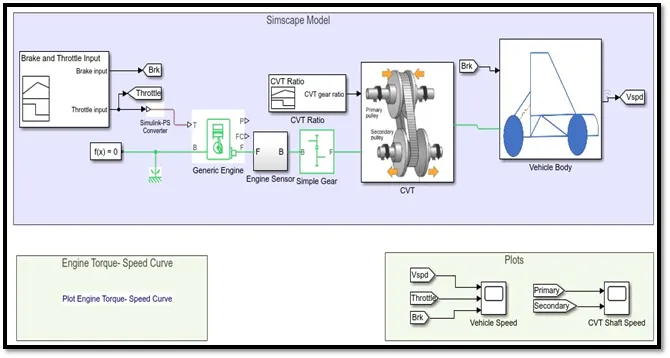
Components:
Continuously Variable Transmission drive (CVT):
More gears in a gearbox are preferable since they may maximise engine speed in a range of driving scenarios. This means that lower gears give better acceleration while higher ratios enhance fuel economy. CVTs are distinguished from standard automatic transmissions by the absence of gears that offer "steps" between low- and high-speed operations. The bulk of them, however, operate by a pair of variable-diameter, cone-shaped pulleys linked by a steel or composite belt. Each pulley's halves are aligned, with the pointed ends of the cones meeting. The connecting belt rides in a V-shaped groove formed by them. One side of the pulley is permanent, while the other is moveable and controlled by a hydraulic cylinder. The cylinder has the ability to change the amount of gap between the two sides of the pulley. Depending on the driving circumstances, the belt can ride lower or higher along the walls of the pulley, affecting the "gear" ratio.
ENGINE:
Represents a system-level model of spark-ignition and diesel engines that may be used in the early phases of modelling when just the fundamental parameters are known. Idle speed and red line controllers are available as options. The throttle input signal T is between zero and one and specifies the engine torque needed as a fraction of the maximum achievable torque.
Mechanical rotational conserving ports F and B are related with the engine crankshaft and engine block, respectively. Connections P and FC are physical signal output ports used to indicate engine power and fuel consumption rate.
VARIABLE TRANSMISSION RATIO:
A variable ratio gearbox is one that may be achieved by mechanical belt CVT, electric, or hydraulic transmissions. The physical signal input r specifies the angular shaft velocity ratio between the input and output.
Mechanical rotational conserving ports are connections B (base) and F (follower). With the Output shaft rotates parameter, you may specify the relationship between the base and follower rotation directions.
INPUT SIGNAL:
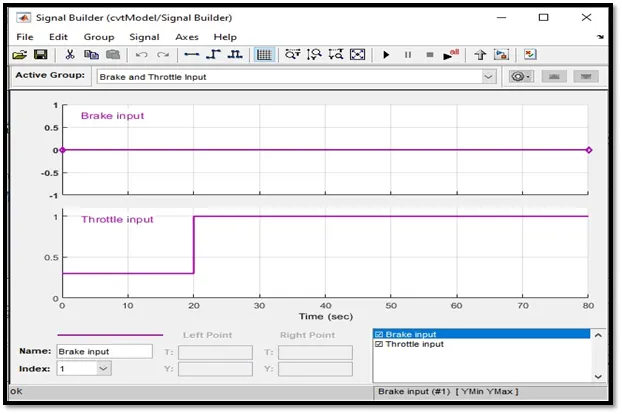
A Signal builder is used to create signals for brake and throttle.
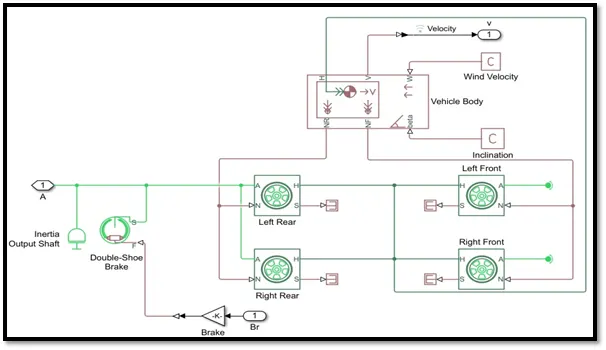
Vehicle body:
Output:
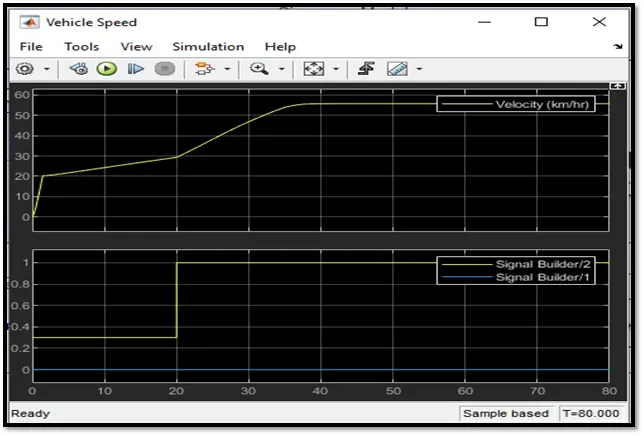
The graph clearly shows that the car reaches its maximum speed (V = 55km/hr) after 30 seconds at full throttle = 1 and then remains constant. Because the brake input value is 0, it has no influence on velocity.