Project
Aim : To Prepare a technical report of simulation of BAJA All-terrain vechicle(ATV) under different conditions.
All Terrain Vehicle:
- An all-terrain vehicle (ATV) also known as a light utility vehicle .it is also a quad bike or simply a quad.It is a vehicle that travels on low-pressure tires with a seat that is straddled by the operator along with handlebars for steering control. As the name impliesvit is designed to handle a wider variety of terrain than most other vehicles.
- It is defined as a motorized off-highway vehicle designed to travel on four low-pressure or non-pneumatic tires having a seat designed to be straddled by the operator and handlebars for steering control.
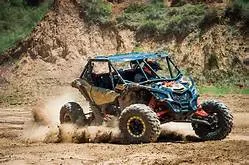
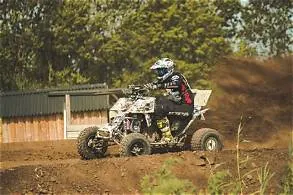
All Terrain Vehicle
- Safety courses and educational literature has reduced the number and severity of accidents among ATC and ATV riders. As cornering is more challenging on an ATC than with a four-wheeled machine, properly leaning into the turn is required, to counterbalance the weight and keep the machine stable.
- Operators may roll over if caution isn't used at high speeds. The lighter front end and smaller footprint of ATCs present both a flipping and steering hazard under acceleration and on inclines.
- Lateral rollovers may also occur when traversing steep inclines. However, in most terrain with the proper riding technique and safety gear, this issues can be mitigated.
- ATCs require unique techniques to ride properly, and turning lean requires more exaggeration than ATVs; Throttle steering is another technique commonly used on ATCs in soft terrain and at high speeds, leaning to the inside of the turn and manipulating the throttle to break traction with the rear tires, resulting in the machines turning on axis while maintaining a forward direction.
Study 1:
Case 1: Simulink model for BAJA ATV with CVT:
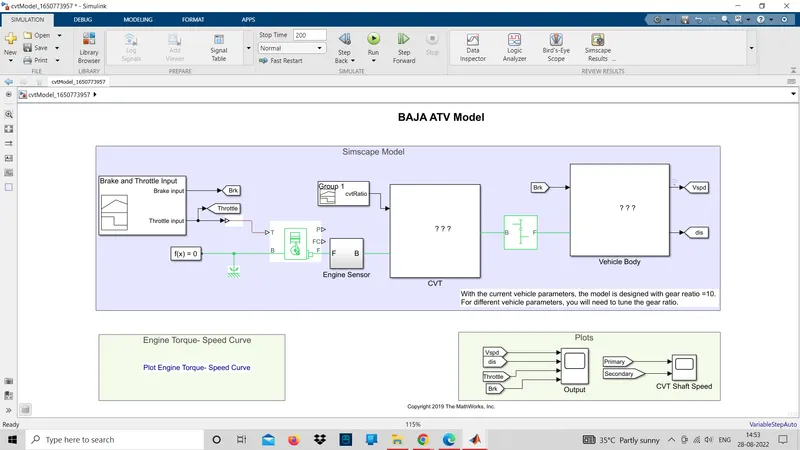
Major components used in the model:
CVT(Continuously variable transmission drive) :
- A continuously variable transmission (CVT) is an automatic transmission that can change seamlessly through a continuous range of gear ratios .This contrasts with other transmissions that provide a limited number of gear ratios in fixed steps. The flexibility of a CVT with suitable control may allow the engine to operate at a constant RPM while the vehicle moves at varying speeds.
- It is better to have more gears in a transmission since it can optimize engine speed in a variety of driving conditions. That means low gears can provide better acceleration while higher gears can maximize fuel economy. CVTs differ from traditional automatic transmissions in that they don't have gears that provide "steps" between low and high-speed operations. Instead the majority of them work via a pair of variable diameter, cone-shaped pulleys connected by a steel or composite belt.
- The halves of each pulley are aligned with the pointed ends of the cones touching. These form a V-shaped groove in which the connecting belt rides. One side of the pulley is fixed, and the other side is movable, actuated by a hydraulic cylinder. The cylinder can increase or decrease the amount of space between the two sides of the pulley. This allows the belt to ride lower or higher along the walls of the pulley, depending on driving conditions, thereby changing the "gear" ratio.
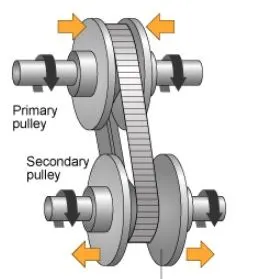
CVT(Continuously variable transmission drive)
CVT Block:-
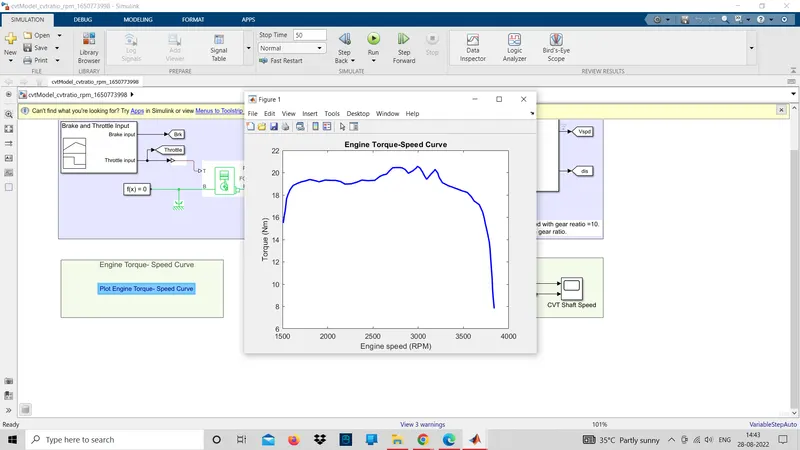
In BAJA ATV model there is a generic engine block that shown in below figure
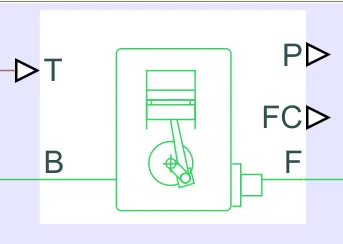
- It mainly represents a system-level model of spark ignition and diesel engines suitable for use at initial stages of modelling when only the basic parameters are available.
- Optional idle speed and red line controllers are included. The throttle input signal T lies between zero and one and specifies the torque demanded from the engine as a fraction of the maximum possible torque.
- Connections F and B are mechanical rotational conserving ports associated with the engine crankshaft and engine block, respectively.
- Connections P and FC are physical signal output ports through which engine power and fuel consumption rate are reported.
Variable transmission ratio:
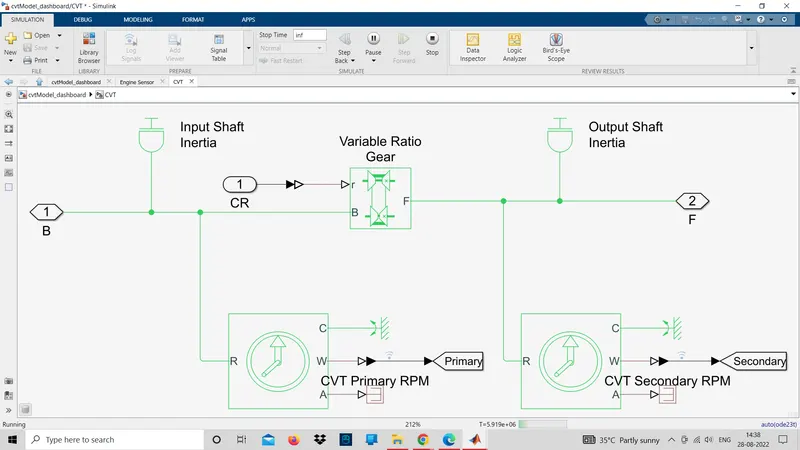
- The Variable Ratio Transmission block represents a gearbox that dynamically transfers motion and torque between the two connected driveshaft axes, the base and the follower.
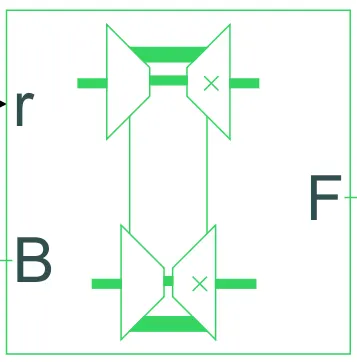
- It Represents a variable ratio gearbox such as implemented by mechanical belt CVT electric or hydraulic transmissions. The physical signal input r defines the ratio of input to output angular shaft velocities.
- Connections B (base) and F (follower) are mechanical rotational conserving ports. It Specify the relation between base and follower rotation directions with the Output shaft rotates parameter.
- Here a siginal bulider is used to creat siginals for brake and throttle.
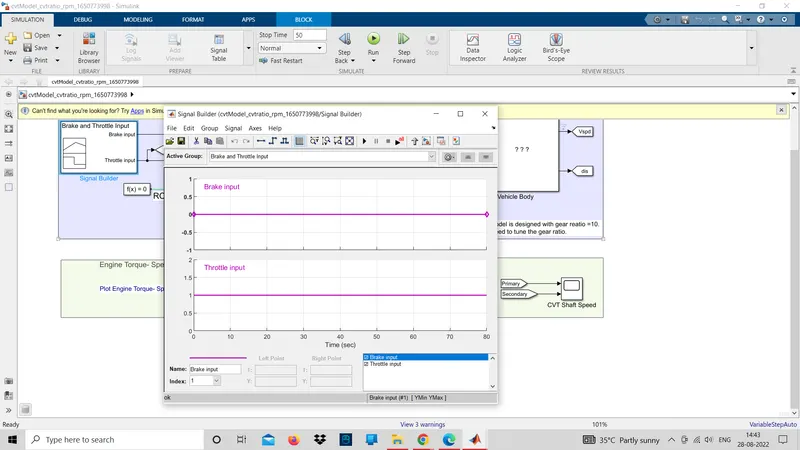
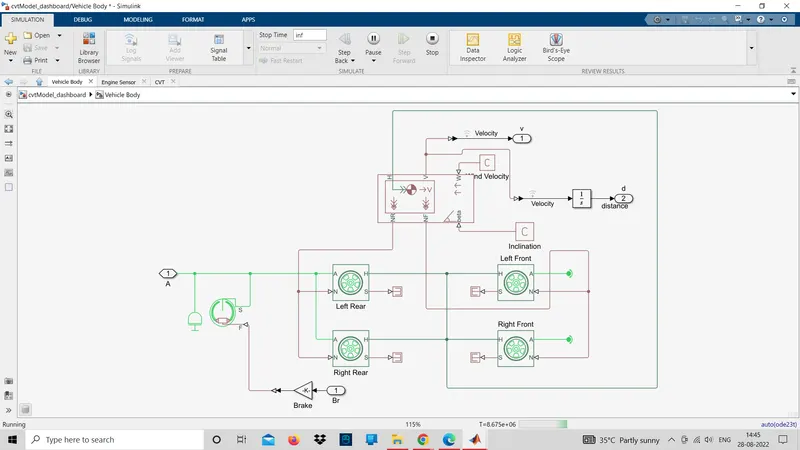
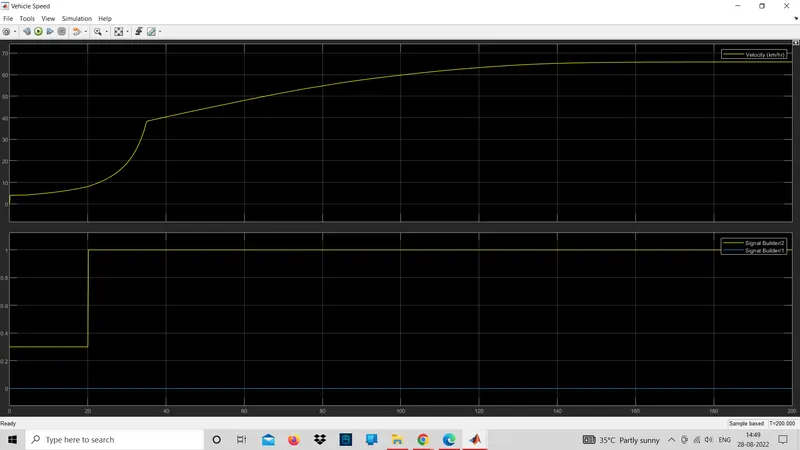
- Here it is clear from the above graph that the output if the vehicle attains its maximum speed i.e = 56 to 58 /hr at full throttle = 1 after 30sec and reamins constant. the barke input value is zero hence it has no effect on velocity.
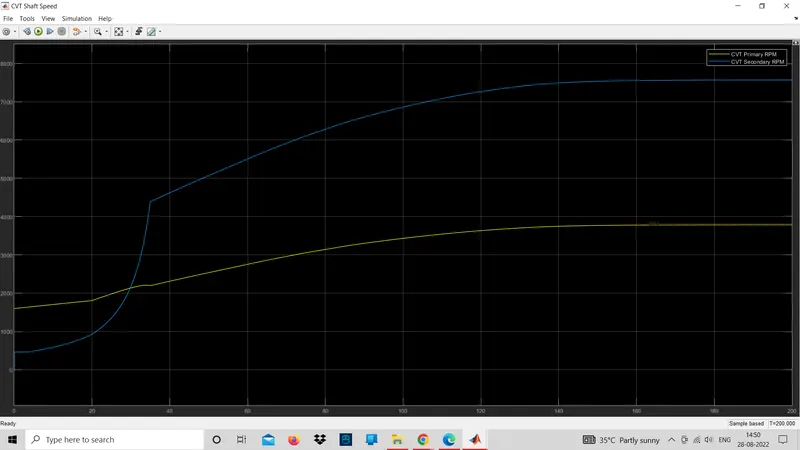
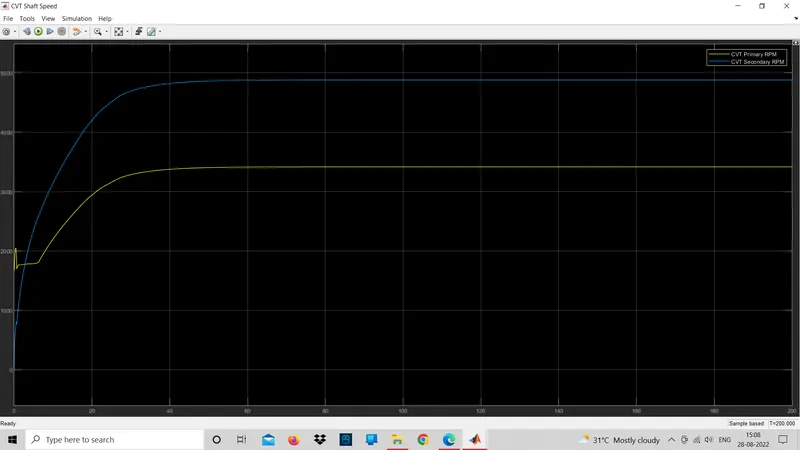
- Here the the above cvt graph shows the variation in angular velocity of the input and output shafts of the variable gear transmission system.these values are different from the gear ratio.
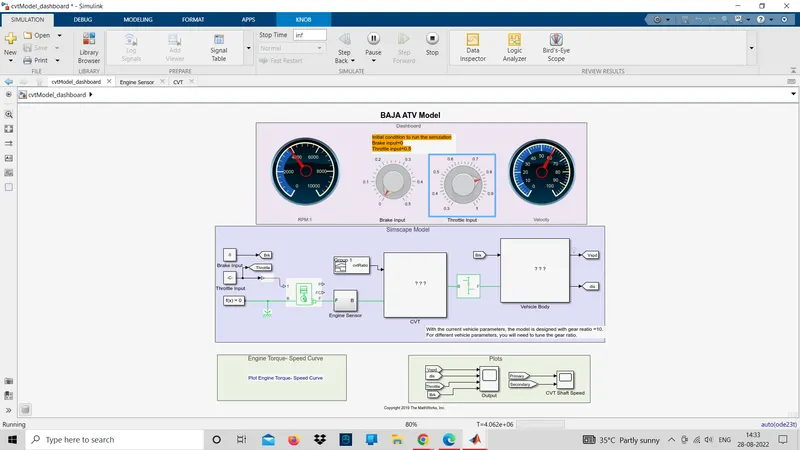
- Here in this model we are used a dashboard which consist of knobs to control the inputs.
- In this case the inputs are Brake and Throttle are not provided using signal builder.a knob is placed to control both the parameters in daily useage of the user.
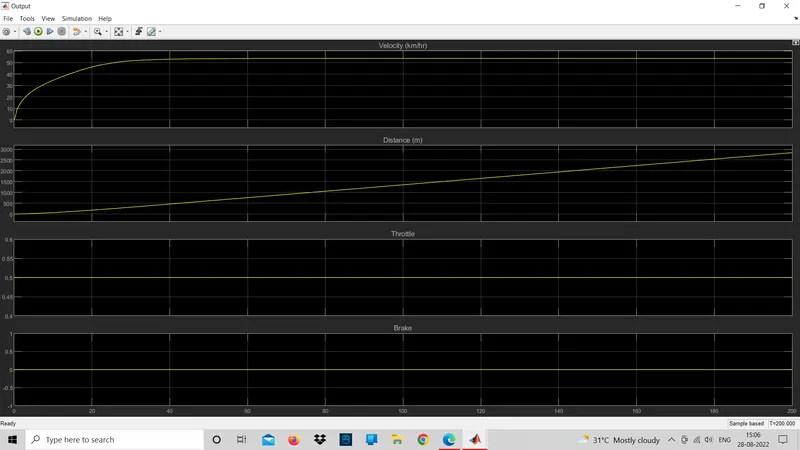
- From this graph it can be observed that the velocity of the vehicle increases largely from 0 to 60 kmph when the value of throttle is 0.5 and brake input is 0. when the brake value is increases from 0.1 to 0.5 the velocity of the vehicle decreases to 0 as show in the above fig. so it shows the direct relation of the vehicle velocity with respect to throottle and brake inputs.
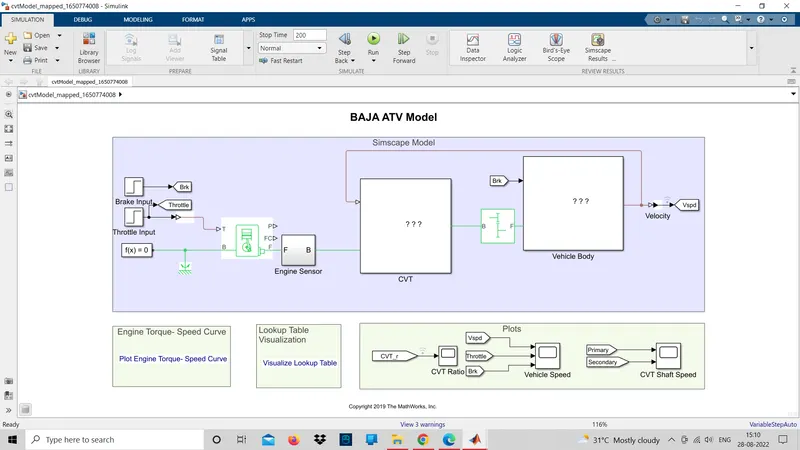
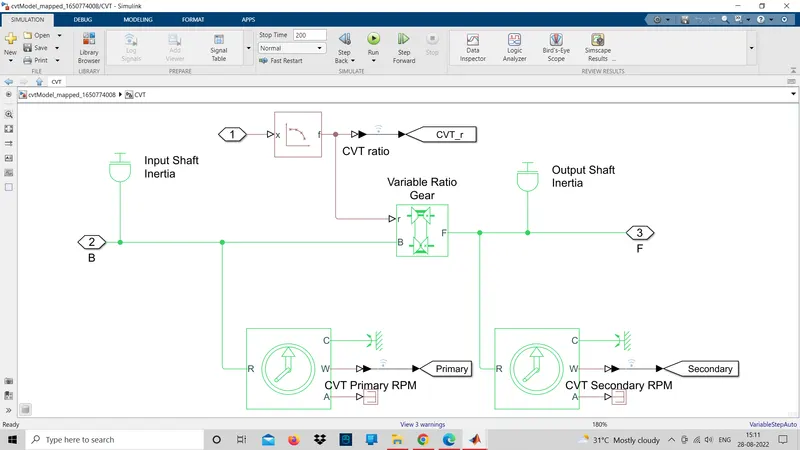
- The main difference between this model and the first model is that in this model the gear ratio input to CVT is provide using a lookup table.
- the vehicle velocity and shaft rpm outputs are same as before.
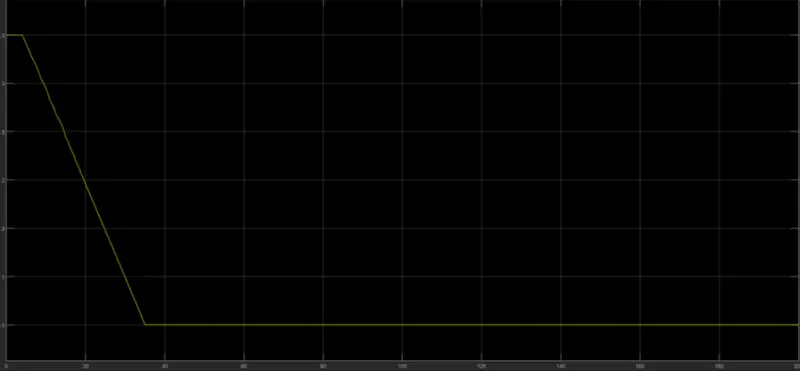
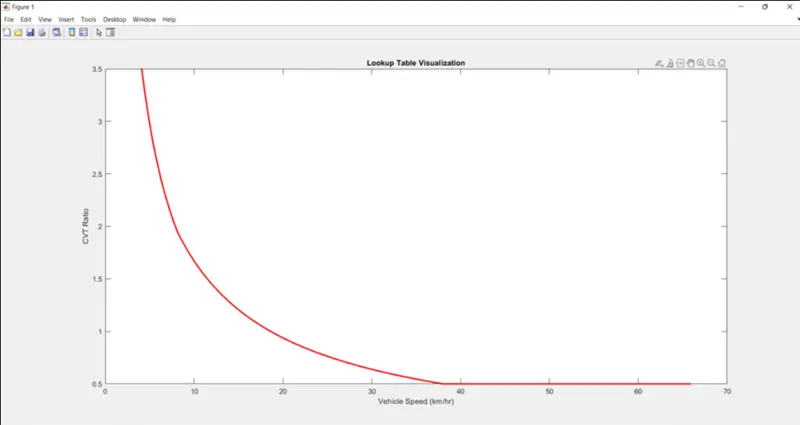
- Here both the results are same as that of the 1st case (i.e simulink model for BAJA ATV WITH CVT) since the input parameters are same.
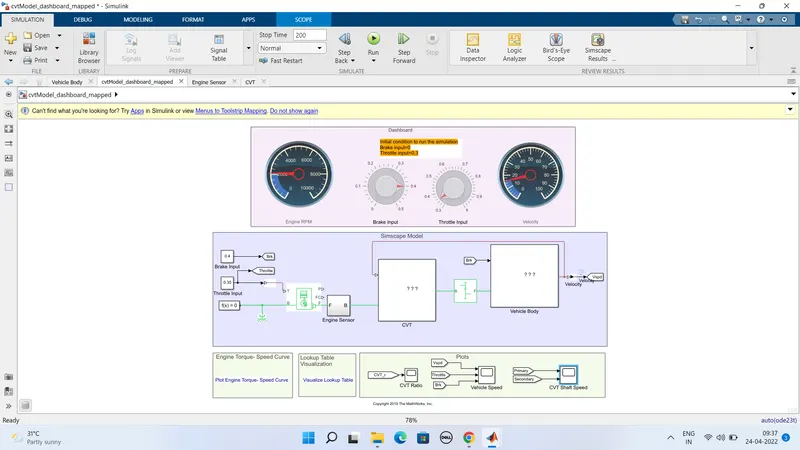
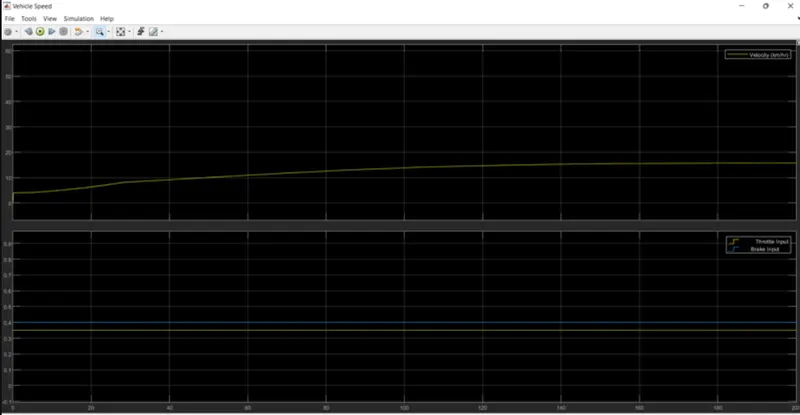
- This is similar to that of Cvt dashboard case the variation in vehicle velocity can be observed with the change in the throttle and brake value the speed of the vehicle decreases.and also increase in the throttle leads to increase vechicle velocity.
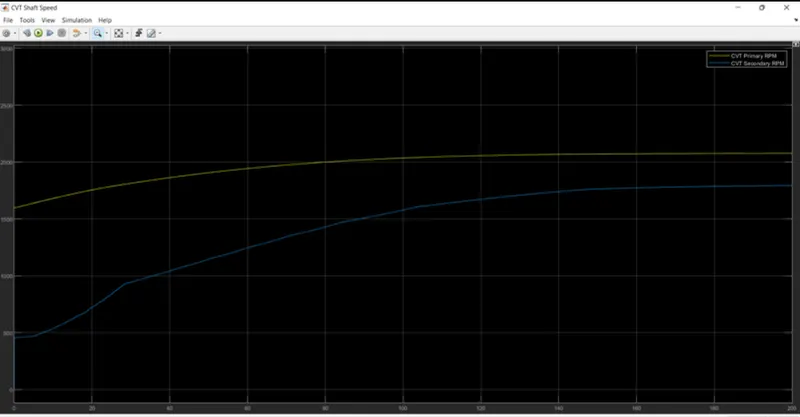
- This graph shows the variation in the rpm of primary and secondary shafts with respect to input parameters.