Project
Aim of the Project:-The aim of this project is understand the function of an all terrain vehicle by level simulation or by run the simulation model of BAJA ALL-Terrain Vehicle.
Objective:-
To prepare a technical report on BAJA ATV explaining model properties for the following:
- without using Lookup table
- using Lookup table
All-Terrain Vehicle (ATV):-
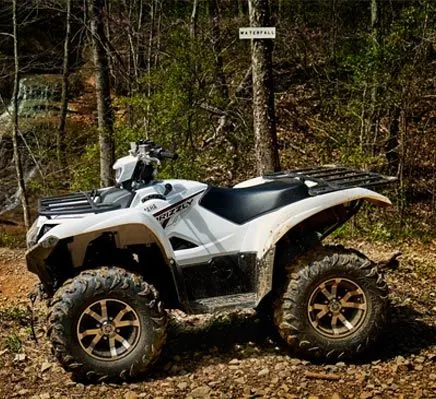
- This vehicle is also known as a light utility vehicle (LUV), a quad bike or simply a quad as defined by the American National Standards Institute(ANSI).
- This is a vehicle that travels on low pressure tires,with a seat that is straddled by the operator, along with handle bars for steering control.
- As the name implies, it is designed to handle a wider variety of terrain than most other vehicles.
- An All terrain vehicle (ATV) is defined as a motorised off highway vehicle designed to travel on four low pressure or non pneumatic tires.
- ATVs are subdevided into two types as designed by the manufacturer.
- Type-I ATVs are intended by the manufacturer for use by a single operator and no passenger.
- TYpe-II ATVs are intended by the manufacturer for use by an operator and a passenger and are equipped with a designated seating position behind the operator.
Transmission:-
- The transmission system is one of the most basic and important parts of a vehicle . We can define it like this, it transfers power from the engine to the wheels.
- Transmission simply refers to the gear box, which uses gears and gear trains to provide speed and torque.
- It is one of the most complex components of our vehicle consisting of a series of gears(gear box). It is primarily responsible for making sure the wheels get the right amount of power so that driver canoperate at a certain speed.
Working principle of Transmission system:-
- The working of the transmission system varies depending on the type of transmission. Typically, the transmission system allows the gear ratio between the drive wheels and the engine. It can be adjusted as the car slows down and increases speed.
- Once we start our car and reach our destination now we have to stop, in this scenario the transmission disconnects the engine from the drive wheels so that the engine can remain idling when the wheels are not in motion.
- The transmission can also provide more responsive acceleration from a stop and enables the engine to run more slowly while the running at a normal speed.
Types of Transmission:-
- Manual Transmission
- Intelligent manual Transmission (IMT)
- Automated Manual Transmission (AMT)
- Automatic Transmission (AT)
- Continuously Variable Transmission (CVT)
- Semi-automatic Transmission
- Dual Clutch Transmission
- Sequential Transmission
- Torque Converter Transmission
- Triptronic Transmission
Continuously Variable Transmission (CVT):-
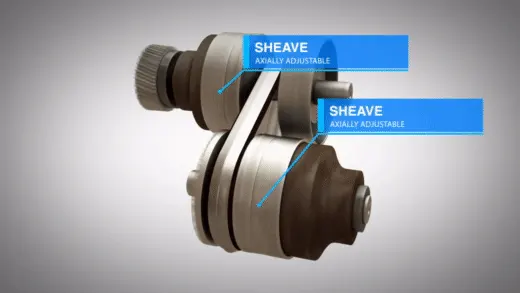
- These are pulley based transmissions primarilly used in small vehicles with smaller engines and they can change gears seemlessly through a constant gear ratio. This is in opposition to other transmissions that offer a limited number of gear ratios in fixed stages.
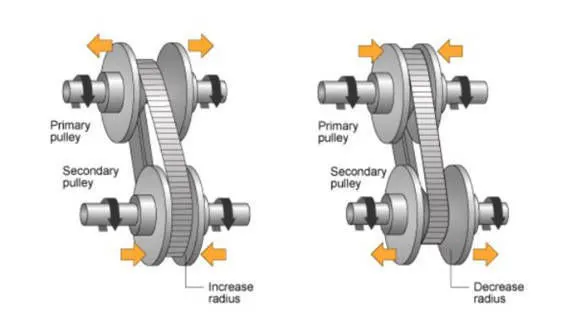
- The CVT uses two pulleys between which a steel belts runs. To continuously change it's gear ratio, the CVT simultaniously adjusts the diameter of the "driver pulley" which transmits torque from the engine and the "driver pulley" which transfers torque to the wheels.
- The width of these pulleys changes depending on the power required as one gets bigger and other gets smaller. Hence this allows delivering strong and smooth accelerantion. Currently the use of CVTs in their cars includes Toyota, Nissan and Honda.
- The flexibility of a CVT with suitable control may allow the engine to operate at a constant RPM while the vehicle moves at varying speed.
CVT Simscape Model
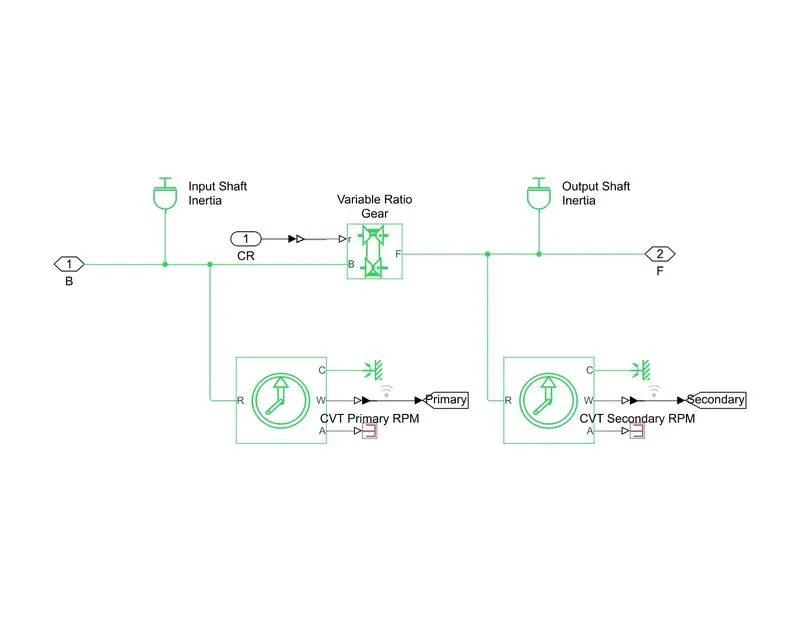
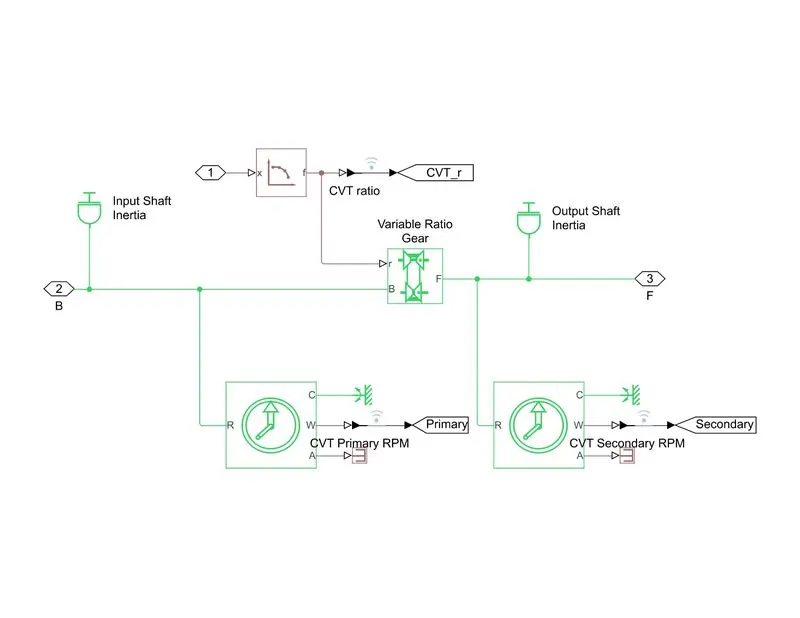
- The input and output shaft inertia represent primary pulley (driver) and secondary pulley (driven), respectively.
- The variable ratio gear block represents the multiple gears of the CVT, with the gear ratio input given to Port R (shown below)
- Two rotational motion sensors are for tracking the angular velocities of the two pulleys.
BAJA ATV Simscape Model without dashboard:
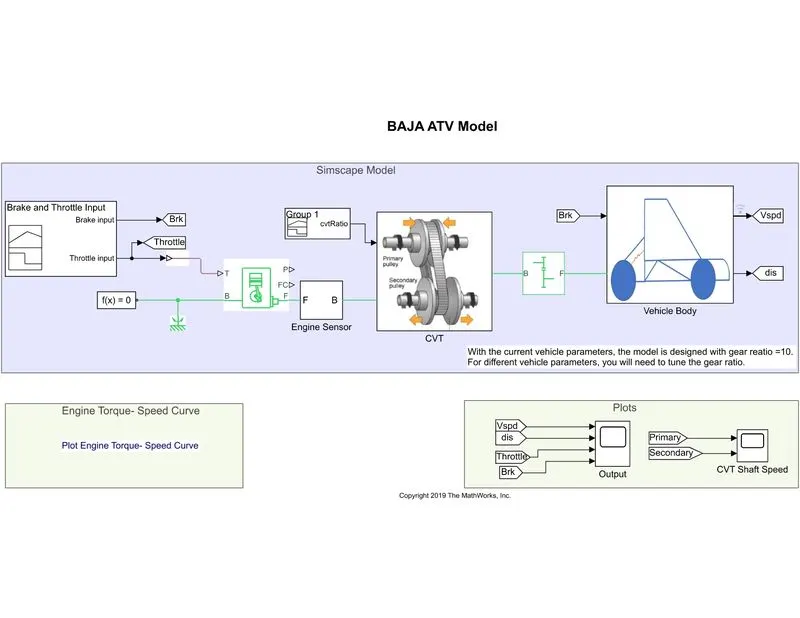
In this simscape model of a BAJA ATV Model first we have to provide two input signal from signal builder to generic engine, which are (1) Brake Input & (2) Throttle Input. Initially the vehicle is in rest mode , it means no motion happen by vehicle. That's why we are not going to fed brake input initially. So first we have to provide throttle input 0.3 upto 20 sec. and after that 1 upto 80 sec. .
Generic Engine:-
Represents a system-level model of spark-ignition and diesel engines suitable for use at initial stages of modeling when only the basic parameters are available. The engine uses a programmed Torque -Speed data for execution of the model. Throttle Input signal is provide to Port T of this generic engine. Also solver configuration and mechanical rotational reference connected with engine block (Port B).The engine crankeshaft is connected with engine sensor.
Engine inertia-0.008 kgm^2
Inital Velocity-1750 rpm
Speed thresold- 100 rpm
Crankshaft (Port F) is connected to an engine sensor, which simply senses the angular velocity and angular displacement of the crankshaft. The simple gear between engine and the CVT gear box is to slow down the engine RPM (in case it is too high) before it is fed to the CVT. An appropriate gear ratio needs to be selected so that over or under-revving isn't an issue.
Vehicle Body:-
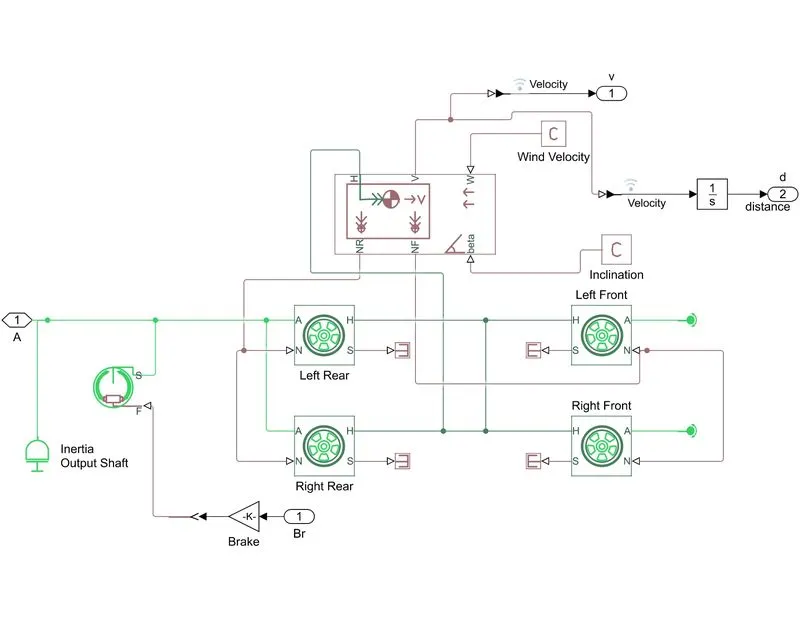
Represents a two-axle vehicle body in longitudinal motion. The block accounts for body mass, aerodynamic drag, road incline, and weight distribution between axles due to acceleration and road profile. The vehicle can have the same or a different number of wheels on each axle. Optionally include pitch and suspension dynamics or additional variable mass and inertia. The vehicle does not move vertically relative to the ground. Connection H is the mechanical translational conserving port associated with the horizontal motion of the vehicle body. The resulting traction motion developed by tires should be connected to this port. Connections V, NF, and NR are physical signal output ports for vehicle velocity and front and rear normal wheel forces, respectively. Wheel forces are considered positive if acting downwards. Connections W and beta are physical signal input ports corresponding to headwind speed and road inclination angle, respectively. If variable mass is modeled, the physical signal input ports CG and M are exposed. CG accepts a two- element vector representing the x and y distance offsets from vehicle CG to additional load mass CG. M represents the additional mass. If both variable mass and pitch dynamics are included, the physical signal port J accepts the inertia of the additional mass about its own CG.
BAJA ATV Simscape Model with dashboard:
Simulink model for the BAJA ATV Model including the dashboard is shown below. The rest of the parts and subsystems are common in the above part
Dashboard: A dashboard (also called dash, instrument panel (IP), or fascia) is a control panel usually located directly ahead of a vehicle's driver, displaying instrumentation and controls for the vehicle's operation.
The initial conditions are as follows:
Brake Input = 0
Throttle Input = 0.3
BAJA ATV Simscape Model with Lookup Table:
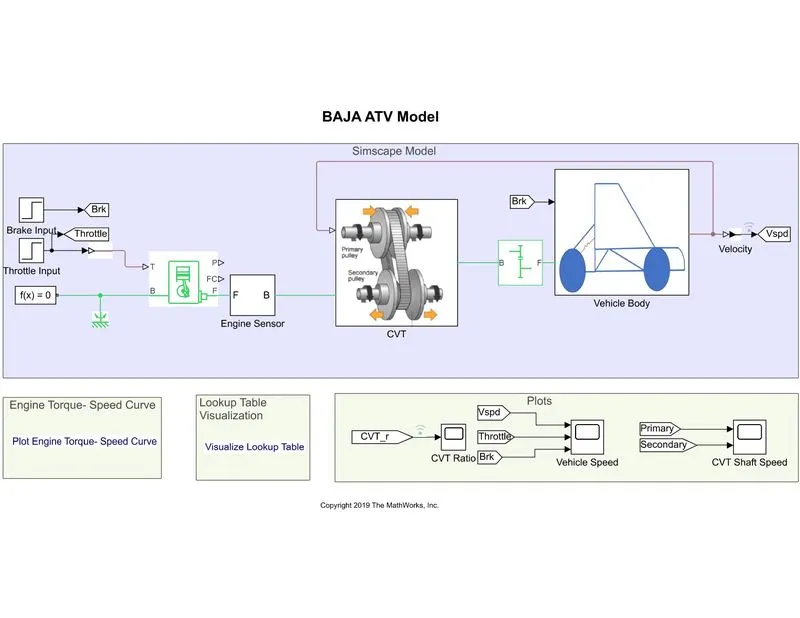
- The only difference with this study is that the CVT gear ratio isn't fed in via a signal builder, but instead via a lookup table (refer below).
- This lookup table is data regarding the relation between CVT gear ratio and vehicle speed, which is incorporated through a simple MATLAB script.
- In above, a CVT gear ratio had to be inputted manually to see the effect on the vehicle's velocity. However, this isn't feasible in reality and doesn't mimic what happens in real time. Through this lookup table, the CVT can be modeled based on the vehicle speed as feedback is taken from vehicle velocity to calculate gear ratio (refer to the feedback loop above - vehicle velocity input into CVT subsystem block).
Lookup Table: A lookup table is an array of data that maps input values to output values, thereby approximating a mathematical function. Given a set of input values, a lookup operation retrieves the corresponding output values from the table. If the lookup table does not explicitly define the input values, Simulink can estimate an output value using interpolation, extrapolation, or rounding, where:
- Interpolation is a process for estimating values that lie between known data points.
- Extrapolation is a process for estimating values that lie beyond the range of known data points.
- Rounding is a process for approximating a value by altering its digits according to a known rule.
A lookup table block uses an array of data to map input values to output values, approximating a mathematical function. Given input values, Simulink performs a “lookup” operation to retrieve the corresponding output values from the table. If the lookup table does not define the input values, the block estimates the output values based on nearby table values.
In place of CVT ratio input, a lookup table is assigned in the models below. It needs to be loaded in the workspace having the file name as Lookuptable_data.mat
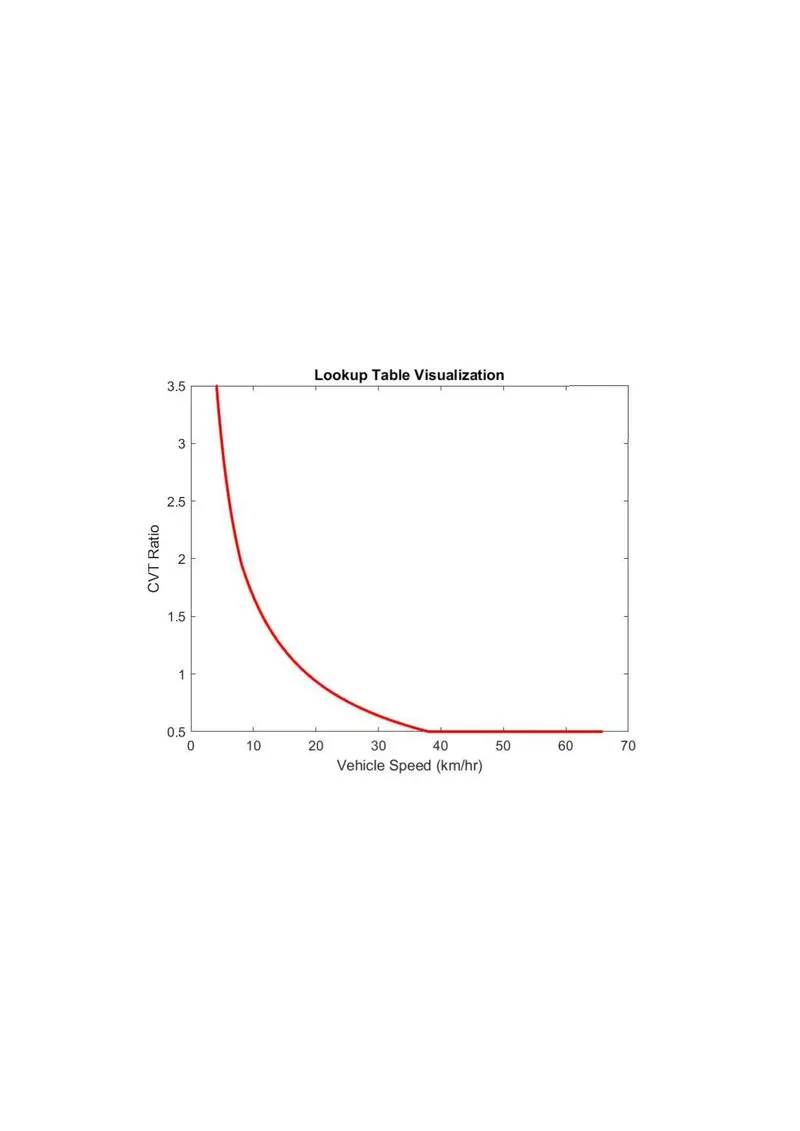
CVT Ratio vs Vehicle Speed:
0 to 20 km/hr, the CVT ratio is constant at 2.3
20 to 30 km/hr, the CVT ratio drops down to 2.03
30 to 50 km/hr, the CVT ratio drops down to 1.8
50 km/hr onwards, the CVT ratio is constant at 1.8
BAJA ATV Simscape Model with Lookup Table & Dashboard:
Conclusion:-
Hence, the given BAJA ATV Model was simulated successfully and from the above results, we can infer that:
- Velocity, CVT Shaft Speed and Engine Speed are directly proportional to the Throttle input and inversely proportional to the Brake input.
- CVT Ratio is directly proportional to Torque and inversely proportional to the Throttle input.
- CVT Primary speed is greater than CVT Secondary speed as they are directly proportional to their shaft diameter.
- The speed might get null at a particular braking resistance.