Project
EV BATCH 17
1.) BAJA All Terrain Vehicle ATV model
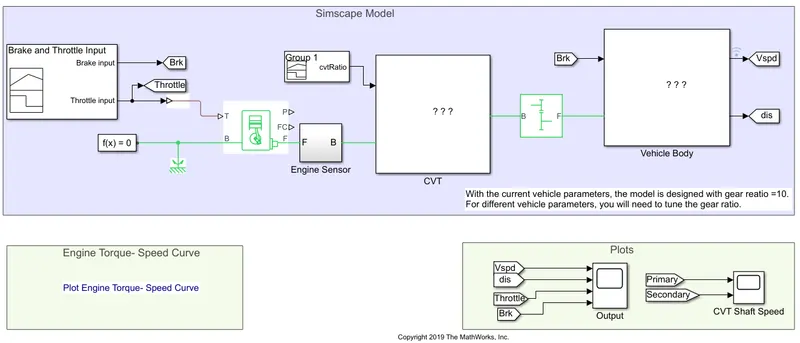
BAJA ATV model contains
Signal Builder
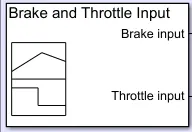
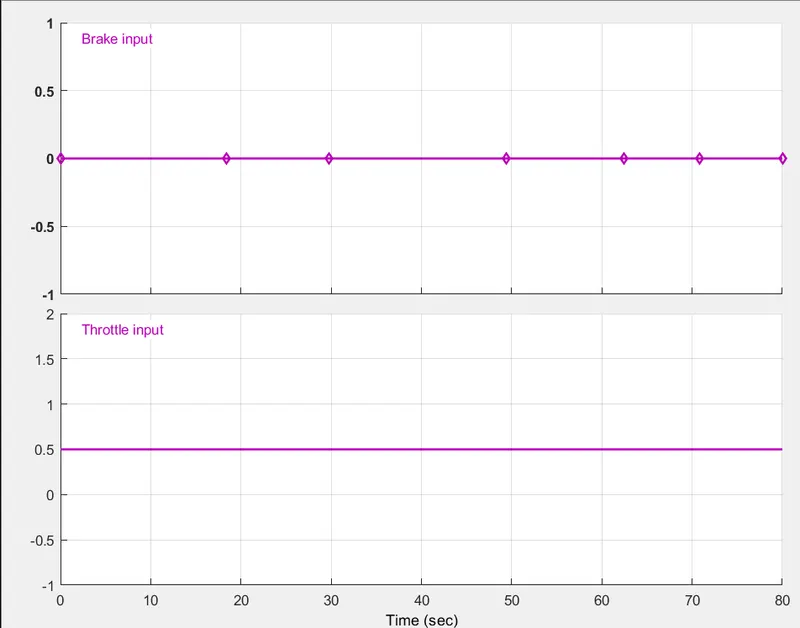
Signal builder is used for giving input values of Brake input and Throttle input and it is connected with Generic Engine block.
Brake input = 0,
Throttle input = 0.5 for first 20s, after 20s input will be 1.
Generic Engine(IC Engine)
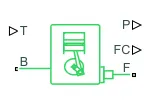
Represents a system-level model of spark-ignition and diesel engines suitable for use at initial stages of modeling when only the basic parameters are available. Optional idle speed and red line controllers are included.
- Engine ports
- B represents Engine block
- F represents Engine crankshaft
- T represents Engine throttle level
- P represents Engine power
- FC represents Fuel consumption
- Throttle input is given to T in engine.
- The parameter for the speed and torque vector are provided from the engine speed-torque curve.
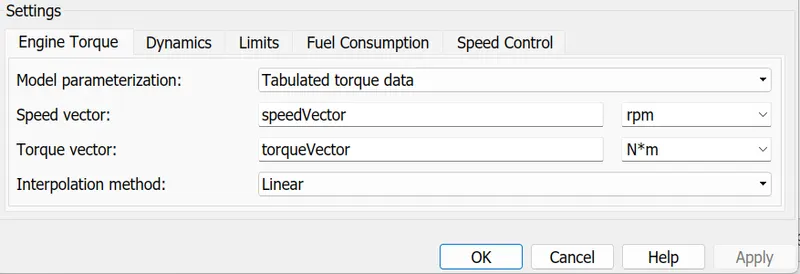
- The data from the speed torque curve are extracted by the data point extraction method.
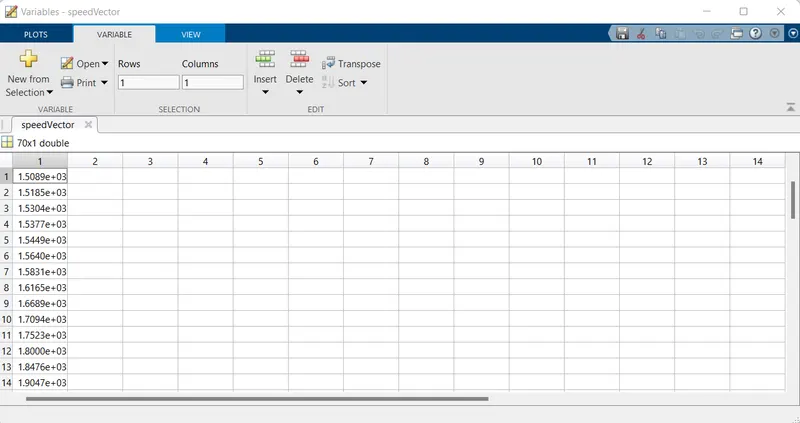
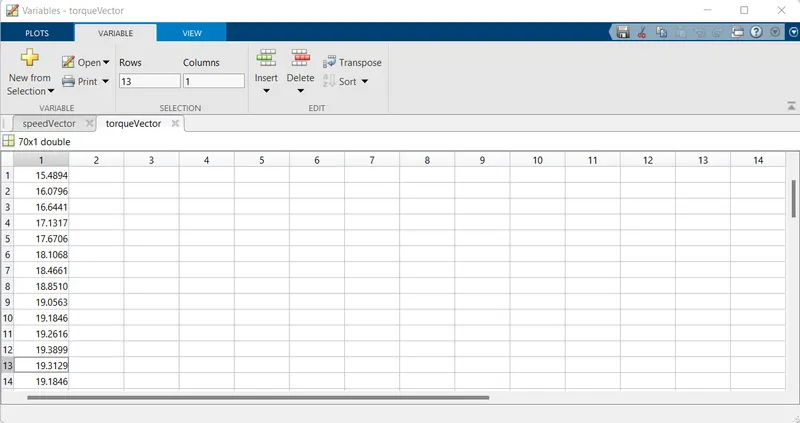
- Solver configuration (to specify the solver parameters before starting the simulation) and Mechanical reference for ground is connected to Engine.
- An ideal rotational motion sensor is connected to Engine crankshaft F to measure the RPM of Engine(Angular velocity of Engine).
- The scope block is used to see the speed.
- PS terminator block is used to terminate the output physical signal.
- The value of RPM is stored in To block of B.
CVT(Continous variable transmission)
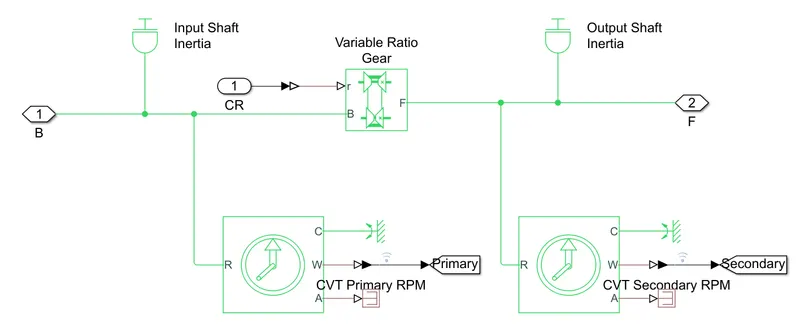
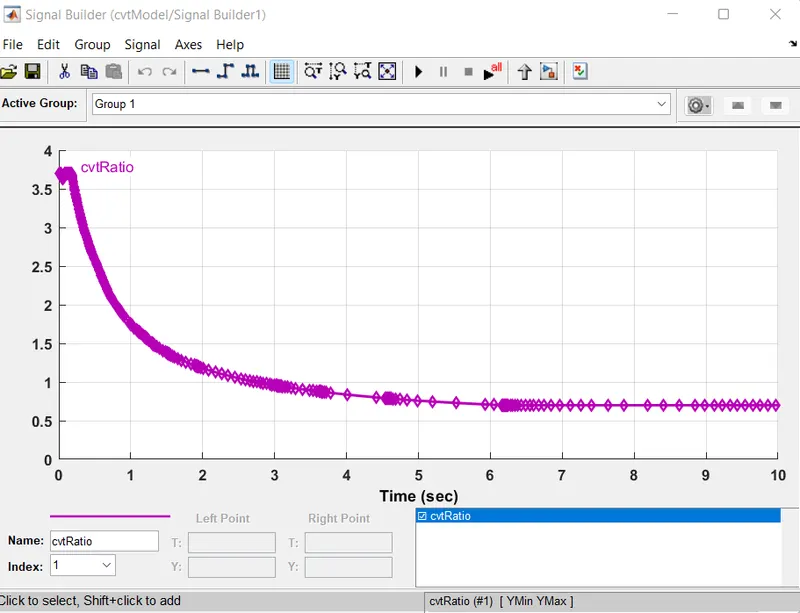
- The input for CVT(CVT ratio) is taken from Signal builder to give the variable gear ratio to CVT.
- The output of Engine sensor(RPM) is connected to CVT.
- Two inertia blocks were used in model. The input shaft inertia and output shaft inertia represents the primary and secondary pulley respectively.
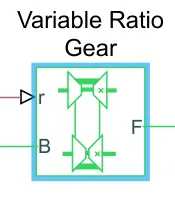
- The variable ratio block represent the gearbox with variable gear ratio.
- The port 'r' of the block defines the ratio of input to the output angular shaft velocities.
- If variator of primary pulley goes outward and secondary pulley goes inward it will leads to Speed reduction.
- If variator of primary pulley goes inward and secondary pulley goes outward it will leads to over drive.
- Both CVT primary and secondary RPM are inversely proportional to the CVT ratio.
Vehicle body
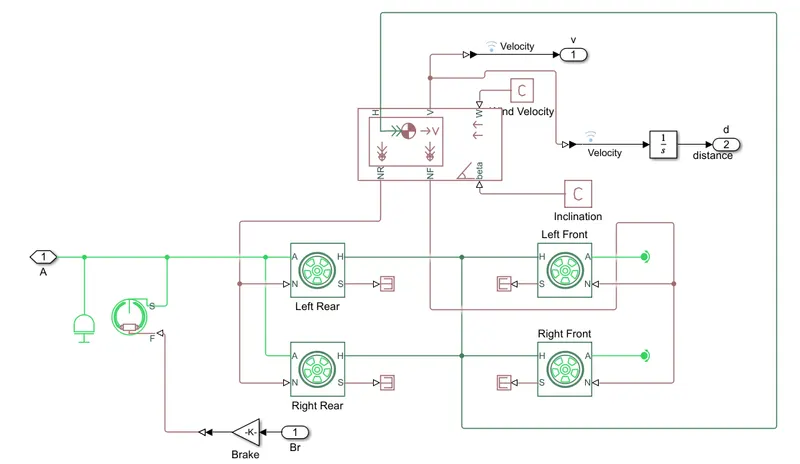
- Vehicle body contains two front wheel and two rear wheel which is connected with Inertia output shaft and double shoe brake.
- This block shows the complete vehicle assembly with the input require to operate the engine.
- Simple gear is connected to Vehicle body to provide the fixed gear ratio to the vehicle body. So that vehicle gained particular fix speed to move forward.
- The tyre blocks are used to represent the four tires of the ATV.
- Vehicle body blocks represent body mass,aerodynamic drag,road incline and weight distribution between axles.

- Double shoe brake block represents a frictional brake with two pivoted rigid shoes that press against a rotating drum to produce a braking action.
- The rigid shoes sit inside or outside the rotating drum in a diametrically opposed configuration.
- A positive actuating force causes the rigid shoes to press against the rotating drum.
- Viscous and contact friction between the drum and the rigid shoe surfaces cause the rotating drum to decelerate.
Result and discussion
Case 1 : Constant zero brake and 0.5 throttle input.
Vehicle speed and distance
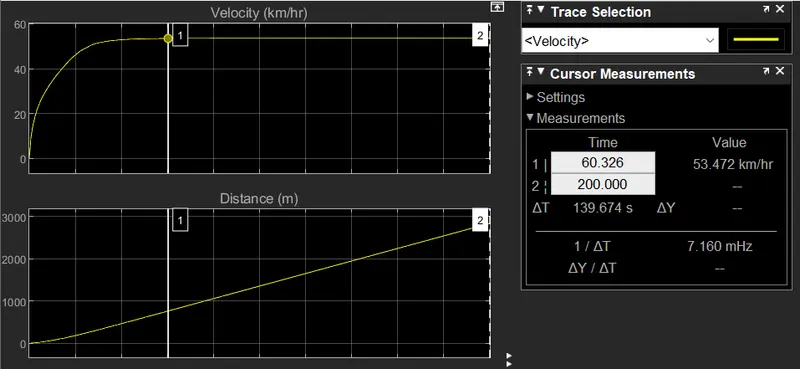
Vehicle accelerates gradually from 0 kmph and reaches the maximum speed of ~ 53.5 kmph at 60 s
CVT Primary and Secondary shaft speed
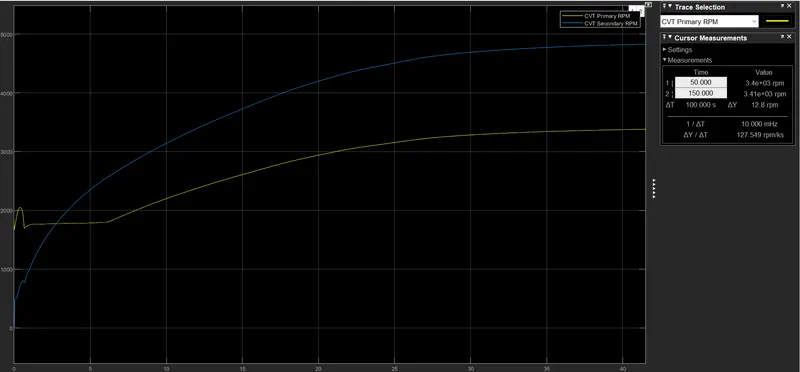
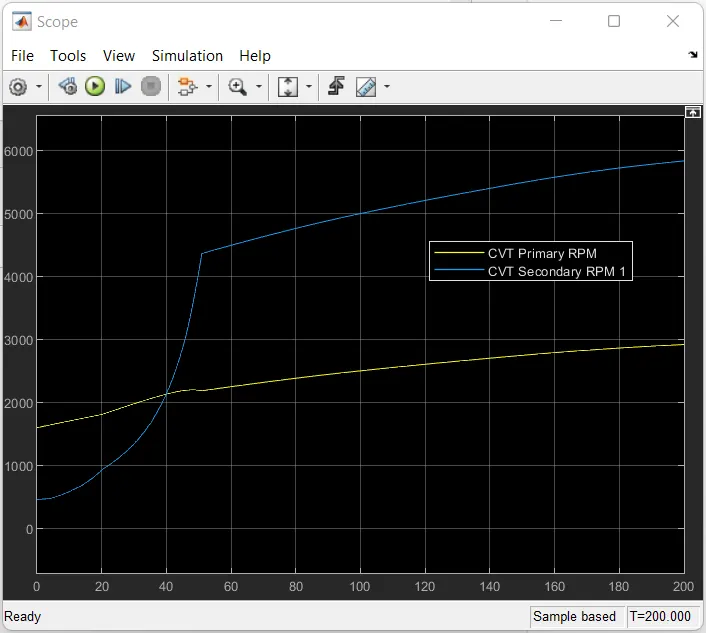
Initially speed of primary shaft is less than secondary shaft (speed reduction) due to higher gear ratio. Once the gear ratio is less than one the secondary shaft speed is more than primary shaft speed (over drive).
Engine speed
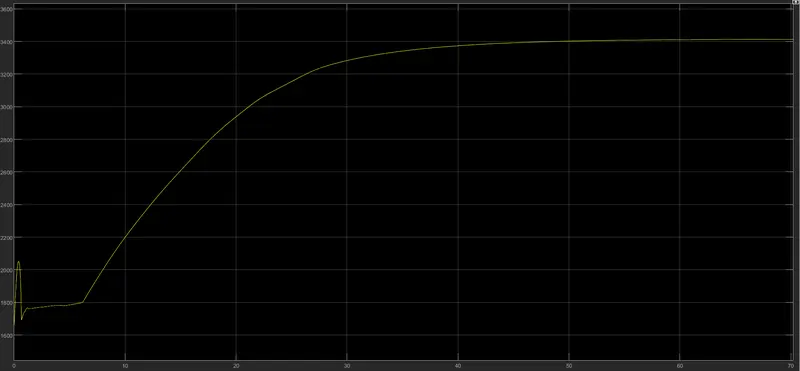
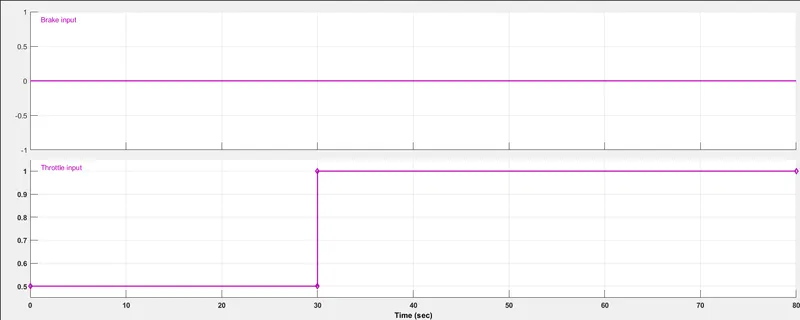
Case 2 : Brake constant zero, Throttle zero till 30 seconds and one after 30 seconds
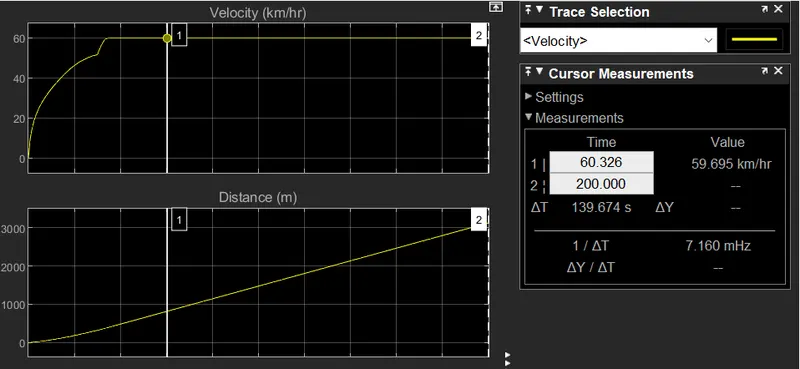
Vehicle speed and distance
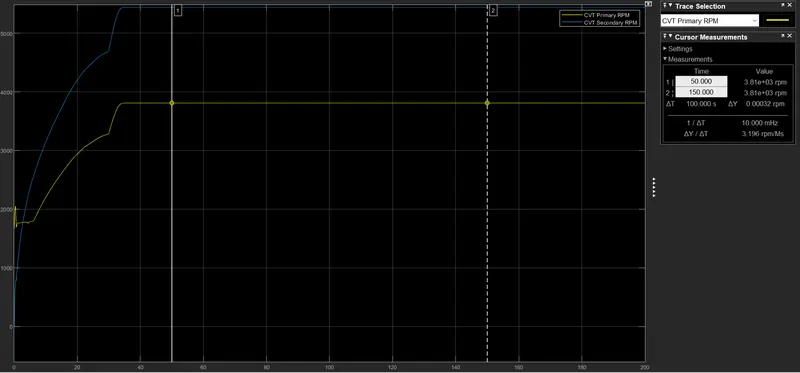
CVT Primary and Secondary shaft speed
Engine speed
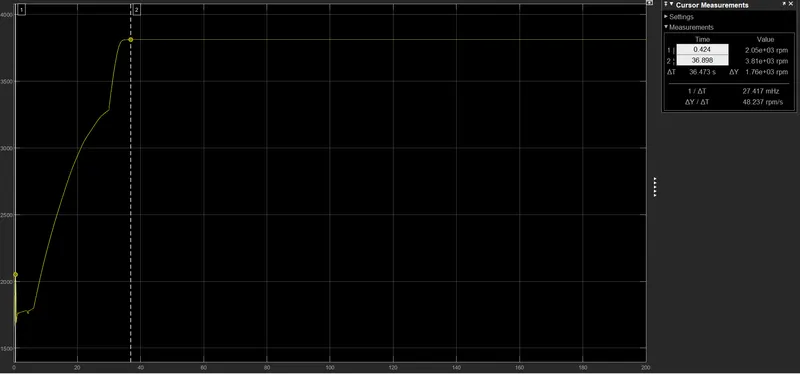
As we can see there is jump in velocity, primary and secondary shaft speed and engine speed at 30 seconds due to the increase in throttle
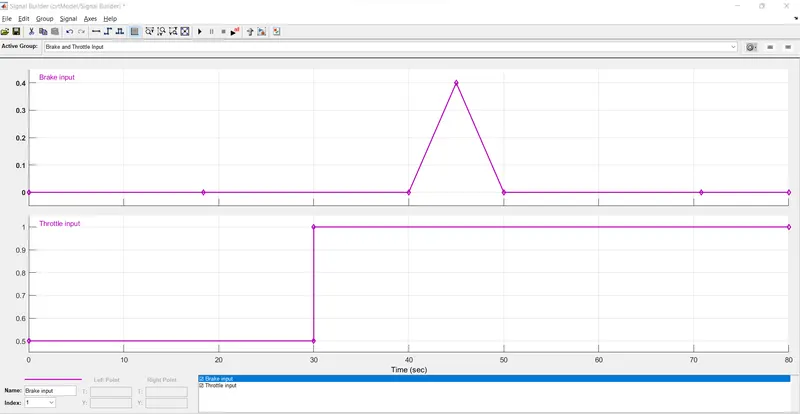
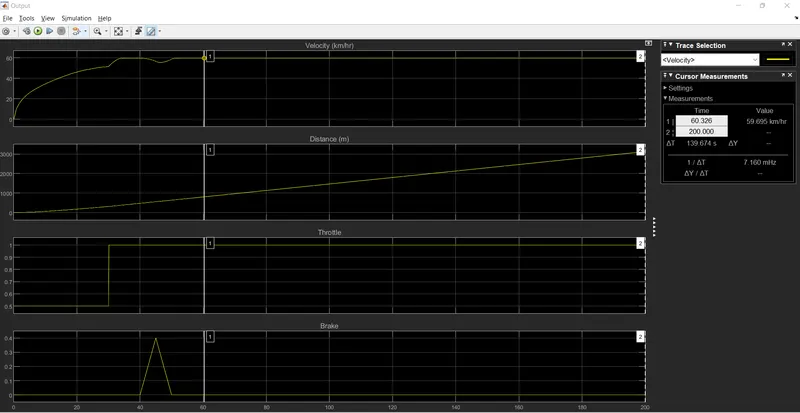
Case 3 : Brake upto 40s zero,between 40s to 50s brake is 0.4 afetr 50s is Zero. Throttle zero till 30 seconds and one after 30 seconds
Vehicle speed and distance
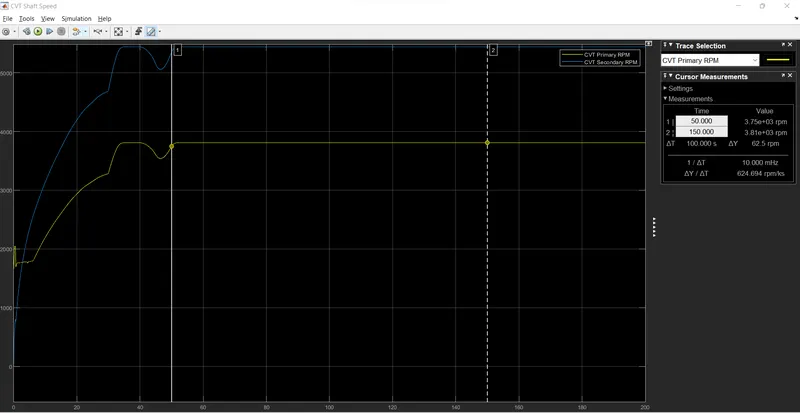
CVT Primary and Secondary shaft speed
Engine speed
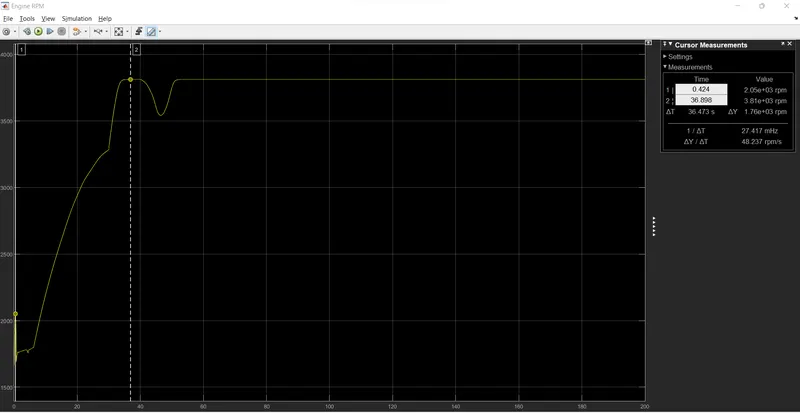
As we can see there is dip in velocity, primary and secondary shaft speed and engine speed from 40 to 50 seconds seconds due to the increase in brake
2.) CVT Model_mapped (with feedback):
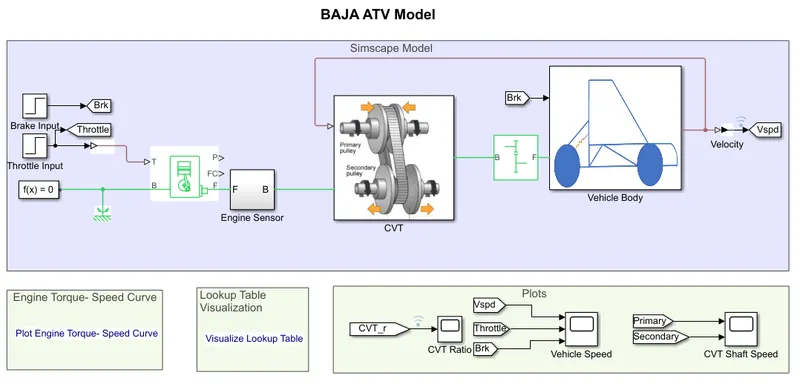
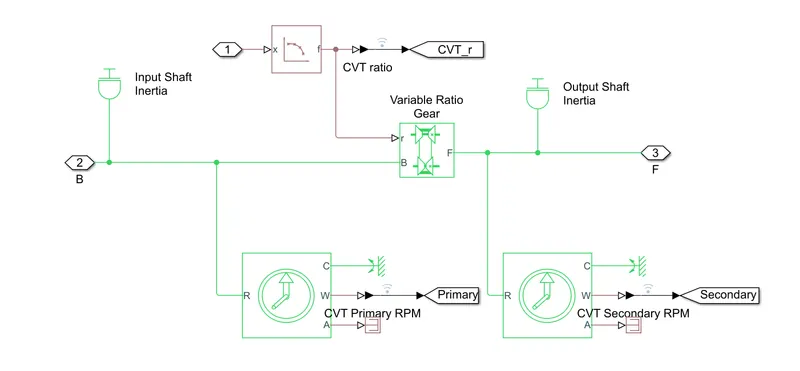
In this model, instead of fixed CVT ratio the CVT ratio is varied based on the vehicle speed. The feedback of the vehicle speed is given as the input to CVT ratio.
Result and discussion
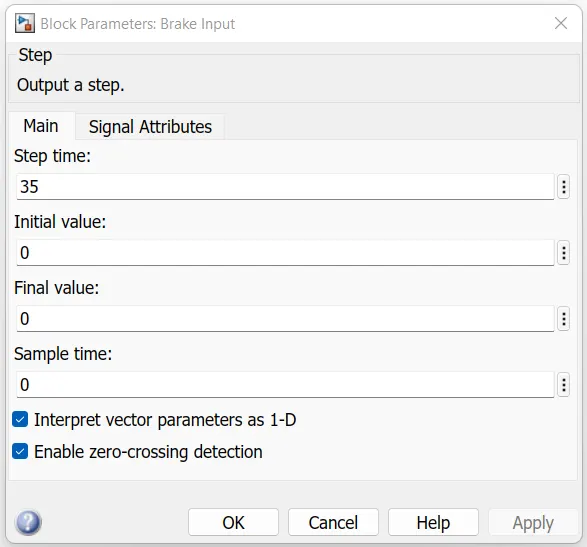
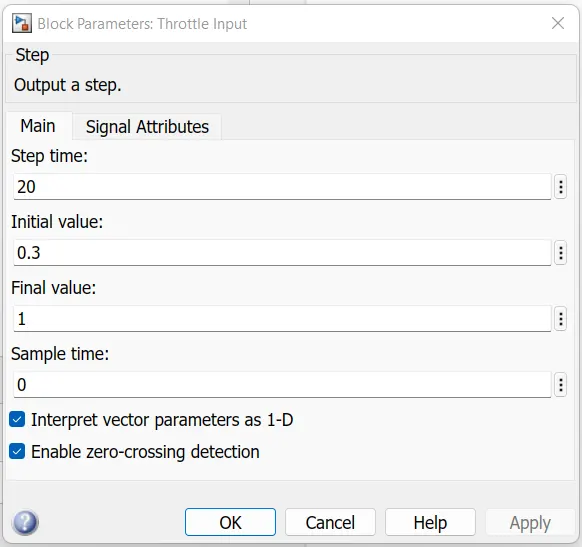
Case 1 : Brake 0, Throttle 0.3 till 20 seconds and 1 after 20 seconds
Vehicle speed:
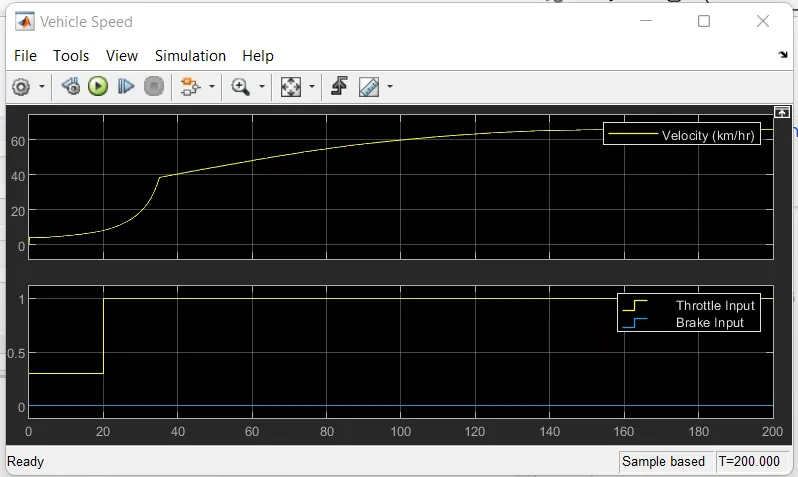
Vehicle speed increases exponentially after 20 seconds due to increase in throttle percentage.
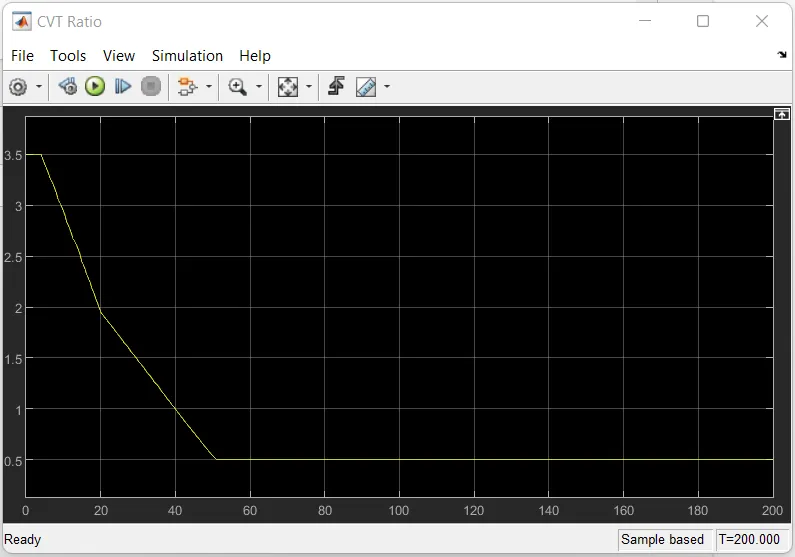
CVT ratio, CVT primary and secondary shaft speeds
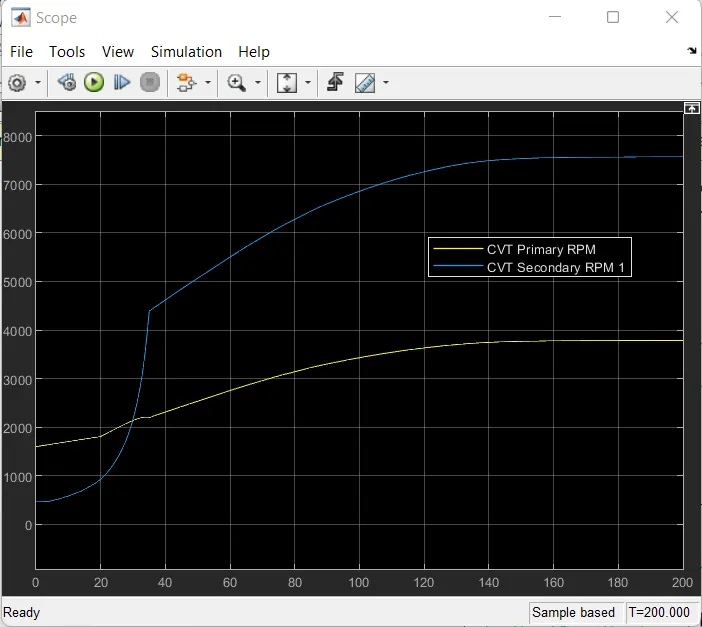
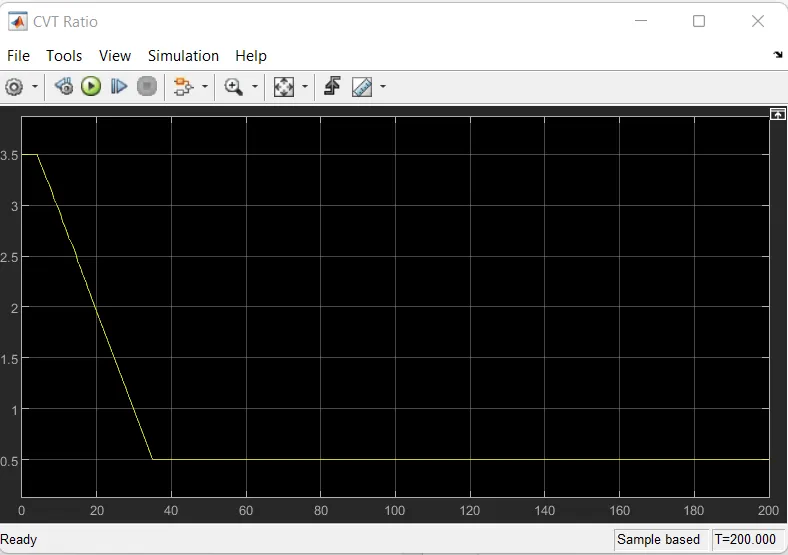
CVT ratio decreases as the vehicle speed increases. Speed of secondary shaft is more than speed of primary shaft once the CVT is less than 1 (overdrive)
Case 2 : Brake 0, Throttle 0.3 till 20 seconds and 0.5 after 20 seconds
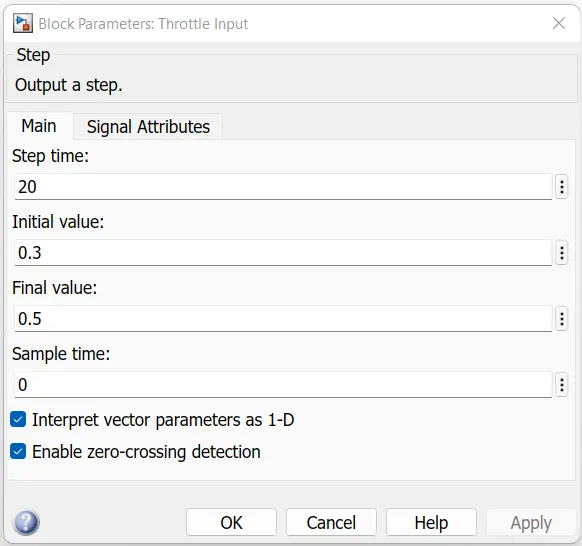
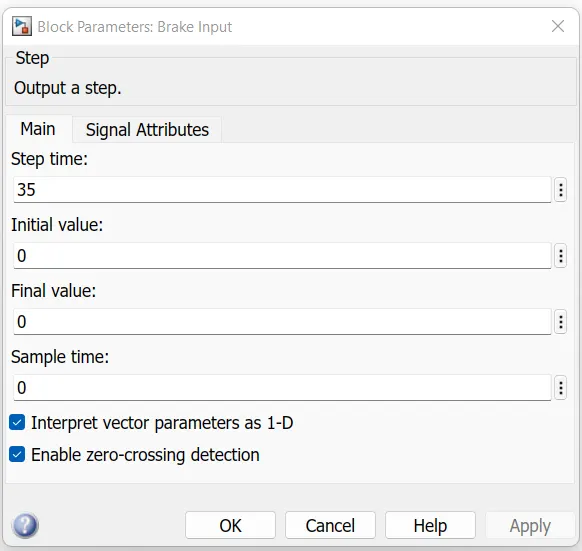
Vehicle speed:
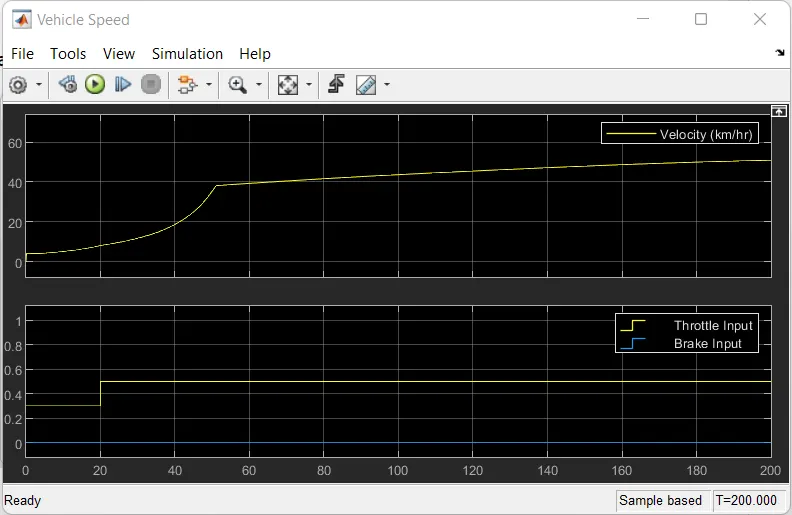
Vehicle speed decreases due to reduction in throttle percentage.
CVT ratio, CVT primary and secondary speed:
CVT ratio increased due to the reduction in vehicle speed. Speed of the CVT secondary shaft changes accordingly.
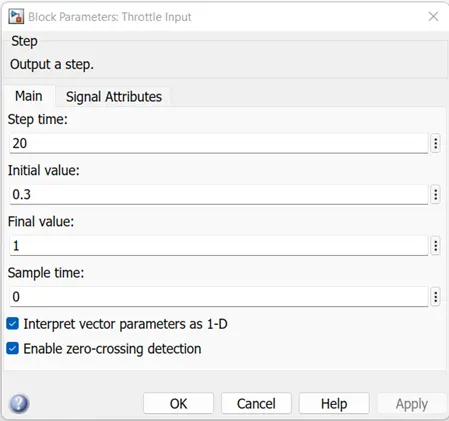
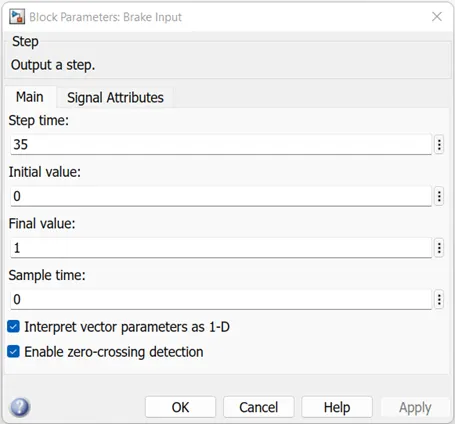
Case 3 : Brake 0, Throttle 0.3 till 20 seconds and 1 after 20 seconds
Vehicle speed:
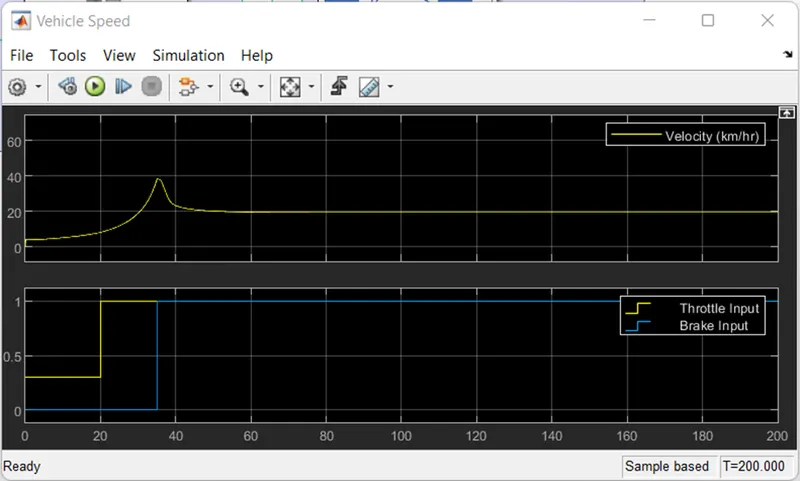
Vehicle speed decreases after 35 seconds due to brake application.
CVT ratio, CVT primary and secondary speed:
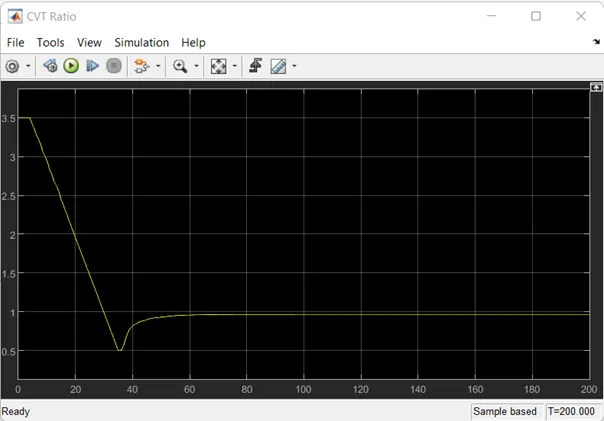
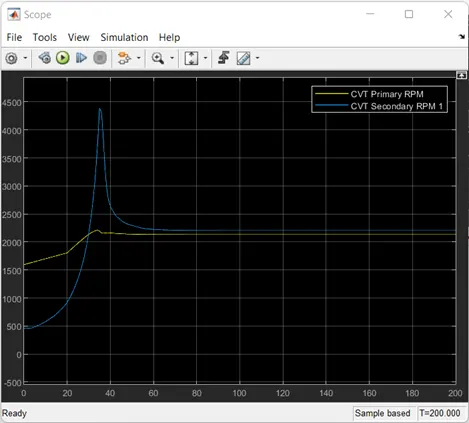
CVT ratio increases after 35 seconds due to reduction in vehicle speed. CVT primary and secondary shaft speed changes accordingly.
Model 3: CVT Model_mapped (with Dashboard):
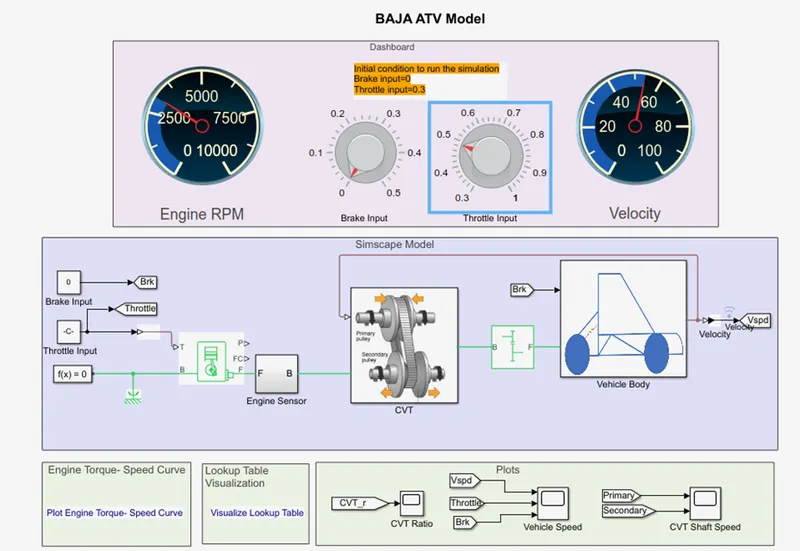
In this model stop time is given as infinite
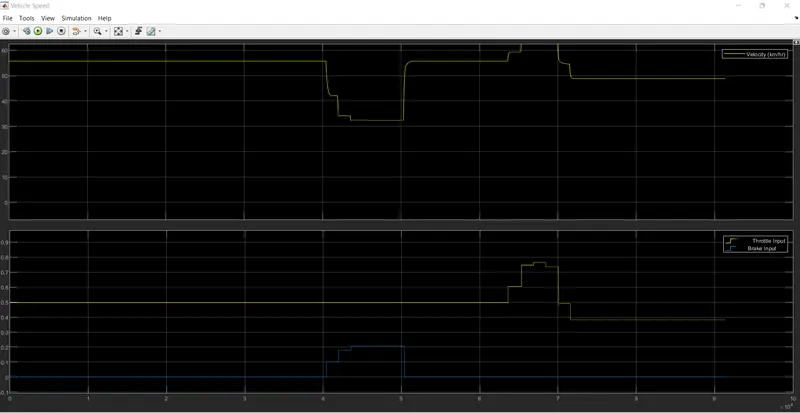
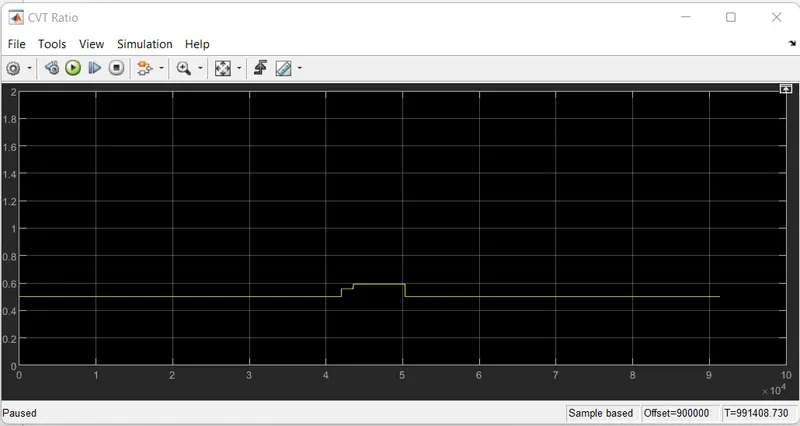
Vehicle speed and engine rpm can be visualized in real time by varying throttle input and brake input using knobs
Vehicle speed, throttle and brake input:
CVT ratio:
CVT primary and secondary shaft speed:
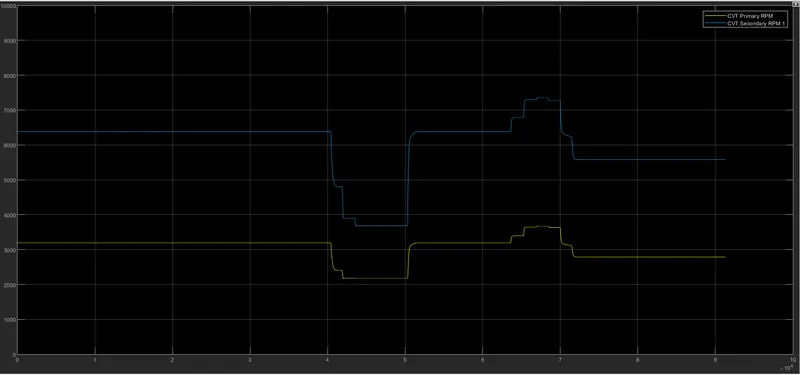
From the above graphs we can see the live results by changing the throttle and brake inputs.