Project 1 - V&V SW Analysis - I
Test plan
OBJECTIVE
US-1:As a Product owner,when long pressed the power button of the phone shall switch on with a company logo at the center of the screen.
US- 2: As a Customer,when the power button is pressed my phone is switched ON and all my icons of the APPS shall be present in the grid
US- 3: As a Product owner,when the phone is powered ON ,I shall see the "call the phone" icon as the first icon at the bottom bar of my screen.
US- 4: As a Product owner ,when the phone is powered ON, I shall see the "Dictionary" icon as the second icon at the bottom bar of my screen.
US- 5: As a Product owner ,when I Clicked my "call the phone" icon ,all the contacts shall be visible based on chronological order.
US- 6: As a Product owner,when I Clicked my "Dictionary icon ,a search bar shall appear at the middle of the screen to let me search the meanings of the words I desire.
US- 7: As a Product owner,when I long pressed my "power on" button ,my phone shall be switched off saying "Good-Bye” Message.
US-8: As a product owner ,my font in the mobile shall always be ''calibri (Body)" and shall be of size 12.
US-9:As a Customer,I need my UI to be touch responsive.
US-10: As a customer ,my mobile phone should have no hard buttons
Scope: It contains information that needs to be tested with respective of an application. The Scope can be further divided into two parts:
- In scope
The activities that not to be tested vigourously .that is we need to test the functionality of the phone such as calling feature ,app management ,on and off features, dictionary fetures these we need to be tested
- Out scope
The activities that don’t need to test vigorously. that is the camera ,flashlight, help , etc not to be tested immediately
Test methodology:
It contains information about performing a different kind of testing like Functional testing, Integration testing, and System testing, etc. on the application. In this, we will decide what type of testing; we will perform on the various features based on the application requirement. And here, we should also define that what kind of testing we will use in the testing methodologies so that everyone, like the management, the development team, and the testing team can understand easily because the testing terms are not standard.
Smoke testing→ Functional testing → Integration testing →System testing →Adhoc testing → Compatibility testing → Regression testing→ Globalization testing → Accessibility testing → Usability testing → Reliability testing → Recovery testing → Installation or Uninstallation testing
Approach
This attribute is used to describe the flow of the application while performing testing and for the future reference.
We can understand the flow of the application with the help of below aspects:
- By writing the high-level scenarios
- By writing the flow graph
By writing the test -level scenarios
in this it is a step approach like
1)swich on the power button and check weather the phone is switching on with the company logo at centre
2)check that is apps on the mobile I properly displaying in order
3)check the app location 1st location is for the call icon and the 2nd icon is for the dictionary
4)open the call app and check the contacts are displaying in chronological order
5)open the dictionary and check the location it must be on centre and also I must able to get the meaning of any word example I desire
6)also check the user interface is touch sensitive
7)when long press it must turn off with message “good bye”
By writing the flow graph
in a procedural way you draw a graph to take the all this checks the above high level writing consumes more time.so graph approach is good
Assumption
It contains information about a problem or issue which maybe occurred during the testing process and when we are writing the test plans, the assured assumptions would be made like resources and technologies, etc.
We assume the mobile phone is charged and bult in apps like dictionary and the contacts are properly installed
Also assuming that the touch sensitivity is properly working
Risk
These are the challenges which we need to face to test the application in the current release and if the assumptions will fail then the risks are involved.
When the bult in apps like contacts and the dictionary is deleted ,then you cant do that functionality
When the power swich is not properly passing the signal then the mobile will be permanently in off condition
Mitigation Plan or Contingency Plan
It is a back-up plan which is prepared to overcome the risks or issues.
We can re-install the apps and continue our testing
In case of switch issue we can replace the switch
Schedule
It is used to explain the timing to work, which needs to be done or this attribute covers when exactly each testing activity should start and end? And the exact data is also mentioned for every testing activity for the particular date.
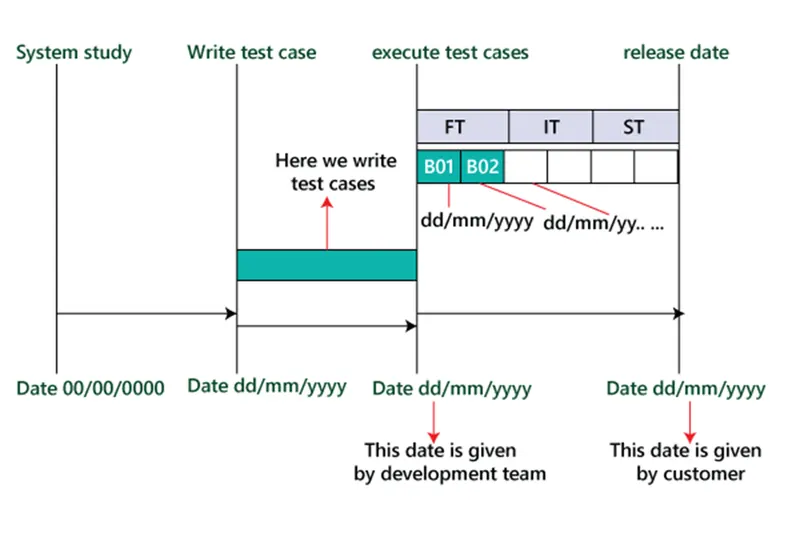
System study date:17/02/2001
Write test case:28/02/2001
Execute test case:15/03/2001
Release date:20/03/2001
Defect tracking
It is generally done with the help of tools because we cannot track the status of each bug manually. And we also comment about how we communicate the bugs which are identified during the testing process and send it back to the development team and how the development team will reply. Here we also mention the priority of the bugs such as high, medium, and low.
Entry and Exit criteria
It is a necessary condition, which needs to be satisfied before starting and stopping the testing process
Entry Criteria
The entry criteria contain the following conditions:
- White box testing should be finished.
- Understand and analyze the requirement and prepare the test documents or when the test documents are ready.
- Test data should be ready.
- Build or the application must be prepared
- Modules or features need to be assigned to the different test engineers.
- The necessary resource must be ready
Effort estimation
In this, we will plan the effort need to be applied by every team member.
Test Deliverable
These are the documents which are the output from the testing team, which we handed over to the customer along with the product. It includes the following:
- Test plan
- Test Cases
- Test Scripts
- RTM(Requirement Traceability Matrix)
- Defect Report
- Test Execution Report
- Graphs and metrics
- Release Notes