Project 1 - Simulating a BTMS
Battery Thermal Management System
Aim:- The aim of the project is to simulate the flow inside the Battery Thermal Management System.
Objective:
- Create an Excel Calculator to estimate the volumetric energy source
- Performing a steady state simulation by assuming the air velocity as 4m/s and heat source as 30000 W/m^3
- Performing the simulation for the element length of 12 mm, 8 mm, 6mm and 4mm. Also calculating the number of iterations required for convergence and plotting the trend.
- To determine the element that gives better accurecy.
- Excel calculator:-
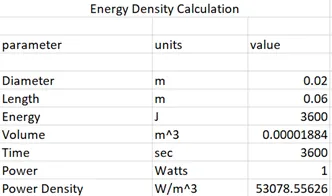
Fig.1: Excel Calculator
The excel calculator has been created to determine the volumetric energy source. The diameter and length of the battery cells are taken from the given model. The Fig.1 shows the excel calculator.
The volume of the model can be calcualted using the formula V=*r^2*h, where r is the radious of the cell in meters and h is the length of the cell in meters. The power can be calculated by using the formula Power=(Energy/Time). And the power density can be calculated as Power density=(power/volume).
- Performing the steady state simulation:
To perform the simulation, the following steps are followed;
Geometry: A simple BTMS model consisting of 5 cells of 2 mm diameter and 6 mm length is imported into the space claim.
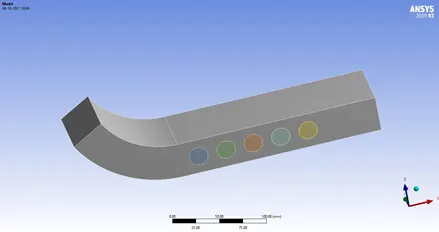
Fig.2: BTMS Model
Mesh: The named selection is done for Inlet, Outlet, Fluid-Volume and Solid Cell and the mesh is generated. The figures 3 to 5 shows the named selections.
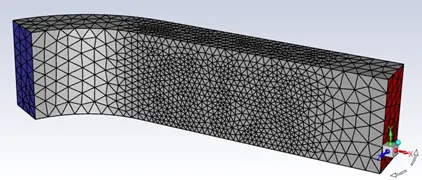
Fig.3: Inlet and Outlet with Mesh
In the above figure blue region in the inlet and red region is the outlet.
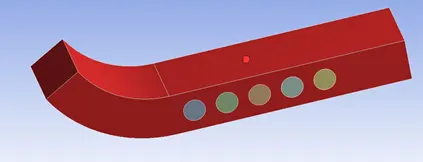
Fig.4: Fluid Volume
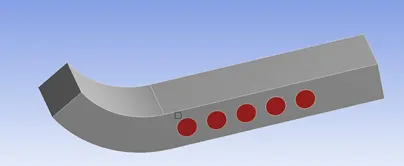
Fig.5: Solid Cells
Solution: To generate the required solution, the following setup is performed,
- Considering Density based Solver and enableing the steady state solver
- Enableing the Energy and turbulence model as k-epsilon model
- Assuming the Solid cell material as Aluminum and assuming the heat source as 30000 W/m^3
- Assuming the air inlet velocity as 4 m/s and oulet pressure as 0 pascals.
Result: Temerature contour of a cell, velocity contour and velocity volume are rendered.
Note:It should be noted that while simulating it is not fine to use any solid material. The selected material should have certain thermal properties to conduct the heat easily.
- Simulation Cases
Case 1: Conducting the Simulation for 12 mm mesh size
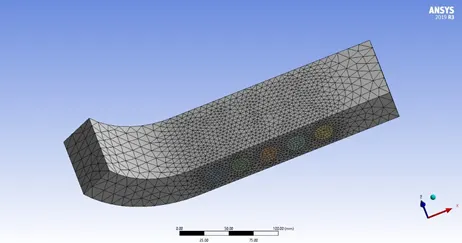
Fig.6: Meshed model
The meshed model shown in the Fig.6 contains 85099 elements.
Plots:
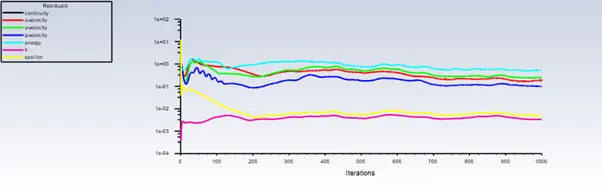
Fig.7: Residual vs Iteration plot
From the fig.7, we can observe that the residual drops and convergence takes place after 900 iterations.
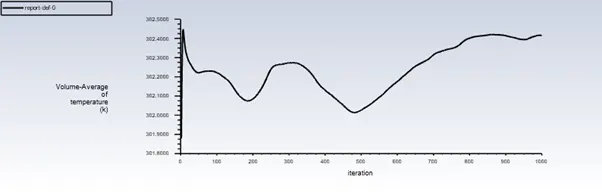
Fig.8: Volume-Average of temperature vs iteration plot
Results:
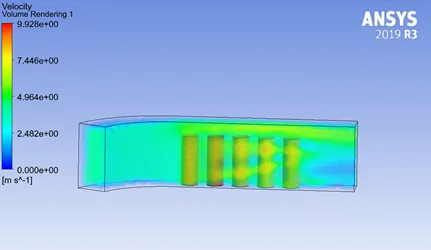
Fig.9: Velocity Volume rendering
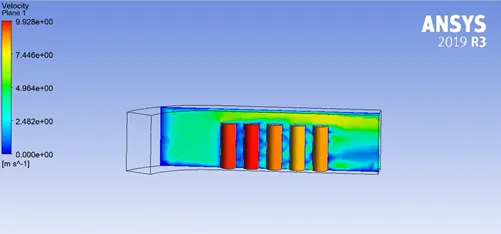
Fig.10: velocity contour
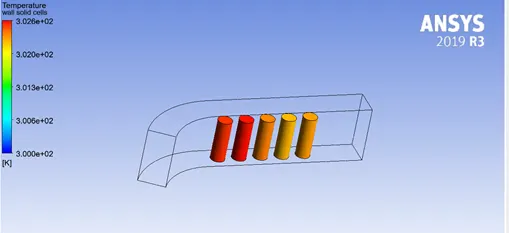
Fig.11: Tempurature contour
Case 2: Conducting the Simulation for 8 mm mesh size
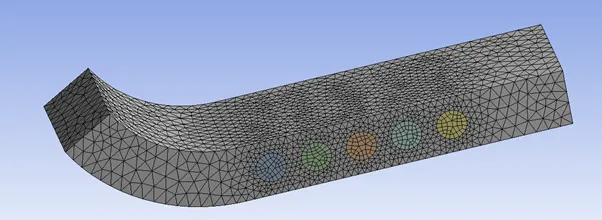
Fig.12: Meshed Model
The meshed model shown in the Fig.12 contains 89086 elements.
Plots:
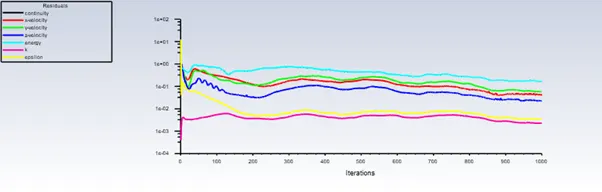
Fig.13: Residual vs Itrations plot
From the fig.13, we can observe that the residual drops and convergence takes place after 900 iterations
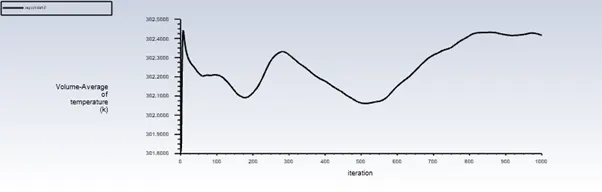
Fig.14: Volume-Average of temperature vs iteration plot
Results:
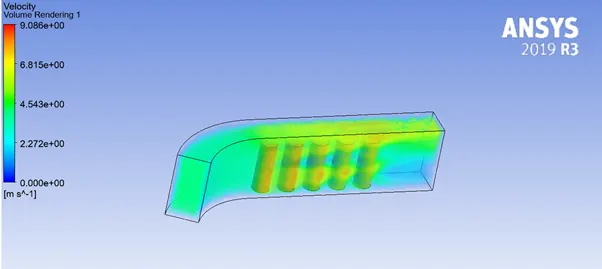
Fig.15: Velocity Volume rendering
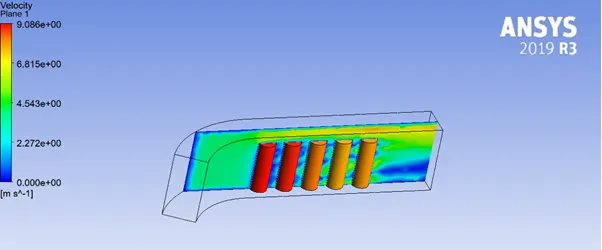
Fig.16: velocity contour
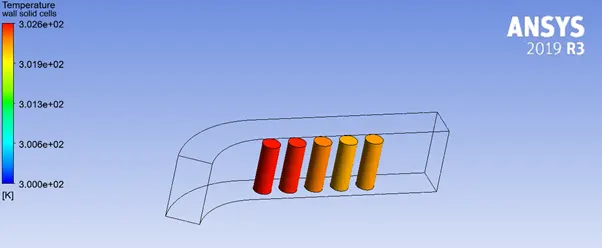
Fig.17: Tempurature contour
Case 3 : Conducting the Simulation for 6 mm mesh size
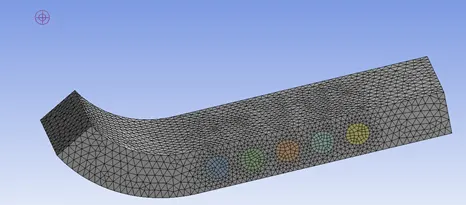
Fig.18: Meshed model
The meshed model shown in the Fig.18 contains 97292 elements.
Plot:
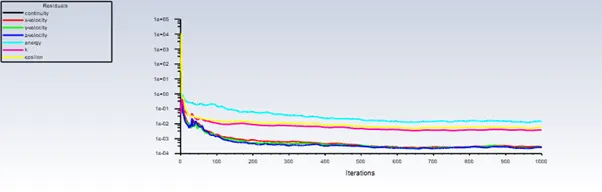
Fig.19: Residual vs Itrations plot
From the fig.13, we can observe that the residual drops and convergence takes place after 900 iterations
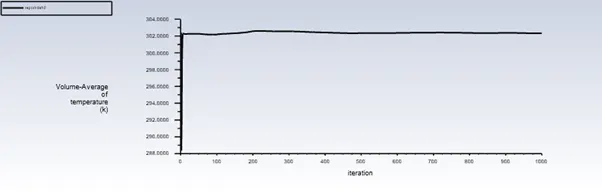
Fig.20: Volume-Average of temperature vs iteration plot
Results:
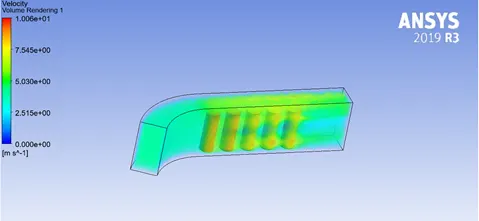
Fig.21: Velocity Volume rendering
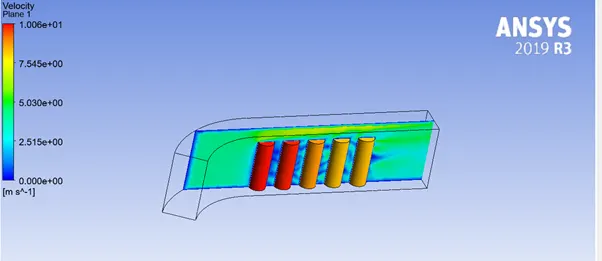
Fig.22: velocity contour
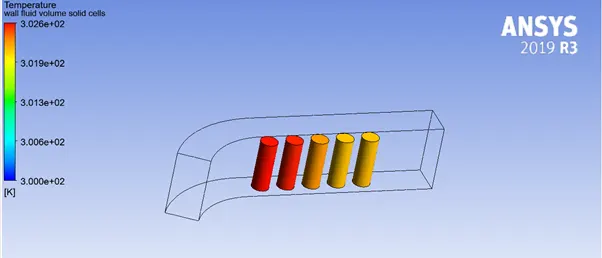
Fig.23: Tempurature contour
Case 4: Conducting the Simulation for 4 mm mesh size
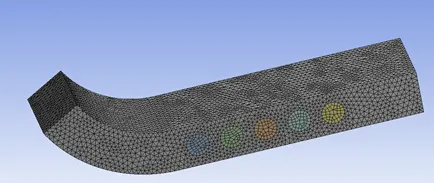
Fig.25: Meshed Model
The meshed model shown in the Fig.18 contains 130843 elements.
Plot:
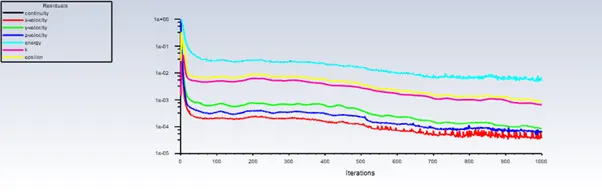
Fig.26: Residual vs Itrations plot
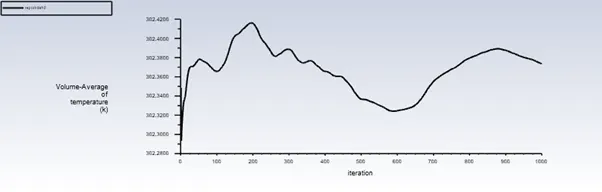
Fig.27: Volume-Average of temperature vs iteration plot
Results:
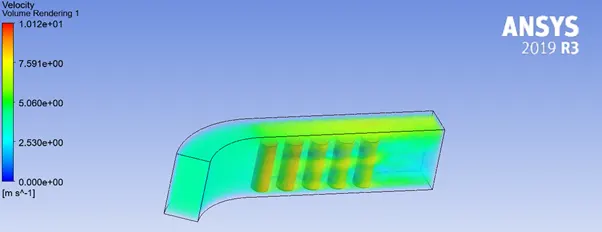
Fig.28: Velocity Volume rendering
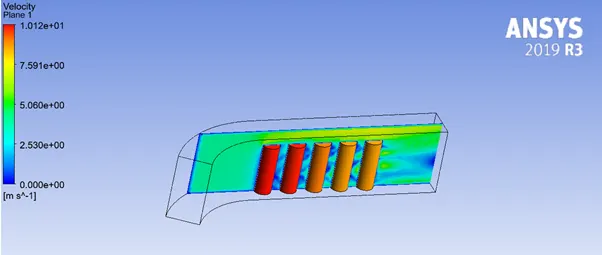
Fig.29: velocity contour
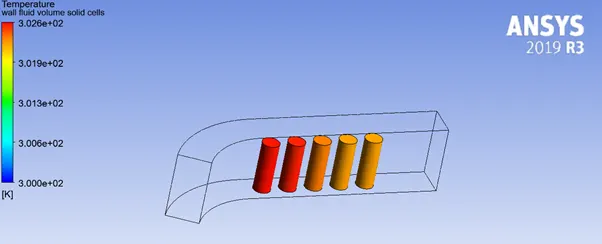
Fig.30: Tempurature contour
Inferance
By observing the above 4 cases, it can be seen that the finer mesh gives more accurate result.
Referance
[1] Skill-Lync. 2021. [online] Available at: <https://skill-lync.com/> [Accessed 4 October 2021].