Project-1: Powertrain for aircraft in runways
PART A
OBJECTIVES:
1. Search and list the total weight of various types of aircraft.
2. Is there any difference between ground speed and airspeed?
3. Why is it not recommended to use aircraft engine power to move it on the ground at the Airport?
4. How an aircraft is pushed to the runway when it's ready to take off?
5. Learn about take-off power, tire design, rolling resistance, tire pressure, and brake forces when landing.
ANS 1: It is difficult to give an exact number of how many types of aircraft there are in the world, as the number is constantly changing due to the development of new aircraft and modifications to existing models. Additionally, different sources may define and categorize aircraft types differently. However, it is estimated that there are currently thousands of different types of aircraft in operation worldwide, ranging from small, single-engine propeller planes to large commercial airliners and military jets.
The below table contains a few examples of different popular types of aircraft with weight comparison.
| TYPE OF AIRCRAFT MODEL MODEL MODEL | MODEL NAME |
EMPTY WEIGHT (Kg) |
MAX FUEL WEIGHT |
MAX CARGO WEIGH(Kg) | MAX GROSS TAKEOFF WEIGHT(Kg) |
| Single-engine piston aircraft | Cessna 172 Skyhawk | 767 | 212L | 262 | 1111 |
| Multi-engine piston aircraft | Piper Seneca V | 1533 | 454L | 483 | 2155 |
| Turboprop aircraft | Beechcraft King Air 350 | 4933 | 1639Kg | 1801 | 6804 |
| Regional airliner | Embraer E175 | 19278 | 6505Kg | 4536 | 40370 |
| Narrow-body airliner | Boeing 737-800 | 41611 | 26054L | 16144 | 78925 |
| Wide-body airliner | Airbus A350-1000 | 143744 | 108279Kg | 30908 | 322050 |
|
Business Jet |
Gulfstream G650ER | 24494 | 20055Kg | 2722 | 46720 |
| Helicopter | Bell 407 | 1285 | 463Kg | 1037 | 2268 |
| Glider | Schempp-Hirth Nimbus 4DM | 419 | N/A | N/A | 509 |
| Amphibious aircraft | Cessna 208 Caravan Amphibian | 2053 | 1256L | 1280 | 3969 |
| Military fighter jet | F-16 Fighting Falcon | 8753 | 3175Kg | N/A | 19195 |
| Supersonic passenger jet | Concorde | 78738 | 94000Kg | N/A | 185068 |
| Air ambulance | Pilatus PC-12 | 2616 | 1280Kg | 803 | 4740 |
| Ultralight aircraft ultralight | Ultralight aircraft | 112 | 19L | 136 | 249 |
| Military transport aircraft | Lockheed Martin C-130J Super Hercules | 34303 | 27842Kg | 19958 | 74390 |
| Airship | Goodyear Blimp | 5830 | 544Kg | 1333 | 8970 |
| Experimental aircraft | Van's RV-10 | 582 | 227L | 454 | 1225 |
|
Light sport aircraft |
Icon A5 | 490 | 76L | 195 | 685 |
|
Seaplane |
de Havilland Canada DHC-6 Twin Otter | 3402 | 570Kg | 1700 | 5670 |
|
Agricultural aircraft airier |
Air Tractor AT-502B | 1860 | 700L | 1950 | 4310 |
ANS2:
Yes, there is a difference between the ground speed and airspeed of an aircraft.
- Airspeed is the speed at which the aircraft is moving through the air. It is measured by the airspeed indicator in the cockpit and is typically measured in knots. Airspeed is affected by various factors such as altitude, temperature, and wind.
- Ground speed, on the other hand, is the speed at which the aircraft is moving relative to the ground. It takes into account the airspeed and the effects of wind. Ground speed can be affected by the direction and speed of the wind.
For example, if an aircraft is flying at an airspeed of 100 knots, and there is a headwind of 20 knots, the ground speed would be 80 knots. Conversely, if the same aircraft were flying at an airspeed of 100 knots and there was a tailwind of 20 knots, the ground speed would be 120 knots. In general, an aircraft's ground speed will be higher than its airspeed if there is a tailwind and lower than its airspeed if there is a headwind.
| Aircraft Condition | Roling resistance Force | Hill climbing Force | Aero-dynamic Drag Force |
| During Takeoff | High | High or Low(depends on the Gradeability of the runway) | High |
| During Flight | None | Medium to High(Depends on higher altitude) | High |
| During Landing | High | Low | High |
ANS 3:
- It is not recommended to use aircraft engine power to move an aircraft on the ground at the airport because it can create safety hazards and cause damage to the aircraft.
- Firstly, the powerful jet blast generated by the aircraft engines can create safety hazards for ground personnel and other nearby aircraft. The high velocity and temperature of the exhaust gases can cause injury, damage to equipment, and even blow away loose objects on the ground.
- Secondly, using engine power to move the aircraft on the ground can cause unnecessary wear and tear on the engines, as well as other components of the aircraft such as the tires, brakes, and landing gear. This can increase maintenance costs and reduce the lifespan of the aircraft.
- Instead, airports typically use ground support equipment, such as tow tractors or aircraft tugs, to move aircraft on the ground. These vehicles are specifically designed to move aircraft safely and efficiently on the ground, and they can be controlled by trained personnel who are familiar with the hazards and requirements of ground handling.
- In summary, using engine power to move an aircraft on the ground is not recommended due to safety hazards and potential damage to the aircraft. Ground support equipment should be used instead to move aircraft on the ground at the airport.
ANS 4:
1) Taxiing:
- Taxiing is the movement of an aircraft on the ground, under its own power, in contrast to towing or push-back where the aircraft is moved by a tug.
- The aircraft usually moves on wheels, but the term also includes aircraft with skis or floats.
- An airplane uses taxiways to taxi from one place in an airport to another; for example, when moving from a hangar to the runway.
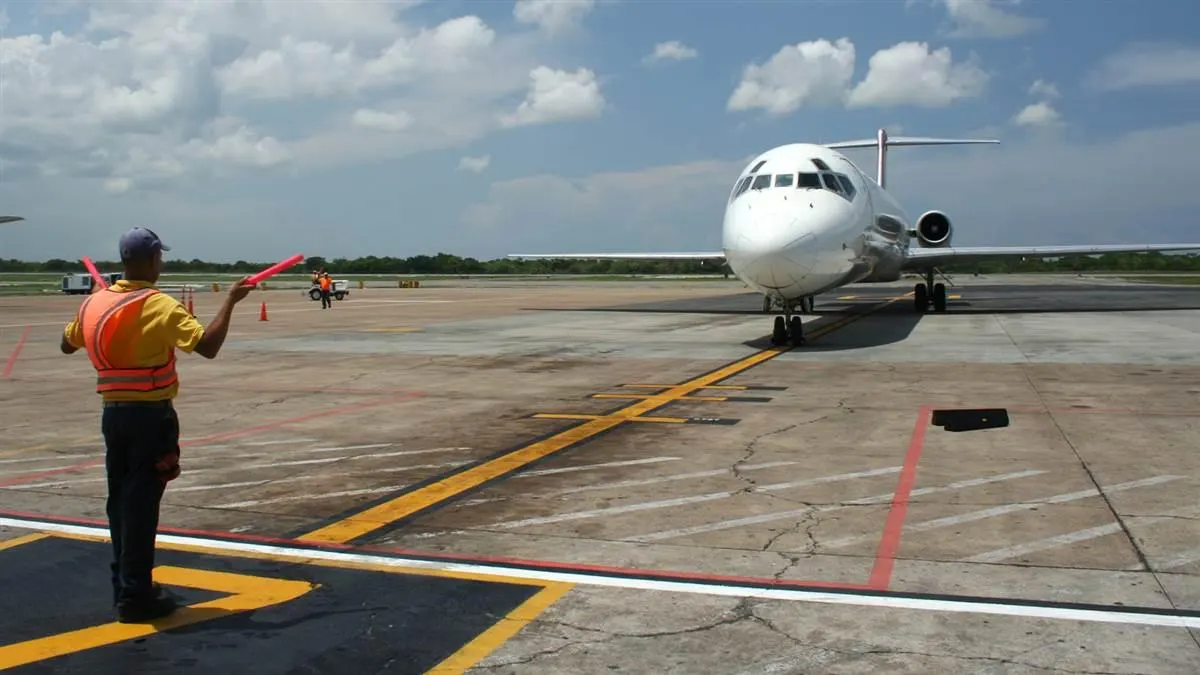
2) Towing:
- Movement of large aircraft about the airport, flight line, and hangar is usually accomplished by towing with a tow tractor.
- In the case of small aircraft, some moving is accomplished by hand pushing on the correct areas of the aircraft.
- Aircraft may also be taxied about the flight line but usually only by certain qualified personnel.
- Towing aircraft can be a hazardous operation, causing damage to the aircraft and injury to personnel, if done recklessly or carelessly.
- This article outline the general procedure for towing aircraft.
- However, specific instructions for each model of aircraft are detailed in the manufacturer's maintenance instructions and are to be followed in all instances.
ANS 5:
When an airplane takes off and lands, several key factors come into play that can affect the aircraft's performance and safety. Here's a breakdown of how each of these factors may come into play:
-
Takeoff power: The amount of power used during takeoff can affect the amount of energy the aircraft has when it lands. Typically, aircraft use full power during takeoff to ensure a safe and timely climb-out. However, if the aircraft is overweight, it may require even more power to achieve a safe takeoff. During landing, pilots will reduce the throttle to idle to slow the aircraft down.
The takeoff power calculation for an aircraft depends on several factors such as weight, temperature, pressure altitude, runway length, and engine performance. Here's a general formula for calculating takeoff power:
Takeoff power = (Takeoff distance x Takeoff weight x Gravity) / (Time to reach takeoff speed x Ground roll factor)
-
Tire design: The design of an aircraft's tires can impact its ability to grip the runway during takeoff and landing. For example, tires with a larger contact area or softer rubber compound may provide better traction, while tires with a harder compound or less contact area may have less grip. Pilots need to ensure that the tires are properly inflated and in good condition to prevent blowouts or other issu
Retreading – Retreading is methods of restoring a worn tyre by renewing the tread area or by renewing the tread area plus one or both sidewalls. Repairs are included in the tyre retreading process.
Load Rating – Load rating is the maximum permissible load at a specified inflation pressure.
Ply Rating – Ply Rating is used to identify the maximum recommended load rating and inflation pressure for a specified tire. It is an index of tire strength.
Speed Rating – The speed rating is the maximum takeoff speed to which the tyre has been tested.
Skid Depth – Skid depth is the distance between the tread surface and the deepest groove as measured in the mould..
-
Rolling resistance: The rolling resistance of an aircraft's tires can affect the amount of energy required to accelerate during takeoff and decelerate during landing. Tires with higher rolling resistance require more force to move, which can affect takeoff distance, climb performance, and landing distance. Pilots must take into account the runway length and conditions when calculating takeoff and landing distances.
The rolling resistance force of an aircraft on the ground can be calculated using the following equation:
Frr = Crr * N
Where:
- Frr is the rolling resistance force (in Newtons)
- Crr is the coefficient of rolling resistance
- N is the normal force acting on the aircraft's wheels (in Newtons)
The coefficient of rolling resistance (Crr) depends on several factors, including the type of tire and the condition of the runway surface. For aircraft on dry concrete runways, Crr typically ranges from 0.002 to 0.015.
The normal force acting on the aircraft's wheels (N) can be calculated using the weight of the aircraft (W) and the angle of inclination of the runway (θ) as follows:
N = W * cos(θ)
Once you have determined the value of Crr and calculated the normal force N, you can use the first equation to calculate the rolling resistance force (Frr).
-
Tire pressure: The pressure of an aircraft's tires can affect its ability to absorb shock during takeoff and landing. Lower tire pressure can provide better shock absorption, but may also make the tires more susceptible to damage. Higher tire pressure can increase the risk of blowouts or other tire-related issues, but may also provide better fuel efficiency and performance.
P = (W/N) * (K/S) * 0.0689476
Where:
- P is the tire pressure (in kilopascals or kPa)
- W is the weight of the aircraft (in Newtons)
- N is the number of wheels supporting the weight of the aircraft
- K is the tire load rating (in Newtons)
- S is the tire contact area (in square meters)
The tire load rating (K) is specified by the tire manufacturer and represents the maximum load that the tire can safely carry at a given pressure.
The tire contact area (S) can be approximated as follows:
S = 3.14 * (D/2)^2
Where:
- D is the tire diameter (in meters)
-
Brake forces: During landing, pilots use the brakes to slow the aircraft down. The amount of brake force applied can affect the rate of deceleration and stopping distance. Too little brake force can cause the aircraft to overshoot the runway, while too much brake force can cause the tires to lock up and skid. Pilots must carefully manage brake force during landing to ensure a safe and controlled stop.
The brake forces of an aircraft during landing can be calculated using the following equation:
Fb = μb * W
Where:
- Fb is the brake force (in Newtons)
- μb is the coefficient of braking friction between the tires and the runway
- W is the weight of the aircraft (in Newtons)
The coefficient of braking friction (μb) is dependent on several factors, including the type of runway surface, tire type, and the condition of the runway. Typical values for μb range from 0.2 to 0.8.
To calculate the weight of the aircraft (W), you can use the following equation:
W = mg
Where:
- m is the mass of the aircraft (in kilograms)
- g is the acceleration due to gravity (9.81 m/s^2)
PART B
OBJECTIVES:
6. A. With necessary assumptions, calculate the force and power required to push / pull an aircraft by a towing vehicle.
B. Develop the model for the calculated force and power using Simulink.
7. A. Design an electric powertrain with type of motor, its power rating, and energy requirement to fulfill aircraft towing application in Simulink. Estimate the duty cycle range to control the aircraft speed from zero to highest. Make all required assumptions. Prepare a table of assumed parameters. Draw a block diagram of powertrain.
(Hint :DC7 Block)
B. Also, Design the parameters in excel sheet.
ANS 6A:
The force and power required to push or pull an aircraft by a towing vehicle can be calculated using the formula Tractive Force = Rolling resistance force + Hill climbing Force + Aerodynamic drag force. Let's break down each of these forces and assumptions:
The formula for the rolling resistance force is:
Frr = μrr * m * g
where:
- μrr = 0.02 (coefficient of rolling resistance)
- m = 50,000 kg (mass of aircraft+tow truck)
- g = 9.81 m/s^2 (acceleration due to gravity)
Plugging in these values, we get:
Frr = 0.02 * 50,000 kg * 9.81 m/s^2 Frr = 9,810 N
Therefore, the rolling resistance force Frr is 9,810 Newtons (N) in SI units.
The formula for the aero dynamic drag force is:
Fad = 0.5 * ρ * v^2 * Cd * A
- ρ = 1.225 kg/m^3 (density of air at sea level and 15°C)
- v = 1.4 m/s (typical towing speed for an aircraft)
- Cd = 0.025 (coefficient of drag for a commercial aircraft)
- A = 120 m^2 (reference area of the aircraft)
Plugging in these values into the formula, we get:
Fdrag = 0.5 * 1.225 kg/m^3 * (1.4 m/s)^2 * 0.025 * 120 m^2 Fdrag = 3.601N
Therefore, the estimated aerodynamic drag force acting on the aircraft being pushed by a towing truck is approximately 735 N. Note that this is just an estimate based on assumed values, and the actual drag force could be higher or lower depending on the specific conditions.
Hill climbing force is zero cause i assumed that normally aircraft runways don't have a slope.
Fhc = m.g.sinψ [where ψ = 0]
Tractive Force = Roling resistence force + Hill climbing force + Aerodynamic drag force
or , Ftf = Frr + Fhc + Fad
or, Ftf = 9810N + 0N + 3.601N
or , Ftf = 9813.601N
or, Ftf = 9814N
Now , the towing truck requires a significant amount of power to move the aircraft. The calculation is given below.
P = F x v
- P = power in watts (W)
- F = total force required to move the aircraft, which is the sum of the rolling resistance force, hill climbing force, and aerodynamic drag force (F = Frr + Fhc + Fad)
- v = towing speed in meters per second (m/s) [ here i am assuming the value is 20m/s]
so , P = F * v
or , P = 9814N * 1.4m/s
or , P = 13739.0421W
or, P = 13740W
Therefore, the power required for the towing vehicle to move the aircraft at a force of 9814 N and speed of 5km/h is approximately 13740 watts (or 13.7 kilowatts).
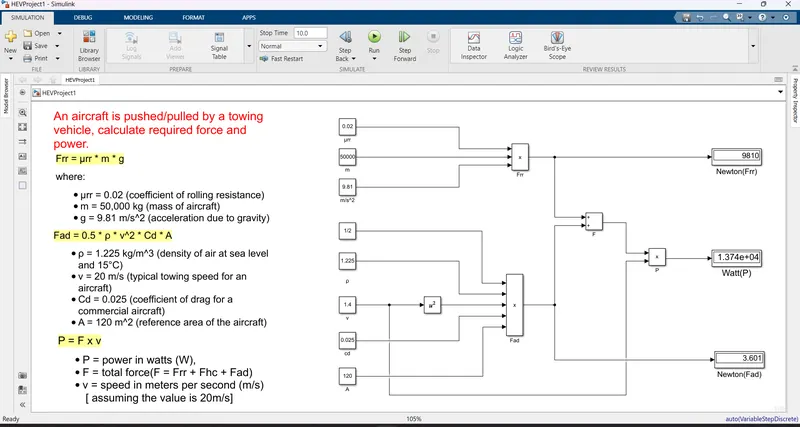
ANS 6B:
Simulink Blocks required to complete the model:
- Constant block
- Square block
- Product block
- Sum block
- Display
Below image is refferred to the Model i made in Simulink after simulated for 10 sec.
ANS 7A:
Power rating, and Energy requirement to fulfill aircraft towing application:
To understand the power and energy first we need to summarize question 6A and 7A.
- A towing truck is towing an aircraft from point A to B in 2 min at a constant speed (assuming)
- velocity of the towing truck is 1.4 m/sec (assumed in question 6A)
- Total tractive force is 9814N (calculated in question 6A)
- Power requiired for the truck to move the aircraft from point A to B is 13.7 Kilowatt (calculated in question 6A)
- total energy consumed is 1644000 joules (calculated below)
Energy = Power * Time
or , Energy = 13.7kilowatt * (2*60)sec
or, Energy = 13700 watt * 120sec
or, Energy = joules or 1644KJ
-
Determining the power rating of the motor of the towing truck.
Now, since the truck is a full EV (assumed), we need to take into account the efficiency of the electric motor and battery system. Let's assume an efficiency of 90% for both the motor and battery.
The power output of the motor is therefore:
Motor power = Power required / Motor efficiency
Motor power = 13700 watts / 0.9
Motor power = 15222.22 watts
The power rating of the motor inside the towing truck would be 15.22 kW.
Next, we can calculate the power required to charge the battery:
Battery charging power = Power required / (Motor efficiency x Battery efficiency)
Battery charging power = 13700 watts / (0.9 x 0.9)
Battery charging power = 16913.6 watts
The power rating of the battery inside the towing truck would be 16.914 kW.
Therefore, to fully tow the aircraft from point A to B using a full EV towing truck with an efficiency of 90%, the truck would require a motor with a power rating of 152.22 kW and a battery with a power rating of 16.914 kW.
-
To calculate the voltage rating of the motor, we need to know the current drawn by the motor at its rated power and voltage.
We can use the formula:
Power = Voltage x Current
or , Current = Power / Voltage
or , Current = 16913.6 watts / Voltage
Let's assume that the voltage rating of the motor is 400 volts (a common voltage for electric vehicles). Then, we can calculate the current drawn by the motor,
Current = 169136 watts / 400 volts
or , Current = 42.28 Amps
Therefore, at a voltage rating of 400 dc volts, the motor would draw a current of 42.3 Amps at its rated power.
- Thus , DC Motor power rating = 152.22 Kilowatt (calculated above)
And DC motor Voltage rating = 400VDC (assumed)
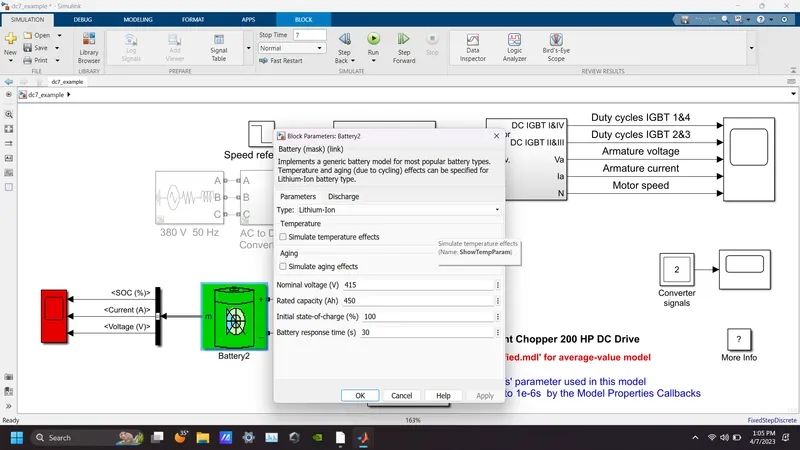
- Battery pack Voltage is 415VDC (assumed).
- Battery Pack max load is 45ADC(assumed)
Energy capacity = Voltage x Current
or , Energy capacity = 415 V x 45A = 18675 Watt-hours (Wh)
Now, to convert watt-hours to ampere-hours, divide the watt-hours by the voltage of the battery pack:
Rate of change of Energy (Wh)= Ah * V
or , Ah = 18675 Wh / 415 V Ah = 45 Ah
- so , The battery rating chould be around 450Ah.
Estimate the duty cycle range to control the aircraft speed from zero to the highest:
Duty cycle = required power / Rated power
or , Duty cycle = 13.7Kwatt/15.22Kwatt = 0.90 or , 90%
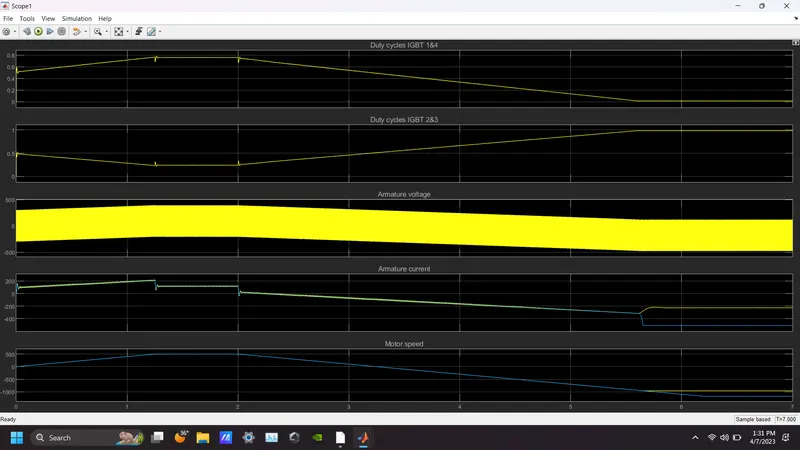
so the duty cycle range to controle the aircraft from zero to the highest speed is 0 to 90%
Assumed Parameters: Only parameters i assumed are listed in the table below , calculated parameters are not in the below table like Rolling resistance force , or energy consumed by battery etc.
| Assumed Parameters | |
| μrr (coefficient of rolling resistance) | 0.02 |
| m (mass of aircraft+tow truck) | 50,000 kg |
| ρ (density of air at sea level and 15°C) | 1.225 kg/m^3 |
| v (typical towing speed for an aircraft) | 1.4 m/s |
| Cd (coefficient of drag for a commercial aircraft) | 0.025 |
| A (reference area of the aircraft) | 120 m^2 |
| Travel Duration (time) | 2 min |
| Motor Voltage rating | 400VDC |
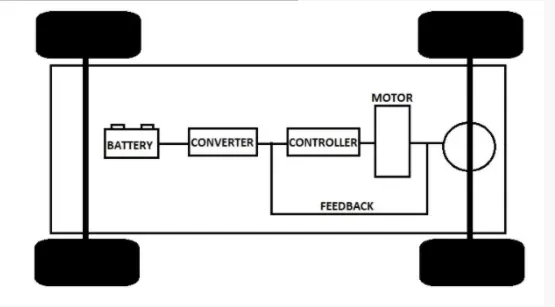
Powertrain block diagram: I am assuming the towing truck is a full EV and forward-wheel drive .
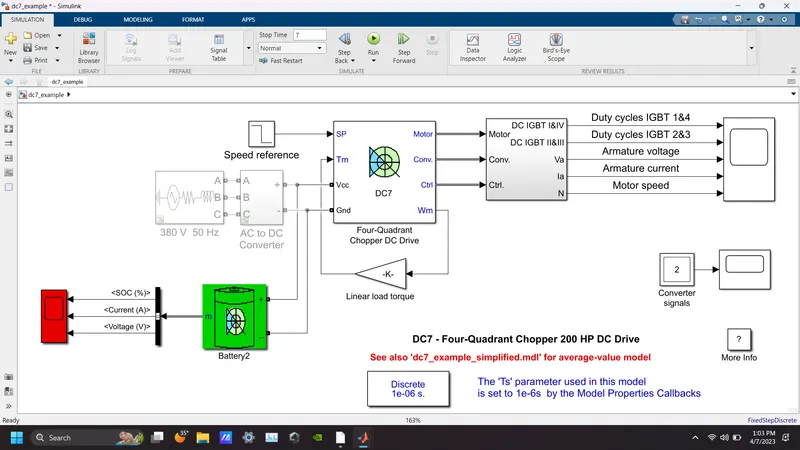
Simulink Model:
ANS 7B:
xlsx file is attached.