Project-1: Powertrain for aircraft in runways
Power train for toeing aircraft
Objective - To design a Power train for toeing aircraft on the runway.
Search and list out the total weight of various types of aircrafts.
Is there any difference between ground speed and air speed?
Why is it not recommended to use aircraft engine power to move it on the ground at Airport?
How an aircraft is pushed to runway when its ready to take off?
Learn about take off power, tyre design, rolling resistance, tyre pressure, brake forces when landing.
With necessary assumptions, calculate the force and power required to push / pull an aircraft by a towing vehicle.
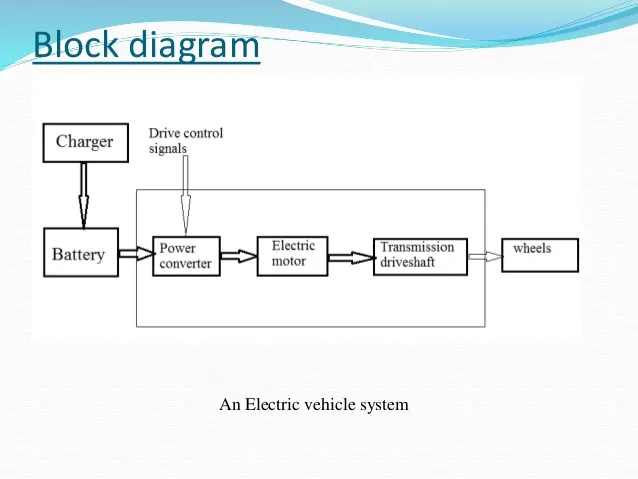
Design an electric powertrain with type of motor, it’s power rating, and energy requirement to fulfill aircraft towing application. Estimate the duty cycle range to control the aircraft speed from zero to highest. Make all required assumptions. Prepare a table of assumed parameters. Draw a block diagram of powertrain.
Solution –
total weight of various types of aircrafts.
MTOW = Maximum take-off weight, MLW = Maximum landing weight, TOR = Take-off run (SL, ISA+15°, MOTW), LR = Landing run
| Type | MTOW [kg] | MLW [tons] | TOR [m] | LR [m] | ICAO category | FAA category |
| Antonov An-225 | 6,40,000 | 591.7 | 3500 | Heavy | Super | |
| Airbus A380-800[1][2][3] | 5,75,000 | 394 | 3100 | 1930 | Super | Super |
| Boeing 747-8F | 4,47,700 | 346.091 | 3100 | 1800 | Heavy | Heavy |
| Boeing 747-8 | 4,43,613 | 306.175 | 3100 | Heavy | Heavy | |
| Boeing 747-400ER | 4,12,770 | 295.742 | 3090 | Heavy | Heavy | |
| Antonov An-124-100M | 4,05,060 | 330 | 2520 | 900 | Heavy | Heavy |
| Boeing 747-400 | 3,96,900 | 295.742 | 3018 | 2179 | Heavy | Heavy |
| Lockheed C-5 Galaxy[4][5][6] | 3,81,000 | 288.417 | 2530 | 1494 | Heavy | Heavy |
| Boeing 747-200[7] | 3,77,840 | 285.7 | 3338 | 2109 | Heavy | Heavy |
| Boeing 747-300[7] | 3,77,840 | 260.32 | 3222 | 1905 | Heavy | Heavy |
| Airbus A340-500[8] | 3,71,950 | 240 | 3050 | 2010 | Heavy | Heavy |
| Airbus A340-600[8] | 3,67,400 | 256 | 3100 | 2100 | Heavy | Heavy |
| Boeing 777F | 3,47,800 | 260.816 | 2830 | Heavy | Heavy | |
| Boeing 777-300ER | 3,51,800 | 251.29 | 3100 | Heavy | Heavy | |
| Boeing 777-200LR | 3,47,450 | 223.168 | 3000 | Heavy | Heavy | |
| Boeing 747-100[7] | 3,40,200 | 265.3 | Heavy | Heavy | ||
| Airbus A350-1000 | 3,08,000 | 233.5 | Heavy | Heavy | ||
| Boeing 777-300 | 2,99,370 | 237.683 | 3380 | Heavy | Heavy | |
| Boeing 777-200ER | 2,97,550 | 213 | 3380 | 1550 | Heavy | Heavy |
| Airbus A340-300[8][9] | 2,76,700 | 190 | 3000 | 1926 | Heavy | Heavy |
| McDonnell Douglas MD-11 | 2,73,300 | 185 | 2990 | 1890 | Heavy | Heavy |
| Airbus A350-900 | 2,70,000 | 175 | 2670 | 1860 | Heavy | Heavy |
| Ilyushin Il-96M | 2,70,000 | 195.04 | 3115 | 2118 | Heavy | Heavy |
| McDonnell Douglas DC-10 | 2,56,280 | 183 | 2990 | 1890 | Heavy | Heavy |
| Boeing 787-9[10] | 2,54,000 | 192.777 | 2900 | Heavy | Heavy | |
| Boeing 787-10[10] | 2,54,000 | 201.849 | Heavy | Heavy | ||
| Airbus A340-200[8][11] | 2,53,500 | 181 | 2990 | Heavy | Heavy | |
| Ilyushin IL-96-300 | 2,50,000 | 175 | 2600 | 1980 | Heavy | Heavy |
| Airbus A330-300[12][13] | 2,42,000 | 185 | 2500 | 1750 | Heavy | Heavy |
| Airbus A330-200[12][13] | 2,42,000 | 180 | 2220 | 1750 | Heavy | Heavy |
| Lockheed L-1011-500 | 2,31,300 | 166.92 | 2636 | Heavy | Heavy | |
| Boeing 787-8[10] | 2,28,000 | 172.365 | 3300 | 1695 | Heavy | Heavy |
| Lockheed L-1011-200 | 2,11,400 | Heavy | Heavy | |||
| Ilyushin IL-86 | 2,08,000 | 175 | Heavy | Heavy | ||
| Boeing 767-400ER | 2,04,000 | 158.758 | 3414 | Heavy | Heavy | |
| Airbus A300-600R[14] | 1,92,000 | 140 | 2385 | 1555 | Heavy | Heavy |
| Boeing 767-300ER | 1,87,000 | 136.08 | 2713 | 1676 | Heavy | Heavy |
| Concorde | 1,85,000 | 111.1 | 3440 | 2220 | Heavy | Heavy |
| Airbus A300-600[14] | 1,63,000 | 138 | 2324 | 1536 | Heavy | Heavy |
| Boeing 767-300 | 1,59,000 | 136.078 | 2713 | 1676 | Heavy | Heavy |
| Airbus A310-300[14] | 1,57,000 | 124 | 2290 | 1490 | Heavy | Heavy |
| Vickers VC10 | 1,52,000 | 151.9 | Heavy | Heavy | ||
| Boeing 707-320B[15] | 1,51,000 | 97.5 | Heavy | Heavy | ||
| Boeing 707-320C[15] | 1,51,000 | 112.1 | Heavy | Heavy | ||
| Douglas DC-8-61 | 1,47,000 | Heavy | Heavy | |||
| Airbus A310-200[14] | 1,42,000 | 123 | 1860 | 1480 | Heavy | Heavy |
| Airbus A400M | 1,41,000 | 122 | 980 | 770 | Heavy | Heavy |
| Douglas DC-8-32 | 1,40,000 | Heavy | Heavy | |||
| Douglas DC-8-51 | 1,25,000 | Medium | Large | |||
| Boeing 757-300 | 1,24,000 | 101.6 | 2550 | 1750 | Medium | Large |
| Boeing 707-120B[15] | 1,17,000 | 86.3 | Medium | Large | ||
| Boeing 757-200 | 1,16,000 | 89.9 | 2347 | 1555 | Medium | Large |
| Boeing 720B[16] | 1,06,000 | 79.5 | Medium | Large | ||
| Boeing 720[16] | 1,04,000 | 79.5 | Medium | Large | ||
| Tupolev Tu-154M | 1,04,000 | 80 | Medium | Large | ||
| Tupolev Tu-204SM | 1,04,000 | 87.5 | 2250 | Medium | Large | |
| Convair 880 | 87,500 | Medium | Large | |||
| Boeing 737-900 | 85,000 | 66.36 | 2500 | 1704 | Medium | Large |
| Boeing 737-900ER | 85,000 | 71.35 | 2804 | 1829 | Medium | Large |
| Boeing 727-200 Advanced[17] | 84,000 | 70.1 | Medium | Large | ||
| Airbus A321-100[18] | 83,000 | 77.8 | 2200 | 1540 | Medium | Large |
| Boeing 737-800 | 79,000 | 65.32 | 2308 | 1634 | Medium | Large |
| Boeing 727-200[17] | 78,000 | 68.1 | Medium | Large | ||
| McDonnell-Douglas MD-83 | 73,000 | 63.28 | Medium | Large | ||
| Boeing 727-100[17] | 72,500 | 62.4 | Medium | Large | ||
| Boeing 727-100C[17] | 72,500 | 62.4 | Medium | Large | ||
| McDonnell-Douglas MD-90-30 | 71,000 | 64.41 | 2165 | 1520 | Medium | Large |
| de Havilland Comet 4 | 70,700 | Medium | Large | |||
| Boeing 737-700 | 70,000 | 58.06 | 1921 | 1415 | Medium | Large |
| Airbus A320-100[18] | 68,000 | 66 | 1955 | 1490 | Medium | Large |
| Boeing 737-400 | 68,000 | 54.9 | 2540 | 1540 | Medium | Large |
| de Havilland Comet 3 | 68,000 | Medium | Large | |||
| Boeing 377 | 67,000 | Medium | Large | |||
| Boeing 737-600 | 66,000 | 54.66 | 1796 | 1340 | Medium | Large |
| Airbus A220-300 | 65,000 | 57.61 | 1890 | 1494 | Medium | Large |
| Hawker Siddeley Trident 2E | 65,000 | Medium | Large | |||
| Airbus A319[18] | 64,000 | 62.5 | 1850 | 1470 | Medium | Large |
| Boeing 737-300 | 63,000 | 51.7 | 1939 | 1396 | Medium | Large |
| Boeing 737-500 | 60,000 | 49.9 | 1832 | 1360 | Medium | Large |
| Airbus A220-100 | 59,000 | 50.8 | 1463 | 1356 | Medium | Large |
| Airbus A318[18] | 59,000 | 57.5 | 1375 | 1340 | Medium | Large |
| Boeing 717-200HGW | 55,000 | 47.174 | 1950 | Medium | Large | |
| Douglas DC-7 | 55,000 | Medium | Large | |||
| de Havilland Comet 2 | 54,000 | Medium | Large | |||
| Boeing 717-200BGW | 50,000 | 46.265 | 1950 | Medium | Large | |
| de Havilland Comet 1 | 50,000 | Medium | Large | |||
| Douglas DC-6A | 48,600 | Medium | Large | |||
| Douglas DC-6B | 48,500 | Medium | Large | |||
| Embraer 190[19] | 48,000 | 43 | 2056 | 1323 | Medium | Large |
| Caravelle III | 46,000 | Medium | Large | |||
| Fokker 100 | 46,000 | 39.95 | 1621 | 1350 | Medium | Large |
| Douglas DC-6 | 44,000 | Medium | Large | |||
| Avro RJ-85 | 42,000 | 36.74 | Medium | Large | ||
| Handley Page Hermes | 39,000 | Medium | Large | |||
| Embraer 175[20] | 37,500 | 32.8 | 2244 | 1304 | Medium | Large |
| Bombardier CRJ900[21] | 36,500 | 33.345 | 1778 | 1596 | Medium | Large |
| Embraer 170[22] | 36,000 | 32.8 | 1644 | 1274 | Medium | Large |
| Bombardier CRJ700 | 33,000 | 30.39 | 1564 | 1478 | Medium | Large |
| Douglas DC-4 | 33,000 | Medium | Large | |||
| Vickers Viscount 800 | 30,400 | Medium | Large |
-Is there any difference between ground speed and air speed?
While ground speed is the airplane’s speed relative to the surface of the Earth, airspeed – at least true airspeed – is its speed relative to the air it is flying in.
true airspeed is simply the speed at which an aircraft is moving relative to the air it is flying in. As such, it’s also the speed at which the air is flowing around the aircraft’s wings.
Ground speed, on the other hand, is the aircraft’s speed relative to the ground.
airspeed is what determines whether there is enough airflow around an aircraft to make it fly, ground speed is what determines how fast an aircraft will get to its destination.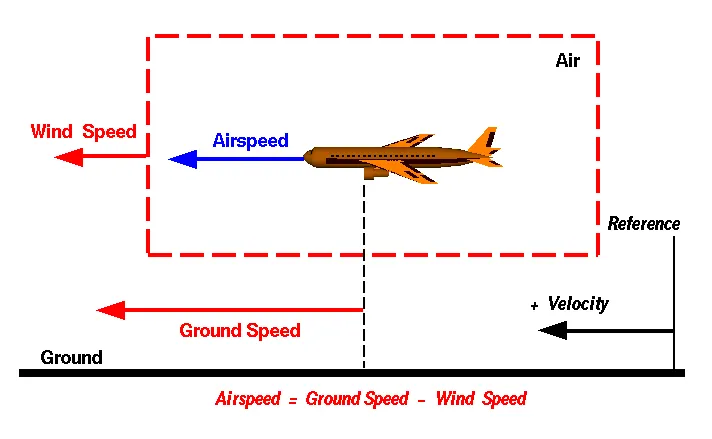
The relationship between airspeed and ground speed is fairly simple. Ground speed is simply the sum of airspeed and wind speed.
If the aircraft is flying in the same direction as the wind is blowing, the aircraft experiences tailwind, and its ground speed is higher than its airspeed. On the other hand, if the wind is blowing against the direction the aircraft is traveling in, the aircraft experiences headwind, and its ground speed is lower than its airspeed.
Why is it not recommended to use aircraft engine power to move it on the ground at Airport?
commercial airplanes are equipped with engines rated from 18,000 to nearly 100,000 lb of thrust. Such thrust levels provide for safe takeoff, flight, and landing over a wide range of temperatures, altitudes, gross weights, and payload conditions. However, the exhaust wake from these engines can pose hazards in commercial airport environments. Operators and airport authorities must carefully consider these hazards and the resulting potential for injury to people and damage to or caused by baggage carts, service vehicles, airport infrastructure, and other airplanes.
When modern jet engines are operated at rated thrust levels, the exhaust wake can exceed 375 mi/h (325 kn or 603 km/h) immediately aft of the engine exhaust nozzle. This exhaust flow field extends after in a rapidly expanding cone. the resulting jet blast or prop wash might cause damage to the terminal building or equipment. Engines close to the ground may also blow sand and debris forward and then suck them into the engine, causing damage to the engine.
How an aircraft is pushed to runway when its ready to take off?
A pushback is the preferred method to move the aircraft away from the gate.
Large aircraft cannot be moved by hand and must have a tractor or tug. Pushback tractors use a low profile design to fit under the aircraft nose. For sufficient traction the tractor must be heavy, and most models can have extra ballast added. A typical tractor for large aircraft weighs up to 54 tonnes (119,000 pounds) and has a drawbar pull of 334 kN (75,000 lbf). Often the driver's cabin can be raised for increased visibility when reversing and lowered to fit under aircraft. There are two types of pushback tractors: conventional and towbarless.
what is
take off power- The procedure for take-off will be that the vehicle will accelerate until it reaches a safe initial flying speed.
Take off performance can be predicted using a simple measure of the acceleration of the aircraft along the runway based on force equilibrium.
The forces involved will be,
T – Thrust of propulsion system pushing aircraft along runway.
D – Aerodynamic Drag of vehicle resisting the aircraft motion.
F – Rolling resistance friction due to the contact of wheels or skids on the ground.
During take-off run the imbalance in these forces will produce an acceleration along the runway.
`(dV)/(dt) =(T-D-F)/m`
where dV/dt is the acceleration along the runway and m is the mass of the vehicle.
rolling resistance- The friction between aircraft and runway will be proportional to the normal force exerted by the aircraft on the runway.
F=μ(W−L)
The normal force will be the difference between Weight of aircraft and Lift, the friction coefficient will be typically of a magnitude of 0.02 for a standard tarmac runway.
Tyre design – the aircraft tyres do not have a pattern which we usually see on a car or truck tyres. There are only groves on the tyres for an aircraft. This is done because the aircraft tyres purpose is to only take off and land the aircraft, while for the automobile the tyres are also used for manoeuvring the automobile in different directions.
Images for tyres
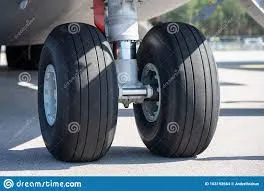
The groves on the aircraft tyres are to displace the water while landing on a wet surface. The aircraft tyres are usually inflated with nitrogen rather then air. As nitrogen is a inert gas the change in temperature and pressure has less affect in it.
Tyre pressure for a aircraft is usually about 200 psi. It is almost 6 times the pressure for a car. This high pressure is because of the weight the tyres are carrying while take off and landing, the higher the pressure the firmer the tyre.
There are about 20 tyres used on single aircraft. The tyres needs replacement after about 100 take off and landings.
Brake forces when landing.- While landing the aircraft is much lighter then while take off as the fuel weight is reduced.
For the landing purpose a Reverse thrust is applied by engines when the aircraft tyres touches the ground. As if we only use the mechanical brakes the wear would be much quicker and the longer run would be required by the aircraft to reduce the speed after landing. The Heavier the aircraft the longer run it needs to reduce the speed.
Now similar to take off acceleration there is decceleration taking while landing
Thus `(dV)/(dt) =(-T-D-F)/m`
where
The forces involved will be,
T – Thrust of propulsion system pushing aircraft along runway.
D – Aerodynamic Drag of vehicle resisting the aircraft motion.
F – Rolling resistance friction due to the contact of wheels or skids on the ground.
necessary assumptions for calculation of force and power required to push / pull an aircraft by a towing vehicle.
Assumptions
| sr | Parameters | values | units |
| 1 | Rolling Resistance coefficient | 0.02 | |
| 2 | Drag Coefficient | 0.6 | |
| 3 | Maximum speed attained by Tow truck | 6.95 | m/s |
| 4 | Tyre radius for Truck | 0.53 | m |
| 5 | Front Area for Tow truck | 1.8 | m^2 |
| 6 | acceleration due to Gravity | 9.81 | m/s^2 |
| 7 | Tow truck mass | 10000 | Kg |
| 8 | Air Density | 1.25 | kg/m^3 |
Forces and Power Calcualtions required to pull/push Aircraft
The total tractive effort is the sum of all these forces:
Fte = Frr + Fad + Fhc + Fla + Fωa
where:
- Frr is the rolling resistance force, given by equation
- Fad is the aerodynamic drag, given by equation
- Fhc is the hill climbing force, given by equation
- Fla is the force required to give linear acceleration given by equation
- Fωa is the force required to give angular acceleration to the rotating motor, given by
equation
Hill Climbing Force(GRADE Force)
The force needed to drive the vehicle up a slope is the most straightforward to find. It is simply the component of the vehicle weight that acts along the slope. By simple resolution of forces we see that:
`F_(hc) = mg sin(ψ)`
Linear Acceleration Force
If the velocity of the vehicle is changing, then clearly a force will need to be applied in addition to the forces. This force will provide the linear acceleration of the vehicle, and is given by the well-known equation derived from Newton’s second law,
`F_(la) = m*a`
However, for a more accurate picture of the force needed to accelerate the vehicle we should also consider the force needed to make the rotating parts turn faster. In other words, we need to consider rotational acceleration as well as linear acceleration.
Aerodynamic drag
This part of the force is due to the friction of the vehicle body moving through the air.
It is a function of the frontal area, shape, protrusions such as side mirrors, ducts and air passages, spoilers, and many other factors. The formula for this component is:
`F_(ad) = 1/2 ρ*A*Cd*v^2`
where ρ is the density of the air, A is the frontal area, and v is the velocity. Cd is a constant called the drag coefficient.
The rolling resistance is primarily due to the friction of the vehicle tyre on the road. Friction in bearings and the gearing system also play their part. The rolling resistance is approximately constant, and hardly depends on vehicle speed. It is proportional to vehicle weight. The equation is:
`F_(rr) = μ_(rr)*m*g`
where μrr is the coefficient of rolling resistance. The main factors controlling μrr are the type of tyre and the tyre pressure. Any cyclist will know this very well; the free-wheeling performance of a bicycle becomes much better if the tyres are pumped up to a high pressure, though the ride may be less comfortable.
Angular Acceleration - The Torque required for this angular acceleration is:
`T = I*G *a/ r`
where I is the moment of inertia of the rotor of the motor. The force at the wheels needed to provide the angular acceleration (Fωa) is found by combining this equation
The force required will be slightly larger, so equation can be refined to:
`F_(ωa) = I* G^2/ (η_gr^2)* a`
Total Tractive force
`F_(te) = I* G^2/ (η_gr^2)* a + μ_(rr)*m*g + 1/2 ρ*A*Cd*v^2 + m*a + mg sin(ψ)`
Assumptions
For the grade force as most of airports have flat plane surfaces there is no slope so the grade force is not required.
The Linear acceleration and angular acceleration are also not taken into consideration as the maximum speed the vehicle attains is about 25Km/hr or 7 m/s. The acceleration is very small as we need to move a heavy mass.
The Diameter for tyre of the tow tractor can be 42 inches. This in radius is 21 inches and in meters is 0.53 m
So the rolling resistance force and Airodynamic Drag Force are the forces acting on the tow tractor
For rolling resistance force the rolling resistance coefficient is take as 0.02. This can be calculated by
The Drag coefficient is take as 0.6 for the tow tractor and the aircraft.
The Area for the Drag force is take as 1.8 m^2 for the Tow Tractor.
The Acceleration Due to gravity 'g' = 9.81 m/s
The air density at sea level is considered that is 1.25 kg/m^3
The maximum velocity for the tractor is 7m/s.
Maximum take off weight for a large commertial jet such as Airbus A380 is 560000 Kgs and the weight for a Tow tractor is 10000 Kgs. For sufficient traction the tow Tractor must be heavy. The Actual pulling weight for Aircraft by the tractor is reduced to 1/10th of its actual weight. So the mass m = 10000 + 56000 = 66000 Kg
Total weight for both the aircraft and tow tractor is 66000 Kgs
So Rolling resitance force is
`F_(rr) = 0.02*66000*9.81`
F_(rr) = 12949.2 N
The aerodynamic Drag force is
`F_(ad) = 0.5*1.25*1.8*0.6*7^2`
F_(ad) = 33.075 N
F_(tr) = F_(ad) + F_(rr)
F_(tr) = 12982.275 N
= 12.98 KN
The total force required to pull the aircraft is 13KN.
Torque required is T = F_(tr) * r
r = radius of tyre
T = 12982.275 * 0.53
T = 6880.605 N-m
And The Power required for the torque can be calcualted by,
P = T * v
T = torque and V = velocity in m/s
P = 6880.605 * 6.95
P = 47781.98 watts
Power Train for Tractor
The Energy required to push the aircraft can be calcualted be
E = P*T
Lets assume the time taken be a towing vehicle to push the aircraft is 5 minutes
T = Time
E = 47782* 300 = 14330000 J
E = 3981.83 watt-hr = 4 kW-Hr
The Power is 47782 Watts and when converted to Hp Is 64 HP.
In order to fulfil the 13 Kn force 64 HP power required to pull/push the aircraft we can choose the either DC motor or AC Motor
For this application we need high torque and speed does not exceed 6.95 m/s so AC Induction motor with 75 HP motor can be used. As Induction motor has a High starting torque.
For this application we can select a AC Induction Motor. 75 HP
The motor reqiured RPM is
()`omega` = anguler speed for motor in rpm `
`omega` = v/r`
`omega` = 6.95/0.5`
`omega` = 13.11 rps`
`omega` = 788 rpm`
Motor specifiacations Current Chart
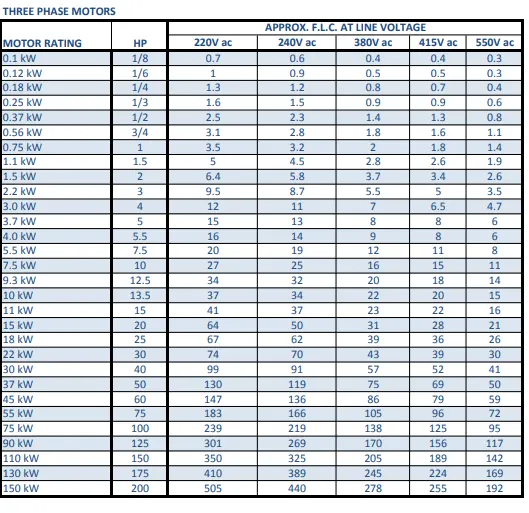
From the chart we select the 75 Hp Motor with 6 Poles and 1000 RPM which fits perfect for the applications.
Voltage = 240 V
Current = 219 amps
Power(in) for motor can be calculated by = v*I
= 240*219
= 52560 w or52.56 Kw
Efficiency of the motor is 95%
so output power for motor is = 0.95* 52.65
P_(output) = 49.932 Kw
Now to match the Traction Power of Vehicle
Power(tr) = V * I
47782 = v * 219
V = 218.1 Volts
Duty cycle required to match the traction power required can be calcualted by
D = (V(req) / V(battery))* 100
D = (218.1/240) * 100
D = 90.8
So the Duty cycle for Motor ranges from 0.1 to .908 for this motor. 90.8 Duty cycle is the needed when the power required is maximum.
Block Diagram