Project-1: Powertrain for aircraft in runways
Project-1: Powertrain for aircraft in runways
There is an ongoing global drive to cut carbon and nitrogen oxide emissions. Despite the introduction of more fuel-efficient and less polluting turbofan and turboprop engines, the rapid growth of air travel in recent years has contributed to an increase in total pollution attributable to aviation. Airports have an ongoing need to reduce emissions in their environment. There are other environmental effects to be considered too.
With an electric taxi system (integrated on an aircraft) they would just need the marshal to help guide them out or in. Any solution that could eliminate the need for tugs is an added bonus and would make the dispatch process faster and more autonomous.
Here we are designing an aircraft towing application with necessary assumptions
1.
Total weight of various types of Aircrafts
We will get started and calculate an example (we operate an Airbus A319):
| Manufacturer’s Empty Weight (MEW) | 36,779 kg |
| + Operator’s Items | + 5,205 kg |
| = Operational Empty Weight (OEW) | = 41,981 kg |
| + Payload | + 13,529 kg |
| = Actual Zero Fuel Weight (AZFW) | = 55,510 kg |
| + Fuel | + 13,239 kg |
| = Actual Gross Weight (AGW) | = 68,749 kg |
| - Taxi Fuel | - 100 kg |
| = Actual Take-Off Weight (ATOW) | = 68,649 kg |
| Fuel consumption | -10,900 kg |
| = Actual Landing Weight (ALW) |
- MTOW = Maximum take-off weight
|
Type |
MTOW [kg] |
|
Antonov An-225 |
640,000 |
|
Scaled Composites Model 351 Stratolaunch |
589,670 |
|
Airbus A380-800 |
575,000 |
|
Boeing 747-8F |
447,700 |
|
Boeing 747-8 |
443,613 |
|
Boeing 747-400ER |
412,770 |
|
Antonov An-124-100M |
405,060 |
|
Boeing 747-400 |
396,900 |
|
Lockheed C-5 Galaxy |
381,000 |
|
Boeing 747-200 |
377,840 |
|
Boeing 747-300 |
377,840 |
|
Airbus A340-500 |
371,950 |
|
Airbus A340-600 |
367,400 |
|
Boeing 777F |
347,800 |
|
Boeing 777-300ER |
351,800 |
|
Boeing 777-200LR |
347,450 |
|
Boeing 747-100 |
340,200 |
|
Airbus A350-1000 |
308,000 |
|
Boeing 777-300 |
299,370 |
|
Boeing 777-200ER |
297,550 |
|
Airbus A340-300 |
276,700 |
|
McDonnell Douglas MD-11 |
273,300 |
|
Airbus A350-900 |
270,000 |
|
Ilyushin Il-96M |
270,000 |
|
McDonnell Douglas DC-10 |
256,280 |
|
Boeing 787-9 |
254,000 |
|
Boeing 787-10 |
254,000 |
|
Airbus A340-200 |
253,500 |
|
Ilyushin IL-96-300 |
250,000 |
2.
Difference between Ground Speed and Air Speed
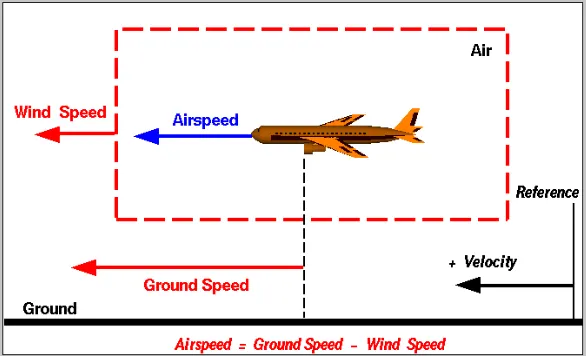
Airspeed vs. Ground Speed
Airspeed
It is simply the speed at which an aircraft is moving relative to the air it is flying in. As such, it’s also the speed at which the air is flowing around the aircraft’s wings.
Ground speed
It is the aircraft’s speed relative to the ground. One thing that should be noted here is that it’s its horizontal rather than vertical speed – an aircraft climbing completely vertically would have a ground speed of zero.
In other words, while airspeed is what determines whether there is enough airflow around an aircraft to make it fly, ground speed is what determines how fast an aircraft will get to its destination.
Wind speed = Airspeed - Ground Speed
For pilots, each airspeed helps them make sure they are flying fast enough to take off, not to stall, and so on, the ground speed helps them figure out how long it will take them to get from one place to another.
3.
Why is it not recommended to use aircraft engine power to move it on the ground at Airport?
Each airplane has to move away from the gate, across the tarmac and wait to get into position for takeoff on the designated runway. Boeing commercial airplanes are equipped with engines rated from 18,000 to nearly 100,000 lb. of thrust. Such thrust levels provide for safe takeoff, flight, and landing over a wide range of temperatures, altitudes, gross weights, and payload conditions. However, the exhaust wake from these engines can pose hazards in commercial airport environments. Operators and airport authorities must carefully consider these hazards and the resulting potential for injury to people and damage to or caused by baggage carts, service vehicles, airport infrastructure, and other airplanes.
Blasting jet reversers blows debris In the crowded gate area creating foreign object damage hazard for adjacent aircraft, gate equipment or terminal waiting area glass windows
By using jet engines as an aircraft’s primary thrust for taxiing, airlines are expending huge amounts of jet fuel while still on the ground, which could be much better used for flying. With the Cost of Fuel being their single biggest expense, many airlines plan to adopt electric taxiing to save fuel and reduce environmental impacts.
4.
In aviation, pushback is an airport procedure during which an aircraft is pushed backwards away from an airport gate by external power. Pushbacks are carried out by special, low-profile vehicles called pushback tractors or tugs.
Since the pilots cannot see what is behind the aircraft, steering is done by the pushback tractor driver and not by the pilots. Depending on the aircraft type and airline procedure, a bypass pin may be temporarily installed into the nose gear to disconnect it from the aircraft's normal steering mechanism.
Once the pushback is completed, the tow bar is disconnected, and any bypass pin removed. The ground handler will show the bypass pin to the pilots to make it clear that it has been removed. The pushback is then complete, and the aircraft can taxi forward under its own power.
Although many aircraft are capable of moving themselves backwards on the ground using reverse thrust (a procedure referred to as a power-back), the resulting jet blast or prop wash might cause damage to the terminal building or equipment. Engines close to the ground may also blow sand and debris forward and then suck them into the engine, causing damage to the engine. A pushback is therefore the preferred method to move the aircraft away from the gate.
Take-off power
The pilot flying (PF) squeezes the thrust levers slightly forwards, advancing the engines to around 20% of their maximum power. Another pause as we hear the engines spool up. All three pilots scan the engine instruments for any anomalies. Satisfied, the PF uses their index finger to press the Take Off/Go Around (TOGA) button.
With a whir of an electric motor, the auto throttle advances the thrust levers forward and sets the takeoff power. With a reassuring whine, the two massive engines under the wings are woken from their slumber. Forcing 65,000 pounds of thrust out of the back of each engine, the 787 Dreamliner starts to pick up speed. “80knots”, calls the Pilot Monitoring (PM), scanning the engine and performance indications like a kestrel locating a rabbit.The bumps from the nosewheel hitting the runway lights get faster and faster as the aircraft approaches its takeoff speed.
As the aircraft reaches its critical speed, the PF pulls gently back on the control column. The tail of the aircraft sinks down, raising the nose into the air. For a moment, the aircraft seems to crouch, nose pointed up, poised, ready to launch skywards. Then, in a magical moment, the wings bite the air rushing over them and the aircraft eases into the night sky.
The pilot releases the brakes and pushes the throttle to maximum takeoff power, and the airplane accelerates down the runway. At some distance from its starting point, the airplane lifts into the air. The distance the airplane cover along the runway before it lifts into the air is called the ground roll (sg). The total takeoff distance also includes the extra distance covered over the ground after the airplane is airborne but before it clears an obstacle of 50 ft for military aircraft and 35 ft for commercial aircraft. This is denoted by sa. The sum of sg and sa is the total takeoff distance.
Tire design
Aircraft tires are amazing when you think about it. The typical airliner tire can handle a 38-ton load. It can meet the ground 500 times before needing a re-tread, a refresh it can take on seven times in its life.
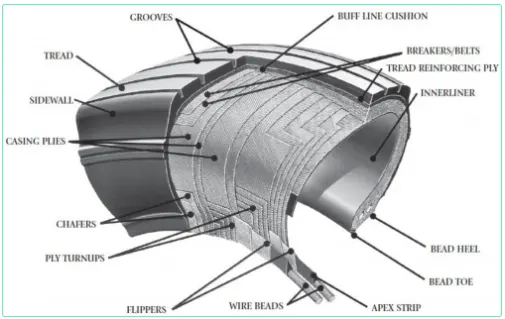
The tires themselves aren't terribly large— a Boeing 737 rides on 27x7.75 R15 rubber, that means it is 27 inches in diameter, 7.75 inches wide, and wrapped around a 15-inch wheel. The sidewalls aren't terribly thick, and the strength of the tire lies in the cords embedded below the tread, Bartholomew says. They're typically nylon, and more recently a variety known as aramid. Each layer of the casing contributes to its load bearing and air pressure resisting capabilities.
In the first moments after a plane touches down, the tires are skidding, not rolling. The airplane essentially drags them down the runway until their rotational velocity matches the velocity of the plane. That's why they smoke upon landing, and why Michelin uses grooves instead of the block patterns seen on your car's rubber—blocks would simply break off. (Most tire wear comes from this moment of contact—where the rubber meets the runway.) The stoutest tires are rated for speeds of up to 288 mph.
Based on the type of plies used the tyres can be:
- Radial ply tires - these tyres feature a flexible casing which is constructed of rubber-coated ply cords which extend around the beads and are substantially at 90° to the centerline of the tread. The casing is stabilized by an essentially inextensible circumferential belt.
- Bias ply tires - these tyres feature a casing which is constructed of alternate layers of rubber-coated ply cords which extend around the beads and are at alternate angles substantially less than 90° to the center line of the tread.
Based on the method for containing the inflation gas the tyres can be:
- Tube-type tyres - these require tubes for inflation retention.
- Tubeless tyres - these do not require tubes. They are constructed with an inner liner (integral rubber lining that is engineered to prevent the diffusion of the inflation gas into the casing.).
Tire pressure
A Boeing 777 uses 14 tires, Airbus' A380 carries 22, and the enormous Antonov An-225 demands 32. The key to their remarkable durability is maximizing the air pressure. The high-flying rubber is typically inflated to 200 psi, roughly six times what you put in an automobile tire, and the tires on an F-16 fighter are pumped to 320 psi. It's really pressurized air that's so strong.
Like everything in aviation, tires must meet specific and demanding rules—for example, a tire must withstand four times its rated pressure for at least three seconds.
Brake forces
Brakes provide this critical stopping function during landings to enable airplanes to stop within the length of the runway. Aircraft brakes also prevent motion of the aircraft when it is parked, limit its speed during taxiing and can even help steer the aircraft on the ground by applying different levels of braking force to the left- and right-side brakes.
Aircraft brakes work in conjunction with other brake mechanisms such as thrust reversers, air brakes and spoilers. Thrust reversers are surfaces that are deployed into the path of the jet blast from the engines to redirect propulsive thrust in a direction that opposes the motion of the aircraft. Air brakes and spoilers are flight control surfaces that create additional aerodynamic drag when deployed into the path of air flowing around the aircraft.
To generate the necessary frictional forces and to handle this much energy within the length of a runway, large commercial transport aircraft typically require multiple discs per brake assembly and brakes on most, if not all, of their wheels.
6. Calculate the Force required to push / pull an aircraft
To calculated the power required to pill/push the aircraft we need to find out the total forces working on the aircraft and towing EV
Here we are considering Antonov AN-225 Mriya aircraft which has total weight of 644101.165 kg’
Which are-
1). Rolling resistance force
2.) Aerodynamic force
3.) Gradient force
Aerodynamic force and Gradient force are very low as compared to the rolling resistance on total pulling force because of the nominal speed of towing and the small gradient.
So, the rolling resistance for aircraft `U_a*mu_a*g` and towing EV `U_t*mu_t*g` respectively.
Assumptions
Towing EV mass`(m_t)=70000`
Friction coefficient of aircraft(`mu_a`)= 0.004
Friction coefficient of Towing (`mu_t`)EV=0.001
Gravity = 9.8 m/s
Total rolling resistance force
`F_ (rr) = mu_a *m_ a *g + mu_ t* m_t*g`
`= 0.004* 644101.165 *9.8 + 0.001*70000*9.8`
`=25934.76 N`
The total 25934.76 N force is required to pull an Antonov AN-225 Mriya aircraft with 70000 kg self weight of towing EV.
For this force the total power required to pull this aircraft at a maximum speed of 5.8m/s is-
P= Force* Velocity
`=25934.76 * 5.8`
`= 150,421.608 w`
`= 150.421 kw`
- 150.421 kw power is required to pull the Antonov AN-225 Mriya aircraft at speed of 5.8m/s.
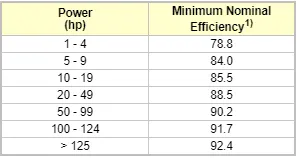
- With 92.4% efficiency and its power factor 0.85 of a motor we have to use at least 200 kw output power producing motor.
Torque = Force * Radius of tire
Torque `= 25934.76 * (1.35/2)`
`= 17,505.963 NM`
`= 17.5 KNM`
Required torque must produce by motor of 201HP is 17,505.963 N-M.
The Energy required for 10 min towing application is `= 200KW * 0.16`
`= 32 KWH`
7.
The duty cycle for constant current we can take`(d)= P_(O)/P_(I)`
As we have`P_(O) = 200KW` and
`P_(I)` =Input current * supply voltage
`=600*400`
`=240 kw`
So, `d= 200/240 = 0.8`
The duty cycle is 80% for this power rating.
We use DC type motor as they have higher initial torque and quick start and stop.
Specification:
Motor Type: DC type
Motor Torque: 17,505.963 N-M
Motor Power: 200 KW and
Motor Energy: 32 KWH
Supply battery Voltage: 400V
Supply current: 600amp
Duty Cycle: 80%
Input Power: 240 kw
Output Power: 200 kw
Towing Speed: 5.8m/s
The heart of an EV is the combination of:
- The electric motor
- The motor's controller
- The batteries
- The controller takes power from the batteries and delivers it to the motor. The accelerator pedal hooks to a pair of potentiometers (variable resistors), and these potentiometers provide the signal that tells the controller how much power it is supposed to deliver. The controller can deliver zero power (when the car is stopped), full power (when the driver floors the accelerator pedal), or any power level in between.
- The controller normally dominates the scene when you open the hood, as you can see here:
- In this car, the controller takes in 300 volts DC from the battery pack. It converts it into a maximum of 240 volts AC, three-phase, to send to the motor. It does this using very large transistors that rapidly turn the batteries' voltage on and off to create a sine wave.
- When we push on the gas pedal, a cable from the pedal connects to these two potentiometers:
- The signal from the potentiometers tells the controller how much power to deliver to the electric car's motor. There are two potentiometers for safety's sake. The controller reads both potentiometers and makes sure that their signals are equal. If they are not, then the controller does not operate. This arrangement guards against a situation where a potentiometer fails in the full-on position.
- The very simplest DC controller would be a big on/off switch wired to the accelerator pedal. When you push the pedal, it would turn the switch on, and when you take your foot off the pedal, it would turn it off. As the driver, you would have to push and release the accelerator to pulse the motor on and off to maintain a given speed.
- Obviously, that sort of on/off approach would work but it would be a pain to drive, so the controller does the pulsing for you. The controller reads the setting of the accelerator pedal from the potentiometers and regulates the power accordingly. Let's say that you have the accelerator pushed halfway down. The controller reads that setting from the potentiometer and rapidly switches the power to the motor on and off so that it is on half the time and off half the time. If you have the accelerator pedal 25 percent of the way down, the controller pulses the power so it is on 25 percent of the time and off 75 percent of the time.
- Most controllers pulse the power more than 15,000 times per second, in order to keep the pulsation outside the range of human hearing. The pulsed current causes the motor housing to vibrate at that frequency, so by pulsing at more than 15,000 cycles per second, the controller and motor are silent to human ears.
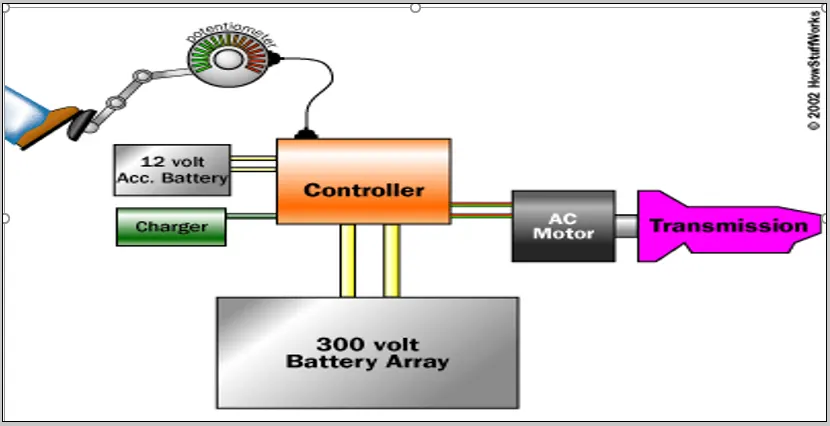
- An AC controller hooks to an AC motor. Using six sets of power transistors, the controller takes in 300 volts DC and produces 240 volts AC, 3-phase. See How the Power Grid Works for a discussion of 3-phase power. The controller additionally provides a charging system for the batteries, and a DC-to-DC converter to recharge the 12-volt accessory battery.
- In an AC controller, the job is a little more complicated, but it is the same idea. The controller creates three pseudo-sine waves. It does this by taking the DC voltage from the batteries and pulsing it on and off. In an AC controller, there is the additional need to reverse the polarity of the voltage 60 times a second. Therefore, you actually need six sets of transistors in an AC controller, while you need only one set in a DC controller. In the AC controller, for each phase you need one set of transistors to pulse the voltage and another set to reverse the polarity. You replicate that three times for the three phases -- six total sets of transistors.
- Most DC controllers used in electric cars come from the electric forklift industry. The Hughes AC controller seen in the photo above is the same sort of AC controller used in the GM/Saturn EV-1 electric vehicle. It can deliver a maximum of 50,000 watts to the motor.
Reference:-
http://www.boeing.com/commercial/aeromagazine/aero_06/textonly/s02txt.html
https://en.wikipedia.org/wiki/Pushback
https://www.wired.com/2016/08/airplane-tires/
https://auto.howstuffworks.com/electric-car2.htm
https://www.skybrary.aero/index.php/Aircraft_Tyre_Maintenance
https://insights.globalspec.com/article/12903/how-do-aircraft-brakes-work
https://thepointsguy.com/guide/the-science-behind-a-beautiful-aircraft-takeoff/
https://tec.ieee.org/newsletter/march-april-2014/electric-green-taxiing-system-egts-for-aircraft