Challenge

Project-1: Powertrain for aircraft in runways

(1)The aircraft gross weight (also known as the all-up weight and abbreviated AUW) is the total aircraft weight at any moment during the flight or ground operation.

An aircraft's gross weight will decrease during a flight due to fuel and oil consumption. An aircraft's gross weight may also vary during a flight due to payload dropping or .

At the moment of releasing its brakes, the gross weight of an aircraft is equal to its takeoff weight. During flight, an aircraft's gross weight is referred to as the en-route weight or in-flight weight.

The list of the total/gross weight of an aircrafts along with the description of it are stated below:

(a)Maximum design taxi weight (MDTW)

The maximum design taxi weight (also known as the maximum design ramp weight (MDRW)) is the maximum weight certificated for aircraft to move carefully on the ground (taxiing or towing) as limited by aircraft strength and airworthiness requirements.

(b)Maximum design takeoff weight (MDTOW)

Is the maximum certificated design weight when the brakes are released for takeoff and is the greatest weight for which compliance with the relevant structural and engineering requirements has been demonstrated by the manufacturer.

(c)Maximum design landing weight (MDLW)

The maximum certificated design weight at which the aircraft meets the appropriate landing certification requirements. It generally depends on the landing gear strength or the landing impact loads on certain parts of the wing structure.

(d)Maximum design zero-fuel weight (MDZFW)

The maximum certificated design weight of the aircraft less all usable fuel and other specified usable agents (engine injection fluid, and other consumable propulsion agents). It is the maximum weight permitted before usable fuel and other specified usable fluids are loaded in specified sections of the airplane. The MDZFW is limited by strength and airworthiness requirements. At this weight, the subsequent addition of fuel will not result in the aircraft design strength being exceeded. The weight difference between the MDTOW and the MDZFW may be utilised only for the addition of fuel.

(e)Minimum flight weight (MFW)

Minimum certificated weight for flight as limited by aircraft strength and air worthiness requirements.

(2) Airspeed is the vector difference between the ground speed and the wind speed. On a perfectly still day, the airspeed is equal to the ground speed. But if the wind is blowing in the same direction that the aircraft is moving, the airspeed will be less than the ground speed.

Ground speed is the airplane’s speed relative to the surface of the Earth, airspeed – at least true airspeed – is its speed relative to the air it is flying in.

As mentioned above, true airspeed is simply the speed at which an aircraft is moving relative to the air it is flying in. As such, it’s also the speed at which the air is flowing around the aircraft’s wings.

Ground speed, on the other hand, is the aircraft’s speed relative to the ground. One thing that should be noted here is that it’s its horizontal rather than vertical speed – an aircraft climbing completely vertically would have a ground speed of zero.

Now the WIND'S effect on ground speed are as follows:

If the aircraft is flying in the same direction as the wind is blowing, the aircraft experiences tailwind, and its ground speed is higher than its airspeed. On the other hand, if the wind is blowing against the direction the aircraft is traveling in, the aircraft experiences headwind, and its ground speed is lower than its airspeed.

Finally we do have some additional information of air speed in general it is of 3 types stated below:

Indicated airspeedis an airspeed that is calculated directly off an aircraft’s pitot-static system. It’s the calculated off the aircraft’s dynamic pressure – the difference between its total pressure and static pressure.

Calibrated airspeed is indicated airspeed adjusted for a variety of errors.

True airspeed is as has been mentioned numerous times in this article, the actual speed at which an aircraft is moving relative to the air it is traveling in. It’s calibrated airspeed adjusted for the the exact conditions (altitude, air temperature, etc.) that the aircraft is flying in.

On the final note we can summarise the fact of these speed are that:

For pilots, both airspeed and ground speed are very important. While the first of those helps them make sure they are flying fast enough to take off, not to stall, and so on, the second one helps them figure out how long it will take them to get from one place to another.

On the other hand, if you are a passenger, you will only need to be concerned about the ground speed as that will tell you how fast are you flying from your origin to your destination – how fast you will be able to get to your meeting, meet your relatives, or do whatever else the reason for your travel might be.

(3)Airliners are generally pushed back from the gate using a tug, as that's the simplest and most efficient method. They then taxi to the runway (and all the way up to the gate, after landing) using their own engines to provide thrust. This is true of both jets and propeller aircraft.

Taxiing (rarely spelled taxying) is the movement of an aircraft on the ground, under its own power, in contrast to towing or push-back where the aircraft is moved by a tug. The aircraft usually moves on wheels, but the term also includes aircraft with skis or floats (for water-based travel).

An airplane uses taxiways to taxi from one place on an airport to another; for example, when moving from a hangar to the runway. The term "taxiing" is not used for the accelerating run along a runway prior to takeoff, or the decelerating run immediately after landing, which are called the takeoff roll and landing rollout, respectively.

The thrust to propel the aircraft forward comes from its propellers or jet engines. Reverse thrust for backing up can be generated by thrust reversers such as on the boeing c17 globemasterIII or reversible pitch propellers such as on the lookheed c130 hercules. Most aircraft, however, are not designed to back up on their own and must be pushed back either by hand or by using an aircraft tug.

At low power settings, combustion aircraft engines operate at lower efficiency than at cruise power settings. A typical A320 spends an average of 3.5 hours a day taxiing, using 600 liters (160 U.S. gal) of fuel. Hybrid electrically driven nose gear are under development to allow high use aircraft to shut down the engines during taxi operations.

The risks which may arise from engine ground running relate to the potential for loss of control of the aircraft by those persons occupying the pilot seats in the flight deck. In most cases, such persons will be maintenance personnel holding specific company-issued approval for the required tasks. The consequences of loss of control during taxi or towing are the same as apply to these operations generally and the concerned only with the risks arising from the static running of one or more aircraft engines. Unwanted consequences from such static running are mainly related to those arising from the unintended movement of the aircraft during engine running - effectively a loss of control - especially during high power engine running. Damage can occur to the aircraft itself, other aircraft nearby or to airside structures. In addition, there is a risk of injury to ground support personnel who may be in relatively close proximity to the aircraft.

A turbine engine failure occurs when a turbine engine unexpectedly stops producing power due to a malfunction other than fuel exhaustion. It often applies for aircraft, but other turbine engines can fail, like ground-based turbines used in power plants or combined diesel and gas vessels and vehicles.

(4) The aircraft moves on wheels. An airplane uses taxiways to taxi from one place on an airport to another; for example, when moving from a terminal to the runway. The aircrafts always moves on the ground following the yellow lines, to avoid any collision with the surrounding buildings, vehicles or other aircrafts.

so here do we have some points which leads to add on aircraft pushed to runway when its ready to take of are:

(i) Parking the plane

As soon as a plane lands and clears the active runway, the pilots receive taxi instructions from ground controllers. Large airports can have complex and confusing taxiway layouts, while some airports simply have a runway and a ramp area.
Approaching the terminal, the pilots look for the flight's assigned gate and watch for the ramp team leader to start waving illuminated, bright orange batons.
There could be a lead-in lighting system to help the pilots line up at the gate, or they might just follow the instructions from the ramp lead.
As the plane slows to a stop, the target for the nose wheel is a painted line on the ramp, matching the type of aircraft. That'll put the plane in the right spot for the passenger boarding bridge.

(ii) Hooking up the plane

The plane's engines provide thrust and electrical power while in flight, but all passenger planes have a small jet engine which generates electricity when the plane is parked -- an Auxiliary Power Unit, or APU.
The APU is in the tail cone, and the pilots start it up to feed power to the plane's systems.
But an APU uses costly fuel from the jet's tanks, so many airports provide a ground power system, or there's a generator cart parked at the gate. Once the plane's access panel is opened and the connection is made with a heavy-duty cable and plug, the source of power is switched, and the engines are shut down.

(iii) Connecting the air-con

The APU also energizes the plane's climate control systems, hopefully keeping the cabin at a nice temperature while parked. Like ground power, some airports provide conditioned air through large-diameter flexible ducts that plug into a port on the belly of the plane.
Or you might see a truck-mounted unit doing the job, with a duct snaking to the plane. Large, wide-body aircraft need two air connections to keep the cabin comfortable.

(iv) De-planing

The passengers inside the plane have jumped up, and they're waiting impatiently in the aisle to get off right now.
If the gate is equipped, a passenger boarding bridge is positioned by the forward left-side doors.
Otherwise, truck- or cart-mounted stairs roll up, and passengers experience the excitement of walking down the stairs and onto the ramp, being able to look back at their aircraft.
Smaller regional jets and turboprops sit close to the ground, and have stairs built into the inside of the plane's doors, with just a couple of steps to the ramp.

(v) Unloading the luggage and cargo

On the right side of the plane, the ramp team has swung into action. After opening the doors to the baggage and cargo holds, a belt-loader or a pod-loader is positioned, depending on the aircraft.
"Rampie" is the industry term for airline employees who load and unload planes.
The rampie inside the belly of a single-aisle plane places each piece of luggage onto the belt, and their partner takes it off the belt and puts it into a baggage cart.
The carts head to the baggage room, and the luggage is dropped onto a conveyor, hopefully showing up on a carousel soon after you've arrived.
Wide-body planes carrying hundreds of passengers needed an efficient way of handling luggage and cargo, so baggage and cargo pods were developed back when jumbo jets first appeared.
Pods are filled with passengers' bags, and handled by a purpose-built machine. One rampie can operate it, and make the pods dance on the loader's platform or in a plane's holds by activating powered wheels.

(vi) Stocking up with food

Catering trucks join the crowd outside the plane's fuselage. Rising on a scissor lift, the truck's box matches the height of the plane's galley doors.
The catering crew replaces used galley carts with newly stocked ones, each cart coded for a specific location in the galleys.
To service the double-deck Airbus A380 mega-jet, catering trucks reach way up, to the upper galley doors

(vii) Cleaning the toilets

Perhaps it's not the most desirable ramp job, but somebody's got to empty the plane's lavatory holding tanks, and refill the fresh water system. Just like a recreational vehicle, this doesn't happen during every stop.
Rampies position a truck- or cart-mounted tank and pump unit, and connect hoses to do the work.

(viii) Refueling

Like your car, a plane's fuel tanks aren't necessarily filled at every stop.
An airline's operations team will have figured out how much fuel is needed for each leg of a plane's daily routing, and when to refuel.
Big tanker trucks connect to the plane's fuel system under the wing, or a pumper truck will hook up to a fuel hydrant in the ramp, then to the jet's tanks, and pump away.

(ix) Pushback

Pushback is when an aircraft is pushed backwards away from the airport gate by vehicles called tugs or tractors.
Closer to departure, an aircraft tug will park right in front of the nose wheel.
The tug might be directly attached to the plane's nose gear with a tow bar, or could be a "wheel-lift" tug. These tugs cradle the nose gear, then lift it up before moving the plane. That gives the tug driver control over the plane's direction during pushback.
New taxi technologies are appearing, like pilot-controlled tugs, and electric motors mounted to the plane's landing gear. Both promise to save fuel, and reduce airport noise.

(x) Boarding and take-off

The crew has finished all the pre-flight preparations, the cabin door is closed, and you're settled into your seat. Your journey begins with a gentle push, in reverse, and you're anticipating the adventures to come.
Make sure you wave goodbye to the rampies -- they've worked hard to get you on your way.
(5) (a) TAKE OFF POWER: A plane's engines are designed to move it forward at high speed. That makes air flow rapidly over the wings, which throw the air down toward the ground, generating an upward force called lift that overcomes the plane's weight and holds it in the sky.
Power settings:
For light aircraft, usually full power is used during takeoff. Large transport category (airliner) aircraft may use a reduced power for takeoff, where less than full power is applied in order to prolong engine life, reduce maintenance costs and reduce noise emissions.
Large transport category(airliner) aircraft may use a reduced power for takeoff, where less than full power is applied in order to prolong engine life, reduce maintenance costs and reduce noise emissions. In some emergency cases, the power used can then be increased to increase the aircraft's performance. Before takeoff, the engines, particularly piston engine are routinely run up at high power to check for engine-related problems. The aircraft is permitted to accelerate to rotation speed (often referred to as Vr). The term rotation is used because the aircraft pivots around the axis of its main landing gear while still on the ground, usually because of gentle manipulation of the flight controls to make or facilitate this change in aircraft attitude (once proper air displacement occurs under / over the wings, an aircraft will lift off on its own; controls are to ease that in).
Assisted takeoff is any system for helping aircraft into the air (as opposed to strictly under its own power). The reason it might be needed is due to the aircraft's weight exceeding the normal maximum take off weight , insufficient power, or the available runway length may be insufficient, or a hot and high airfield, or a combination of all four factors. Assisted takeoff is also required for gliders, which do not have an engine and so are unable to take off by themselves.
Vertical takeoff refers to aircraft or rockets that take off in a vertical trajectory. Vertical takeoff eliminates the need for airfields. Most vertical take off aircraft are also able to land horizontally, but there were certain rocket powered aircraft of the that only took off vertically, landing in other ways.
(b)Here we have some tyre asspects as follows:

Retreading – Retreading is methods of restoring a worn tyre by renewing the tread area or by renewing the tread area plus one or both sidewalls. Repairs are included in the tyre retreading process.

Load Rating – Load rating is the maximum permissible load at a specified inflation pressure.

Ply Rating – Ply Rating is used to identify the maximum recommended load rating and inflation pressure for a specified tyre. It is an index of tyre strength.

Speed Rating – The speed rating is the maximum takeoff speed to which the tyre has been tested.

Skid Depth – Skid depth is the distance between the tread surface and the deepest groove as measured in the mould.

Aircraft tyres must have an approved speed and load rating and have sufficient clearance when retracted through landing gear to allow for tyre growth. Tyre growth is the increase in the size of the tyre due to centrifugal forces at high speed.

Aircraft tyres may be Tube-type or Tubeless

Tubeless tyres are more advantageous over tube-type. There is no longer the use of tube-type tyre in recent aviation. Nowadays all airliners are using tubeless tyres. Tubeless that are meant to be used without a tube has the word TUBELESS on the sidewall of the tyre.

Aircraft tyres may be Radial or Bias

Almost all airliners are using Radial tyre. Bias is an older design, and it’s mainly used for road vehicles. Radial tyres have the word RADIAL on the sidewall. Radial tires are more expensive than bias-ply tyres. Radial tires are in demand because of their lower life cycle cost and long term value.

Are aviation tyres are conductive?

Yes, Today’s tyres are conductive. Aircraft tyres are manufactured with tread rubber with conducting compounds to permit earthing of static charges.

In early days when tyres were not sufficiently conductive, aircraft used to have a conductive strip hanging down from the axle of the landing gear. Upon landing, this strip would be the first part of the aircraft to touch the earth. This discharges any static electricity accumulated on the outer surfaces of the aircraft. Now you don’t see them any more.
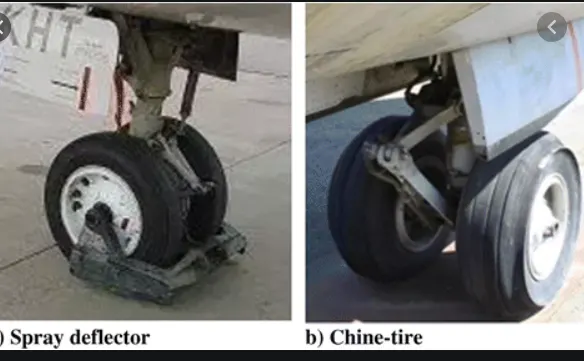
What is the purpose of Chines in aviation tyre

Chines are also called deflectors. Chine tyre used on the nose wheel of aircraft, specially fuselage-mounted jet engines. It diverts runway water away from the engine inlets.

Chines are circumferential protrusions that are moulded into the sidewall of nose tyres that deflect water sideways to help reduce excess water ingestion into the engines. Tyres may have chines on one or both sides, depending on the number of nose tyres on the aircraft.

Aircraft Tyre Standards

Each tyre manufacturer produces their own designs of the tyre with different tread patterns, wear patterns, wear limits etc, and in some cases, different names for the same part of the tyre. But all tyres must meet the approved standards before being accepted by the FAA or CAA.

All commercial aircraft tyres approved under FAA Requirement Technical Standard Order (TSO) C62. A TSO is a minimum performance standard for specified materials, parts, and appliances used on civil aircraft.

  1. They support the weight of an aircraft while it is on the ground.
  2. It also provides the necessary traction for braking and stopping of an aeroplane.
  3. Tyre also helps to absorb the shock of landing and provide cushioning the roughness of takeoff, roll-out, and taxi operations.
(c)
Landing of airplane is the eventual stage of flight, presenting slow motion of airplane from a height of 15m to a complete stop after landing and subsequent run on runway. Landing is the most difficult stage of flight requesting very high pilotage skills from pilots. Landing is accomplished by slowing down and descending to the runway. This speed reduction is accomplished by reducing thrust and/or inducing a greater amount of drag using flaps, landing gear or speed brakes. The takeoff process of flight can be divided into two main stages- acceleration and takeoff. These stages are divided by other certain sub-stages.
The progress of the aircraft industry has now reached the point that all these stages can be carried out without the participation of the pilot, i.e. use the autopilot system. In civil aviation, unmanned systems are still used with caution, mainly only at horizontal flight stage and still with control from crew side. However, mainly experienced pilots carry out the landing process. Due to the complexity and danger of all actions at the time of landing, this stage is considered the most dangerous according to statistics.The aim of the work is to analyze the factors influencing the ground path length and develop a system that could fully automatically stop the aircraft after landing on runway or at least to help the pilots in determining the rest of the braking distance to prevent dangerous situations. The developed system and methodology will inform the crew of how much braking distance remains. System calculations includes remaining length of the runway, taking as a basis the output signals from the systems that the aircraft is equipped with. Also system is taking into account various factors such as weather conditions, brakes and tires condition, braking rate, retardation statistics, aerodynamic properties of a specific aircraft, control method etc.In this thesis, the braking distance of the aircraft is analyzed. According to statistic of incidents is very important to develop an automated device capable of controlling the braking distance of the aircraft after landing and during takeoff . The device is able to calculate the necessary braking force at any time moment in order to rationally use the braking system of the aircraft, maximally prolong the wear of tires and brakes, and to ensure the safety of passengers and to exclude the possibility of pilot error , a side of strength of the elements and structures made with various materials.
(6) To solve such a problem assumption/standard data are taken place which are:
(i)weight of the aircraft(M)=41000kg
weightof the fuel+passengers+cargo+crew(m)=20000kg
Gross weight(M+m)=61000kg
(ii)Drag_coefficient(c_d)=.03
(iii)Rolling resistance(µ)=0.02(stone block paved road)
(iv)Air density(ρ)=1.25kg/m^3
(v) Velocity of an aircraft (V)=40mph=17.89m/s
(vi) Frontal area of an aircraft(A)=198.3m^2(BOEING 747)
(vii)Taxi time=7mins=7*60=420sec
TRACTIVE FORCE(F)=AIR DRAG FORCE+ROLLING RESISTANCE FORCE
F=(0.5*ρ*A*V^2*c_d)+µ*(M+m)*g
F=(0.5*1.25*198.3*17.89^2*0.03)+(0.02*(41000+20000)*9.81)
F=1190+11968.2=13158.2N
F=13.158KN
P=F*V=13.158*17.89=235.4KW
(7)so energy required in the Towing operation is:
E=P*T=235.4*420=98.86MJ
So the type of motor consist of
Voltage(Vout) =400V
Full load current(Iin)=340A (Where out=output
in=input) and (V=voltage,I=current)
Rated/calculated power(Pin)=Vin*Iin
235.4=Vin*340
Vin=235.4/340
Vin=.693V
Now similarly we have
Vout=Pout/340
400=Pout/340;
Pout=136000W=136KW
As we pretty much clear about the defination of Duty cycle and in formula representation is stated below:
DUTY CYCLE=Pout/Pin (for a constant current P∝V)
Pout/Pin=Vout/Vin=Duty cycle
Duty Cycle=136/235.4=.578
Duty cycle=57.78%
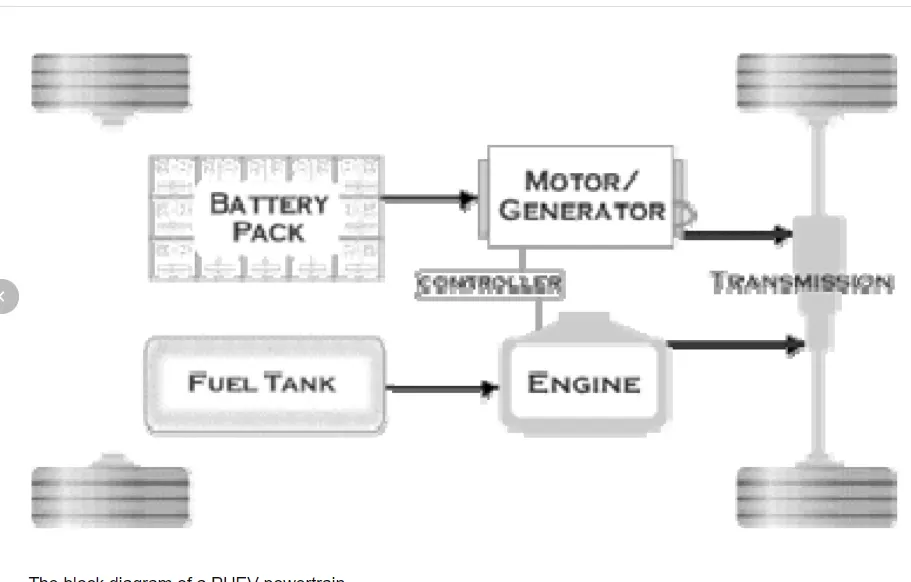
BLOCK DIAGRAM FOR THE POWERTRAIN:
In parallel hybrid electric vehicles the required torque for driving and operating the onboard accessories is generated by a combination of internal combustion engine and an electric motor.
Your portfolio, next

Ship work like this
in your own course.

Talk to a career counsellor

Free 20-minute call. We'll map the right course to where you want to work.

By submitting you agree to our Terms and Privacy Policy.

Talk to a career counsellor

Free 20-minute call. We'll map the right course to where you want to work.

By submitting you agree to our Terms and Privacy Policy.