Project-1: Powertrain for aircraft in runways
Project 1
Part A: 1. Search and list out the total weight of various types of aircrafts.
2. Is there any difference between ground speed and air speed?
3. Why is it not recommended to use aircraft engine power to move it on the ground at Airport?
4. How an aircraft is pushed to runway when its ready to take off?
5. Learn about take off power, tyre design, rolling resistance, tyre pressure, brake forces when landing.
Part B:
6. A. With necessary assumptions, calculate the force and power required to push / pull an aircraft by a towing vehicle.
B. Develop the model for the calculated force and power using Simulink.
7. A. Design an electric powertrain with type of motor, it’s power rating, and energy requirement to fulfill aircraft towing application in Simulink. Estimate the duty cycle range to control the aircraft speed from zero to highest. Make all required assumptions. Prepare a table of assumed parameters. Draw a block diagram of powertrain. (Hint :DC7 Block)
B. Also, Design the parameters in excel sheet. Aircraft gross weight:
The aircraft gross weight also known as the all up weight and abbreviated AUM is the total air craft weight at any moment during the fight or ground operation An aircraft gross weight will decrease during a fight due to fuel and oil consumption an aircraft gross weight may also vary during a flight due to payload dropping At the moment of releasing its brakes the gross weight of an aircraft is equal to its take off weight during flight ,an aircraft gross weight is referred to as the en-route weight or in flight weight
1.Gilder Gilder is a fixed wing plane that is supported in flight by the dynamic reaction of the air against its lifting surface and whose free weight does not depend on a engine motor gilder have small engine for extending their fight when necessary by sustaining the altitude normally a sailplane is on a continuously desecending scope with some being powerful enough to take off self launch
weight of gilder planes:110kg-200kg
2.Powered lift:
A powered lift aircraft takes off vertically under engine power but uses a fixed wing for horizontal flight these aircraft do not need a long runway to take off and land like helicopters but they have a speed and performance similar to standard fixed wing aircraft in combat or other situation
Weight:160kg
3.Fighter aircraft:
A fighter aircraft often referred to simply as a fighter is military fixed wing aircraft designed primarily of air to air combat against other aircraft. The key performance features of a fighter include not only its fire power but also its high speed and manuverability relative to the target aircraft
Weight:13500kg
4.Transport planes: Military transport aircraft or military cargo aircraft are used to airlift troops weapons and other military operations. transport aircraft can be used for both strategic and tactical mission and are often diverted to civil emergency relief missions.
Weight:250,000 kg
5.Aerobatic planes An aerobatic aircraft is an aerodyne (a heavier than air aircraft) used in aerobatics both for flight exhibitions and aerobatic competitions Weight: 771 kg 2) difference between ground speed and air speed:
Ground speed:
Ground speed is the airplanes speed relative to the surface of the earth Ground speed is what determines how fast an aircraft will get to its destination Ground speed is simply the sum of airspeed and wind speed It is independent of ground speed Air speed:
Air speed is the speed relative to the air it is flying in. Air speed is what determines whether there is enough air flow around an aircraft to make it fly
3) why is it not recommended to use aircraft engine power to move it on the ground at airport?
Towing is coupling two or more objects together so that they may be pulled by a designated power source the towing source may be a motorized land vehicle vessel animal or human and the load being any thing that can be pulled Although many aircraft are capable of moving themselves backwards on the ground using reverse thrust (a produce referred to as a power back) the resulting jet prop might cause damage to the terminal building or equipment. Engines close to the ground may also blow sand and debris forward and then suck them into the engine.
A push back is therefore the preferred method to move the aircraft away from the gate Although most aircraft are capable of moving themselves backwards on the ground using reverse thrust a producer called as a power back it is not typically done due to the following reasons:
The jet blast from the engines can damage the terminal building and near by equipment it can even throw away people standing near by
Engines can blow sand and debris Engine can suck in sand and debris which can cause serious damage to the engine
It is easier for the truck driver to see the surrounding better than the pilot sitting in the cockpit with limited windows
The pushback truck driver knows the airport better than the pilot
The plane engines are very loud. This noise can add up substantially when multiple planes are moving around the airport it wont be a pleasant experience for people sitting inside the terminal as most people don’t even like the sound of power full motor bikes
It saves fuel virgin atlantic had proposed a new system in which the pushback trucks will push the plane all the way to the runway to save fuel and reduce impact on near by environment Take off power, tyre design, rolling resistance, tyre pressure, brake forces when landing:
a.Take off performance:
Take off performance can be predicated using a simple measure of the acceleration of the aircraft along the runway based on force equilibrium The forces involved will be T -thrust of propulsion system pushing aircraft along runway D – aerodynamic drag of vehicle resisting the aircraft motion F – rolling resistance friction due to the contact of wheels or skids on the ground During take-off run the imbalance in these forces will produce an acceleration along the runway dv/dt = T-D-F/m the procedure for take -off will be that the vehicle will accelerate until it reaches a safe initial flying speed.
The pilot can then rotate the vehicle to an attitude to produce climb lift and it will ascent from the ground. The determination of this safe flying speed or rotation speed V R is a critical factor in determining take off performance for safety reasons VR is usually determined as being 1.1*V stall V stall: is the lowest speed that the aircraft can be flown before the airflow starts to sperate from wings as the angle of attack becomes too great.
The wings is assumed in this case to be in take off configuration or “clean” It can be calculate based on knowledge of the aircraft take off configuration and hence the maximum achievable lift coefficient CL(max) to maintain level flight the lift produced must equal the weight hence the stall speed can be calculate as V stall= square root W/1/2cL(max)ps
b.Tyre design of aircraft: When it comes to safety tyres are one of the most important components of aircraft. They help to absorb the shock of landing and provide the necessary traction for braking and stopping of an aircraft Aircraft tyre is designed to withstand extremely heavy loads while landing take off taxing and parking.
The number of wheels required for aircraft as the weight of the aeroplane needs to be distributed more evenly Carcass plies are used to from the tire they are sometimes called casing plies. An aircraft tyre is constructed for the purpose it serves Unlike an automobile or truck tyre it doesn’t have to carry a load for a long period of continuous operation. However an aircrafts tyre absorbs the high impact loads of landing and also its operating at high speed for a short time when required Retreading - Retreating is methods of restoring a worn tyre by renewing the tread area or by renewing the tread area plus one or both side walls.
Repairs are include in the tyre retreading process Load rating:
Load rating is the maximum permissible load at a specified inflation pressure.
Ply rating:
Ply rating is used to identify the maximum recommend load rating and inflation pressure for a specified tyre.
It is an index of tyre strength Speed rating:
Speed rating is the maximum take off speed to which the tyre has been tested Skid depth:
Skip depth is the distance between the tread surface and the deepest groove as measured in the mould Aircraft tyre must have an approved speed and load rating and have sufficient clearance when retracted through landing gear to allow for tyre growth.
Tyre growth is the increase in the size of the tyre due to centrifugal forces at high speed. C)Rolling resistance: Rolling resistance sometimes called rolling friction or rolling drag is the force resisting the motion when a body (such as a ball tire or wheel) rolls on a surface it is mainly caused by effects elastic at is not all the energy needed for deformation or movement of the wheel roadbed etc is recovered when the pressure is removed.
Two forms of this are hysterisis losses and permanent plastic deformation of the object or the surface ( e g . soil) another cause of rolling resistance lies in the slippage between the wheel and the surface which dissiplates energy. Note that only the last of these effects involves friction therefore the name “rolling friction” is to an extend a misnomer.
The rolling resistance can be expressed as Fr =cW Where Fr =rolling resistance or rolling friction(N,lbf) C = rolling resistance cofficient - dimensionless (cofficient of rolling friction - CRF) W = mag =normal force -or weight - of the body (N,lbf) M = mass of body (kg, lb) Ag = acceleration of gravity (9.81 m/s^2,32.174 ft/s^2) D)Tyre pressure: Car tyres are not just unsafe when they are old and worn out you need to ensure you known that tyre pressure you have in your tyres when you drive it because there are critical safety and economic implications.
Car tyre pressure is a measurement of how munch air is in your pneumatic tyre and ensures the tyres wear evenly and maintain the correct level of grip on the road surface this is commonly expressed as PSI or pounds per square inch 6.force and power required to push/pull an aircraft by a towing vehicle The force to move an air plane on an absolute flat runway with no wind at constant low speed is equal to the rolling resistance between the plane and the tarmac.
The rolling resistance for the air plane can be calculate as: Fr =cmr ag Where Fr =rolling resistance (N,lbf) C = rolling resistance cofficient Mr =rolling mass (kg,lbm) Ag = acceleration of gravity (9.81m/s^2) The friction force for the puller can be calculated to Ff =mw = m mf ag Where Ff =friction force (N,lb) M= friction cofficient W= weight (N,lbf ) Mf = friction mass (kg) The drag force acting on the tow will be:
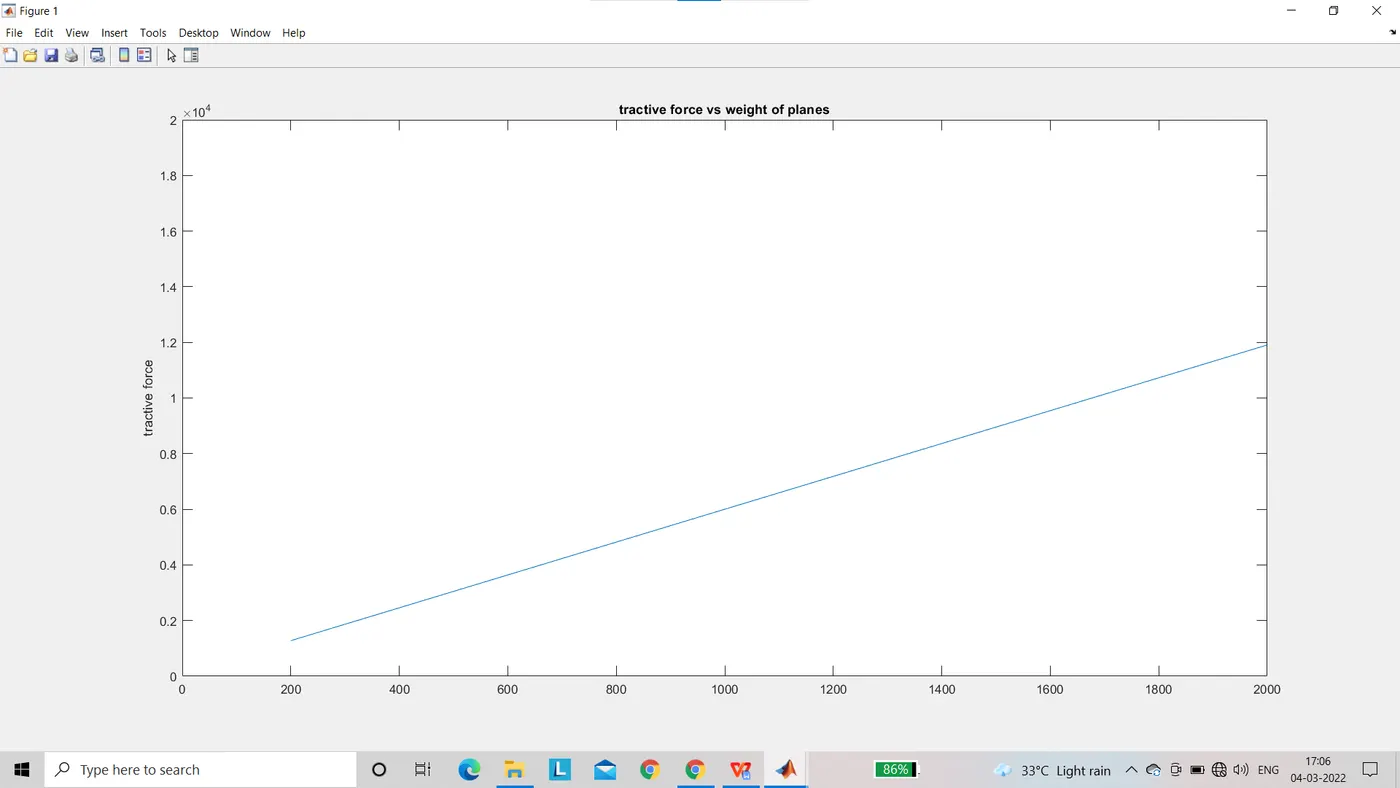
The drag force D exerted on a body travelling though a fluid is given by D=1/2 CpAv^2 C is the drag cofficient which can vary along with the speed of the body but typical values range from 0.4 to 1.0 for different fluids (such as air and water) P is the density of the fluid through which the body is moving V is the speed of the body relative to the fluid Now the tractive force or the pulling force required by the tow will be Pulling force = drag force + friction force +rolling resistance force
Now let us consider aircrafts with the following specifications:
Now as we have seen that various kinds of planes have different weights the amount of pulling force also will be different therefore we will consider a range of weight :
Range of weight =200kgs -250000kgs The towing speed considered is 5 m/s Area range : 50 -100m^2 Cofficient of rolling resistance: 0.02 Cofficient of friction: 0.01