Project-1: Powertrain for aircraft in runways
Objecive 1:
the different term represent different weight or masses.for each fight,the weights are taken into account for several reasons.
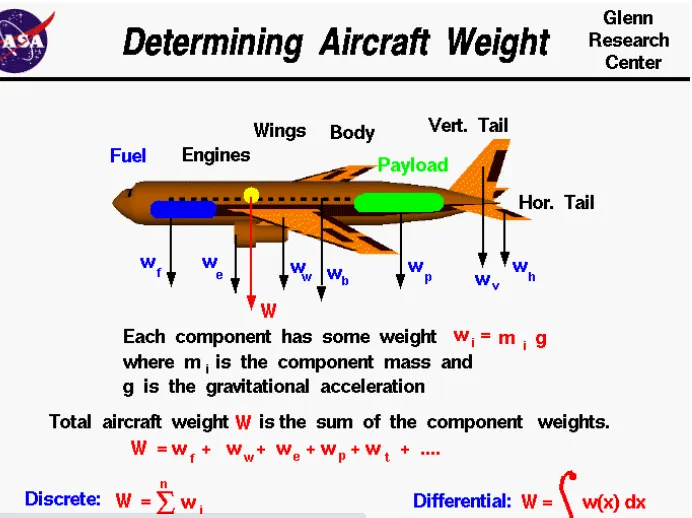
Manufacres empty weight(MEW)--
also called manufacture weight empty (MWE) or Licensed empty weight it is the weight of the aircraft as built and includes the weight of the structure,power plant,funishgs installions ,system and other equipment that are considered an integral part of an aircrft. this exciudes any baggage ,passenger .or usable fuel.
Zero fuel weigh (ZFW)---
this is the total weight of the airplane and all its content but excluding the total weight of the usable fuel airplane reduced ,but the ZFW remains contant .maximum zero fuel weight (MZW) is the maximum wight allowed before usable fuel and other specified unsable agents are loaded.
operating empty weight(OEW)---
(Roughly equivalent to basic empty weight on light aircraft). it is the basic weigh of an aircaft induding the crew.all fuids necessary for operattion such as engine oil,engine coolant ,water, unusable fuel and all operator items and equiment for flight but excluding usable fuel and the payload .
payload---
it is the carrying capacity of an aircraft.it includes cargo, people ,extra fuel .in the case of a commercial airline ,it may refer only to to revenue generating cargo paying passengers.
Maximum takeoff weight (MTOW)-----
this is the maximum weight a which the pilot of the aircraft is allowed to attempt to take off.
Regulated takeoff weight (RTOW)---
depending on different factors .RTOW or maximum permissible akeoff weight varies for each takeoff.it can never be higher than MTOW.
Maximum landing weight (MLW)----
this maximum weight at which an aircraft is permitted to land .the following images depicts takeoff weight components.
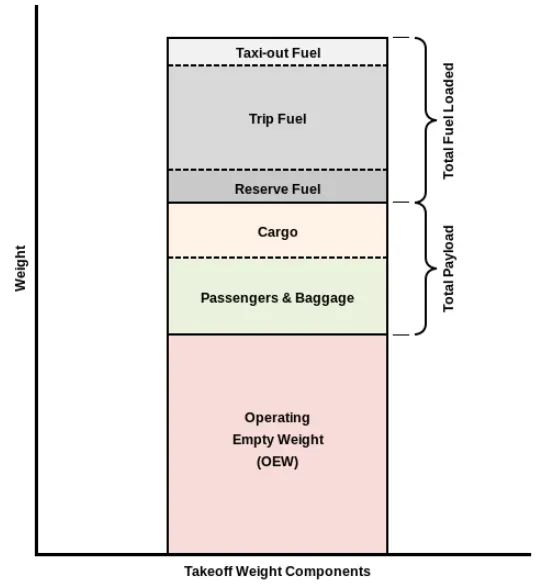
maximum ramp weight (MRW)----
also called maximum taxi weight (MTW).it is the maximum weight authorized for maneuvering (taxing or towing )an aircraft on the ground .
Aircraft gross weight-----
it is the total aircraft weight at any moment during the fig or ground operation .this decreases during fig due to fuel and oil consumption.
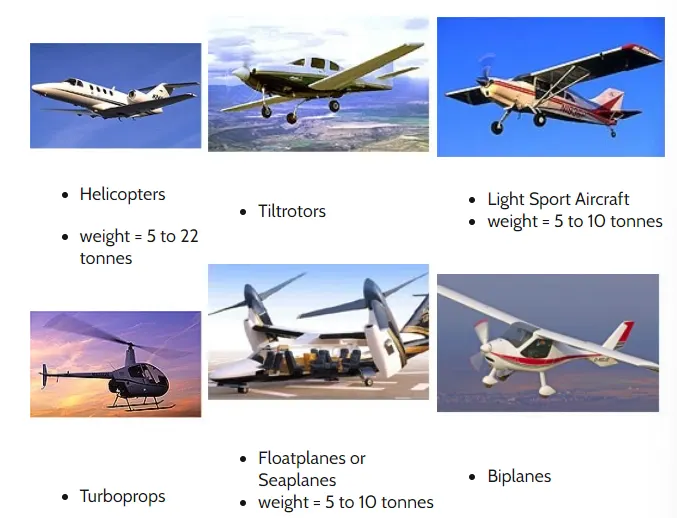
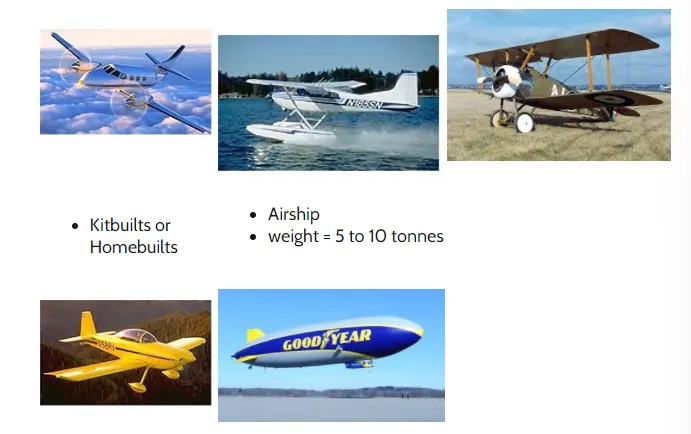
types of aircraft-----
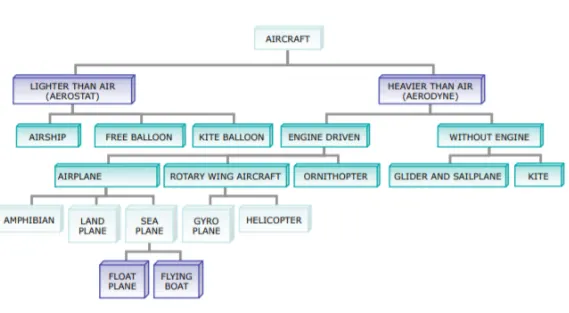
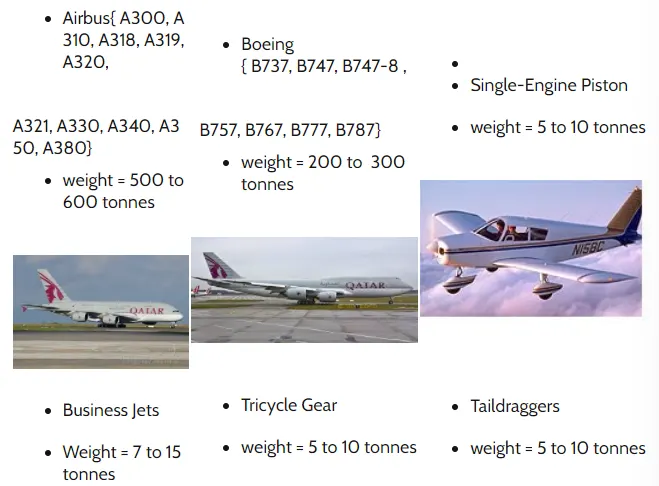
Objective-2
is there any difference beween ground speed and air speed?
ground speed----
it when you are measuring the horizontal velocity of the plane relative to the ground its the speed that is shown on the speedometer of a car .if your car suddenly started levitating for god know
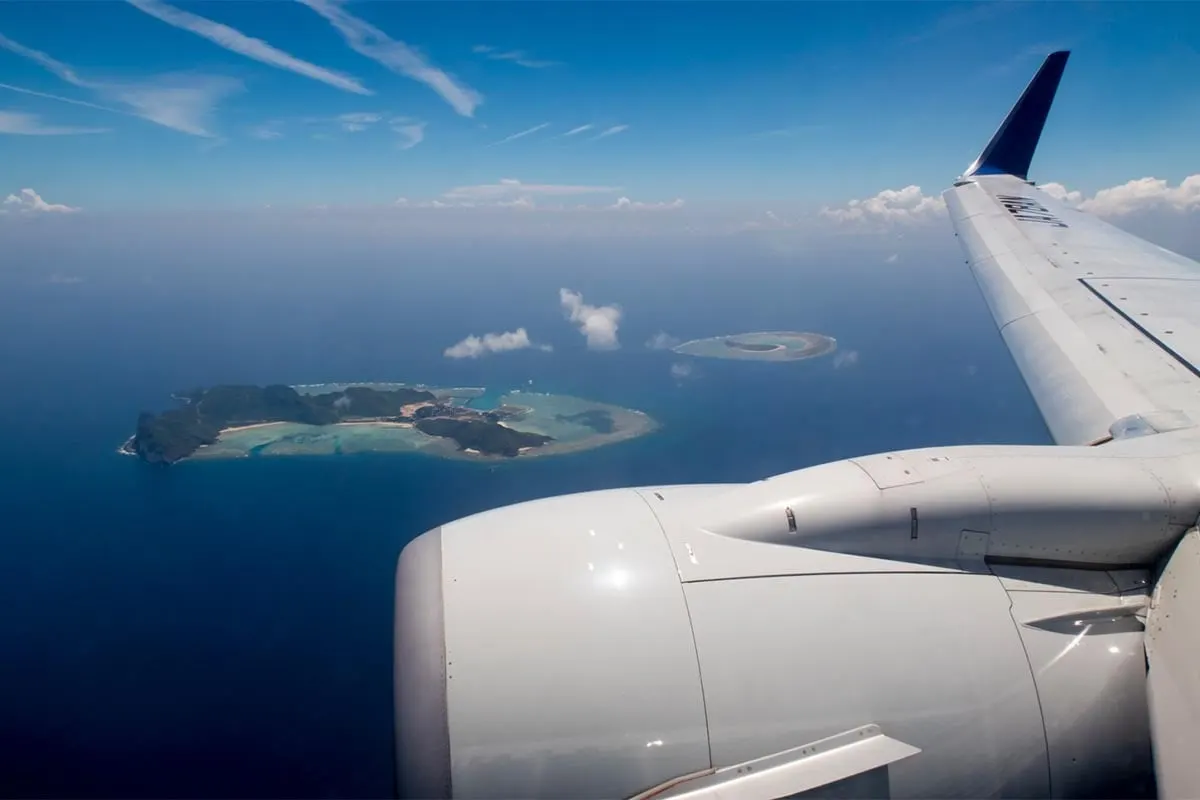
As talked about briefly in my article about how fast passenger airplanes fly, generally speaking, there are two different types of speed when talking about airplanes – ground speed and airspeed.
While ground speed is the airplane’s speed relative to the surface of the Earth, airspeed – at least true airspeed – is its speed relative to the air it is flying in.
Below, I will explain the two types of speed in more detail, as well as talk about the four types of airspeed that are commonly used.
Airspeed vs. Ground Speed
As mentioned above, true airspeed is simply the speed at which an aircraft is moving relative to the air it is flying in. As such, it’s also the speed at which the air is flowing around the aircraft’s wings.
Ground speed, on the other hand, is the aircraft’s speed relative to the ground. One thing that should be noted here is that it’s its horizontal rather than vertical speed – an aircraft climbing completely vertically would have a ground speed of zero.
In other words, while airspeed is what determines whether there is enough airflow around an aircraft to make it fly, ground speed is what determines how fast an aircraft will get to its destination.
Wind’s Effect on Ground Speed
The relationship between airspeed and ground speed is fairly simple. Ground speed is simply the sum of airspeed and wind speed.
If the aircraft is flying in the same direction as the wind is blowing, the aircraft experiences tailwind, and its ground speed is higher than its airspeed. On the other hand, if the wind is blowing against the direction the aircraft is traveling in, the aircraft experiences headwind, and its ground speed is lower than its airspeed.
The Moving Walkway Analogy
In case you are still unsure about the difference between airspeed and ground speed, here’s an analogy to bring the concepts “down to earth.”
Imagine a moving walkway going from point A to point B moving at 3 miles per hour.
And, imagine you are walking on the walkway at a speed of 3 miles per hour relative to the walkway. In other words, you are moving from point A to point B at a speed of 6 miles per hour – the sum of the speed of the walkway and the speed at which you are walking relative to the walkway
objective-3
We are assuming passenger commuter aircraft and large airliners. Aircraft move using their own engine power all the time on the airport apron and taxiways under their own power to go towards runways and after landing taxi to their assigned gate.
The only time they use external assistance is to pushback from the gate. Large turbofan aircraft need help to reverse via a pushback tractor. The engines are turned on after the pushback is complete and the aircraft can move forward under It’s own power.
To be accurate, some aircraft can reverse using a variable pitch prop or thrust reversing on turbofans but generally reversing is done via pushback tractors. Blasting jet reversers blows debris In the crowded gate area creating foreign object damage hazard for adjacent aircraft, gate equipment or terminal waiting area glass windows
objective-4
Ready for take-off in ten steps…
- The pilot parks the aircraft in exactly the right place. Usually with the help of an automatic system, but occasionally guided by a marshaller waving two paddles or wands. Dozens of handling personnel are already standing by to perform a whole range of tasks simultaneously.
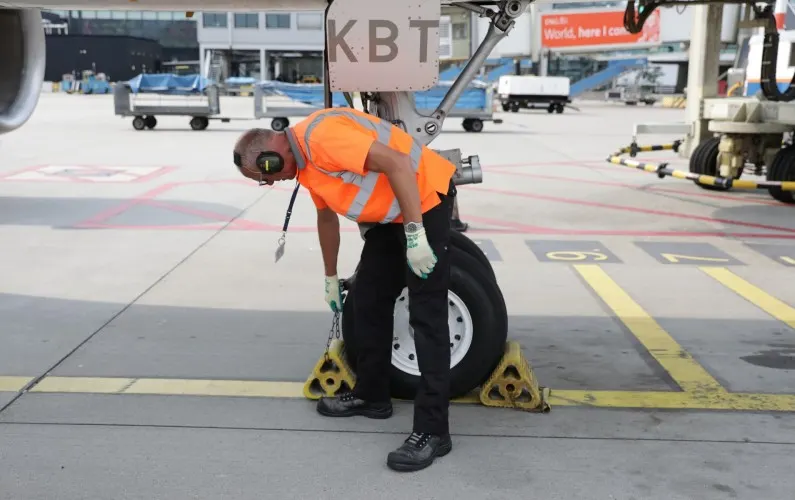
- As soon as the aircraft is stationary and the engines are switched off, the first priority is to disembark the passengers as quickly as possible. The apron handler places chocks in front of the wheels and connects the ground power. Meanwhile, the passenger bridge manoeuvres up to the door and a belt loader rolls up to the cargo hold. Luggage is unloaded and transferred to the terminal on baggage carts.
- Refuelling begins, usually from a hydrant at the stand. A hose is attached to this from a special vehicle called a dispenser, with the other side connected to the fuel tank in the wing. Read more about refuelling here.
- Now it is time to service the aircraft. The caterer loads new meals and takes away the food waste and used cutlery and crockery. Other activities include draining the lavatories, replacing the headrest covers, removing rubbish and distributing fresh blankets and in-flight magazine.
- A specialist team – or sometimes the crew themselves – cleans the cabin so that the new passengers board a pristine aircraft.
- Meanwhile, specialists from the airline conduct a technical check to make sure that the engines, wings, control surfaces, landing gear, instruments, doors and other equipment are in full working order.
- The aircraft is now ready for baggage to be loaded for the next flight. This is a quick process, on average taking only 10-15 minutes. A little later the passengers start boarding. As soon as they are all in their seats, the door is closed and the pilot informs air-traffic control that the flight is ready for departure.
- The apron handler removes the chocks. A so-called pushback truck reverses the aircraft into taxiing position, pushing it with a towbar attached to the nose-wheel strut. Or, in the most modern versions, by actually lifting the wheel. That speeds up coupling and decoupling.
- The aircraft taxis to the runway to depart at the agreed time.
- The pilot waits for permission to take off from air-traffic control. This is possible once the departure route is clear. As soon as the go-ahead is received, the plane takes to the air at full power.
Mission accomplished!
A smaller narrow-body jet can often depart again within just half an hour of landing. In the case of large wide-body aircraft, the process takes two to three hours. Either way, every successful turnaround is a top-class achievement in a whole range of ways
Ready for take-off in ten steps…
From landing to take-off in next to no time
“Cabin crew, prepare for landing...” Your flight is approaching Schiphol and preparing to land on a runway assigned by air traffic control. The wheels hit the ground and passengers applaud as the aircraft taxis briskly towards the gate. Even as it safely reaches its designated stand and travellers spring from their seats to wait in the aisle until the door opens, ground personnel are gathering outside to ready it for departure as fast as possible. What needs to be done to get the plane back in the air on time.
objective:-5
A method for predicting the rolling resistance of aircraft tires rolling in dry snow is described. Knowledge about the rolling resistance on a snow-covered surface is required when complying with aircraft certification and operational rules, which account for runway surface conditions. In addition to the rules, the Joint Aviation Authorities have issued Advisory Material Joint (AMJ) 25X1591, a document providing information, guidelines, and recommendations for calculating the rolling resistance of aircraft tires in dry snow. The analytical method presented in AMJ 25X1591 gives unsatisfactory results when compared to experimental data. A new method Is presented for predicting the rolling resistance due to snow. This new method and the AMJ method are validated by comparing the results of both methods for single tires and full-scale aircraft with available experiments. Tn general, a much better agreement with experimental data is found for the new method than for the AMJ method
objective:-6
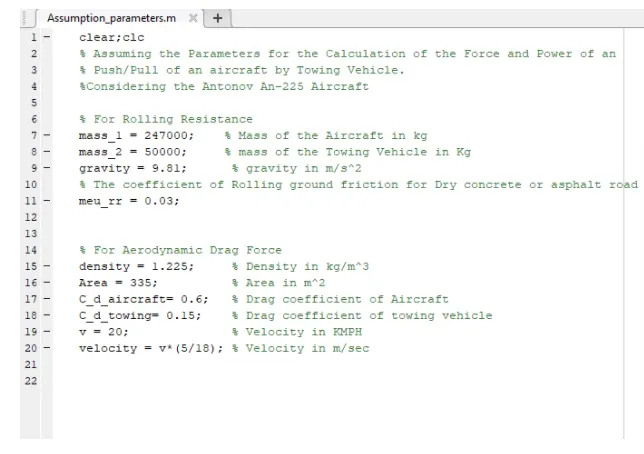
intialy we need to given input values in the editor tab to make sure we get the values into the block such if we changes the values then the block value automatically changes.
to calculate the force ,use the fromulas above using the constant ,sum and display blocks.
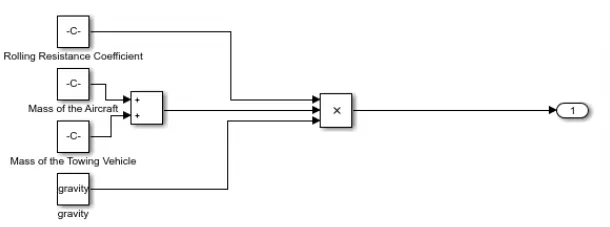
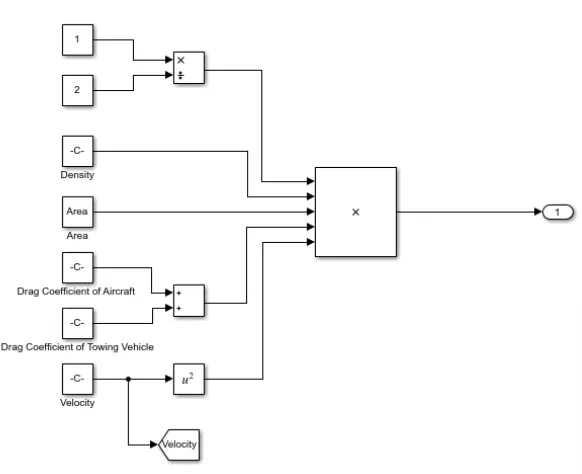
now run the model and check the force and power values .
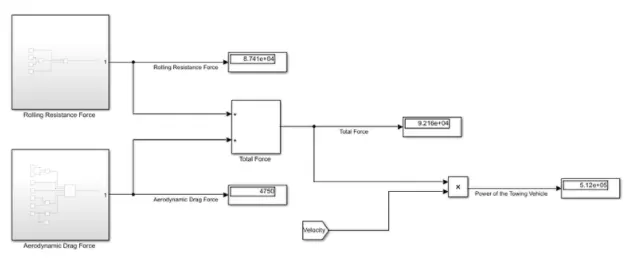
the values of the rolling force is 87.41kn ,aerodynamic drag force is 4750n,the total force is 92.16kn ,and the power is 512kw.
objective :-7
A. Design an electric powertrain with type of motor, it’s power rating, and energy requirement to fulfill aircraft towing application in Simulink. Estimate the duty cycle range to control the aircraft speed from zero to highest. Make all required assumptions. Prepare a table of assumed parameters. Draw a block diagram of powertrain.
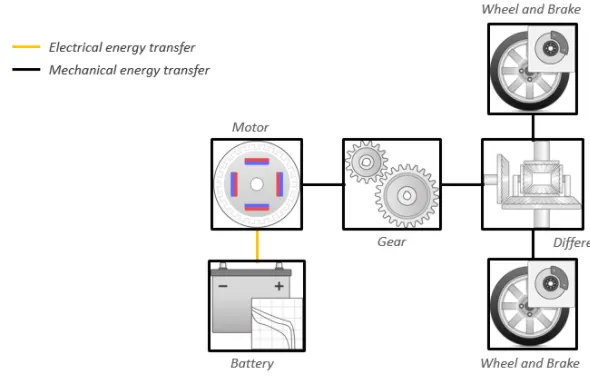
an airplane pushback vehicle is required to move airplanes awys from airport terminal and tow them acroos the airfied for routine maintenace .the pushback vehicle must be able generate a large towing force but it also has a high speed to travel quickly between pushback operation.
let the wheel radius be 0.5
maximum torque on wheels
t=0.5*92157.57
t=0.5*92157.57
t=46078.785n-m
assume the induction motor
input power in term of mechanical power be 560KW
duty cycle =output power /input power=512\560
=0.91428
=91.4428%
the heavy duty factor for an aircraft is designed for operation extreme local conditions
objective:-8
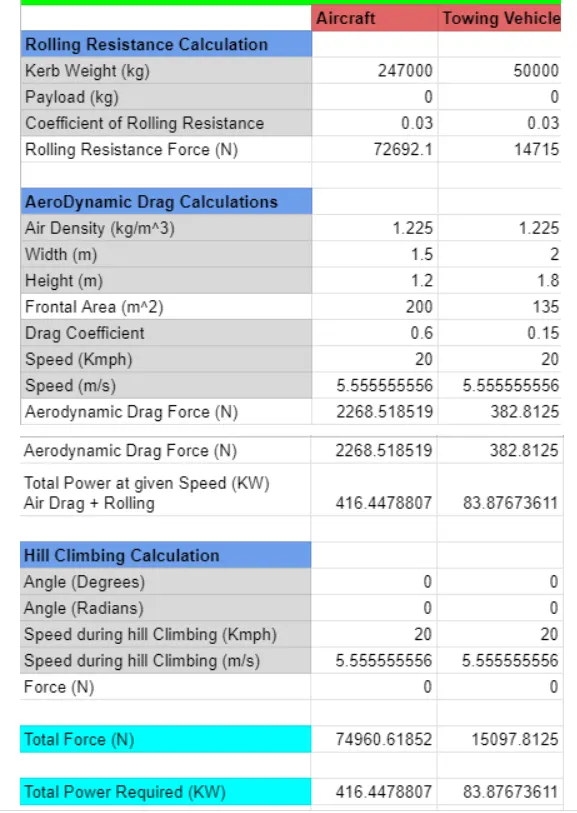
use the above calculation in an excle sheet and calculate the aircraft and towing vehicle power and force .
force and power calculation .
%PROGRAM TO CALCULATE THE TRACTION FORCE, POWER & TORQUE OF AN AIRCRAFT

clear all
close all
clc

%ASSUMED VALUES
urr = 0.03;                          %rolling resistance coefficent
u = 0.2;                             %friction resistance coefficent
ma = 31298;                          %mass of aircraft in kg
mt = 1100;                           %mass of towing tractor in Kg
g = 9.81;                            %acceleration of gravity m/sec^2
rho = 1.25;                          %density of air in kg/m^3
A = 158.3;                           % frontal area array m^2
cd =0.02;                            %coefficent of drag
v = 3;                               %velocity m/sec
r = 0.35;                            % radius of towing vehicle wheels in m
G = 20;                              %gear ratio

%FORCE CALCULATION
frr = urr*(ma+mt)*g;                 %rolling resistance force in N
fad = 0.5*rho*A*cd*v^2;              %aerodynamic force in N
ffr = u*(ma+mt)*g;                   %friction force in N

%TRACTION FORCE CALCULATION
Traction_force_in_N = (frr + fad + ffr)              %total traction force in N

%POWER CALCULATION
Power_KW = (Traction_force_in_N * v)/1000            %aircraft power calculation