Project 1 - Parsing NASA thermodynamic data
Aim :- Write a code in matlab for Nasa thermodynamic data file and then get the plots and values for the molecular weight of gas species.
Objective :-
- Write a function that extracts the 14 coefficients and calculates the enthalpy,entropy and specific heat for all the species in data file.
- Calculate the molecular weight of each species and display it in the command window.
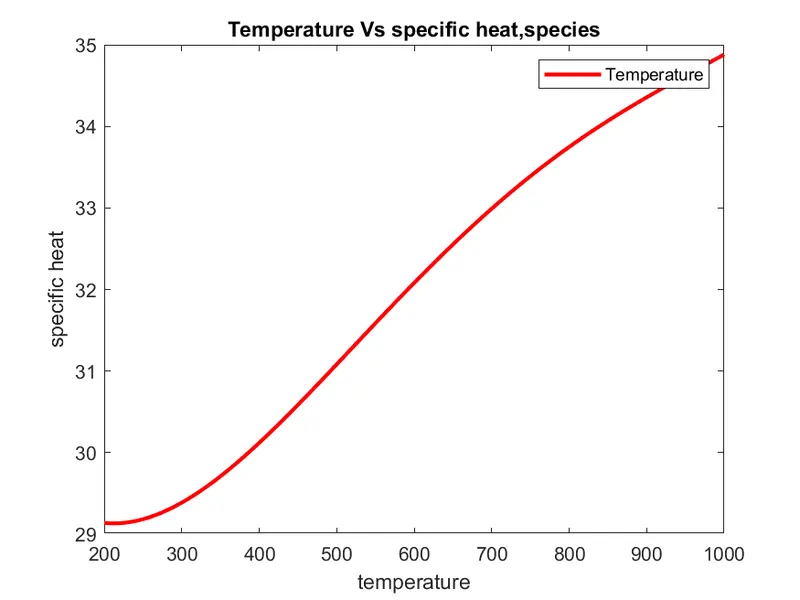
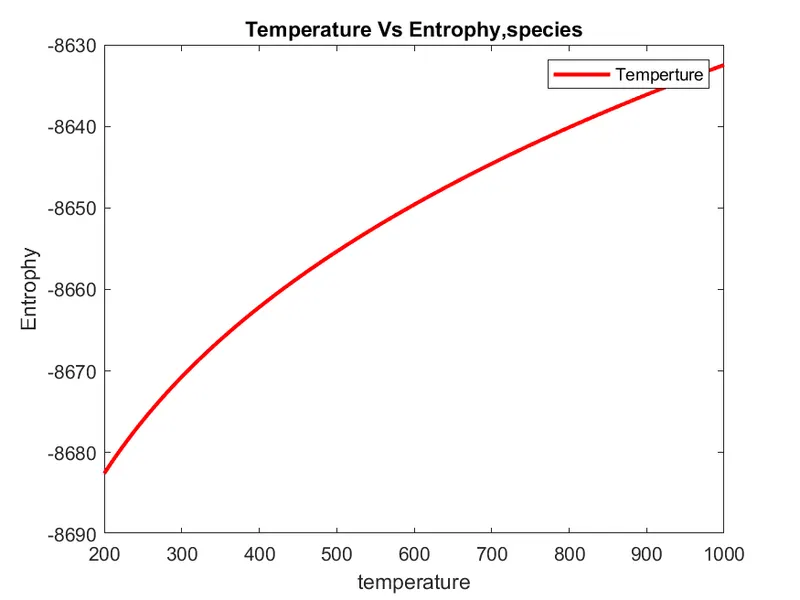
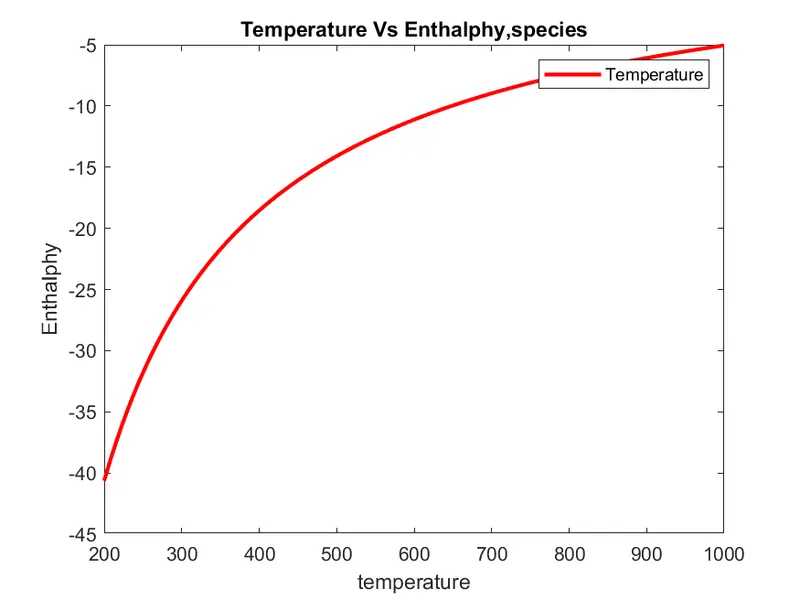
- Plot the Cp,Enthapy,Emtropy for the local temperature range(low temperature :: high temperature) specific for each species.
- Save the plots as images with appropriate names and dump them in separate folders for each species with a suitable name.All these should be generated automatically.
- The main program that you will submit will just take the "THERMO (3).dat " file as an input and generate Cp,,h and s plots.
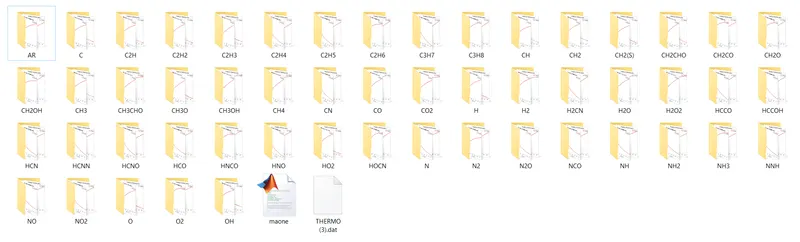
- Screenshot of the window where all the folders are saved.
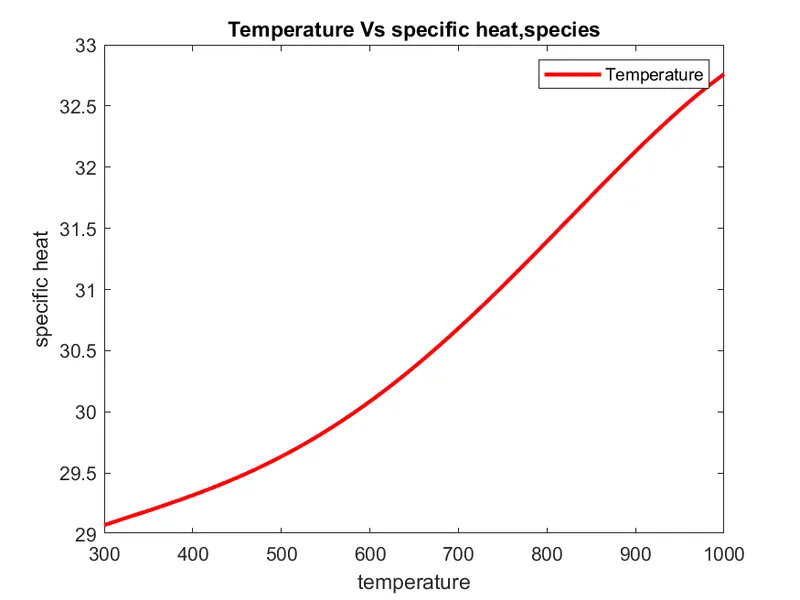
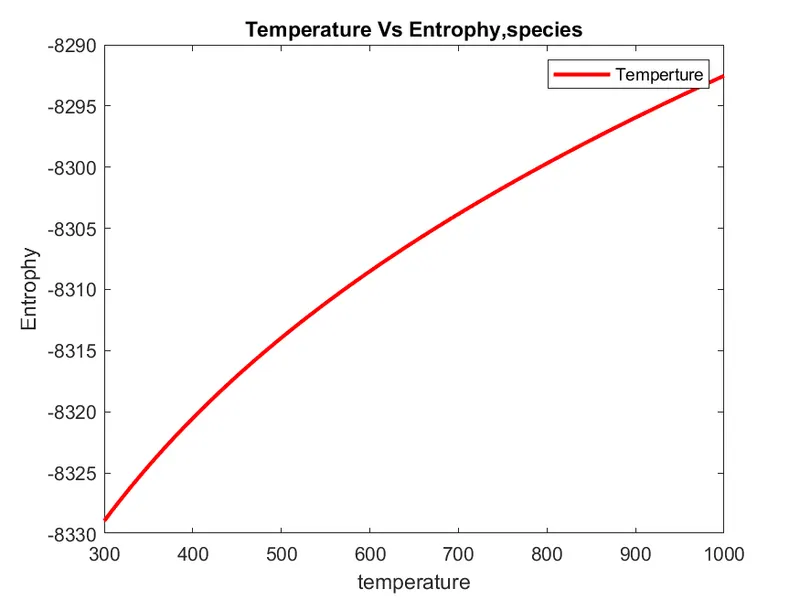
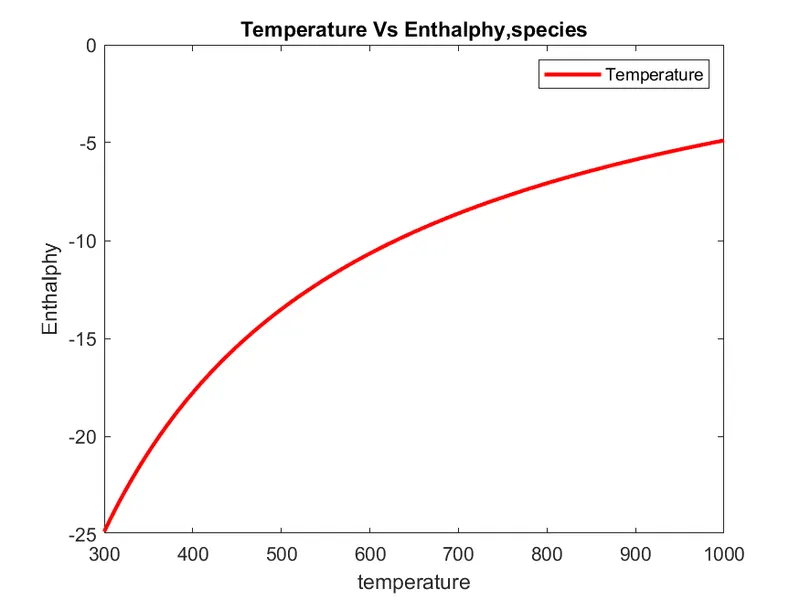
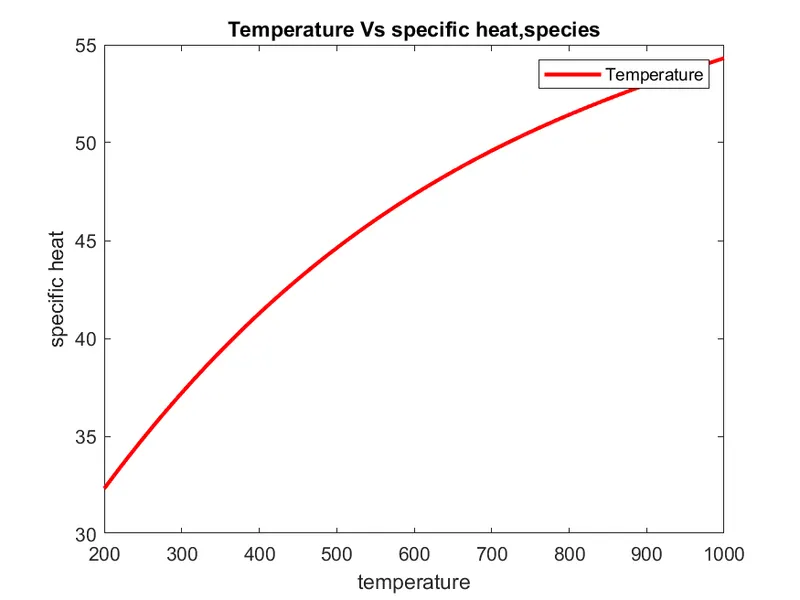
- Plots for O2,N2 and CO2 species.
Theory :-
Here R is the Universal gas constant (8.314),T is the temperature.
Specific Heat:-
Cp/R = a1 + a2 T + a3 T^2 + a4 T^3 + a5 T^4
It is the amount of energy that must be added in the form of heat to one unit of mass of the substance in order to cause an increase of one unit in its temperature.
Enthalpy :-
H/RT = a1 + a2 T/2 + a3 T^2 /3 + a4 T^3/4 + a5 T^4/5 + a6/T
A property of a thermodynamic system is equal to the system internal energy plus the product of its pressure and volume.it reflects the capacity to do non mechanical work and the capacity to release heat.
Entropy:-
S/R = a1 lnt + a2 T + a3 T^2 /2 + a4 T^3 /3 + a5 T^4 /4 + a7
The measure of a system thermal energy per unit temperature that is unavilable for doing useful work .Because work is obtained from ordered molecular motion .In a system contained so as to prevent the mass transfer for processes at constant pressure the heat absorbed or released equals the change in Enthapy.
Main Program:-
clear all
close all
clc

%Getting data file
f = fopen('THERMO (3).dat','r');
fgetl(f);

%Reading header
tline = fgetl(f);
A = str2num(tline);
global_low_temp = A(:,1);
global_med_temp = A(:,2);
global_high_temp = A(:,3);

%skip comment lines
for i=1:3
    fgetl(f)
end

%Reading species data
for i = 1:53
    line1 = fgetl(f);
    l = strsplit(line1);
    m = length (l);
    sp = l(1);
    species = char(sp);


    low_temp = str2double(l(m-3));
    mid_temp = str2double(l(m-2));
    high_temp = str2double(l(m-1));

    % storing the valve of 2nd line
    line2 = fgetl(f);
    a = strfind(line2,'E');
    a1 = str2double(line2(1:(a+3)));
    a2 = str2double(line2((a(1)+4):(a(2)+3)));
    a3 = str2double(line2((a(2)+4):(a(3)+3)));
    a4 = str2double(line2((a(3)+4):(a(4)+3)));
    a5 = str2double(line2((a(4)+4):(a(5)+3)));

    % storing the value of 3rd line
    line3 = fgetl(f);
    b = strfind(line3,'E');
    a6 = str2double(line3(1:(b(1)+3)));
    a7 = str2double(line3((b(1)+4):(a(2)+3)));
    a8 = str2double(line3((b(2)+4):(a(3)+3)));
    a9 = str2double(line3((b(3)+4):(a(4)+3)));
    a10 = str2double(line3((b(4)+4):(a(5)+3)));

     % storing the value of 4th line
    line4 = fgetl(f);
    c = strfind(line3,'E');
    a11 = str2double(line4(1:(c(1)+3)));
    a12= str2double(line4((c(1)+4):(a(2)+3)));
    a13 = str2double(line4((c(2)+4):(a(3)+3)));
    a14 = str2double(line4((c(3)+4):(a(4)+3)));

    T = linspace(low_temp,high_temp,500);


    %universal gas constant
    R = 8.314;

    % Function for Specific heat,Enthalpy and Entropy for lower and higher temperature
 if T<=mid_temp

        %for lower temperature
        cp=(a8 + a9*T+a10*T.^2+a11*T.^3+a12*T.^4)*R;
        h=(a8 + a9*T/2)+a10*(T.^2)/3+a11*(T.^3)/4+a12*(T.^4)/5+(a13./T)*R;
        s=(a8*log(T)+a9*T+a10*(T.^2)/2+a11*(T.^3)/3+a12*(T.^4)/4+a13)*R;
 else
        %for higher temperature
        cp=(a1 + a2*T+a3*T.^2+a4*T.^3+a5*T.^4)*R;
        h=(a1 + a2*T/2)+a3*(T.^2)/3+a4*(T.^3)/4+a5*(T.^4)/5+(a6./T).*T*R;
        s=(a8*log(T)+a9*T+a10*(T.^2)/2+a11*(T.^3)/3+a12*(T.^4)/4+a13*T.^5/5)*R;
 end


    % Creating folder
    nasa_file = species;
    mkdir(nasa_file);
    current = pwd;
    cd(nasa_file);


    % Creating figure of specific heat :

    figure(1)
    plot(T,cp,'linewidth',2,'Color','r');
    title(['Temperature Vs specific heat,species']);
    xlabel('temperature');
    ylabel('specific heat');
    legend ('Temperature','Specific heat');

    % saving .png file of figure
    fig = sprintf('specific heat of %s.png',species);
    saveas (gca,fig);


    % creating figure of enthalphy

    figure(2)
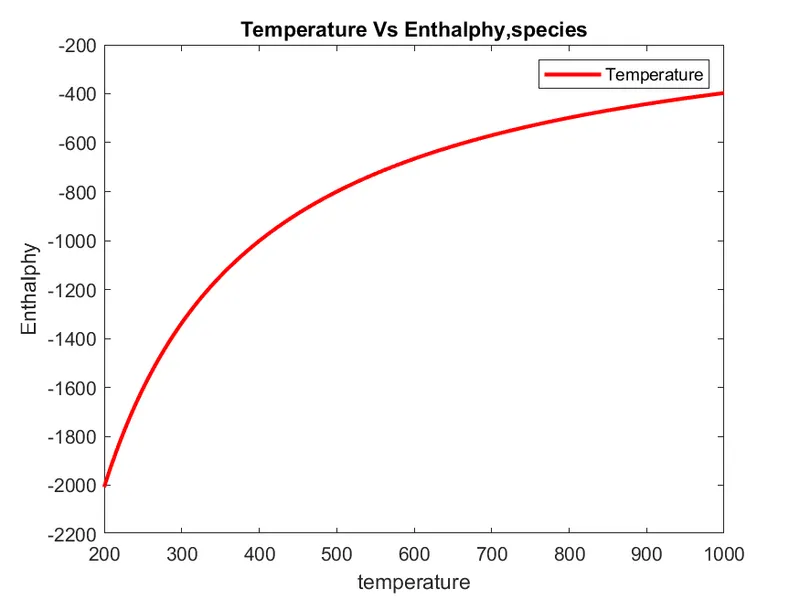
    plot(T,h,'linewidth',2,'Color','r');

    title(['Temperature Vs Enthalphy,species']);
    xlabel('temperature');
    ylabel('Enthalphy');
    legend ('Temperature','Enthalphy');

    % saving .png file of figure
    fig = sprintf('Enthalphy of %s.png',species);
    saveas (gca,fig);

    % creating figure of Entrophy

    figure(3)
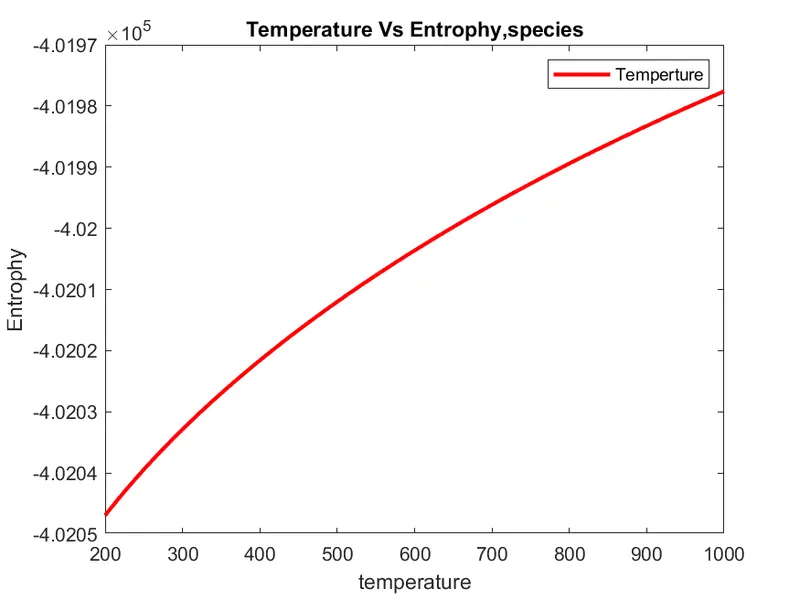
    plot(T,s,'linewidth',2,'Color','r');

    title(['Temperature Vs Entrophy,species']);
    xlabel('temperature');
    ylabel('Entrophy');
    legend ('Temperture','Entrophy');

    %saving .png file of figure
    fig = sprintf('Entrophy of %s.png',species);
    saveas (gca,fig);

    cd ..

    % creating figure of molecular weight
    atom = ['H','C','O','N','A','S'];
    atomic_weight = [1.008 12.011 15.999 14.007 39.948 32.065];
    mw = 0;

    for p = 1:length(species)
    for q = 1:length(atomic_weight)
        if strcmp(species(p),atom(q))
mw = mw + atomic_weight(q);
position = q;
        end
    end

    % Used for multiplication into the number of atom
    n = str2double(species(p));
    if n > 1
        mw = mw + atomic_weight(position)*(n-2);
    end
    end

    % display molecular weight

    fprintf('molecular weight of %s : %f\n ',species,mw);

end
~ 53 Elements :-
Temperature vs Specific heat , O2
Temperature Vs Entropy , O2
Temperature Vs Enthalpy ,O2
Temperature Vs Specific Heat , N2
Temperature Vs Entropy , N2
Temperature Vs Enthalpy , N2
Temperature Vs Specific heat , CO2
Temperature Vs Entropy , CO2
Temperature Vs Enthalpy , CO2
Molecular Weight of some elements :-
molecular weight of O : 15.999000
molecular weight of H : 1.008000
molecular weight of OH : 17.007000
molecular weight of C : 12.011000
molecular weight of CH : 13.019000
molecular weight of CH2(S) : 45.084000
molecular weight of CH3 : 14.027000
molecular weight of CH4 : 15.035000
molecular weight of CO : 28.010000
molecular weight of HCO : 29.018000
molecular weight of CH2OH : 30.026000
molecular weight of CH3OH : 31.034000
molecular weight of C2H : 13.019000
molecular weight of C2H3 : 14.027000
molecular weight of C2H4 : 15.035000
molecular weight of C2H5 : 16.043000
molecular weight of C2H6 : 17.051000
molecular weight of CH2CO : 41.029000
molecular weight of HCCOH : 42.037000
molecular weight of H2CN : 27.026000
molecular weight of HNO : 31.014000
molecular weight of N : 14.007000
molecular weight of NNH : 29.022000
molecular weight of N2O : 30.006000
molecular weight of NH : 15.015000
molecular weight of NH3 : 16.023000
molecular weight of NO : 30.006000
molecular weight of HCNO : 43.025000
molecular weight of NCO : 42.017000
molecular weight of CN : 26.018000
molecular weight of HCNN : 41.033000
molecular weight of N2 : 14.007000
molecular weight of AR : 39.948000
molecular weight of C3H8 : 31.078000
molecular weight of C3H7 : 30.070000
molecular weight of CH3CHO : 43.045000
molecular weight of CH2CHO : 42.037000