Project 1 (Mini Project on Vehicle Direction Detection
Requirement:
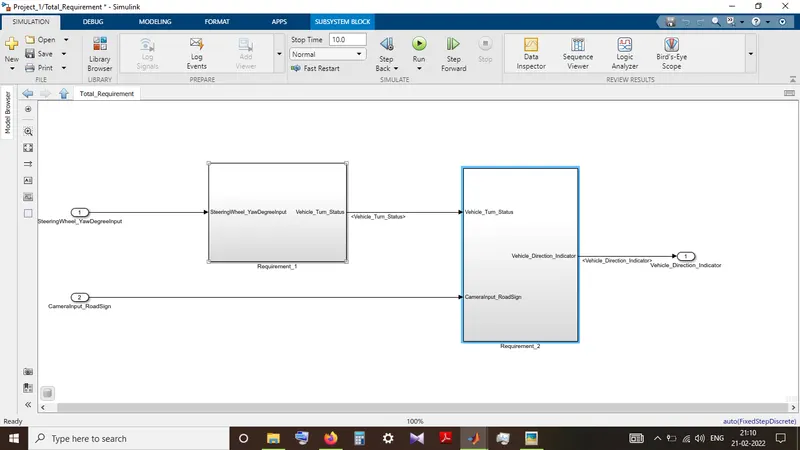
Here as per requirement analysis we need to build a model to which steering your head he is given as an input. Based on this input we have to identify weather the vehicle is running straight or taking a left or right turn. The entire thing is asked to execute in two subsystems.
The first subsystem it is asked to verify which direction vehicle is taking and in the second subsystem it is checked for predefined direction signs and later it is compared to the input received from on board camera of the vehicle for confirming whether vehicle is moving in the right direction or not.
Subsystem 1/requirement_1:
in this subsystem the steering wheel your rate he’s given as an input. This value is checked with our predefined right turn, left turn, straight drive limit angles. For comparison we have used two switch blocks how do you to which yaw rate is given as threshold input.
Based on the degrees the logic of this is developed. The output of the subsystem he's vehicle turn status which will be in degrees that word defined in angular limits.
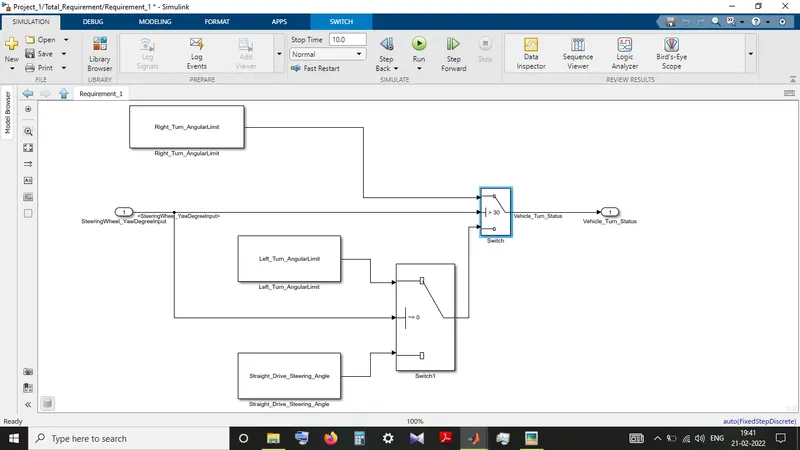
Signal, port names and their parameters, dimensions are given as per requirement sheet
Subsystem 2/ requirement 2:
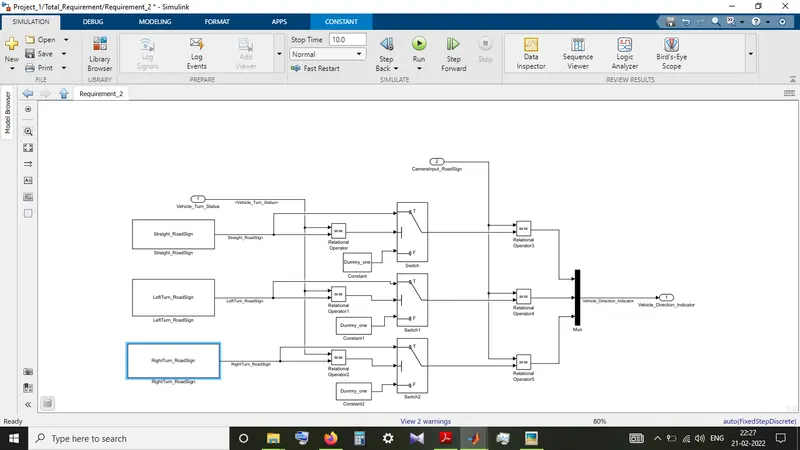
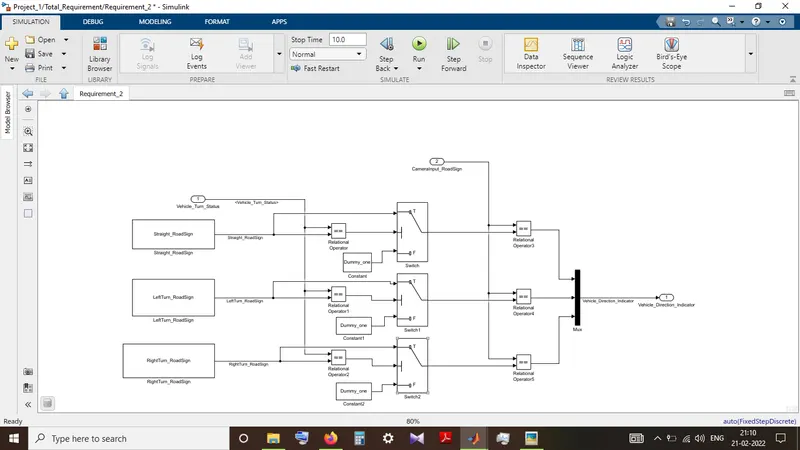
For this subsystem 2 inputs are given and one final output is taken. The two inputs are vehicle turn status exactly which is optained from our first subsystem and we’ll be in degrees, And the second input will be from on board camera which reads the roadsign and determines the angle.
Here at first based on the vehicle turn status it is Determined whether it is matching with predefined left turn road sign, right turn road sign, straight road sign. this is done by using a relational operator. Each of the comparison output he is given to a switch which switches on the output of these three comparison.
A dummy variable of inital value 1 is created and connectected to switch second port as a filler
Now as per the requirement sheet these thre individual outputs are compared with the input from on board camera. The comparison is done using a relational operator individually the output is given by the relational operator whose condition is satisfied.
These signals are muxed into a single signal as requested in the requirement sheet. The output signal is named as vehicle direction indicator.
Creation of SLDD:
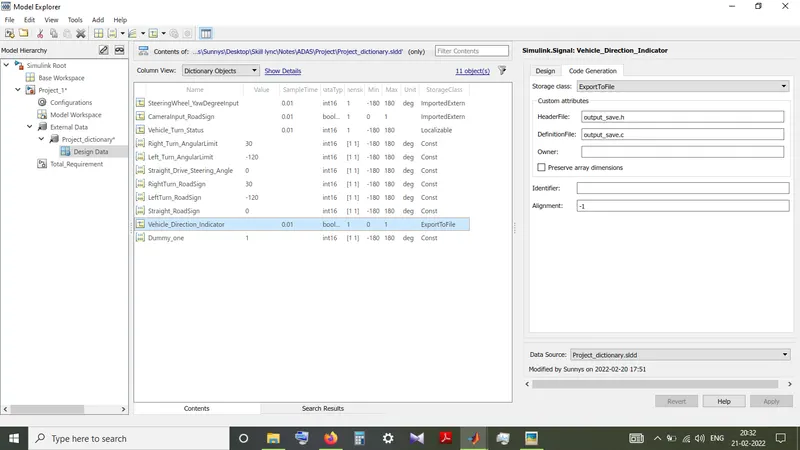
A symlink data dictionary he’s created with the name project_dictionary. All the signals, And the calibration values that were used in the model and given in in the requirement sheet or define in this dictionary.
The data types, initial values, minimum end Maximum values, storage classes etc were defined as per the requirement sheet.
For output signals header file and definition file were also defined
1 no additional dummy one parameter with value 1 he is also generated to use in our requirement.
Defining Model Settings:
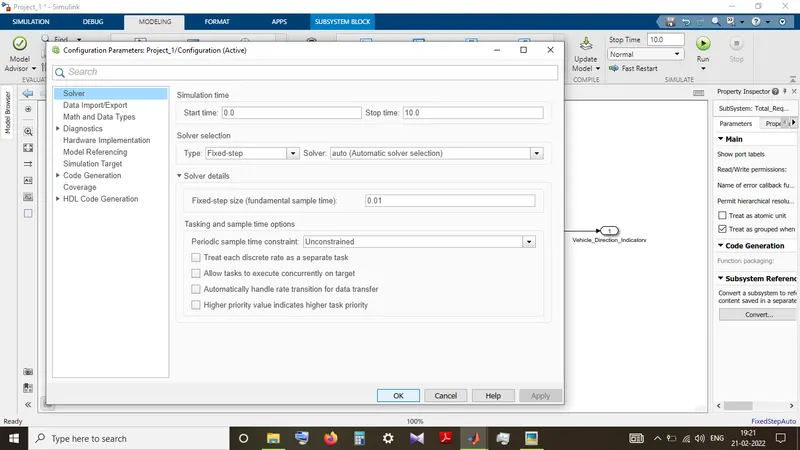
In the model configuration settings all the solverconfigurations are changed as per the requirement. Firstl the solver type changed to fixed step with sample time 0.01s.
All the error and warning settings are modified as per guidelines
Model Advisor:
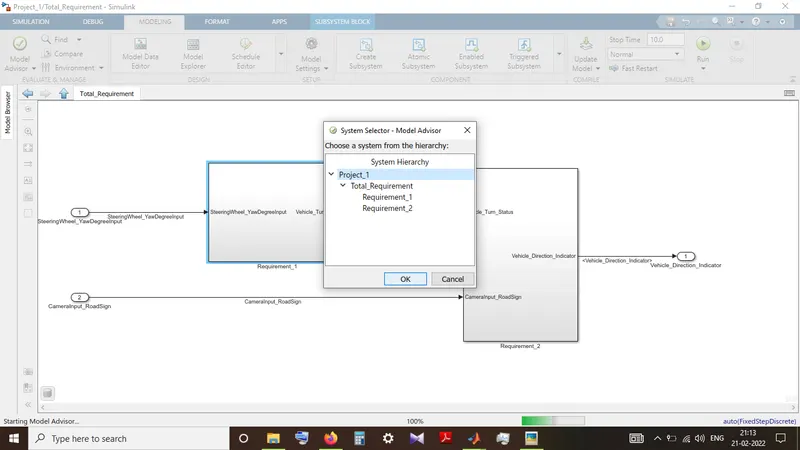
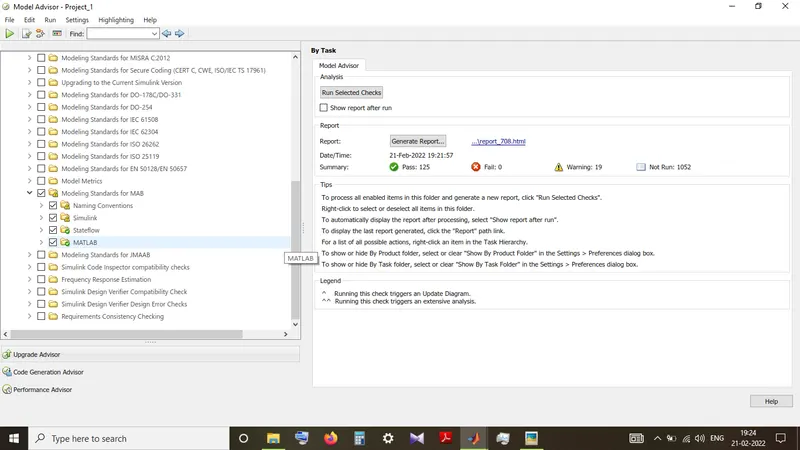
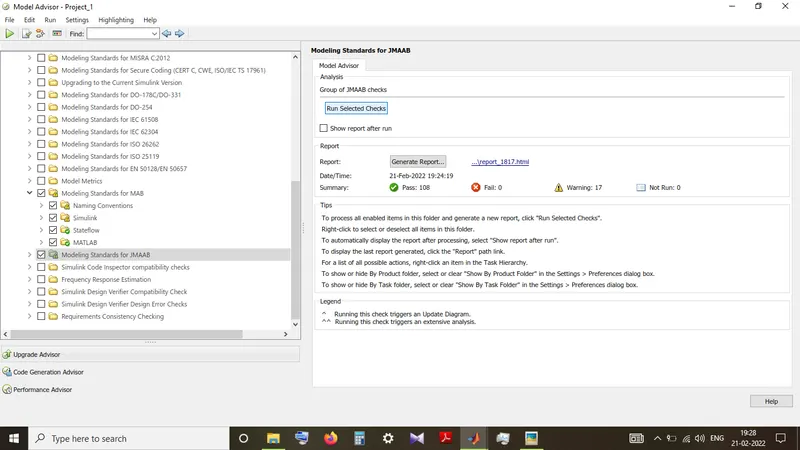
Now in the modeling tab we have the model advisor option in the model advisor option we have selected the complete model and then checked weather our created project is as per the modeling standards of MAB and JMAAB guidelines. Upon running the checks we can clearly see that our model has passed all the checks that were in the guidelines and a few warnings.
Output check:
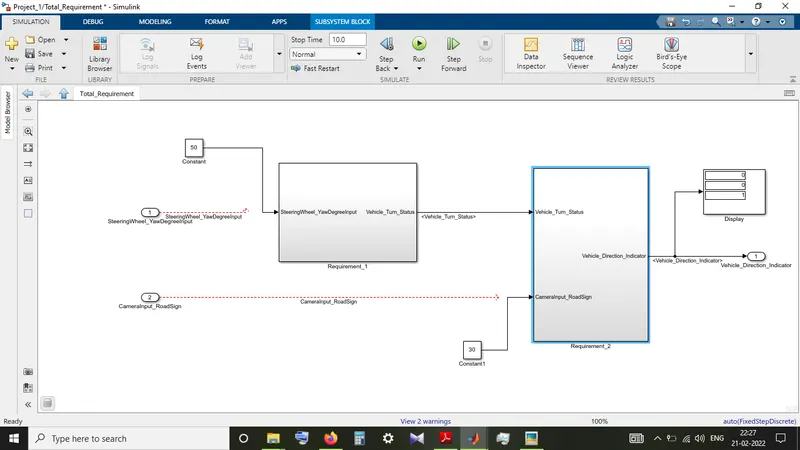
Testing is done by giving dummy yaw rate as 50 degrees and camera input as 30 degrees ( whch indicates right turn sign)
After execution it can be clearly seen in the output that the third value in the display block is 1. and in our subsystem the third signal is comparison with post RightTurn_RoadSign.
hence it can be clearly understood our model is working properly