Project 1 Mechanical design of battery pack
In this project,we are going to use the Cell: ANR26650M1-B
Battery pack capacity: 18 kWh
calculations are made with some assumptions
A battery consists of one or more electrochemical cells (battery cells) which are converting chemical energy into electrical energy (during discharging) and electrical energy into chemical energy (during charging). The type of elements contained within a battery and the chemical reactions during discharging-charging events define the chemistry of a battery.
A battery cell consists of five major components: electrodes – anode and cathode, separators, terminals, electrolytes, and a case or enclosure. For automotive applications, there are different types of cells used Individual battery cells are grouped into a single mechanical and electrical unit called a battery module. The modules are electrically connected to form a battery pack.
From the battery data sheet, we have to observe the following cell parameter. 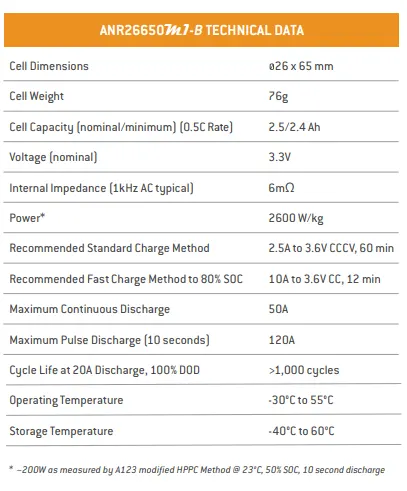
From above all parameters we will calculate further parameters which are used for battery pack construction.
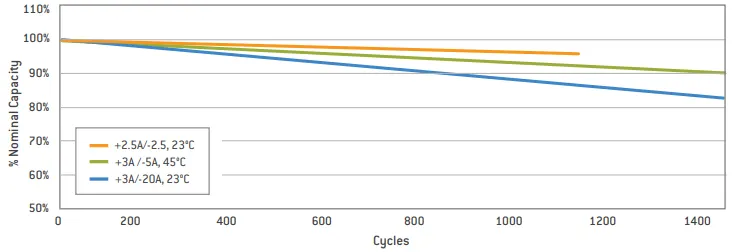
Cycle Life Performance, 100% DOD, Various Temperatures and Discharge Rates of cell:
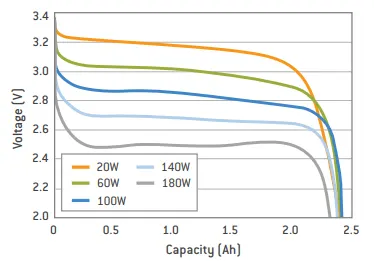
Constant Power Discharge Characteristics at 23°C of cell:
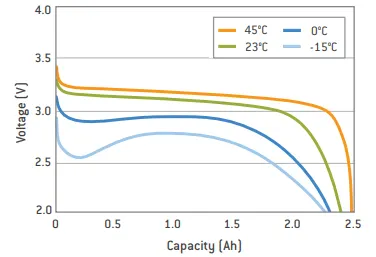
2.5C Constant Current Discharge at Various Temperatures:
A123’s high-performance Nanophosphate lithium iron phosphate (LiFePO4) battery technology delivers high power and energy density combined with excellent safety performance and extensive life cycling in a lighter weight, more compact package. Our cells have a low capacity loss and impedance growth over time as well as high usable energy over a wide state of charge (SOC) range, allowing our systems to meet end-of-life power and energy requirements with minimal pack oversizing.
Cell dimensions:
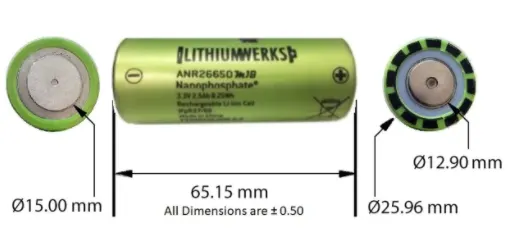
ANR26650M1-B Specifications
Nominal Ratings
Voltage: 3.3 Volts
Capacity: 2.5 Ah
Energy: 8.25 Wh
Specific Power: 2600 W/kg
Impedance (1KHz AC Typical) 6 mΩ
Cycle Life at 1C/1C, 100% DOD: > 4000 cycles
Cell Type: 26650 Lithium Ion Power Cylindrical Cell
Discharging
Max Continuous Discharage: 50 A
Max Pulse Discharge Current >50% SOC (10s): 120 A
Minimum Voltage: 2 Volts
Temperature: -30ºC to 55ºC
Charging
Recommended Standard Charge: 2.5 Amps
Max Charge Rate: 10 Amps
Max Pulse Charge Current <50% SOC (10s): 25 A
Float Voltage: 3.45 Volts
Recommended charge V & Cut-off Current: 3.6 Volts, taper to 125mA
Temperature
(reduce charging current to 250mA when under 0ºC): 0ºC to 55ºC
Mechanical
Diameter: Ø25.96 +/- 0.5 mm (1.0")
Length: 65.15 +/- 0.5 mm (2.6")
Mass: 76 g
Cell calculation:
1) Volume of the cell: For the calculation of the volume of the cell we use the formula of Volume of cylinder.
so the formula is: Pi*r^2*h
From Datasheet of Cell, we have 'r' and 'h' values
r=0.013m and h=0.065m = Volume of the cell: Pi*r^2*h
: 3.14*(0.013^2)*0.065
:0.0000344929m3
The volume of the cell is 0.0000344929m3
Basically, the value of the volume of the cell is used to find out the total volume of the battery pack.
Cell Energy= Cell Capacity (Ah) × Cell Voltage (V)
= 2.5 × 3.3
= 8.25 Wh
Cell Energy is 8.25 Wh
The value of a single cell is used to calculate the total energy of the battery pack.
Single Cell Energy Density
Volumetric energy (Wh/m3) = Single Cell Energy / Volume of each cell
= 8.25 Wh / 0.0000344929m3
=2,39,179.6572 Wh/m3
Single Cell Energy Density is 2,39,179.6572 Wh/m3
Battery Pack Assumtions:
There are 45 cell are in series and45 cells are in parallel, and as above maintioned we are going to use Cell: ANR26650M1-B this cells.
Battery pack calculation:
Now we calculated parallel and series combinations so we can now calculate total no of cells required
Total no of cells: Series cells * parallel cells
:50*44
:2,200.
Total no of cells required are 2,200.
So from series and parallel combination, we can calculate the voltage of battery pack and the current of the battery pack.
Voltage= no of cell in series* nominal voltage.
= 50*3.3
= 165V
The total value of voltage is 165V.
Current=No of parallel cells * cell capacity
= 44*2.5
=110Ah.
The total value of Current is 110Ah
So now we can calculate the how much mount of energy this combination have by product of voltage and current, and check the it will satisfied or not our requirement
Energy= Voltage * Current
= 165 * 110
= 18150WAh or 18.15kWh
The total value of Energy is 18150WAh or 18.15kWh .
So our calculation are satisfied requirement what we need.
now we have total no of cells and volume of single cell so we can calculate the total volume required for battery pack
Total volume = no of cells * Volume of single cell
= 2200 * 0.0000344929
=0.07588438m3
Total volume required for battery pack is 0.07588438m3
We also have single cell weight from that we can calculate the total weight of battery pack without other mechanical and electrical connections.
Weight = No of cells * weight of single cell.
= 2200 * 0.076
= 167.2kg
Weight of battery pack is 167.2kg
Energy dencity= volume * battery pack energy
= 0.07588438 * 18150
= 1,377.301497kWh/m^3
Energy dencity is 1,377.301497kWh/m^3
Now we all parameters which we need to construct the battery pack in physically.
- Package: 50S / 44P
- Capacity: 110 Ah
- Voltage: 165 V
- Weight: 167.2kg (Only Cells)
- No of Cells: 2100
- Power: 18150Wh or 18.15 kWh
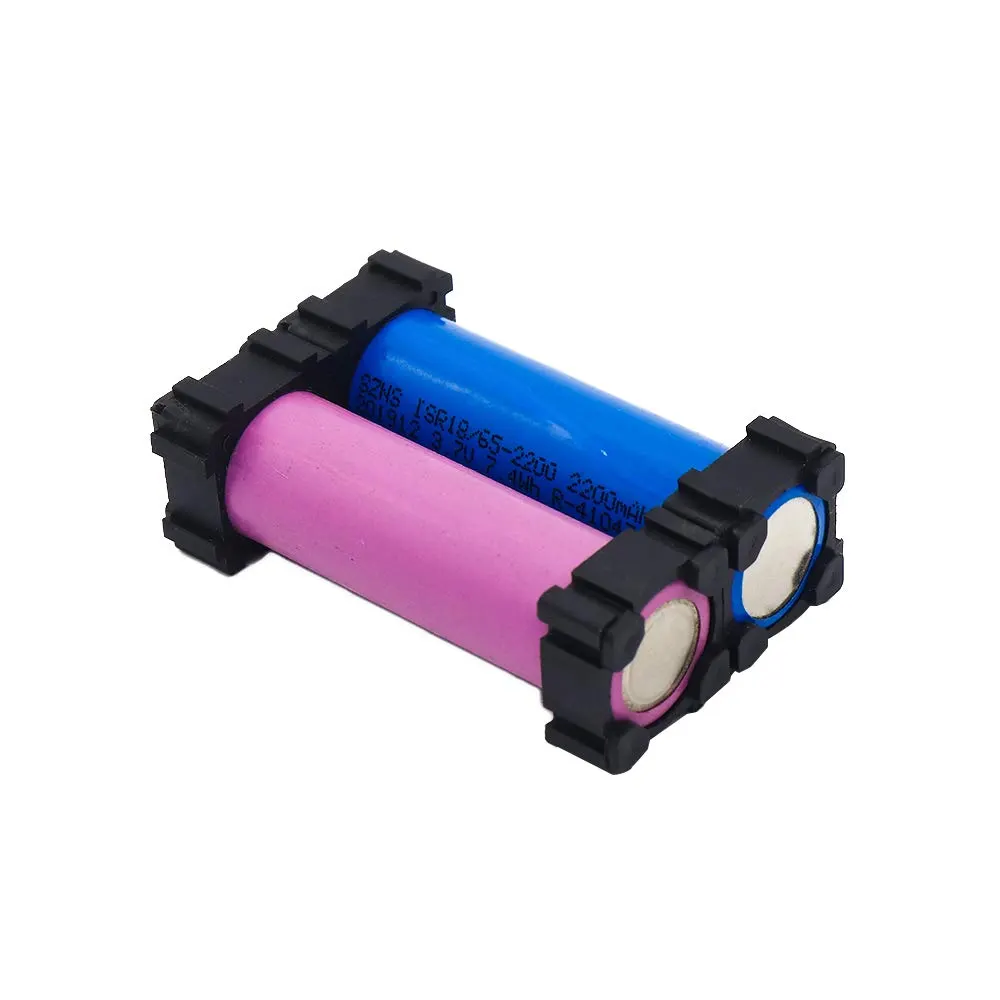
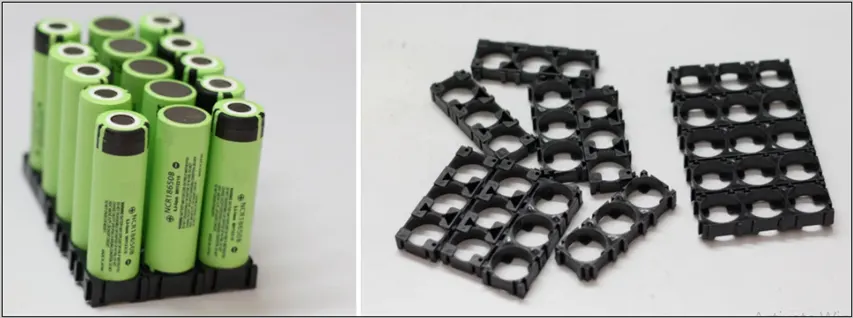
BATTERY HOLDER ,SPACER For CELL CYLINDRICAL LI-ION
Nickel Strips
Nickel strip is generally used in battery building. Its due to its efficiency of usage in spot welding and soldering as well its high corrosion resistance over time. It has good properties and excellent resistance to many corrosive environments. The pure nickel will never get rust after it applied to battery packs. It won’t affect the current transfer between batteries.
battery enclosure
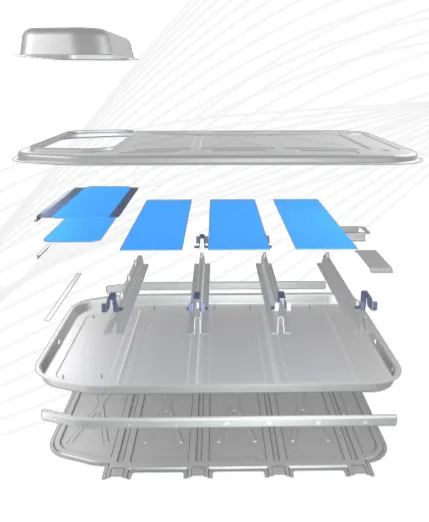
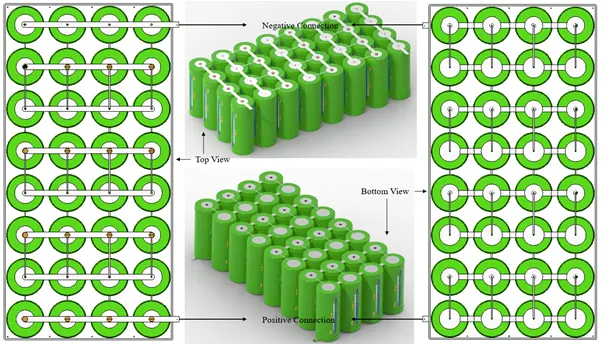
we design battery pack for 50s and 44p cell along wth battery spacers to hold cells and for their connection nickel strip is used .