Project 1 Mechanical design of battery pack
Q
Battery pack capacity: 18 kWh
Cell: ANR26650M1-B
Prepare a detailed battery pack drawing along with its enclosure. State your assumptions.
A
Features
The ANR26650M1-B is the next generation of A123 Systems’ pioneering 26650 cylindrical cell, now with greater power and energy density and lower impedance. This versatile lithium ion cell is suitable for a wide variety of applications and system designs. Proven performance in the toughest conditions, combining durability, reliability, and safety, the ANR26650 cell offers an excellent combination of price-performance.
Cylindrical Cell Primary Applications
- Portable high power devices
- Stationary battery backup systems
- Grid stabilization energy storage systems
- Commercial truck and bus hybrid electric vehicles (HEVs)
Nanophosphate® LiFePO4 Benefits
- Cycle Life at 1C/1C, 100% DOD, > 4000 cycles
- Safety: Excellent abuse tolerance and environmentally friendly
- Life: Excellent calendar life, 10X cycle life vs. conventional lithium ion
ANR26650M1-B Specifications
Nominal Ratings
Voltage: 3.3 Volts
Capacity: 2.5 Ah
Energy: 8.25 Wh
Specific Power: 2600 W/kg
Impedance (1KHz AC Typical) 6 mΩ
Cycle Life at 1C/1C, 100% DOD: > 4000 cycles
Cell Type: 26650 Lithium Ion Power Cylindrical Cell
Discharging
Max Continuous Discharage: 50 A
Max Pulse Discharge Current >50% SOC (10s): 120 A
Minimum Voltage: 2 Volts
Temperature: -30ºC to 55ºC
Charging
Recommended Standard Charge: 2.5 Amps
Max Charge Rate: 10 Amps
Max Pulse Charge Current <50% SOC (10s): 25 A
Float Voltage: 3.45 Volts
Recommended charge V & Cut-off Current: 3.6 Volts, taper to 125mA
Temperature
(reduce charging current to 250mA when under 0ºC): 0ºC to 55ºC
CALCULATIONS
So let’s us assume that the voltage of the battery pack is 300V
We know that P = Volatge*Current, hence we can calculate the Battery pack capacity.
Pack Capacity = Energy Capacity / Pack Voltage
Pack Capacity = (18*10^3)/300 = 60 Ah
No. of the cells in series = Pack Voltage / Cell Voltage = 300/3.3 = 90.90 so nearly 91 cells
No. of the cells in parallel = Pack Capacity / Cell Capacity = 60/2.5 = 24 cells
Total number of the cells in battery pack = (No. of the cells in series) *(No. of the cells in parallel) = 91*24 = 2184 cells
Total Energy of the pack = Pack Voltage * Pack Capacity = 300 * 60 = 18 kwh
So the battery pack having 18 kwh capacity with 91S24P Configuration.
Weight of the battery pack = (Total numbers of the cells in the battery pack) * (cell weight) = 2184 * 76 = 166 kg
Length of the battery pack = (No. of the cells in series) *(Cell Diameter) =
91 * 0.026 = 2.36 m
Width of the battery pack = (No. of the cells in the parallel) *(Cell Diameter) =
24 * 0.026 = 0.624 m
Area of the battery pack = (length of the battery pack) * (breadth of the battery pack) = 2.36 * 0.624 = 1.472 m^2
Volume of the battery pack = (Area of the battery pack) * (Cell Height) =
1.472 * 0.065 = 0.0956m^3 = 95.6 litres
Specific Energy density = Pack Energy Capacity/Weight of the battery pack =
(18 * 10^3)/166 = 108.43 Wh/kg
Volumetric Energy Density = Pack Energy Capacity / Volume of the battery pack = (18*10^3)/95.6 = 188.28 Wh/L
Cost of the battery pack = (Total no. of cells in the battery pack )*(Cost of the each cell) = 2184 * 6.55 $ = 14305.2 $ = 1072890 Rs
Design Overview:
NIKEL STRIPS


Battery Connection Welding Strip with 99.96% Pure Nickel -5Pcs. made of Pure Nickel Plate with 99.96% Pure Nickel Strap Strips Sheets.
It is generally used in the welding of battery points together to connect the batteries in combinations. These Nickel strips are popular because of their good performance while soldering as it gets soldered very quickly and easily with normal soldering metal with High tensile tension and Low resistivity.
They are mainly used in the manufacture of nickel-hydrogen batteries, lithium batteries, high magnification power tools batteries, laptop batteries, battery combination with HM.
SPOT WELDING
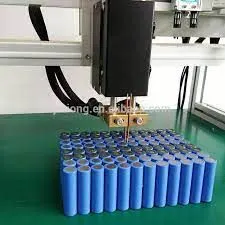
This battery spot welder is suitable for welding battery connections with solid welding, no discoloration of the welding joints, elimination of the grinding process and high welding efficiency. In addition, the welding machine draws power from the power grid instantaneous power is low, the power factor is high, the impact on the power grid is small, energy saving; the output voltage is stable, good consistency.
Battery Management System (BMS)

A BMS (Battery Management System) is essential in a Lithium-Ion battery system. This device manages a real-time control of each battery cell, communicates with external devices, manages SOC calculation, measures temperature and voltage, etc. (see key features on the right bar). The choice of BMS determines the quality and lifespan of the final battery pack.
Our BMS-Matrix® technology is a totally modular BMS solution, allowing you to build a very large capacity or power battery from unit “energy bricks”.
The configuration of a battery is done in a completely software-based way, whether for sizing, configuration but also operation and real-time monitoring.
All operating parameters can be configured according to the expected characteristics of the battery (peak power, average power, maximum DoD level, precharge of the system to be powered, and much more).
The deployment of a system using BMS-Matrix® technology is therefore very fast, and requires very little design (NRC) or prototyping costs before going into production. As certification is carried out at the level of the unit “energy bricks”, the final system benefits from the certification of the modules.