Project 1 - Design Enterprise Security Model
Components of the Security Model:
- Bank's Website (www.mybank.com): The website is developed in Java technology with the latest secure coding standards.
- So the data is sanitized to prevent SQL injection and other web vulnerabilities.
- Web Application Server (Apache 2.0): The server handles server-side validation for incoming requests
- ensuring that only legitimate and properly formatted requests are processed.
- Relational DBMS (Oracle 11.2.0.2.0): The database stores data using AES encryption
- It ensures that the customer's person and financial data is protected.
- Router/Gateway/Firewall/VPN (Cisco - ASA Series, 9.14(x)): These devices are used for Authentication, Authorization, and preventing duplication of requests.
- They form the network perimeter, allowing only authorized traffic to enter the network. These network devices help in filtering the network traffic using firewalls and providing a secure network connection by enabling VPN to access the website data.
- IDS/IPS (Juniper Networks - Junos OS Release 17.3R1): Intrusion Detection System (IDS),Intrusion Prevention System (IPS)
- They are used to monitor network traffic for malicious requests and take appropriate actions, such as blocking suspicious traffic.
- Database Activity Monitoring (IBM - Guardium Data Protection 11.5): This tool monitors activities within the database and alerts in case of any suspicious events, providing real-time visibility into database activities.
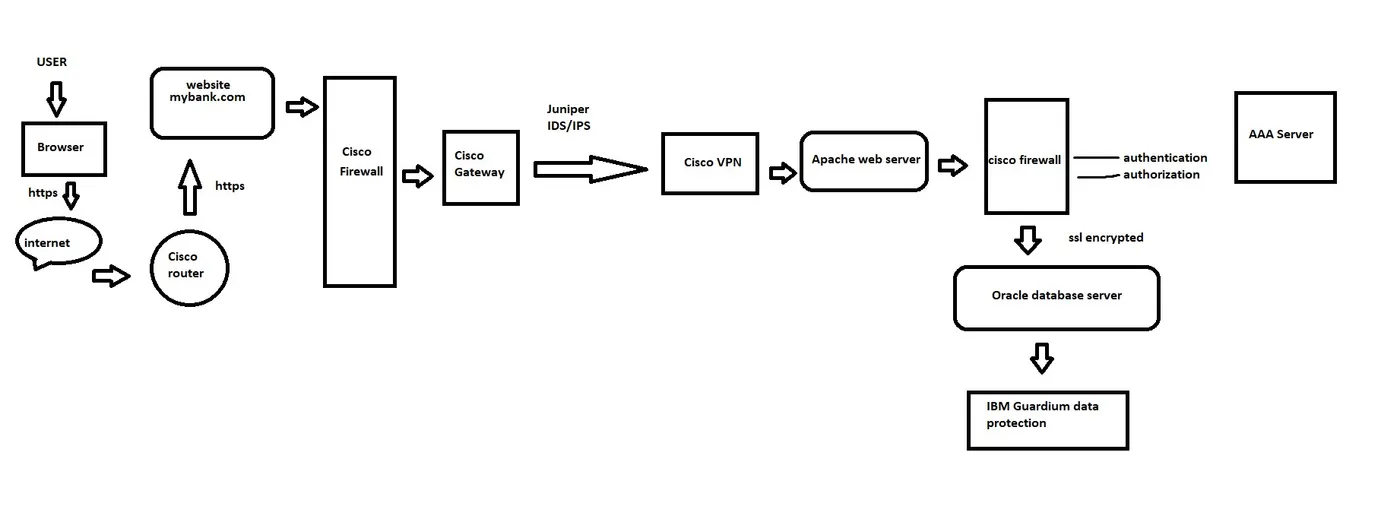
Security checklist to ensure the security of the bank's infrastructure/assets:
1. Website Security:
- Using secure connection via https to access the website and ensure the website follows the latest security coding standards.
- Regularly review and update code for vulnerabilities.
- Implement proper input validation to prevent SQL injection and other web attacks.
2. Web Application Server Security:
- Keep the Apache server up to date with security patches.
- Implement server-side validation and access controls.
- Configure server logs for auditing and monitoring.
3. Database Security:
- Update the Oracle DBMS with security patches on regular basis.
- Enforce strong access controls and authentication for database users.
4. Network Security:
- Cisco ASA Series devices need to have strict firewall rules.
- Implement VPN for secure remote access.
- Ensure that router and gateway configurations are regularly reviewed and hardened.
5. Intrusion Detection and Prevention:
- Maintain the Juniper IDS/IPS with the latest signatures and updates.
- Configure alerts for suspicious network activities.
- Implement automated responses to block malicious traffic.
6. Database Activity Monitoring:
- Configure Guardium Data Protection to monitor and audit any suspicious database activities.
- Set up real-time alerts for unusual database access.
- Regularly review and update Guardium policies.
7. Periodic Security Hardening:
- All devices in the infrastructure should undergo regular security hardening on a weekly basis as scheduled.
8. Incident Response Plan:
- Develop and maintain an incident response plan if any security breaches occur.
- Implement regular data backups and test disaster recovery procedures.
9. Security Training:
- Provide security awareness training to employees and customers to prevent social engineering attacks.
10. Third-Party Security Assessment:
- Conduct regular security assessments of third-party services used in the infrastructure.
11. Compliance and Auditing:
- Ensure the infrastructure and security is always compliant with relevant banking regulations and industry standards.
- Conduct regular security audits and assessments.
12. Documentation:
- Maintain detailed documentation of the security measures, configurations, and policies in place.