Project 1 - Creation of user defined data type to implement the user interfaces for working with ‘Set’ (Mathematical Set theory) using Linked List
#include <stdio.h>
#include <stdlib.h>
// Node structure for the linked lists
struct Node {
int data;
struct Node *next;
};
// Function to traverse and print a linked list
void linkedListTraversal(struct Node *ptr) {
while (ptr != NULL) {
printf("%d ", ptr->data);
ptr = ptr->next;
}
printf("\n");
}
// Function to insert a node at the end of the linked list
struct Node* insertAtEnd(struct Node *head, int data) {
struct Node *ptr = (struct Node *)malloc(sizeof(struct Node));
ptr->data = data;
ptr->next = NULL;
if (head == NULL) {
return ptr;
}
struct Node *p = head;
while (p->next != NULL) {
p = p->next;
}
p->next = ptr;
return head;
}
// Function to find the union of two sets
struct Node* findUnion(struct Node *head1, struct Node *head2) {
struct Node *unionHead = NULL;
struct Node *temp1 = head1;
// Insert all elements of the first list into the union list
while (temp1 != NULL) {
unionHead = insertAtEnd(unionHead, temp1->data);
temp1 = temp1->next;
}
// Insert elements of the second list if they are not already in the union list
struct Node *temp2 = head2;
while (temp2 != NULL) {
struct Node *search = unionHead;
int found = 0;
while (search != NULL) {
if (search->data == temp2->data) {
found = 1;
break;
}
search = search->next;
}
if (!found) {
unionHead = insertAtEnd(unionHead, temp2->data);
}
temp2 = temp2->next;
}
return unionHead;
}
// Function to find the intersection of two sets
struct Node* findIntersection(struct Node *head1, struct Node *head2) {
struct Node *intersectionHead = NULL;
struct Node *temp1 = head1;
// Check elements of the first list against the second list
while (temp1 != NULL) {
struct Node *temp2 = head2;
while (temp2 != NULL) {
if (temp1->data == temp2->data) {
intersectionHead = insertAtEnd(intersectionHead, temp1->data);
break;
}
temp2 = temp2->next;
}
temp1 = temp1->next;
}
return intersectionHead;
}
int main() {
struct Node *head1 = NULL;
struct Node *head2 = NULL;
// Create first linked list: 1 -> 2 -> 3
head1 = insertAtEnd(head1, 1);
head1 = insertAtEnd(head1, 2);
head1 = insertAtEnd(head1, 3);
// Create second linked list: 3 -> 4 -> 5
head2 = insertAtEnd(head2, 3);
head2 = insertAtEnd(head2, 4);
head2 = insertAtEnd(head2, 5);
printf("1st set Elements: ");
linkedListTraversal(head1);
printf("2nd set Elements: ");
linkedListTraversal(head2);
// Find and print the union of the two lists
struct Node *unionList = findUnion(head1, head2);
printf("Union: ");
linkedListTraversal(unionList);
// Find and print the intersection of the two lists
struct Node *intersectionList = findIntersection(head1, head2);
printf("Intersection: ");
linkedListTraversal(intersectionList);
return 0;
}
logic)
Data Structures: A single Node structure for simplicity.
Traversal Function: linkedListTraversal to traverse and print a linked list.
Insertion Function: insertAtEnd to add elements to the end of a linked list.
Union Function: findUnion combines elements from both linked lists without duplicates.
Intersection Function: findIntersection identifies common elements between the two linked lists.
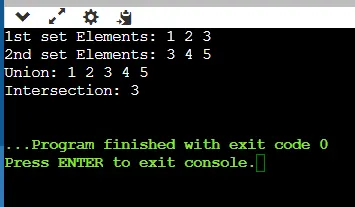
Main Function: Initializes the linked lists, performs insertions, and prints the results, including the union and intersection of the two lists.
output)