Project 1 - Creation of user defined data type to implement the user interfaces for working with ‘Set’ (Mathematical Set theory) using Linked List
c code
#include
#include

// Node structure for the linked list
typedef struct Node {
    int data;
    struct Node *next;
} Node;

// Function to insert an element into a linked list
void insert(Node **head, int data) {
    Node *newNode = (Node *)malloc(sizeof(Node));
    newNode->data = data;
    newNode->next = NULL;

    if (*head == NULL) {
        *head = newNode;
    } else {
        Node *temp = *head;
        while (temp->next != NULL) {
            temp = temp->next;
        }
        temp->next = newNode;
    }
}

// Function to print the elements of a linked list
void printList(Node *head) {
    while (head != NULL) {
        printf("%d ", head->data);
        head = head->next;
    }
    printf("\n");
}

// Function to find the union of two sets
Node *setUnion(Node *set1, Node *set2) {
    Node *result = NULL;
    while (set1 != NULL) {
        insert(&result, set1->data);
        set1 = set1->next;
    }
    while (set2 != NULL) {
        if (!search(result, set2->data)) {
            insert(&result, set2->data);
        }
        set2 = set2->next;
    }
    return result;
}

// Function to find the intersection of two sets
Node *setIntersection(Node *set1, Node *set2) {
    Node *result = NULL;
    while (set1 != NULL) {
        if (search(set2, set1->data)) {
            insert(&result, set1->data);
        }
        set1 = set1->next;
    }
    return result;
}

// Function to check if an element is present in a linked list
int search(Node *head, int key) {
    while (head != NULL) {
        if (head->data == key) {
            return 1; // Element found
        }
        head = head->next;
    }
    return 0; // Element not found
}

// Function to free the memory allocated for the linked list
void freeList(Node *head) {
    Node *temp;
    while (head != NULL) {
        temp = head;
        head = head->next;
        free(temp);
    }
}

int main() {
    Node *set1 = NULL;
    Node *set2 = NULL;

    // Example input: insert elements into sets
    insert(&set1, 1);
    insert(&set1, 2);
    insert(&set1, 3);

    insert(&set2, 2);
    insert(&set2, 3);
    insert(&set2, 4);

    printf("Set 1: ");
    printList(set1);

    printf("Set 2: ");
    printList(set2);

    Node *unionResult = setUnion(set1, set2);
    printf("Union: ");
    printList(unionResult);

    Node *intersectionResult = setIntersection(set1, set2);
    printf("Intersection: ");
    printList(intersectionResult);

    // Free the memory allocated for the linked lists
    freeList(set1);
    freeList(set2);
    freeList(unionResult);
    freeList(intersectionResult);

    return 0;
}
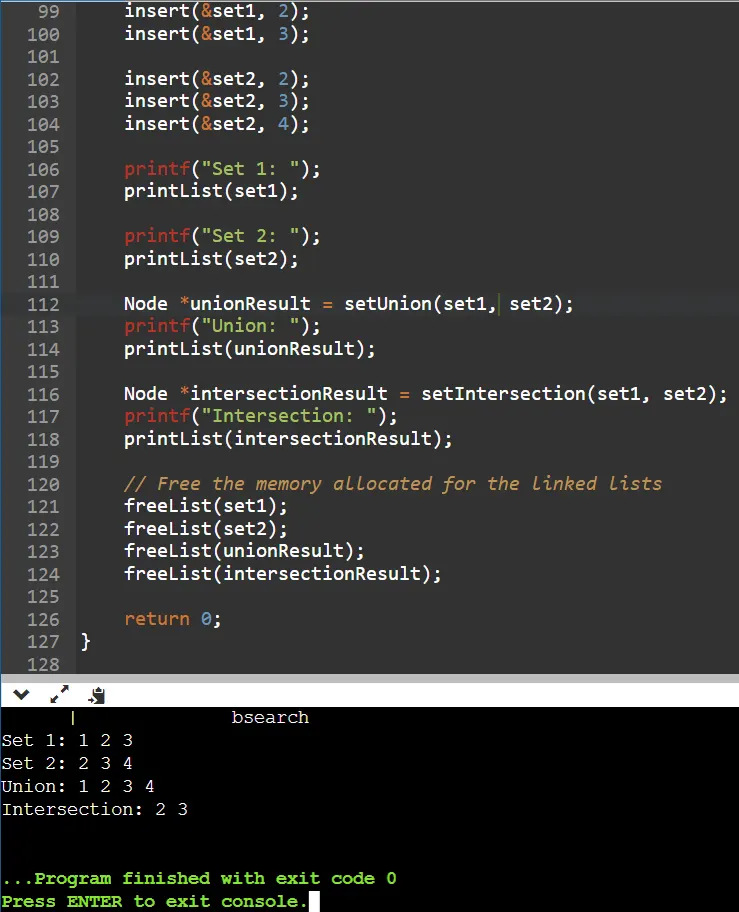
output
Set 1: 1 2 3
Set 2: 2 3 4
Union: 1 2 3 4
Intersection: 2 3
#include
#include
// Node structure for the linked list
typedef struct Node {
int data;
struct Node *next;
} Node;
// Function to insert an element into a linked list
void insert(Node **head, int data) {
Node *newNode = (Node *)malloc(sizeof(Node));
newNode->data = data;
newNode->next = NULL;
if (*head == NULL) {
*head = newNode;
} else {
Node *temp = *head;
while (temp->next != NULL) {
temp = temp->next;
}
temp->next = newNode;
}
}
// Function to print the elements of a linked list
void printList(Node *head) {
while (head != NULL) {
printf("%d ", head->data);
head = head->next;
}
printf("\n");
}
// Function to find the union of two sets
Node *setUnion(Node *set1, Node *set2) {
Node *result = NULL;
while (set1 != NULL) {
insert(&result, set1->data);
set1 = set1->next;
}
while (set2 != NULL) {
if (!search(result, set2->data)) {
insert(&result, set2->data);
}
set2 = set2->next;
}
return result;
}
// Function to find the intersection of two sets
Node *setIntersection(Node *set1, Node *set2) {
Node *result = NULL;
while (set1 != NULL) {
if (search(set2, set1->data)) {
insert(&result, set1->data);
}
set1 = set1->next;
}
return result;
}
// Function to check if an element is present in a linked list
int search(Node *head, int key) {
while (head != NULL) {
if (head->data == key) {
return 1; // Element found
}
head = head->next;
}
return 0; // Element not found
}
// Function to free the memory allocated for the linked list
void freeList(Node *head) {
Node *temp;
while (head != NULL) {
temp = head;
head = head->next;
free(temp);
}
}
int main() {
Node *set1 = NULL;
Node *set2 = NULL;
// Example input: insert elements into sets
insert(&set1, 1);
insert(&set1, 2);
insert(&set1, 3);
insert(&set2, 2);
insert(&set2, 3);
insert(&set2, 4);
printf("Set 1: ");
printList(set1);
printf("Set 2: ");
printList(set2);
Node *unionResult = setUnion(set1, set2);
printf("Union: ");
printList(unionResult);
Node *intersectionResult = setIntersection(set1, set2);
printf("Intersection: ");
printList(intersectionResult);
// Free the memory allocated for the linked lists
freeList(set1);
freeList(set2);
freeList(unionResult);
freeList(intersectionResult);
return 0;
}