Project 1
1. Design a battery pack for a car roughly 150 Kw with 120 V. Use 3500 mAh 3.6V nominal NMC chemistry cell.
a. Design the battery pack configuration.
b. Draw the BMS topology for this battery pack.
Answer:-
a)Design the battery pack configuration.
Cell Specifications:
Nominal Voltage= 3.6V
Max. Voltage= 4.2V
Nominal cell capacity= 3500mAh = 3.5 Ah
Rated power=150kw
Rated voltage=120v
First finding the motor current= (rated power *1000)/rated voltage
= (150*1000)/120
=1250A
Number of cells in series = total voltage /cell nominal voltage
Assuming the max voltage as the total voltage
Number of cells in series = 120 /3.6
Number of cells in series = 33.33
Rounding off the number of cells in series depends on
- Maximum voltage
- Minimum voltage
Test-1
Rounding off 33.33 to 33
Nominal battery voltage = cell nominal voltage * 33
= 3.6 * 33 = 118.8V
Maximum battery voltage = cell max voltage * 1
= 4.2*33 = 138.6 v
Minimum battery voltage = cell minimum voltage * 1
= 2.7 *33 =89.1V
Test-2
Rounding off 33.33 to 34
Nominal battery voltage = cell nominal voltage * 34
= 3.6 * 34 = 122.4V
Maximum battery voltage = cell max voltage * 2
= 4.2*34 = 142.8v
Minimum battery voltage = cell minimum voltage * 2
= 2.7 *34=91.8V
Number of cells in parallel = Total current/cell nominal capacity
Number of cells in parallel = 1250/3.5
Number of cells in parallel = 357.14
The number of cells in series is taken as test-2 with 34 cells in series.
The number of cells in parallel is taken as 357 cells.
The nominal voltage of the battery pack = no. of cells in series * nominal voltage of a cell
= 34* 3.6
= 122.4 V
Rated capacity of the battery pack = no of cells in parallel * rated capacity of a cell
= 357 * 3.5
= 1249.5Ah
The overall voltage of the battery pack = maximum voltage of a cell * no of cells in series.
The overall voltage of the battery pack = 4.2 * 34 = 142.8V
The battery pack configuration is 34s357p
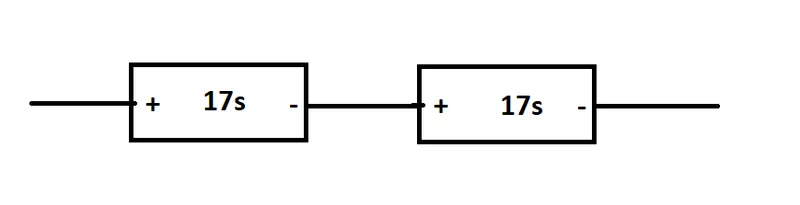
The 34 cells are connected in series like shown below
b.Draw the BMS topology for this battery pack.
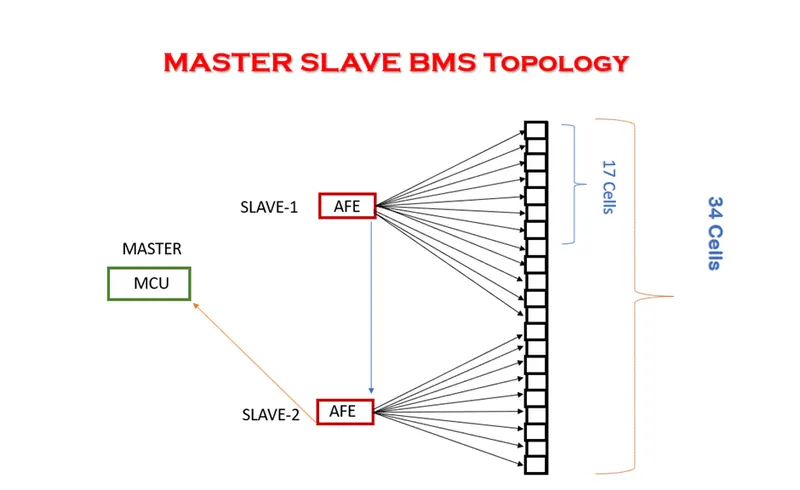
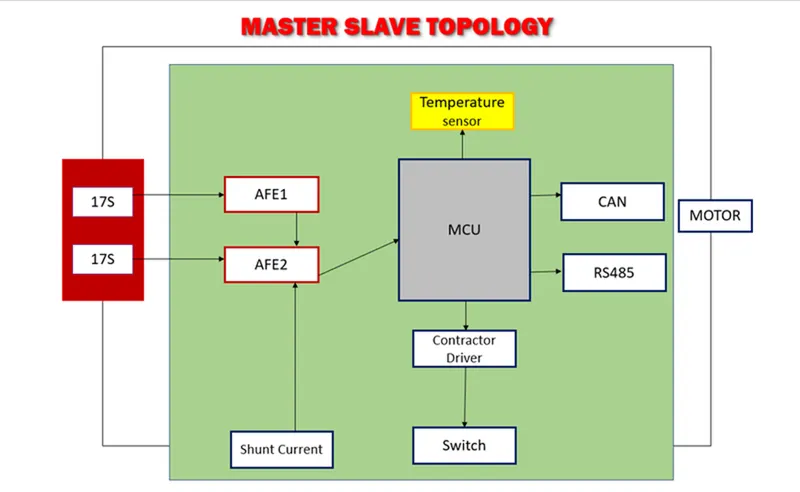
For the above battery pack we have to draw the BMS topology based on number of cells connected in series so the number of cells is 34 cells so the cells are more than 18 then we use master & slave topology
In this topology we using daisy chain interface means it collects the all data of slave-1 is sent to slave-2 collects the 17 cells data and the slave-2 and slave-1 data sent to micro controller unit. The topology is shown below
2. Build a 3S2P battery pack configuration with generic battery block using Matlab/Simulink.
Answer:-
Total number of cells in battery pack = no.of cells in series * no.of cells in parallel
= 3*2
=6 cells
Series connection of a battery:
Batteries are connected from teminal to terminal in a way that the +ve terminal one battery is connected to -ve termnal of the other battery and -ve terminal of one battery is connected to +ve terminal of other battery.
Parallel connection of a batteery:
Batteries are connected from terminals to same terminals of the other batteries that is +ve terminal of one battery is connected to +ve terminal of other battery and -ve terminal of one battery is connected to -ve terminal of other battery.
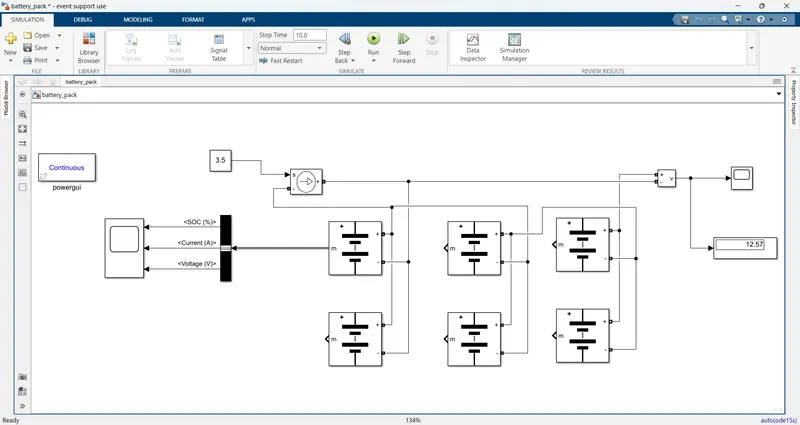
The battery pack model is shown below
Model explanation:
The voltage is measured bu using voltage measurement and is connected across the battery pack and the scope is connected to bus selector and is connected to battery measurement port for measuring the SOC,voltage & current of the cell the constant block is connected to controlled current source and is given load to the battery pack.
Battery parameters are given below
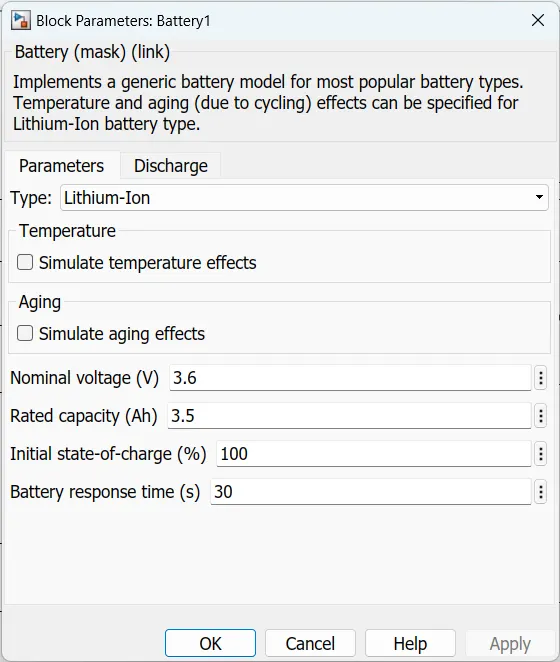
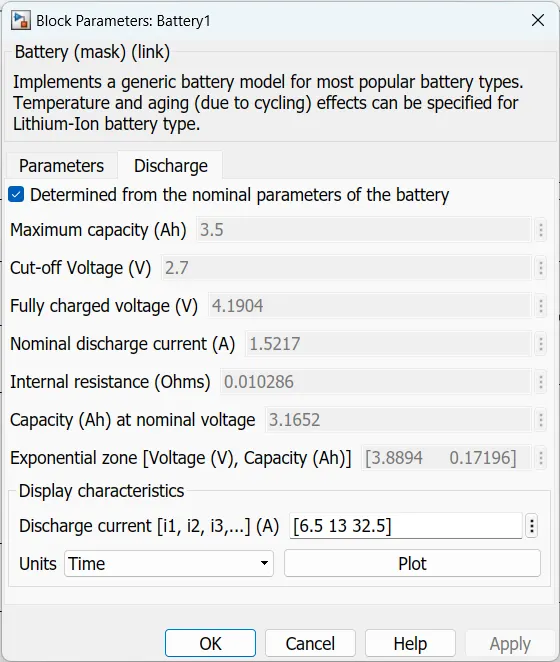
Nominal voltage of cell = 3.6v
Rated capacity of cell =3.5Ah
Maximum voltage of cell =4.2v
Total number of cells in a battery pack = no.of cells in series * no.of cells in parallel
= 3*2 = 6 cells
Nominal voltage of the battery pack = no.of cells in series * nominal volatege of a cell
Nominal voltage of the battery pack = 3*3.6v = 10.8v
Rated capacity of battery pack = no.of cells in parallel * Rated capacity of a cell
= 2*3.5
Rated capacity of battery pack=7Ah
Overall voltage of the battery pack=maximum capacity of the cell*no.of cells in series
=4.2*3
Overall voltage of the battery pack =12.6v
Capacity: The capacity of a battery or cell is defined as the amount of energy that it can deliver in a single discharge. Battery capacity is normally specified in amp-hours (or milli-amp-hours) or as watt-hours.
Charge rate or C-rate : The definition of the charge rate or C-rate of a battery or cell is the charge or discharge current in Amperes as a proportion of the rated capacity in Ah. For example, in the case of a 500 mAh battery, a C/2 rate is 250 mA and a 2C rate would be1 A.
Constant-Current Charge: This refers to a charging process where the level of current is maintained at a constant level regardless of the voltage of the battery or cell.
Constant-Voltage Charge: This definition refers to a charging process in which the voltage applied to a battery is held at a constant value over the charge cycle regardless of the current drawn.
Cycle Life: The capacity of a rechargeable cell or battery changes over its life. The definition of the battery life or cycle life of a battery is number of cycles that a cell or battery can be charged and discharged under specific conditions, before the available capacity falls to a specific performance criteria - normally 80% of the rated capacity.
Cut-off voltage: As a battery or cell is discharged it has a voltage curve that it follows - the voltage generally falling over the discharge cycle. The definition for a cell or battery of the cut-off voltage cell or battery is the voltage at which the discharge is terminated by any battery management system. This point may also be referred to as the End-of-Discharge voltage.
Energy Density: The volumetric energy storage density of a battery, expressed in Watt-hours per litre (Wh/l).
Power Density: The volumetric power density of a battery, expressed in Watts per litre (W/l).
Rated Capacity: The capacity of a battery is expressed in Ampere-hours, Ah and it is the total charge that can be obtained from a fully charged battery under specified discharge conditions
Self-Discharge: It is found that batteries and cells will lose their charge over a period of time, and need re-charging. This self-discharge is normal, but various according to a number of variables including the technology used and the conditions. Self-discharge is defined as the recoverable loss of capacity of a cell or battery. The figure is normally expressed in a percentage of the rated capacity lost per month and at a given temperature. The self-discharge rate of a battery or cell is very dependent upon the temperature.
Specific Energy: The gravimetric energy storage density of a battery, expressed in Watt-hours per kilogram (Wh/kg).
Specific Power: The specific power for a battery is the gravimetric power density expressed in Watts per kilogram (W/kg).
Results :
After running the model the voltage like shown below
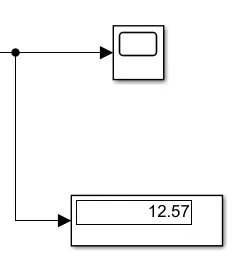
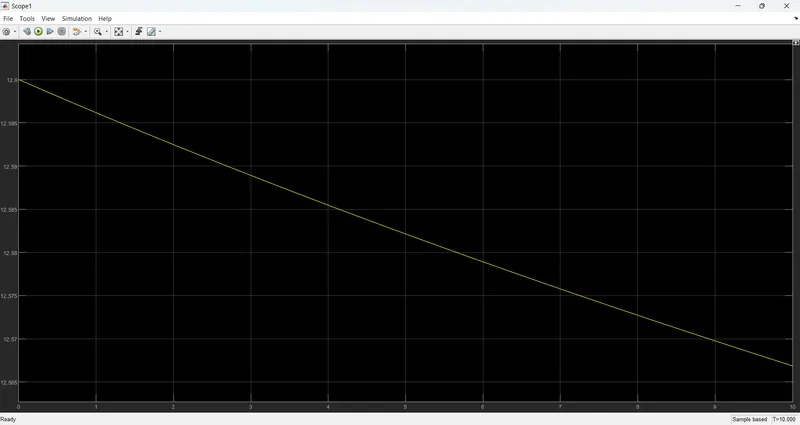
The voltage is dropped from 12.6v to 12.57v for this battery pack.
Cell SOC,Current & voltage are shown below
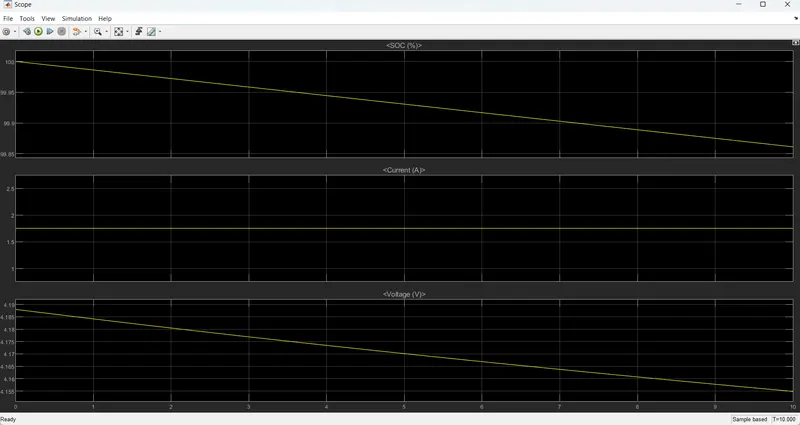
First plot shows SOC of the cell it is dropped from 100% to 99.86 %
Second plot shows Current of the cell it is nearly 1.8A
Third plot shows voltage of the cell it is dropped from 4.188v to 4.155volts