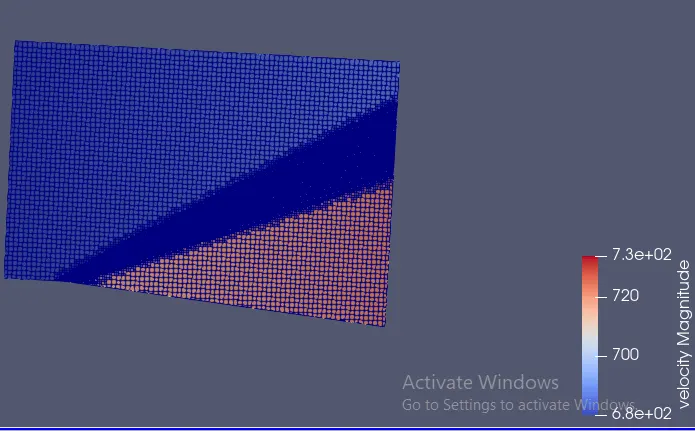
Prandtl Meyer Shock problem
- when the flow is subsonic, and it encounters any obstacle or change in flow area , the fluid element has sufficient time to adjust themselves according to downstream obstacle or area change.
- The acoustic signal which carries the information regarding any obstacle or change in flow area downstream travels at the speed of sound.
- however, in supersonic case the information coded in the acoustic signal doesnt get sufficient time to pass this information upstream.
Flow accross shock wave are adiabatic and irreversible in nature
- the shock wave is very thin compression wavefront of thickness comparable to mean free path of gas molecules in flow field.
- the flow accorss the shockwave is of high velocity.
- owning to the above factors, the fluid crosses the wave in infinitesimal time.
- thus thus the fluid particles are unable to exchange energy with the surrounding.
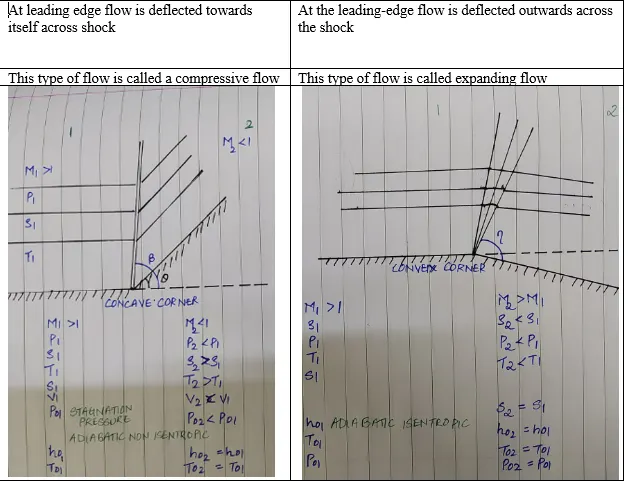
Natural and external shock waves are predominently oblique in nature
- Normal shock waves
- Oblique shock waves
- Expansion shock waves

Boundary conditions:
- boundary conditions are constraints for solution of boundary value problem
- there are 3 types of boundary conditions
Dirichlet boundary condition: determines value on the domain boundary of unknown function
eg: u(x,t)displacement of vibrating string with end fixed at x=0 and x=h
u(0,t)=0 and u(h,t)=0 are the dirichlet b.c
neumann boundary condition: determines value of derivatve of solution at domain boundary
robin bc: consists of linear combination of values of field variable and derivatives at boundary
boundary conditions used in case set up
inlet: a dirichlet boundary condition used for velocity specifying value 680m/s that gives mach 1.6 at temperature boundary condition maintained at 286.1k at which speed of sound is 417.57m/s. Pressure boundary condition set to zsero normal gradient which is neumann boundary condition.
outlet: the pressure and velocity bc are set to zero normal gradient. Supersonic outlets are set to neumann bc as as boundary pressure and velocity is extrapolated from the interior field.
top-botton wall: top bottom wall set at slip condition. the temperature boundary condition set at zero normal gradient
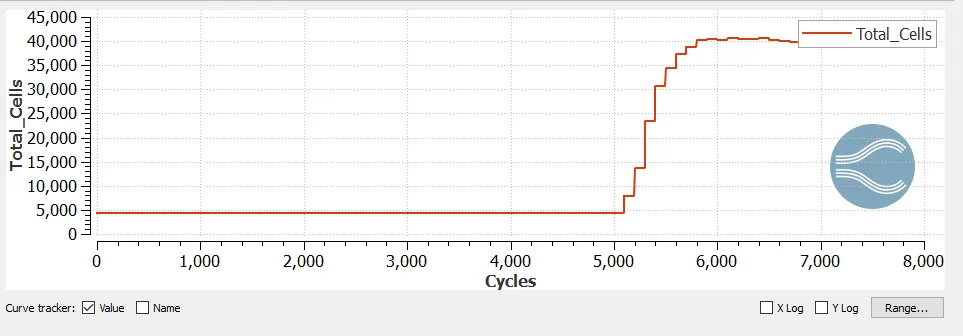
The steady state simulation ran for 25000 cycles. A density based solver is used , since in supersonic compressible flow the density increases on downstream side.
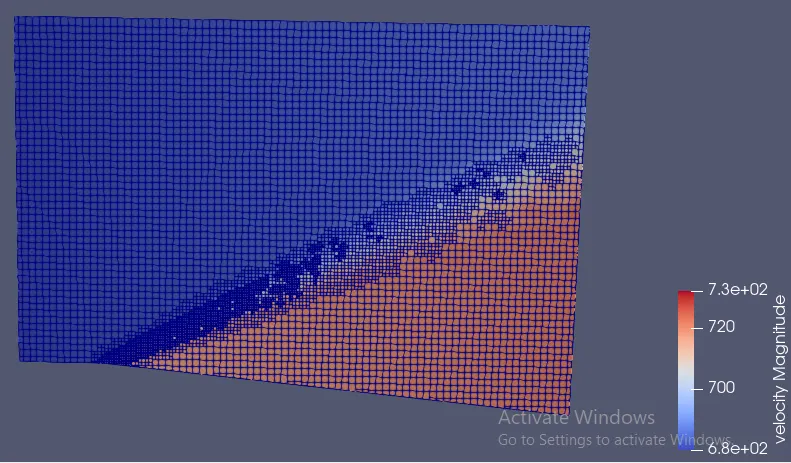
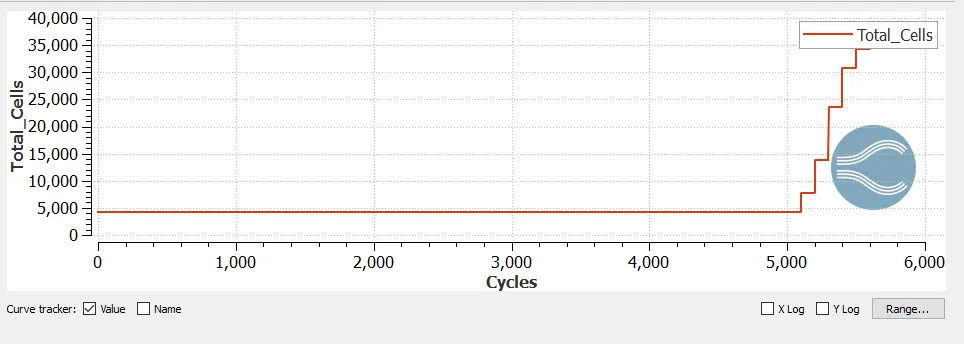
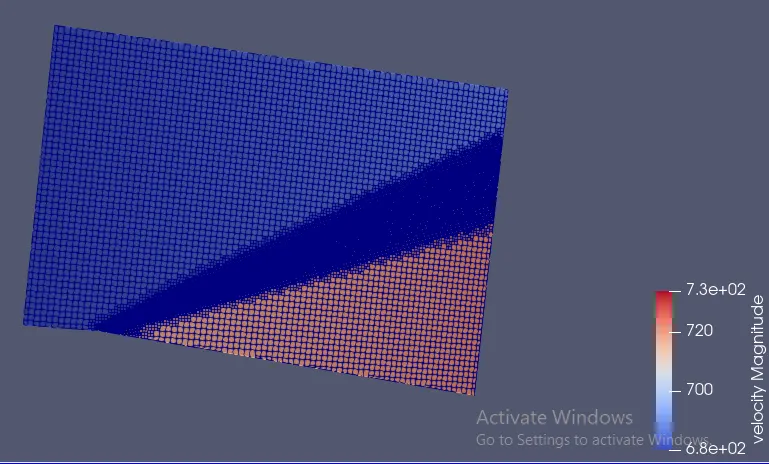
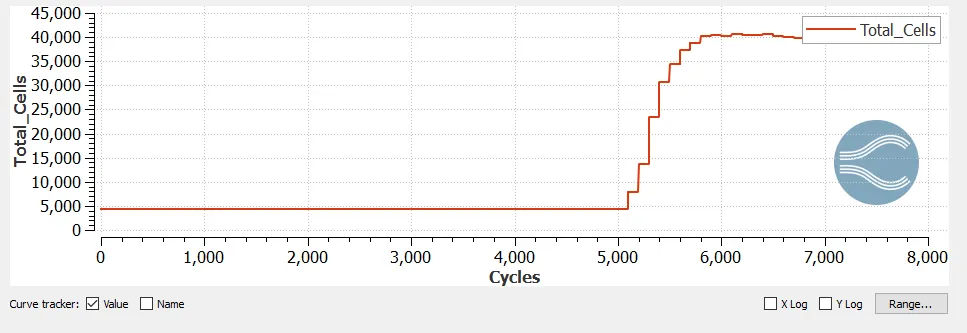
a temperature based adaptive mesh refinement is used with a base grid of 0.8m. Maximum embedd level is set at 2. the results are observed for 3 sub grid criterion; 0.01,0.1,0.05
AMR is a technique which is used to refine accuracy of specific areas within a domain where quantification of precision is required, while maintaining the precision and resolution of other areas at lower level. In this simulation the region where shock occurs will have higher order of precision therefore finer cells than the surrounding region which has the base grid size of 0.8m.
Temperature based mesh refinement computes the rate of temperature change. I.e. the temperature curvature within the shock domain. If the curvature exceeds user defined value the mesh will be refined. Maximum embedding level is 2(n)
Thus, the refined mesh will have cell size:
Grid size= Base grid (0.8m)/2^2(n)=0.2m