MOTION ANALYSIS ON INTERNAL GENEVA ASSEMBLY
PROJECT ON INTERNAL GENEVA MECHANISM :
AIM:
To Create and perform motion analysis on Internal geneva wheel Assembly.
INTRODUCTION :
The Geneva drive or Maltese cross is a gear mechanism that translates a continuous rotation movement into intermittent rotary motion.Internal Geneva wheel is a Mechanical component that includes INTERMITTENT MOTION MECHANISM between the driver and driven wheels.So, Geneva mechanism is also called as Intermittent motion mechanism.Intermittent motion is nothing but discontinuous motion of driven wheel.In this project we are going to understand the mechanism of the Internal Geneva wheel where the slots of the driven wheel are cut Internally.
Geneva wheel is a timing device that is majorly used in Mechanical watches.The name, Geneva drive, is derived from the device's earliest application in Mechanical, which were popularized in Geneva, being the classical origin of watchmaking industry in Switzerland.The Geneva Mechanism basically converts continuous motion of the driver into discontinuous motion of the driven wheel.This is illustrated in the following animations.


Simple Geneva wheel Mechanism Internal Geneva Wheel
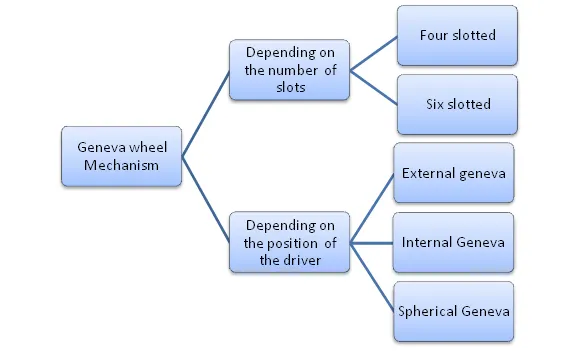
In Six slotted Geneva Wheel, For 1 revolution of Geneva Driven Wheel ,the driver should complete six revolutions .
In Four slotted Geneva Wheel, For 1 revolution of Geneva Driven wheel ,the driver should complete four revolutions.
CLASSIFICATION OF GENEVA WHEEL MECHANISMS:
OBJECTIVES OF THE PROJECT :
- To Create 3-D Models for Driver and Driven Parts of the Internal Geneva mechanism based on the given 2-D drawings in Solid works.
- To Perform motion analysis by rotating the driver wheel at 10rpm and 20 rpm.
- To Obtain the following plots for both cases:
- Contact force (between driving and the driven wheel) as a function of time.
- Angular Displacement of the driven wheel.
- Compare the contact forces with and without "Precise contact" between the assebly parts.
- To plot a graph of Angular Velocity V/s time for the driver.
CONDITIONS :
- Use 60 Frames per second for 10 RPM and 120 Frames per second for 20 RPM.
- The 2-D drawings for designing the assembly are as follows:
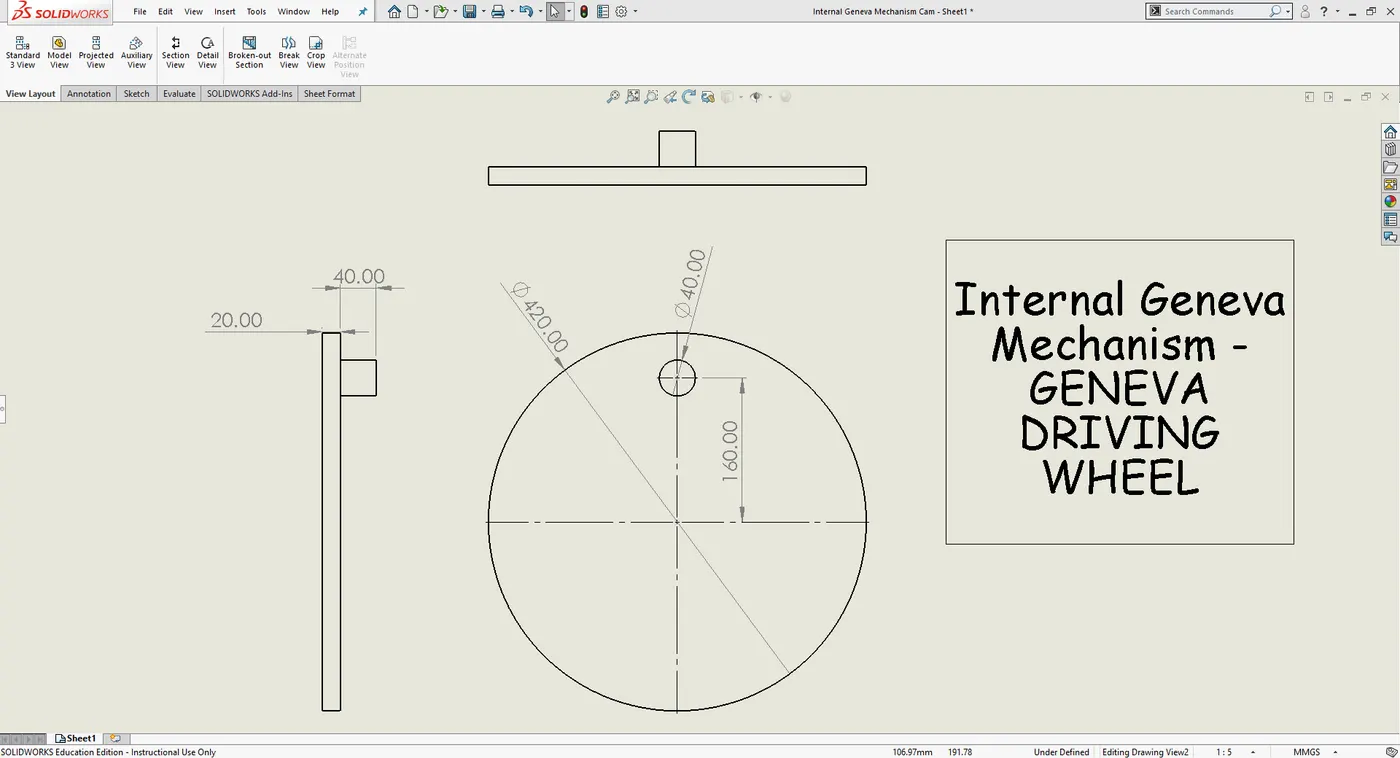
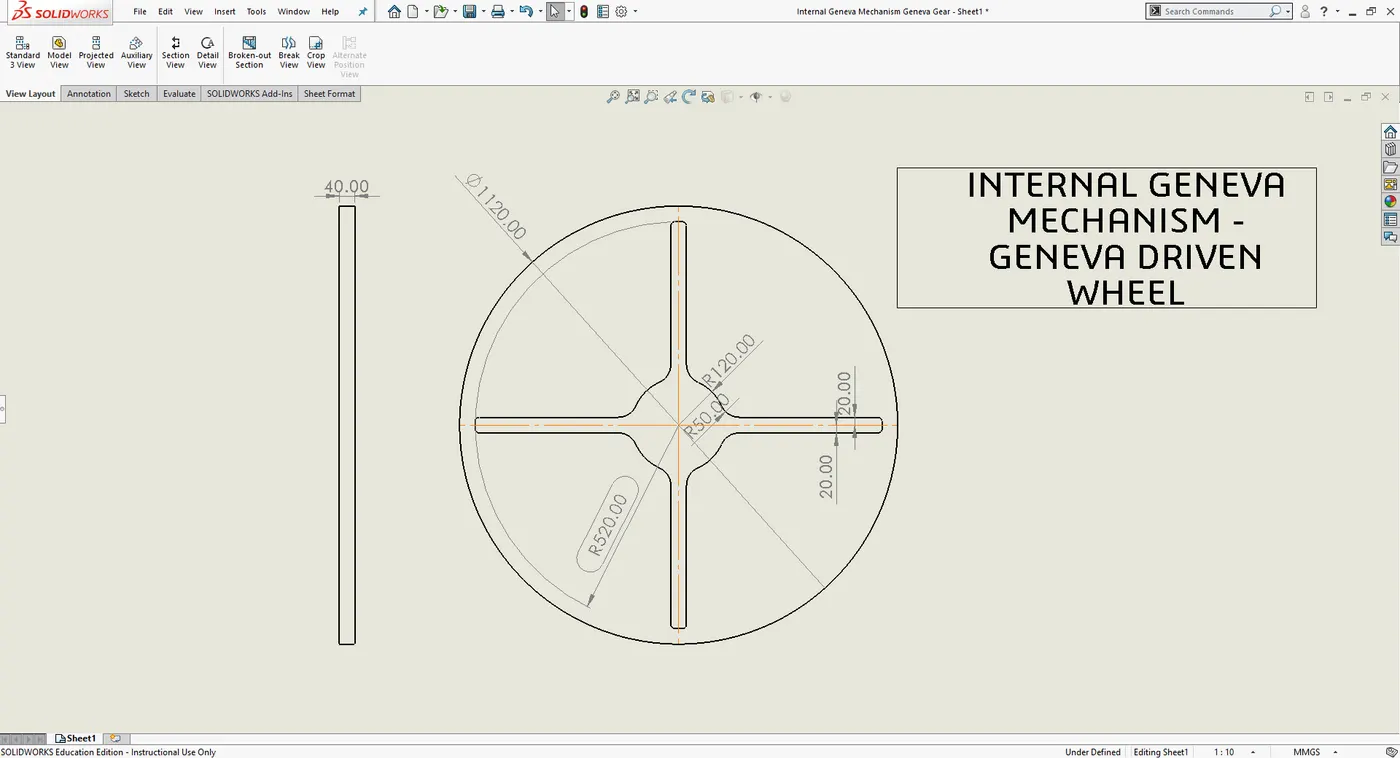
These Dimensions are considered for Design process.
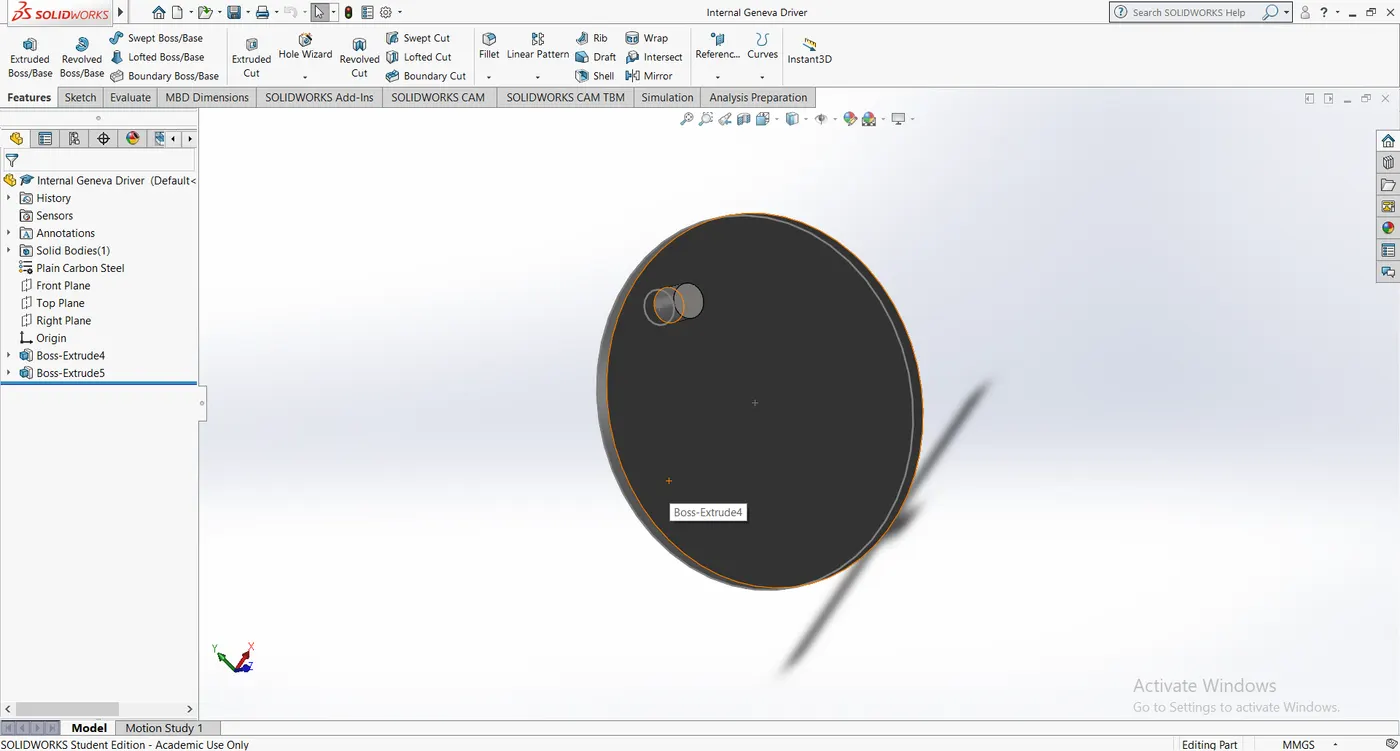
3-DIMENSIONAL MODELS FOR DRIVER AND DRIVEN PARTS OF GENEVA ASSEMBLY :
GENEVA DRIVER
GENEVA DRIVEN:
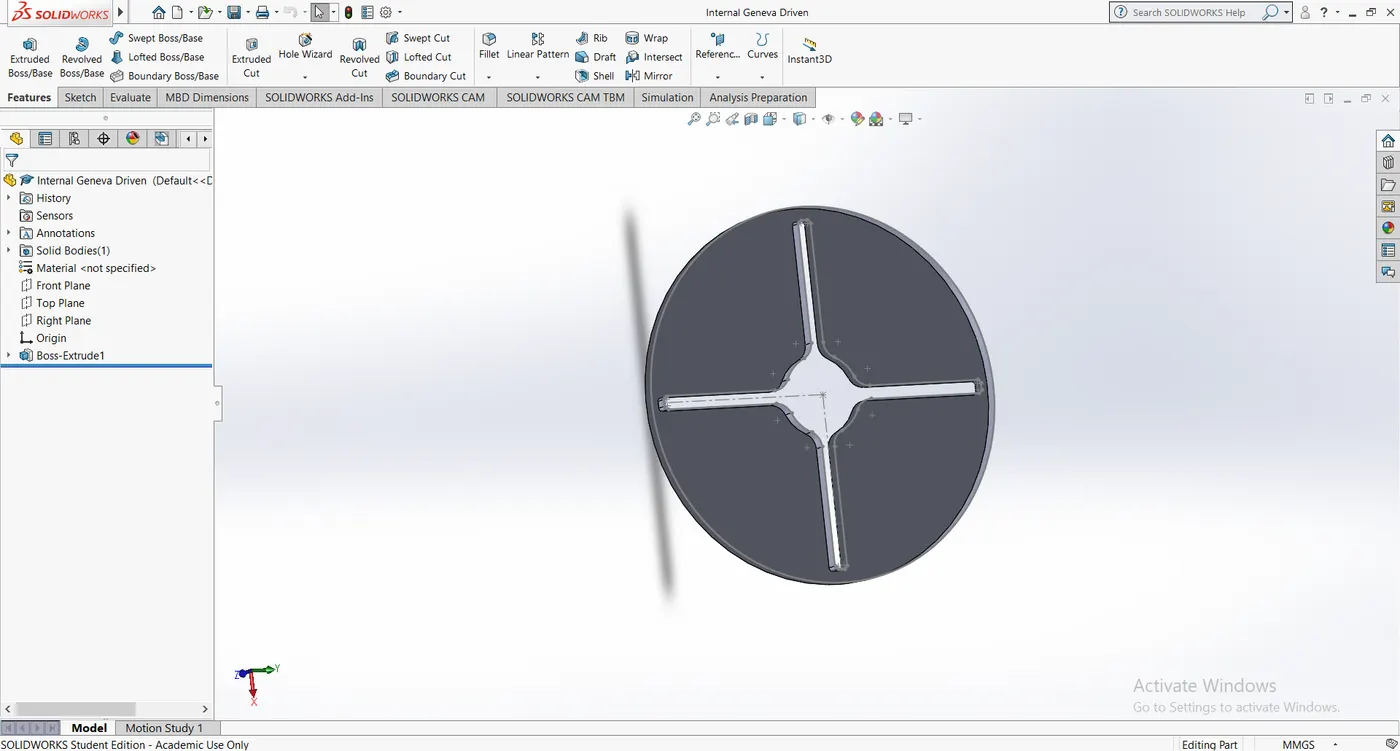
The above figures indicate the 3-D Models of Driver and Driven wheels done in Solid Works.The assembly after joining the corresponding parts is given below:
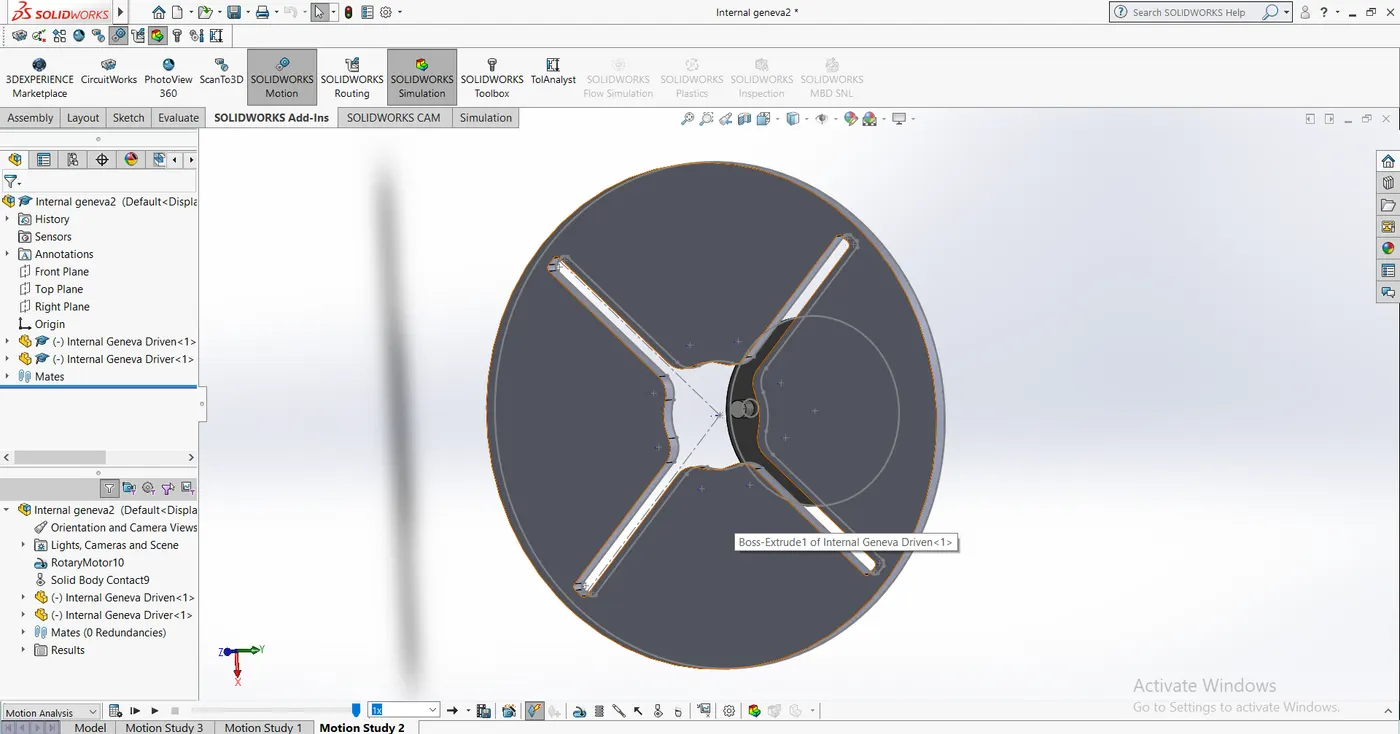
The above assembly is further analysed further using Motion Studies.Various graphs are plotted after motion study. Thre animation of the assembly is shown below.
The nature of various plots are drawn for different parameters such as contact force ,Angular Displacement,Angular Velocity.
PLOT OF CONTACT FORCE V/s TIME BETWEEN THE DRIVER AND DRIVEN WHEEL :
Conditions of the plot :
- Speed of the driver: 10 RPM
- Type of Contact: Not Precise(Clock-Wise)
- Number of Frames per Second: 60 FPS
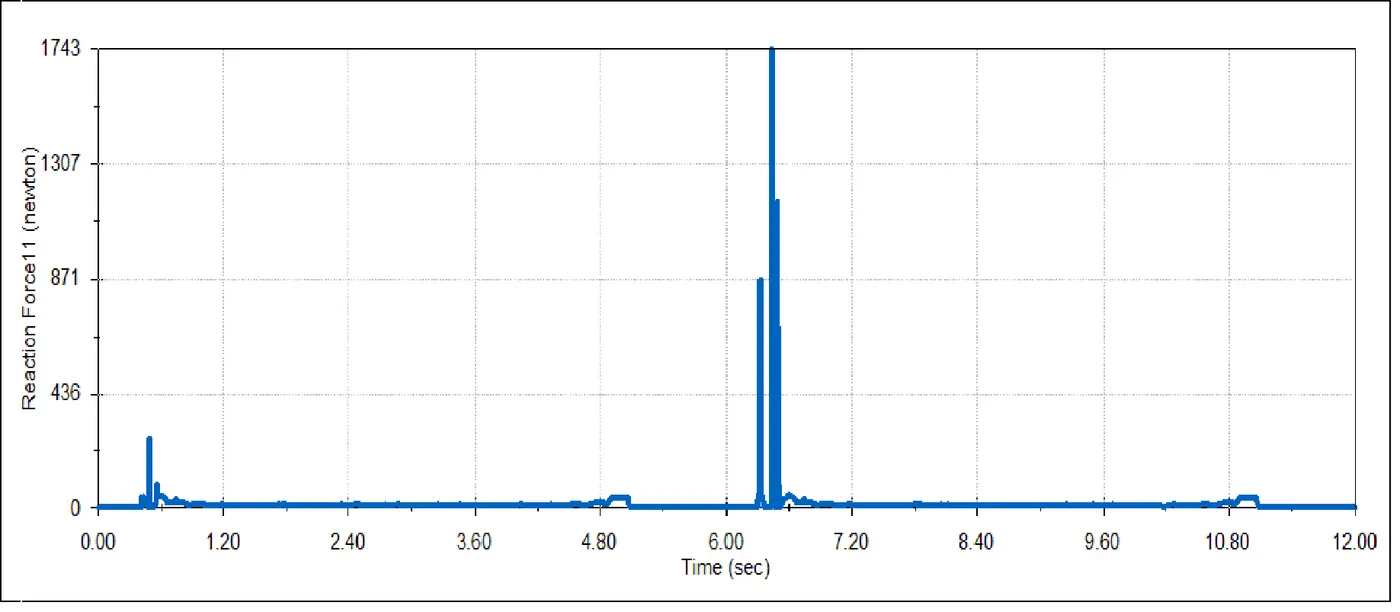
The above plot is obtained when the speed of the driver is set to 10rpm using a constant speed motor.The above graph indicates the force exerted on the driver due to driven wheel by the contact existing between them.
Explaination:
When the pin enters the slot for the first time the less amount of force is exerted on the driver.This force is about nearly 258.51 Newton in 0.5th second.As the driver rotates the pin further drives the driven wheel and rotates it in clockwise Direction.The pin then leaves the slot and enters the 2nd slot.But during this time the pin exerts more contact force on the driven wheel and hence the Force reaches a peak value of 1742.71 Newton at t=6.45 sec. After the pin successfully sits into the slot the contact force gets reduced.
PLOT OF CONTACT FORCE V/s TIME BETWEEN THE DRIVER AND DRIVEN WHEEL :
Conditions of the plot :
- Speed of the driver: 10 RPM
- Type of Contact: Precise(Clock-Wise)
- Number of Frames per Second: 60 FPS(It indicates that graph is obtained by recording 60 co-ordinates for each second of Motion Analysis ,having each co-ordinate for each frame.and thus there will be
`60 fps ×8 sec=480 values`)
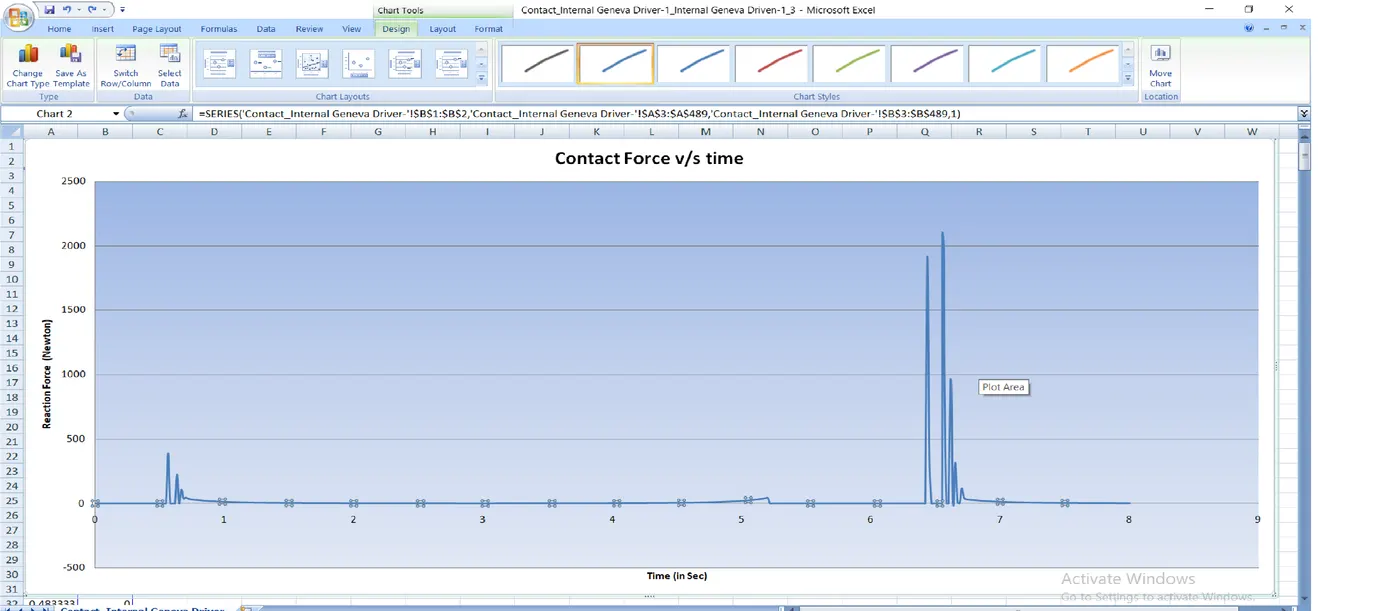
Explaination:
This is the graph obtained by plotting Contact force against time using precise contact.In this type of motion Analysis there exists a accurate and precise contact between the parts of the assembly for which the solid body contact is said to be existed. The peak value of the contact force is very high compared to the previous graph .This happens because of close and precise contact between the members of the assembly.
The peak value of force is about 2094.901 Newton at t=6.55 sec.This peak value is obtained when the pin tries to enter the slot of Geneva. As and when the pin sits into the slot there will be clearance between the pin and slot and hence the contact force almost drops to zero at time,t=7sec.
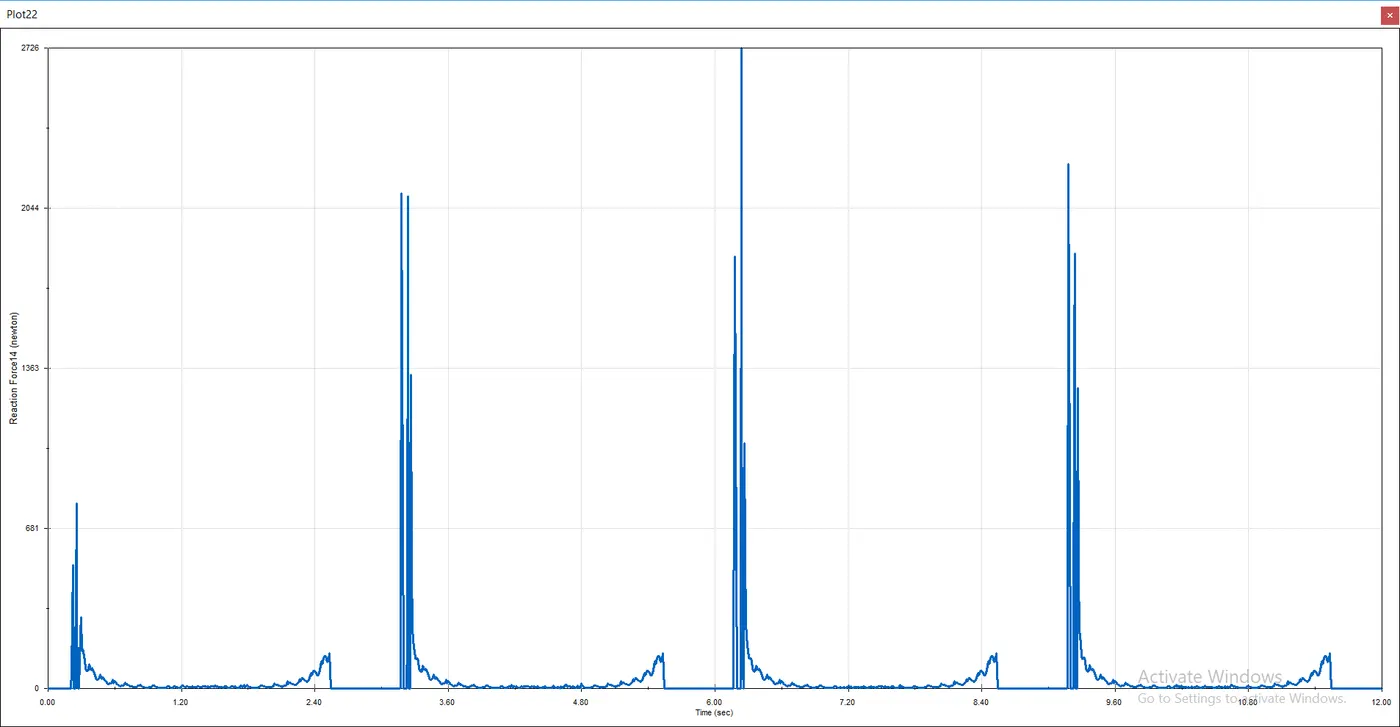
PLOT OF CONTACT FORCE V/s TIME BETWEEN THE DRIVER AND DRIVEN WHEEL :
Conditions of the plot :
- Speed of the driver: 20 RPM(Clock-Wise)
- Type of Contact: Without Precise contact
- Number of Frames per Second: 120 FPS(It indicates that graph is obtained by recording 60 co-ordinates for each second of Motion Analysis ,having each co-ordinate for each frame.and thus there will be
`120 fps ×8 sec=960 values`
 Explaination:
This plot is drawn for many number of cycles of rotation since the range of the time is more in the above plot.Here the speed of the driver is set to 20 RPM using a constant speed motor. Here also the contact force is high during the entry of pin into the slot compared to the exit.But compared to other graphs at 10 RPM, here the value of contact force is high about 2725.92 Newtons at t=602416 sec.
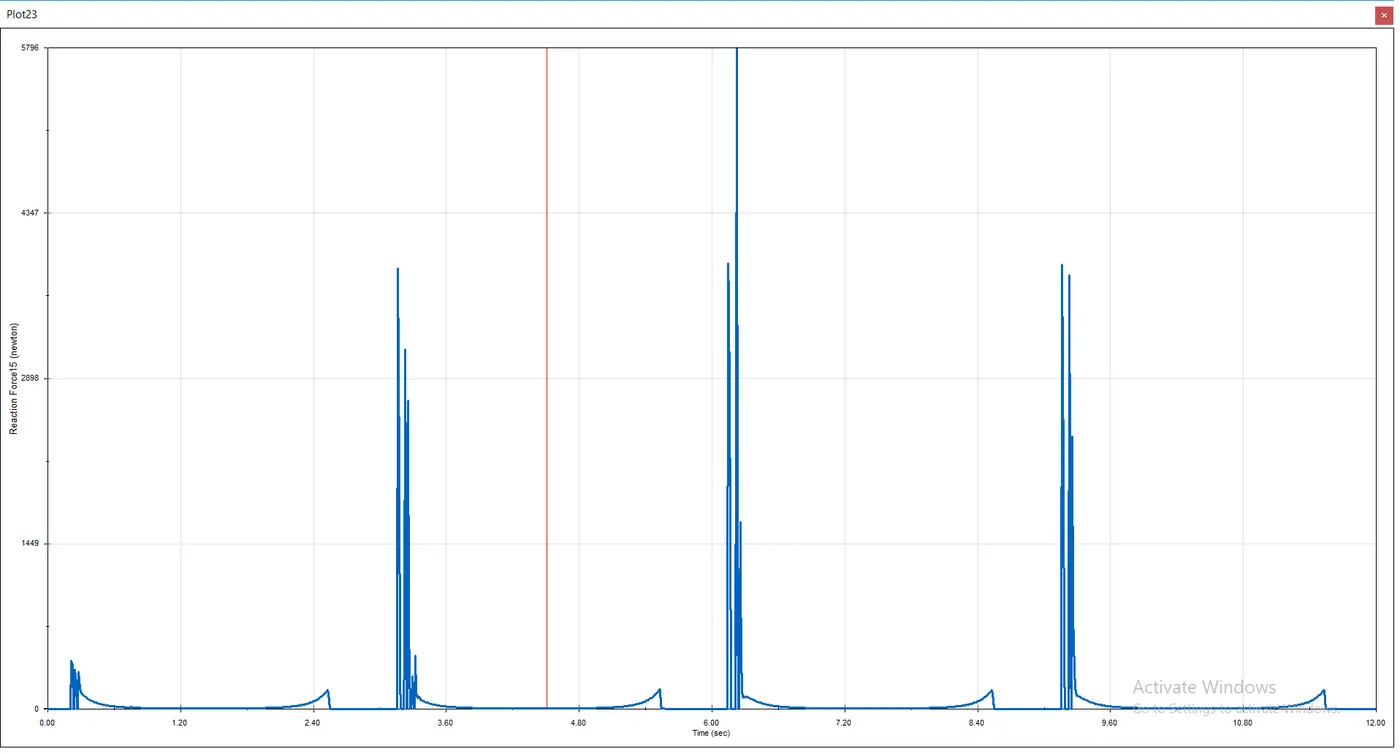
PLOT OF CONTACT FORCE V/s TIME BETWEEN THE DRIVER AND DRIVEN WHEEL :
Conditions of the plot :
- Speed of the driver: 20 RPM(Clock-Wise)
- Type of Contact: With Precise contact
- Number of Frames per Second: 120 FPS
Explaination:
This is the plot obtained for the precise contact between the parts of the assembly.As it is seen in the graph we can justify that the peak value of contact force is at the entry of the pin into the Geneva slot.Since there is a precise contact between the parts the contact force will be high. It is about 5795.823 Newtons at t=6.225 sec.
Tabular Column indicating the variation of forces:
| Constant speed Of Motor (in RPM) | No of Frames per Second | CONTACT FORCE in Newton (With Precise Contact) | CONTACT FORCE in Newton (Without Precise Contact) |
| 10 | 60 | 2094.901 | 1742.71 |
| 20 | 120 | 5795.823 | 2725.92 |
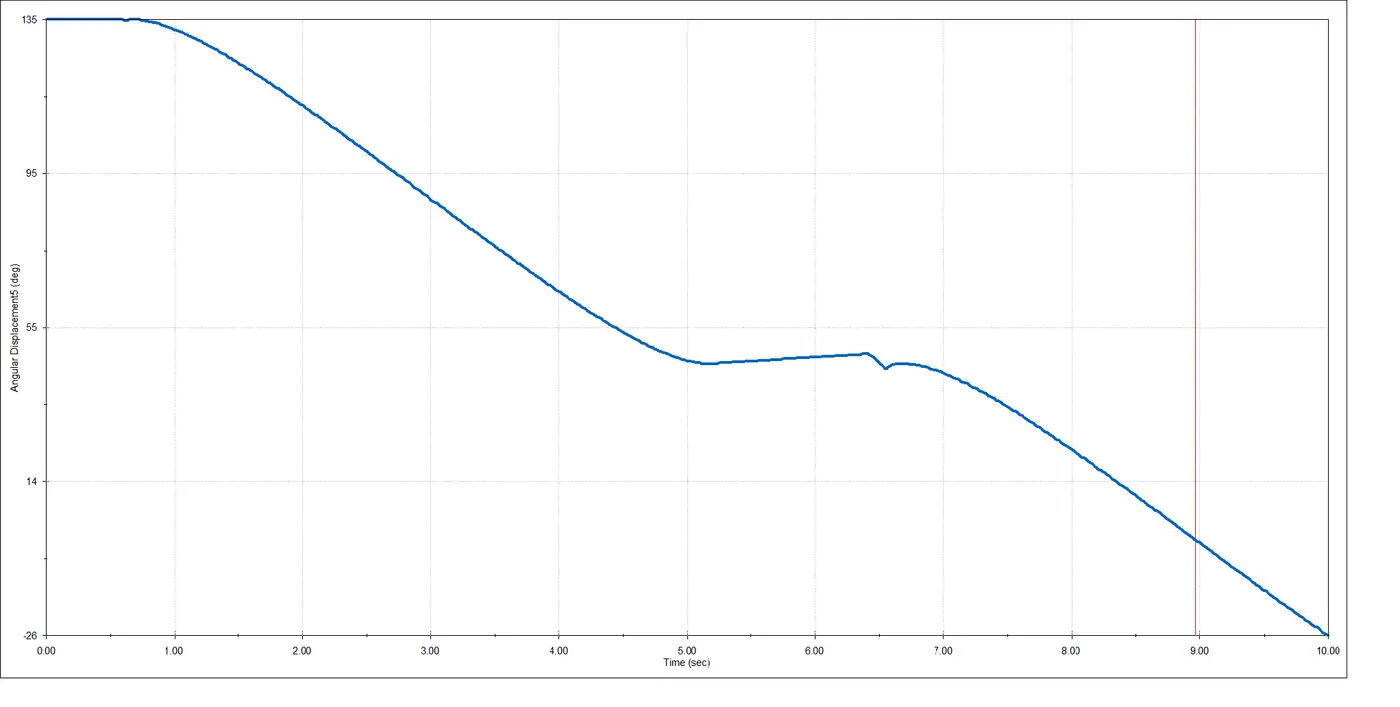
PLOT OF ANGULAR DISPLACEMENT OF DRIVEN WHEEL v/s TIME (sec):
Conditions of the plot :
- Speed of the driver: 10 RPM
- Number of Frames per Second: 60 FPS
Explaination
The above plot indicates the variation of Angular Displacement v/s time ,The initial state of Driven wheel is `135°` from the horizontal. Gradually as the driver rotates the angular displacement of the driven wheel remains constant until the pin enters the slot. As soon as the pin enters the slot the angular displacement goes on decreasing as the driven Wheel rotates Clockwise direction.
When the pin comes out from the slot ,the driven wheel stops rotating and dwells for some time i.e., from t=4.98sec to t=6.65 sec.But During this time also,a slight increase in Angular Displacement can be seen.This variation occurs due to inertia of the driven wheel and improper locking of pin into the slot during Entry ,this can be observed in the animation.
After the dwell time the pin enters the slot and once again the driven wheel completes another half rotation.
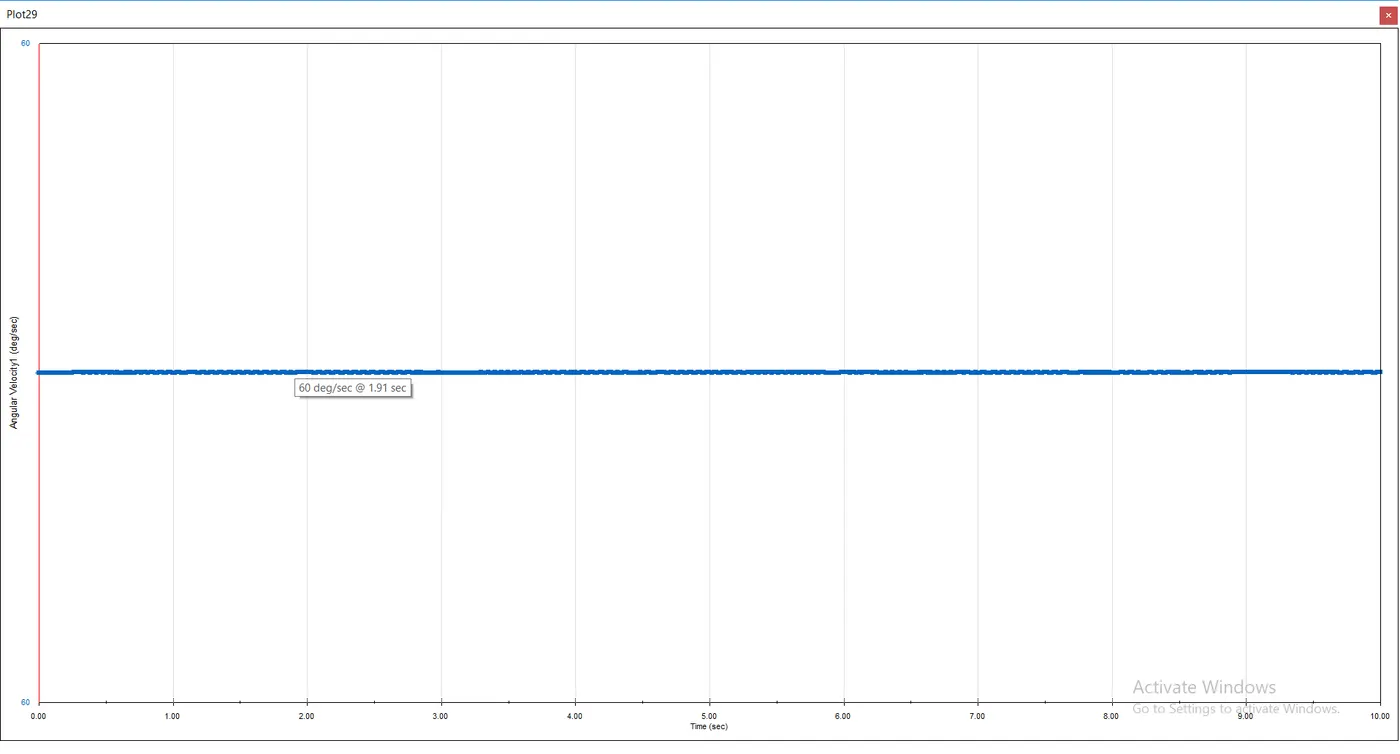
PLOT OF ANGULAR VELOCITY OF DRIVEN WHEEL v/s TIME (sec):
Conditions of the plot :
- Speed of the driver: 10 RPM
- Number of Frames per Second: 60 FPS
Explaination:
This is the plot for Angular Velocity against time for driver wheel.Here the constant speed motor is attached to the Geneva driver.The speed of the motor is 10 RPM.
We Know that Angular Velocity is given by, `ω=(2πN)/60`
Hence at N=10 RPM, `ω=(2π(10))/60=π/3=60 (deg)/sec`
This Angular Velocity remains constant since we are using a constant speed motor .
PLOT OF ANGULAR VEL OF DRIVEN WHEEL v/s TIME (sec):
Conditions of the plot :
- Speed of the driver: 20 RPM
- Number of Frames per Second: 60 FPS
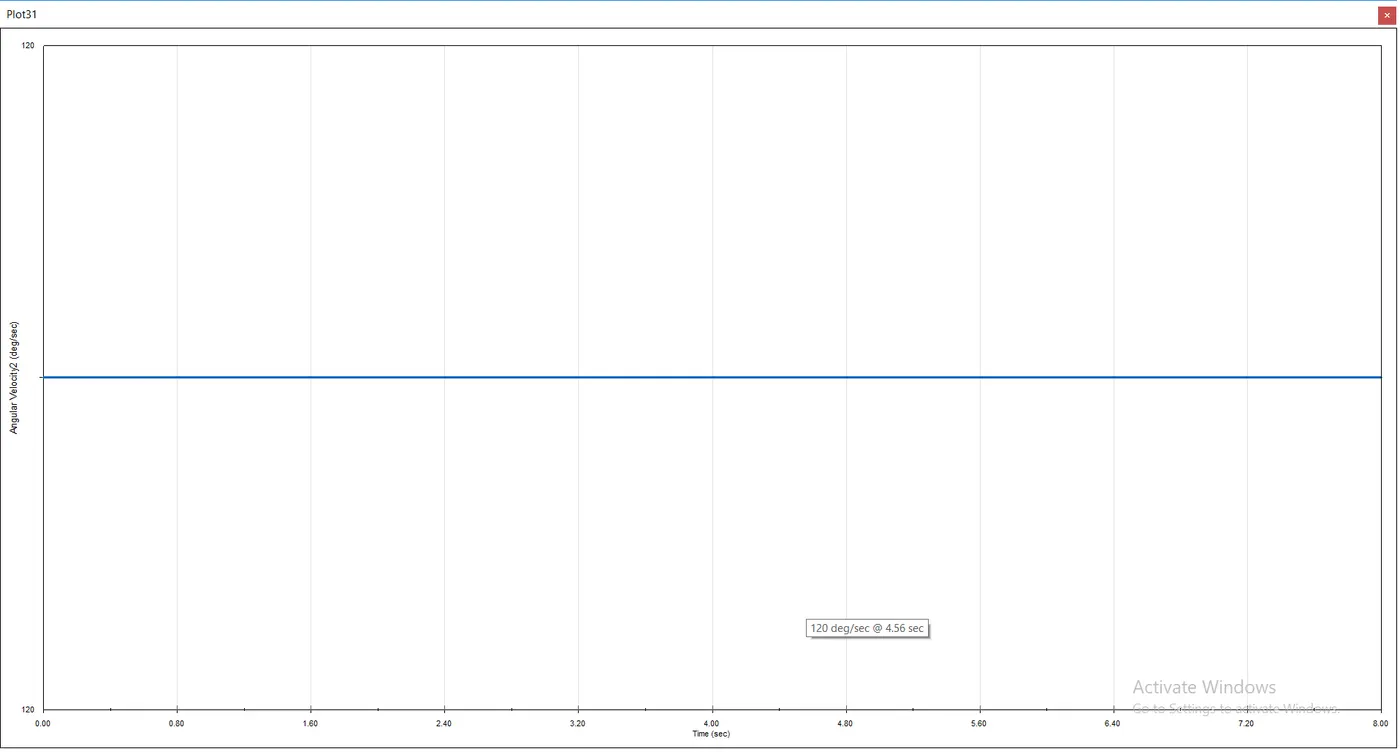
Explaination:
This is the plot for Angular Velocity against time for driver wheel.Here the constant speed motor is attached to the Geneva driver.The speed of the motor is 20 RPM.
We Know that Angular Velocity is given by, `ω=(2πN)/60`
Hence at N=20 RPM, `ω=(2π(20))/60=2π/3=120 (deg)/sec`
This Angular Velocity remains constant since we are using a constant speed motor.
RESULTS :
- The Maximum Contact force at 10 RPM (without Precise Contact) is : 1742.71 N
- The Maximum Contact force at 10 RPM (with Precise Contact) is : 2094.901 N
- The Maximum Contact force at 20 RPM (without Precise Contact) is : 2725.92 N
- The Maximum Contact force at 20 RPM (with Precise Contact) is : 5795.823 N
- The Angular Velocity of the driver wheel(deg/sec) at 10 RPM is : 60 deg/sec
- The Angular Velocity of the driver wheel(deg/sec) at 10 RPM is : 120 deg/sec
CONCLUSION :
Thus the stated objectives are achieved and the parts of Geneva wheel and the assembly is done succesfully. The various plots are drawn as the results of Motion Analysis.
FURTHER IMPROVEMENTS :
The project can be further improved to the spherical Geneva Mechanism and other motion studies can be done .
Part and assembly files for Internal Geneva Wheel:
File for Geneva Driver:https://drive.google.com/file/d/1wYHcljus9QmD6cMVFiB6gkPiJtSaYGq6/view?usp=sharing
File for Geneva Driven wheel: https://drive.google.com/file/d/1or674_mPWyNTmfJuoxHW4QhnhFVs0Hb0/view?usp=sharing
Assembly File for Internal Geneva Wheel: https://drive.google.com/file/d/11Gm07wj57GmrGEINuEMt0KnJzZVpfA5v/view?usp=sharing