Mixing efficiency
Objectives:
- Set up steady state simulations to compare the mixing effectiveness, in the two given tee - joints, at given conditions
Theory:
The Reynold's Averaged Navier Stokes equations, which are used to describe turbulent fluid flows contain a term called 'Reynold's stress', which arises due to 'averaging' of Navier Stokes equations. To close the equations and solve for fluid characteristic terms like velocity, the Reynold's stress value needs to be found out.
The Reynold's stress value can be found out from Boussinesq hypothesis equation, which contains eddyviscosity term. So, if eddy viscosity is known, Reynold's stress can be found out and thus RANS equations can be closed and fluid characteristics can be found out.
To find eddy viscosity, standard K - Epsilon and standard K - Omega turbelnt models are used.
K - Epsilon turbulent model:
In standard K - Epsilon turbulent model, K stands for fluid Kinetic Energy and Epsilon (`epsilon`) stands for kinetic energy dissipation. The Eddy viscosity, which needs to be calculated, is an expression containing both K and `epsilon` terms. So by solving for K and `epsilon`, eddy viscosity can be found out.
Epsilon term represents kinetic energy dissipation due to adverse pressure gradients (or eddies), due to which the kinetic energy of the fluid is converted into thermal energy, the rate at which this happens is called as kinetic energy dissipation, `epsilon`. This can be understood physically as a hinderance to the motion of a body by friction, in case of fluids, the friction is the viscosity and the energy thus lost is Kinetic energy due to turbulence or turbulent kinetic energy.
To find the Kinetic Energy and Kinetic energy dissipation, two transport equations corresponding to Kinetic energy and energy dissipation are to be solved, these values are then used to find eddy viscosity.
The transport equation of epsilon contains damping functions, which correspond to the damping of kinetic energy near adverse pressure gradient regions. These dampng functions are emperical. They are solved to dampen kinetic energy or increase Kinetic energy dissipation. So, at low Reynold's numbers, near the walls of a pipe, these damping functions are to be solved.
These damping functions are additional functions that needs to be solved whenever K epsilon model is used at low Reynold's number regions (walls of a pipe, where laminar sublayer exists, within which viscous effects are predominant). This means that using K epsilon model, near the walls of a pipe or where viscous effects are predominant is not gonna give accurate results.
K - Omega turbulent model:
This is a modification to K epsilon model which gives more accurate results near the walls than its predecessor model. Omega is the specific turbulence dissipation term, which has same significance as epsilon in K epsilon model. Omega and epsilon are related by the equation below,
`omega = (epsilon)/(C_mu*k)`, where `C_mu` is a coefficient which is used to find the damping function `f_mu` in k epsilon model, whose value is 0.09.
Omega, like epsilon is also found by solving a transport equation. The disadvantages of K epsilon model are covered in K omega model, which is developed after the former. The primary reason why K epsilon model is no good at low Reynold number flows is because of damping functions, which are not accurate. There are no damping functions in K Omega model, this is because there are different coefficients that are used in the transport equation of omega.
So, K omega model gives more accurate results near the walls, than K epsilon model.
Introduction:
In this project, the mixing of hot and cold streams of air, which are incoming at different velocities and mixing, is simulated. The RANS equations are solved using standard K epsilon and standard K omega model, for two cases of momentum ratios and two cases of different lengths of the pipe. The effect of meshing is also studied on the mixing.
The momentum ratios considered are 2 and 4. A short and long tee joints are considered, the cold inlet stream temperature is at `19°`Centigrade and the hot inlet stream temperature is at `36°` Centigrade.
The momentum ratio, in case of a mixing tee, is the ration of velocity of hot fluid to the velocity of cold fluid. For current project, the momentum rations considered are 2 and 4.
The basic structure of simulation in this project is, setting up the geometry by extracting the required volume only, meshing the geometry with certain element size, for a reasonable accuracy, setting up the physics of the problem by chosing the solver and by giving boundary conditions and intial conditions, and then solving the problem. Simulation is then done after analyzing the results, using a post processor.
In this project, for short mixing tee, the simulation is done using both K - Epsilon and K - Omega turbulent models, and based on the results thus obtained, the best suited one for current case is chosen for subsequent simulations. The simulation is done for each of the given momentum ratios for short as well as long geometries.
Simulation:
For short mixing tee:
1. Case 1 - Short mixing tee with momentum ratio 2, K - Epsilon model:
Hot air inlet velocity: 3 mt/sec
Cold air inlet velocity: 6 mt/sec
Hot air inlet temperture : 36° Centigrade
Cold air inlet temperature : 19° Centigrade
Mesh size : 3 mm
A. Meshed geometry:
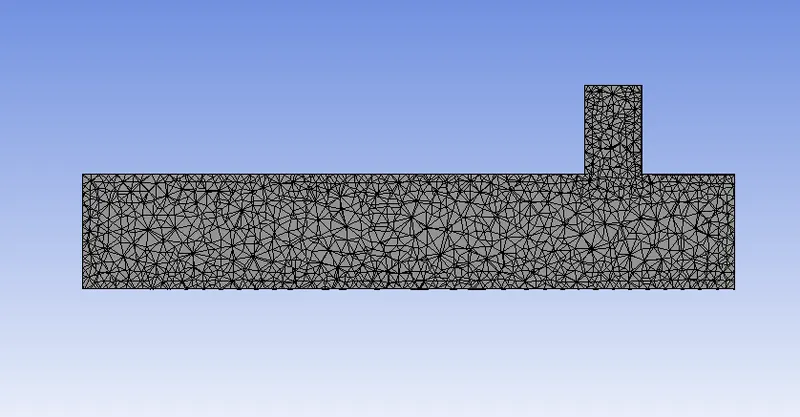
Number of elements: 39,549
Number of nodes: 8295
After setting up the problem and solving, the results obtained are,
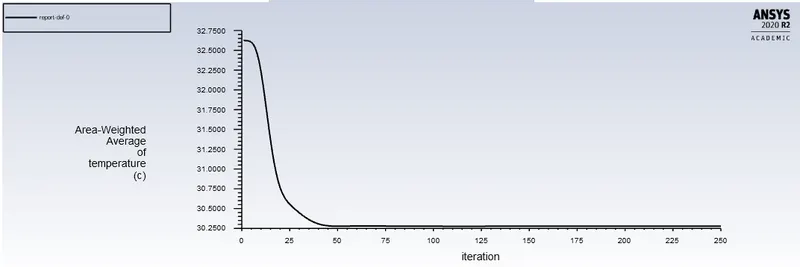
A. Weighted average of temperature versus iterations:
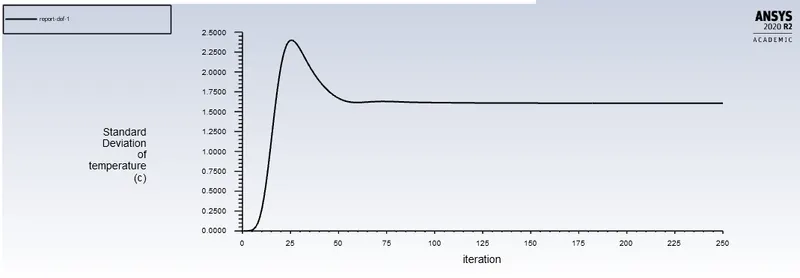
B. Standard deviation of temperature versus iterations:
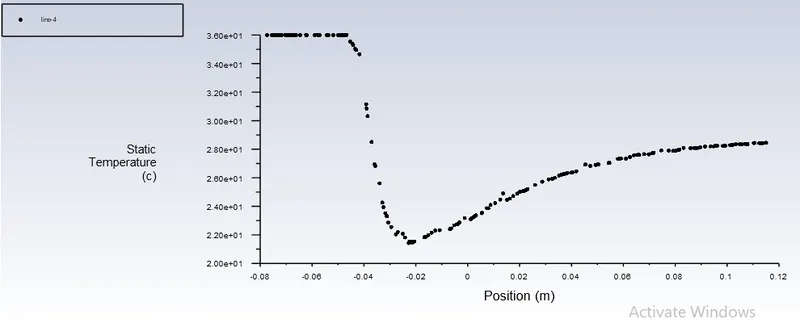
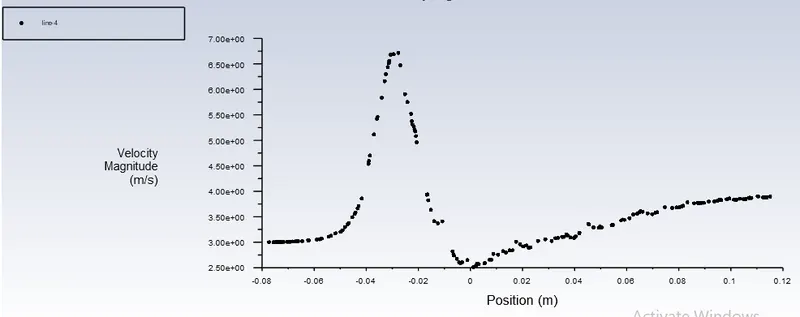
C. Temperature along the length of mixing tee:
D. Velocity along the length of mixing tee:
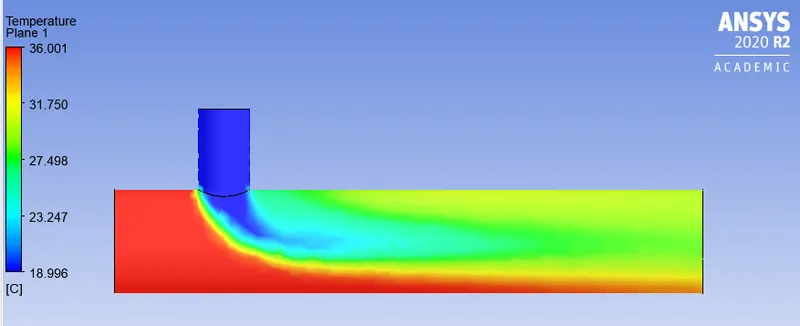
E. Temperature across the flow:
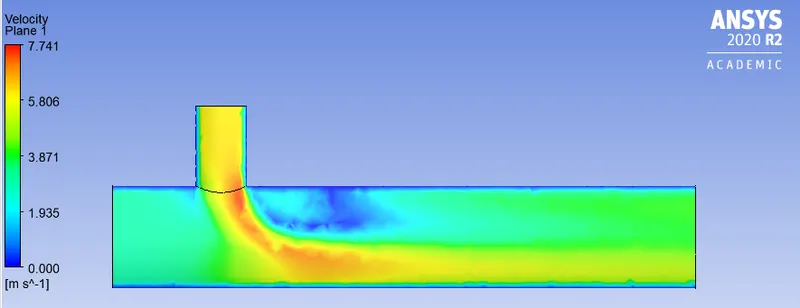
F. Velocity across the flow:
G. Standard deviation of temperature:
H. Temperature versus iterations:
2. Case 2 - Short mixing tee with momentum ratio 2, K - Omega model:
Hot air inlet velocity: 3 mt/sec
Cold air inlet velocity: 6 mt/sec
Hot air inlet temperture : 36° Centigrade
Cold air inlet temperature : 19° Centigrade
Mesh size : 3 mm
The meshed geometry would be same. The results are,
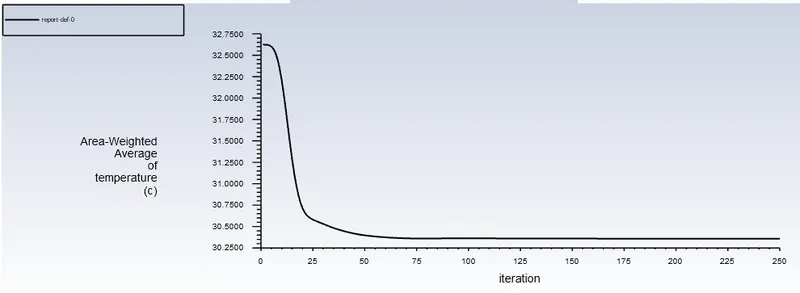
A. Temperture versus number of iterations:
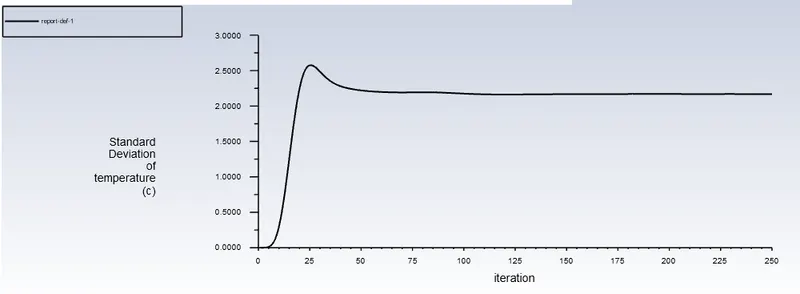
B. Standard deviation of temperature:
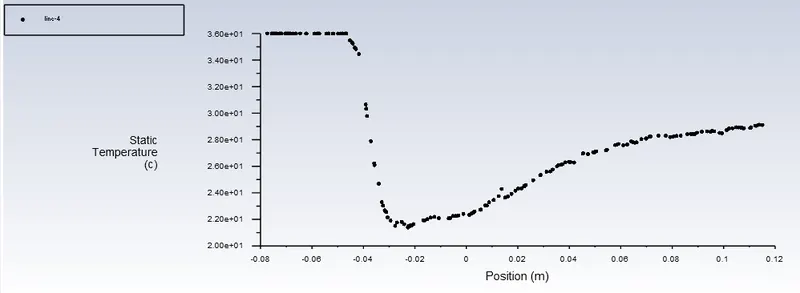
C. Temperature along the length:
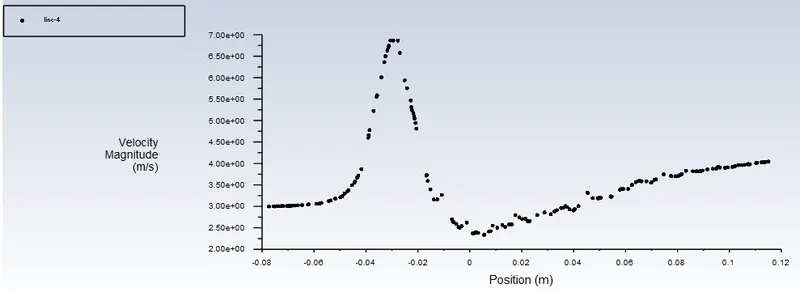
D. Velocity along the length:
E. Temperature across the flow:
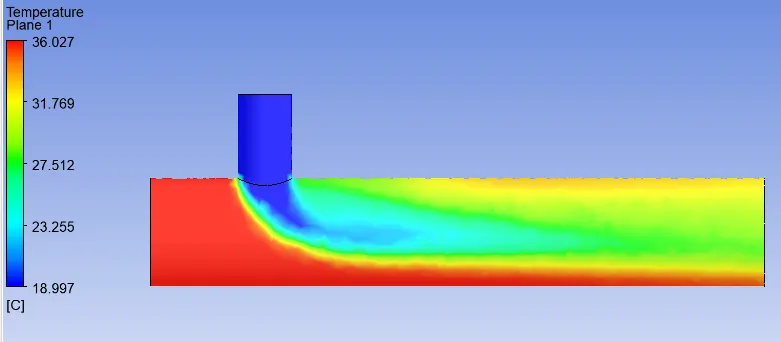
F. Velocity across the flow:
G. Standard deviation of temperature:
H. Temperature versus iterations:
Inferences:
- From the results from both K - Epsilon and K - Omega models, the number of iterations taken by K - Epsilon model, to reach the steady state, is less than the number of iterations taken to reach steady state, for K - Omega models
- The standard deviation corresponding to temperature at the outlet is also less for K - Epsilon than for K - Omega
Hence, by considering the inferences drawn above, K - Epsilon model is chosen for subsequent cases.
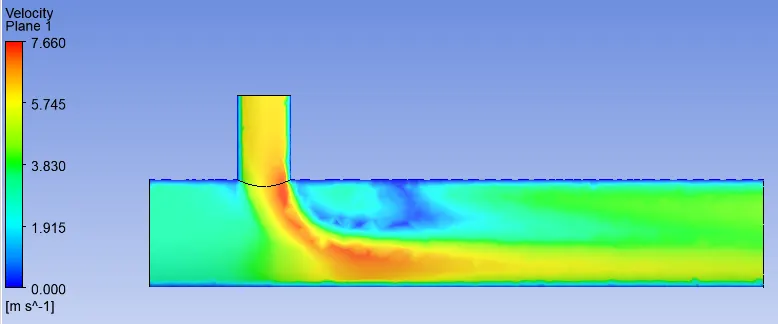
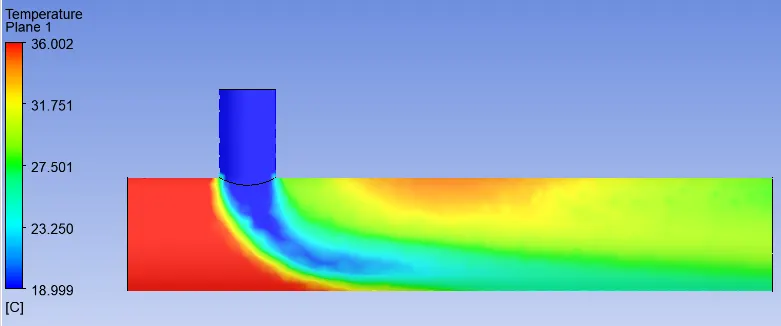
Case - 3: Short mixing tee with momentum ratio 4, K epsilon model:
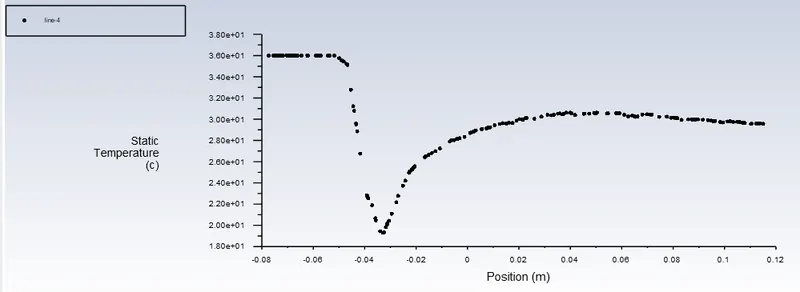
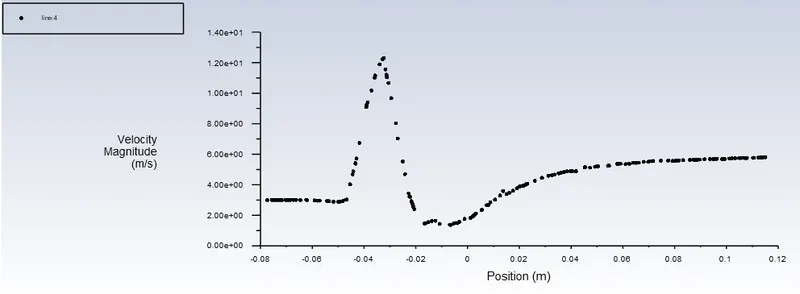
The mesh size is same as above (3 mm). After setting up the model, considering the inputs just as above, the results obtained are,
A. Temperature along the length:
B. Velocity along the length:
C. Temperature across the flow:
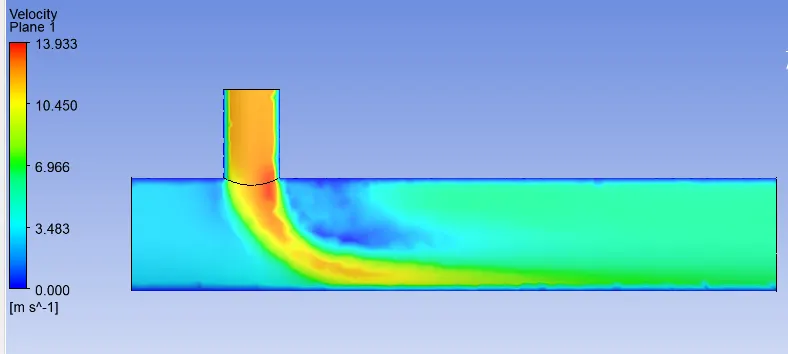
D. Velocity across the flow:
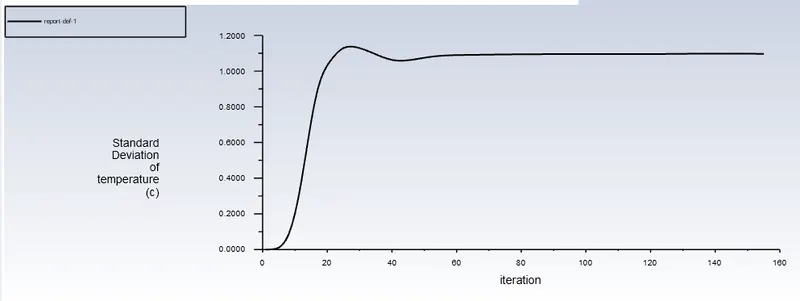
E. Standard deviation of temperature:
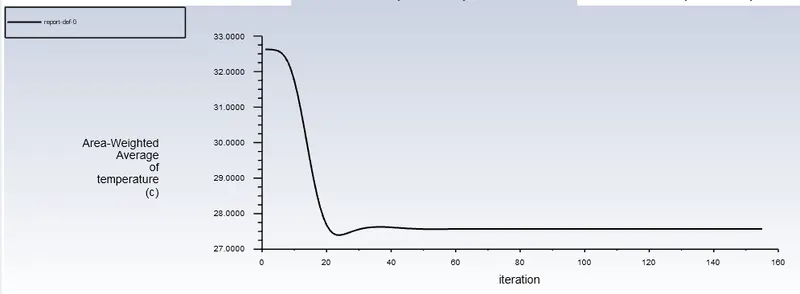
F. Temperature versus iterations:
For long mixing tee:
Case 1: Momentum ratio - 2, K - epsilon model:
Mesh size: 3 mm
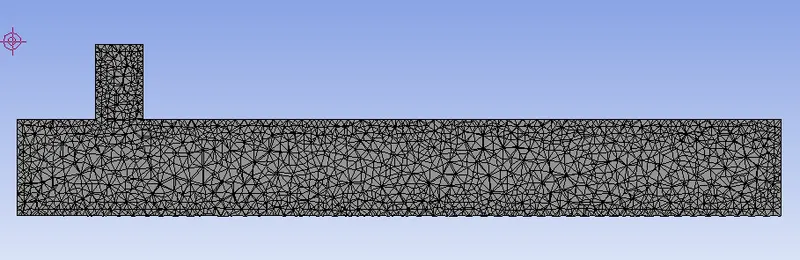
Number of nodes: 11710
Number of elements: 56504
A. Meshed geometry:
After setting up the conditions same as for short mixing tee, the results obtained are,
B. Temperature along the length:
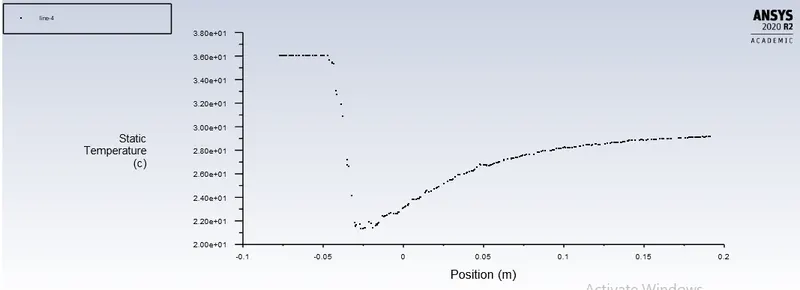
C. Velocity along the length:
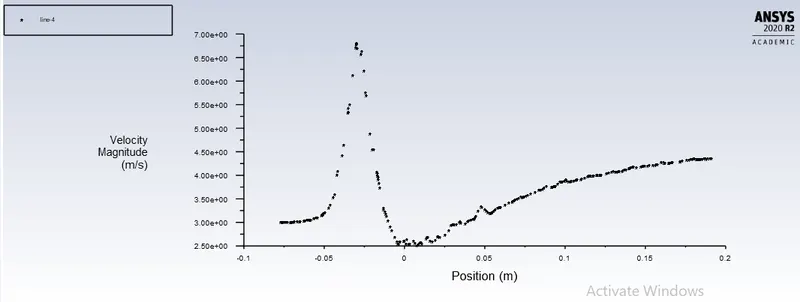
D. Temperature across the flow:
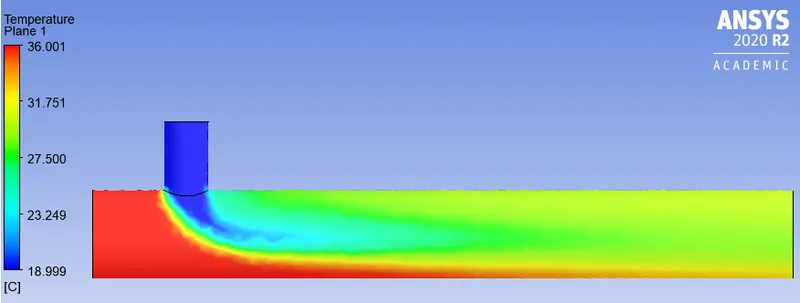
E. Velocity across the flow:
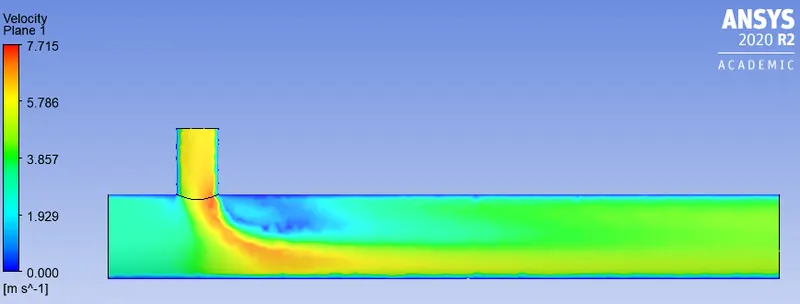
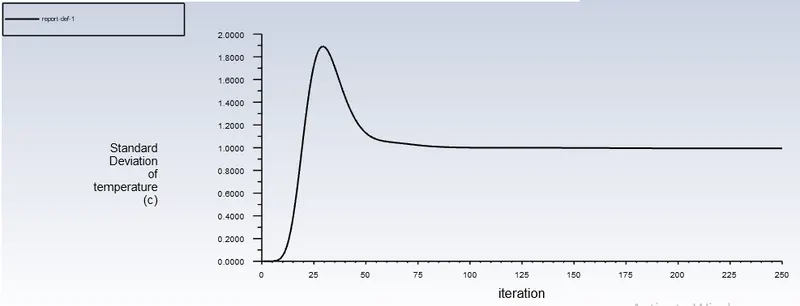
F. Standard deviation of temperature:
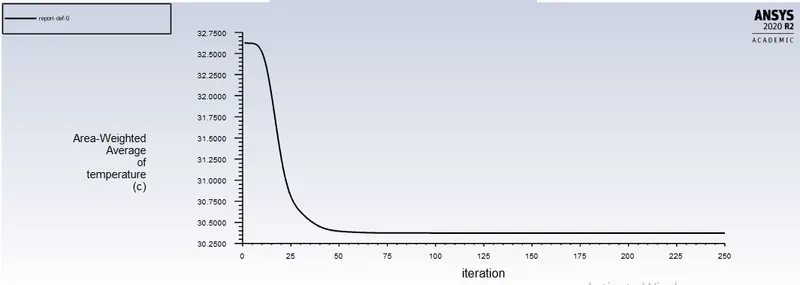
G. Temperature versus iterations:
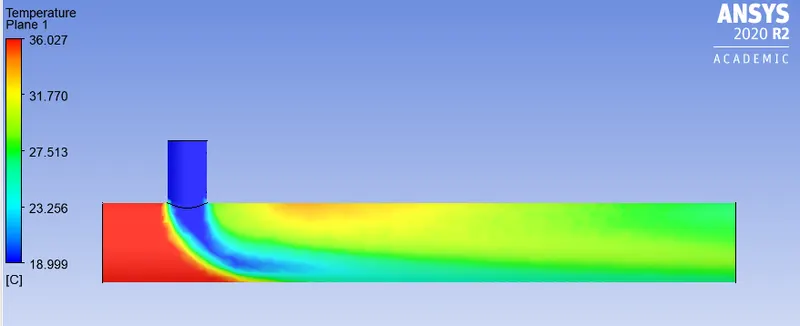
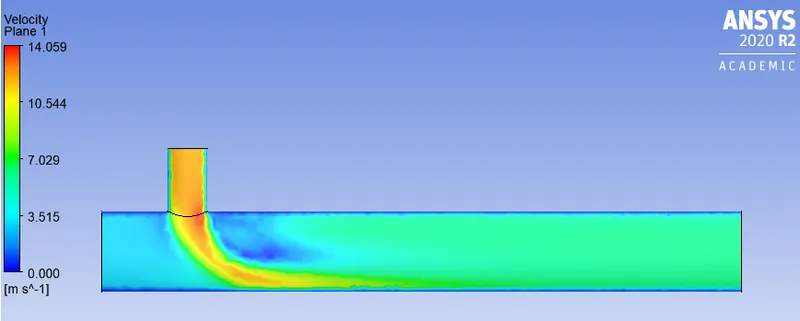
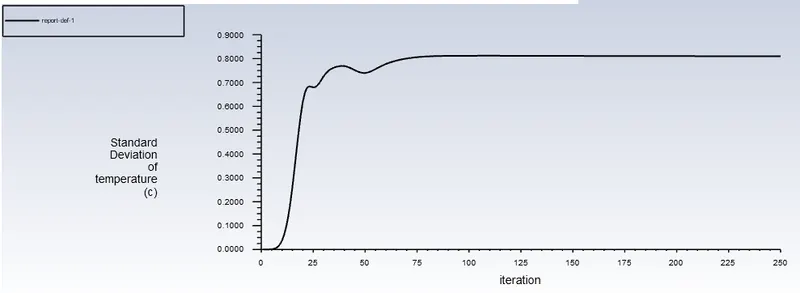
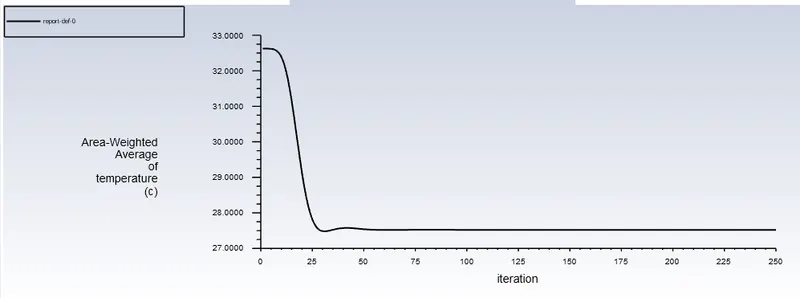
Case 2: Momentum ratio 4, K Epsilon model:
The meshed geomtery will be same and after simulation, the results obtained are,
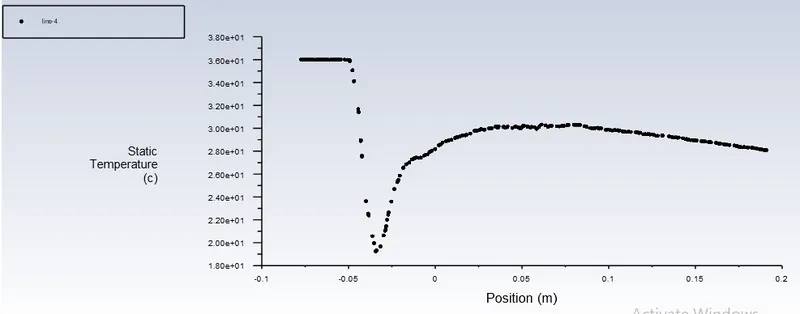
A. Temperature along the length:
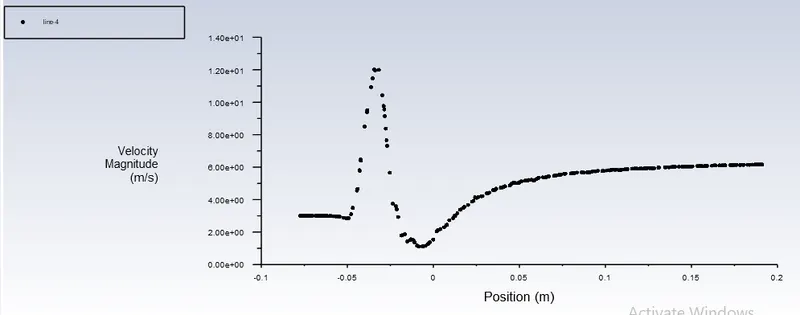
B. Velocity along the length:
C. Temperature across the flow:
D. Velocity across the fluid:
E. Standard deviation of temperature:
F. Temperature versus iterations:
Inferences:
- The number of iterations is less in both long mixing tee and short mixing tee when the momentum ratio is high. When the momentum ratio is high, the difference in velocities between hot and cold inlet is high, meaning that the turbulent kinetic energy difference between both the fluids is high, and as the rate of energy transfer between two bodies is directly proportional to the difference in energies between the same two bodies, the system has reached the steady state soon
- When the momentum ratio is 4, the standard deviation of temperature also has less 'fluctuation' and has reached steady state at less number of iterations in contrast to the same when the momentum ratio is 2
- Also, the steady state value of standard deviation, corresponding to temperature, for long mixing tee is less than the corresponding value of short mixing tee, though the number of iterations it took to reach the steady state is almost same for either of them
It can be concluded that the mixing is better when the momentum ratio and the length of mixing tee joint are high
Mesh study:
Mesh study is done for short mixing tee, for K epsilon model. The mesh study is done by considering three values of mesh, 2 mm, 3 mm and 4 mm.
NOTE: This study is done by considering momentum ratio 2
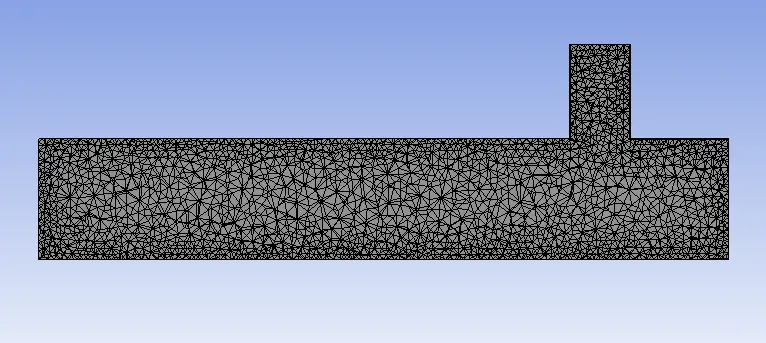
A. Element size 2 mm:
Number of nodes: 21348
Number of elements: 105944
Meshed geometry:
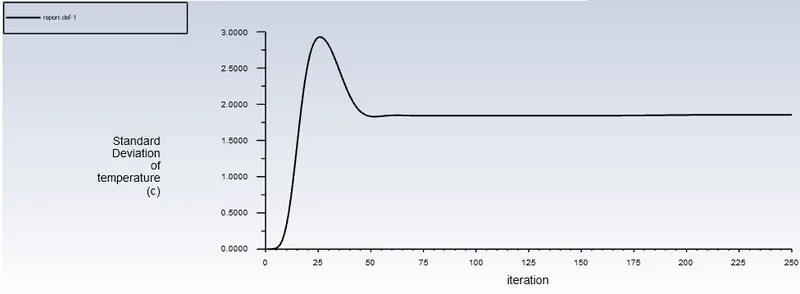
Standard deviation of temperature:
Temperature versus number of iterations: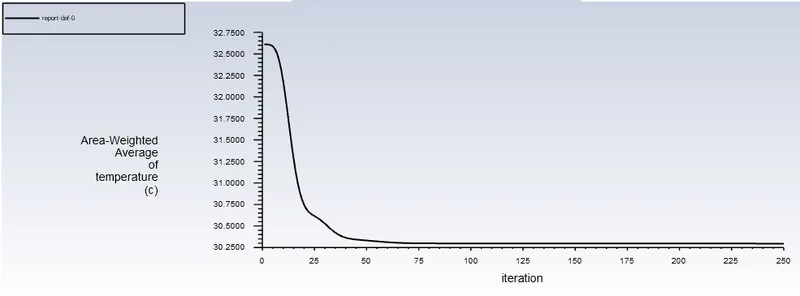
Tempereature across the flow:
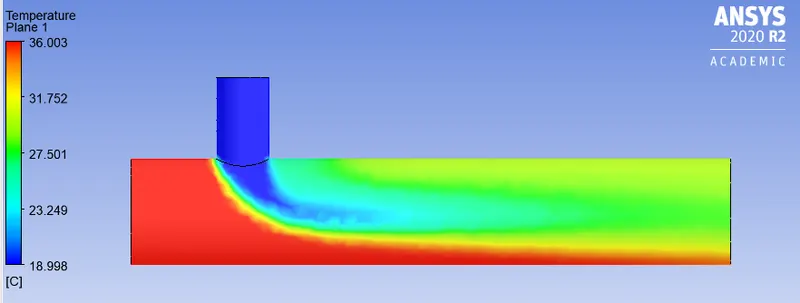
Velocity across the flow:
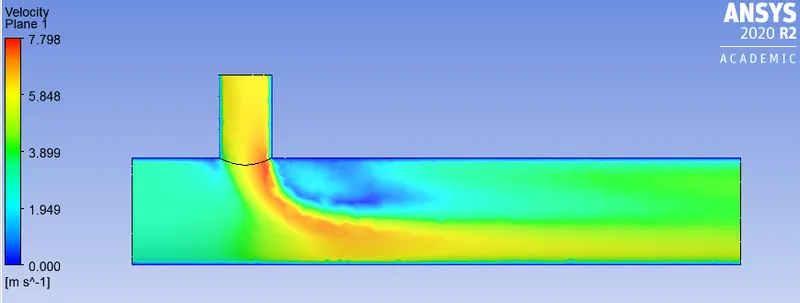
B. Element size 3 mm:
This case has already been done above.
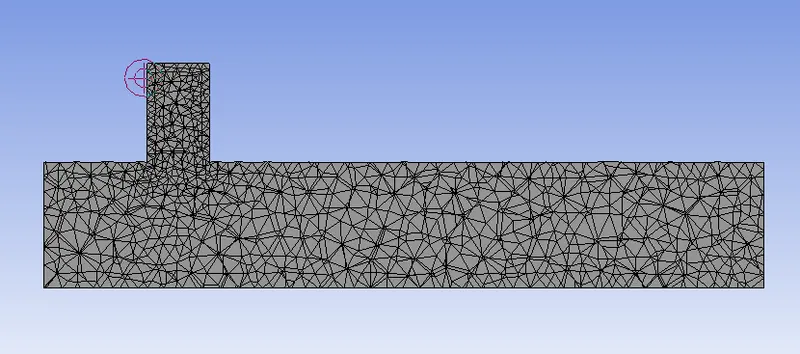
C. Element size 5 mm:
Number of nodes: 3127
Number of elements: 14202
Meshed geomtery:
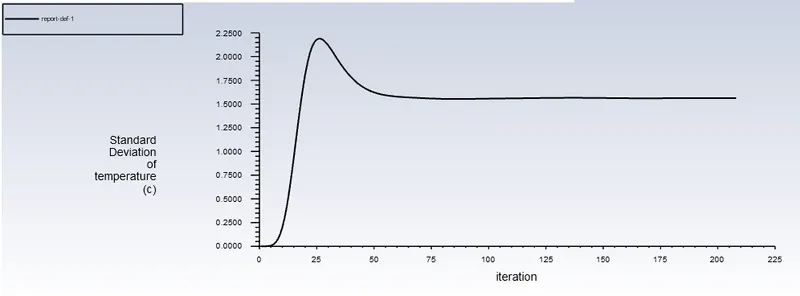
Standard deviation of temperature:
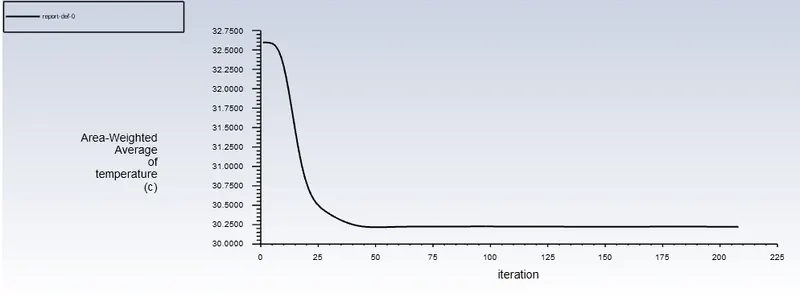
Temperature versus iterations:
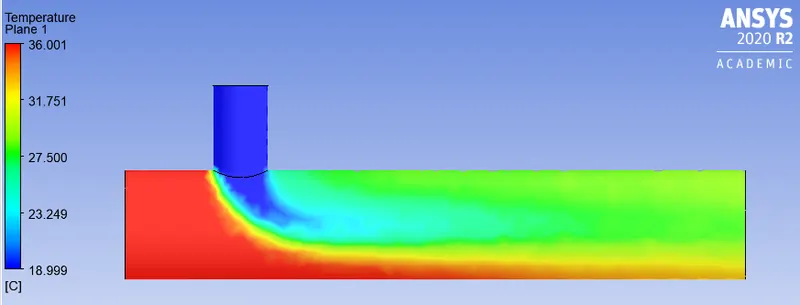
Temperature across the flow:
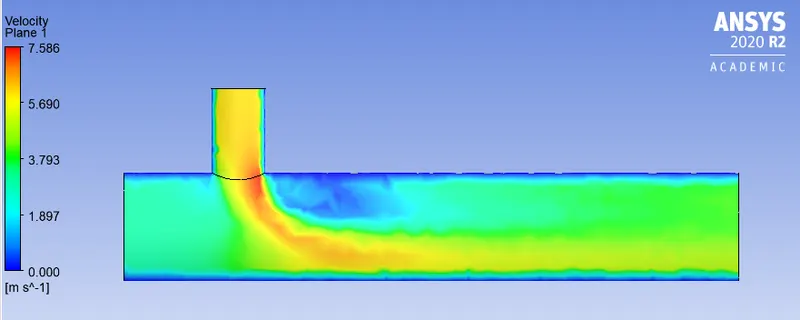
Velocity across the flow:
Inferences:
- Although the number of iterations for all three cases, to reach steady state, is same when the element size is 2 mm, the standard deviation has less 'fluctuations'. So for a reasonable accurracy, it requires less load on the machine when the element size is large
Results:
For short mixing tee joint:
| S.no | Momentum ratio | Average outlet temperature (°C) | Cell count | Number of iterations |
| 1 | 2 | 30.26 | 39549 | 48 |
| 2 | 4 | 27.51 | 39549 | 43 |
For long mixing tee joint:
| S.no | Momentum ratio | Average outlet temperature (°C) | Cell count | Number of iterations |
| 1 | 2 | 30.36 | 56504 | 51 |
| 2 | 4 | 27.52 | 56504 | 50 |
Conclusions:
- K epsilon turbulent model gives best results when there are no adverse pressure gradient regions in the field. K Omega turbulent model gives better results than K epsilon model near walls or adverse pressure region
- For greater mixing effectiveness, momentum ratio need to be higher
- The standard deviation corresponding to temperature, of long mixing tee is less than that of short mixing tee joint