Mathemathical Model of a Battery.
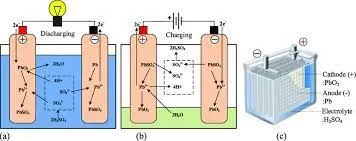
Working Principle of Lead Acid Battery
- When the sulfuric acid dissolves, its molecules break up into positive hydrogen ions (2H+) and
sulfate negative ions (SO4—) and move freely. If the two electrodes are immersed in solutions and
connected to the DC supply then the hydrogen ions being positively charged and moved towards the
electrodes and connected to the negative terminal of the supply. The SO4— ions being negatively
charged moved towards the electrodes connected to the positive terminal of the supply main (i.e.,
anode). - Each hydrogen ion takes one electron from the cathode, and each sulfates ions takes the two negative ions from the anodes and react with water and form sulfuric and hydrogen acid. The oxygen, which produced from the above equation react with lead oxide and form lead peroxide (PbO2.) Thus, during charging the lead cathode remain as lead but the lead anode gets converted into lead peroxide, chocolate in color.
- If the DC source of supply is disconnected and if the voltmeter connects between the electrodes, it will show the potential difference between them. If wire connects the electrodes, then current will flow from the positive plate to the negative plate through an external circuit i.e. the cell is capable of supplying electrical energy.
% A constant P discharge experiment for a lead-acid battery.
% The system has 10 batteries, each 12V lead-acid, 50Ah.
% We use 10 s steps, as these are sufficiently small for a constant power discharge. We set up arrays to store the data.

T=(0:10:10000); % Time goes up to 10,000 in 10 s steps.

% This is 1001 values.
CR=zeros(1,1001); % Charge rem. from bat. Peukert corrected.
DoD=zeros(1,1001); % Depth of discharge, start fully charged.
V=zeros(1,1001); % Battery voltage, initially set to zero.
CS=zeros(1,1001); % Charge supplied by the battery in Ah

NoCells=60; % 10 of 6 cell (12 V) batteries.
Capacity=50; % 50 Ah batteries, 10 h rate capacity.
k=1.12; % Peukert coefficient
deltaT = 10; % Take 10 s steps, OK for constant power.
P = 5000; % We will drain the battery at 5 kW.

% Calculated values
Rin= (0.022/Capacity)*NoCells; % Internal res.
PeuCap= ((Capacity/10)^k)*10;

% Starting voltage set outside loop
E=open_circuit_voltage_LA(0,NoCells);
I = (E - (E*E - (4*Rin*P))^0.5)/(2*Rin);
V(1)= E - I*Rin;

for n=2:1001

E=open_circuit_voltage_LA(DoD(n-1),NoCells);
I = (E - (E*E - (4*Rin*P))^0.5)/(2*Rin);
CR(n) = CR(n-1) +((deltaT * I^k)/3600);
DoD(n)= CR(n)/PeuCap;

if DoD(n)>1
DoD(n)=1;
end

% We will say that the battery is "dead" if the depth of discharge exceeds 99%.
V(n)=open_circuit_voltage_LA(DoD(n),NoCells) - I*Rin;

if DoD(n)>0.99
V(n)=0;
end

if V(n)>0
CS(n)=CS(n-1)+ ((I*deltaT)/3600);
else
CS(n)=CS(n-1);
end

end

figure(1)
plot(T,V,'b.');
ylabel('Battery voltage/Volts');
xlabel('Time/Seconds');
title('Constant power discharge of a lead acid battery');
axis([0 4000 100 140]);


function E_oc=open_circuit_voltage_LA(x,N)

% Find the open-circuit voltage of a lead-acid battery at any value of depth of discharge.
% The depth of discharge value must be between 0 (fully charged) and 1.0 (flat).

if x<0
error('Depth of discharge <0.');
end
if x > 1
error('Depth of discharge >1')
end

E_oc= (2.15 - ((2.15-2.00)*x)) * N;

end
This model takes into account self-discharge, battery storage capacity, internal resistance, overvoltage, and environmental temperature. Nonlinear components are used to represent the behavior of the different battery parameters thereby simplifying the model design. The model components are found by using manufacturers' specifications and experimental tests. This model can be used to accurately evaluate battery performance in electrical systems.
Peukart capacity: It expresses approximately the change in capacity of rechargeable lead-acid batteries at different rates of discharge. As the rate of discharge increases, the battery's available capacity decreases, approximately according to Peukert's law.
- This equation assumes that the battery is discharged till flat, at constant current I amps and this will
last T hrs.
Cp = I^k*T
dt = time step between calculation
Loss of charge = dt*I^k
CRn = total charge removed from the battery by nth step of simulation.
CR(n+1)=CRn+dt⋅Ik3600Ah">CR(n+1)=CRn+dt⋅Ik3600Ah
Depth of Discharge:
- It is the ratio of charge removed to the original charge. It is common to stop the iteration at 0.99
DoD = CRn/Cp
Result:
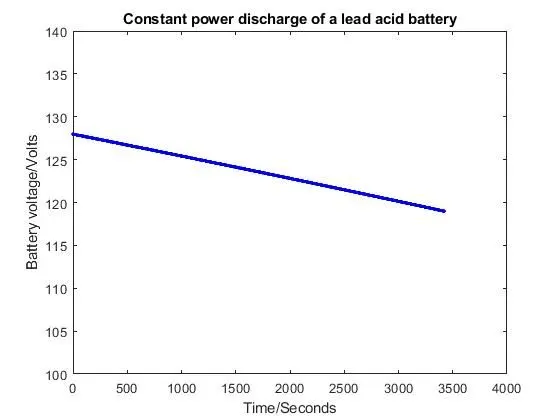
This line is liner here because lead-acid batteries voltage depends on the depth of discharge which is mentioned above in the equation defined for E in function and that equation follows similar behavior as that of linear line property i.e. y-mx+c. Whereas in the case of other batteries it won't follow linear line behaviour rather it will follow polynomial behaviour but the voltage will be a function of depth of discharge only.