Internal Geneva Mechanism
AIM :
to impart motion analysis study on internal geneva mechanism assembly and obtain various characteristic data of physical quantities related to the motion study.
INTRODUCTION TO GENEVA MECHANISM :
The name, Geneva drive, is derived from the device's earliest application in mechanical watches, which were popularized in Geneva, being the classical origin of the watchmaking industry.
The Geneva drive is also called a "Maltese cross mechanism" due to the visual resemblance when the rotating wheel has four spokes, since they can be made small, and are able to withstand substantial mechanical stress. These mechanisms are frequently used in mechanical watches.
In the most common arrangement of the Geneva drive, the client wheel has four slots and thus advances the drive by one step at a time (each step being 90 degrees) for each full rotation of the master wheel. If the steered wheel has n slots, it advances by 360°/n per full rotation of the propeller wheel.
Because the mechanism needs to be well lubricated, it is often enclosed in an oil capsule.
INTERNAL VARIANT :
An internal Geneva drive is a variant of the design. The axis of the drive wheel of the internal drive can have a bearing only on one side. The angle by which the drive wheel has to rotate to effect one step rotation of the driven wheel is always smaller than 180° in an external Geneva drive and always greater than 180° in an internal one, where the switch time is, therefore, greater than the time the driven wheel stands still.
POPULAR USAGE:
- movie projectors/cameras
- mechanical watches
- canning industry
- tool switching in an auto lathe, plotters, CNC machines
- automated sampling devices
- turret lathes, screw machines etc.
OTHERS VARIENTS :
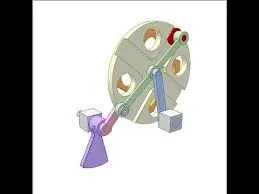
MECHANISM ASSEMBLY:
1) locus of the driver spindal
CAD MODELS AND ASSEMBLY FILE LINKS:
geneva driven part:
https://drive.google.com/file/d/1feGt7zltRaRbb_7kfJkMwaqaL6zdvi3c/view?usp=sharing
driver part:
https://drive.google.com/file/d/1gxCdt9SVH68sLexpmFVImmsgQqpX1fVx/view?usp=sharing
assembly part:
https://drive.google.com/file/d/1cbJTQPta1K-ecwQ93kUVhE-gKgMiOaV2/view?usp=sharing
MOTION STUDY ANALYSIS :
STUDY SETUP 1 :
motor:
- rotary type
- rpm: 10 clockwise
- motion type: constant speed
- fps: 60
contact:
- contact type: solid bodies
- material: steel(dry), for both components
- friction effect: default / on
- elastic properties: default / on
motion study properties:
- fps: 60
- study span: 1 complete revolution of the driven wheel from the initial(disengaged) position
contact forces vs. time (Precise contact: off):
contact forces vs. time (Precise contact: on):
angular displacement vs time (driven wheel):
angular velocity vs time (driven wheel):
STUDY SETUP 2 :
motor:
- rotary type
- rpm: 20 clockwise
- motion type: constant speed
- fps: 120
contact:
- contact type: solid bodies
- material: steel(dry), for both components
- friction effect: default / on
- elastic properties: default / on
motion study properties:
- fps: 120
- study span: 1 complete revolution of the driven wheel from the initial(disengaged) position
contact forces vs. time (Precise contact: on):
angular velocity vs time (driver wheel):
angular velocity vs time (driven wheel):
simulation results:
https://drive.google.com/drive/folders/1Y48ly0NRZYDYlnTKpUiaTlBYFXgJMZ-x?usp=sharing
CONCLUSION:
- amount of average force and angular velocity increases with an increase in motor rpm hence, torque transmitted by driver wheel
- with precision contact selected, any mishaps with impinging material effects are avoided at all. though you can increase the accuracy level and 3D contact resolution levels.
- amount of jerk and disengagement chances increase with higher rpm as the driven wheel has higher residual motion after driving spindle has left the slot.