Independent Research Project
Aim :-
Design and analysis of a SAE Baja Vehicle.
Objective :-
- To perform Free-Free run analysis
- To perform front impact analysis.
- To perform Side impact analysis.
- To perform front Bump analysis.
- To perform front impact analysis.
- To perform Roll over analysis.
Result Looking for :-
- Stress generated during impact.
- Stain Value
- FOS of ATV during impact.
INTRODUCTION:
For a better performance of a ATV car it is important to make sure that all components work as per proposed design calculations. As roll cage chassis being the important system, which absorbs all the static and dynamic loads the structure must be such that it will sustain the stresses generated without deformation. Various forces act’s on the vehicle when the vehicle is in static as well as in the dynamic condition. These forces cause deformation which resulted in stress generation at different areas of the roll cage. These forces generally occur during the event performing various rounds such as breaking, acceleration, maneuverability and endurance. The stiffness factor of the roll cage must be able to resist these forces acting.
REQUIREMENT OF VEHICLE:-
- Cost of the vehicle
- Endurance or life
- Parts easily available for maintenance
- Speed and acceleration
- Mass and overall dimension must be less
- Maneuverability
- Aesthetics and ergonomics
- Driver comfort and safety
Roll cage:-
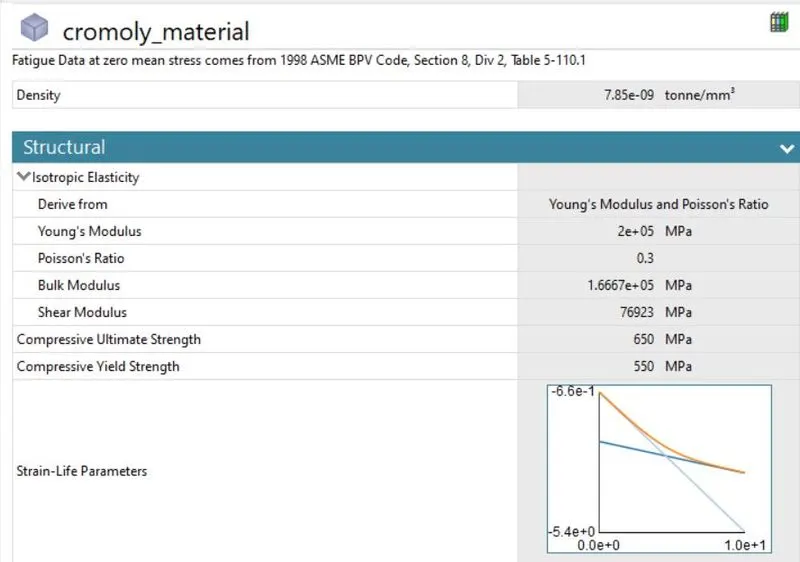
Roll Cage can be called as skeleton of a vehicle, besides its purpose being seating the driver, providing safety. The roll cage is of utmost importance for us as it would be the one which would provide mounting points for various systems and ergonomics and looks to the vehicle our design of the roll cage started with ergonomic and driver comfort study. While in motion, the chassis gets subjected to various kinds of forces The two very commonly used materials for making the space frame chassis are Chromium Molybdenum steel (Chromoly AISI -4130) and AISI 1018. Both these materials were analyzed for different parameters and finally decided to use AISI 4130 steel for making the tubular space frame chassis because of several reasons. AISI 1018 grade steel exhibits better Thermal properties but it is weaker than Chromoly in terms of strength. As the safety of driver is the main priority, therefore the material with better stiffness and strength was chosen. Chromoly steel 4130 has better structural property than AISI 1018 Grade steel hence the former was considered as the basic material for fabricating a tubular space frame chassis. Even though the cost of Chromoly is marginally higher than that of AISI 1018 grade steel, the safety of the driver is prominently more important for the team.
CAD model :-
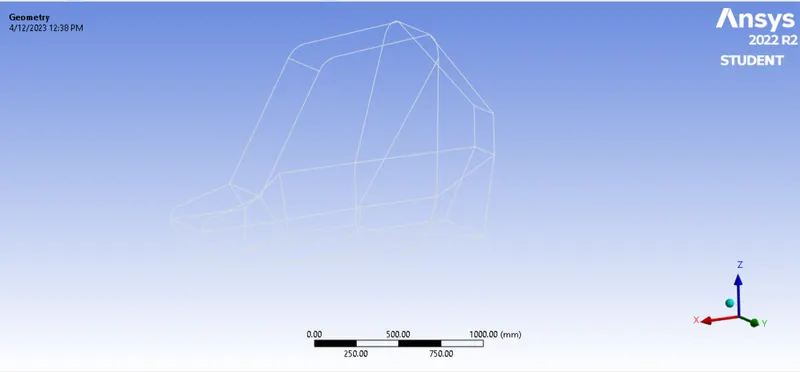
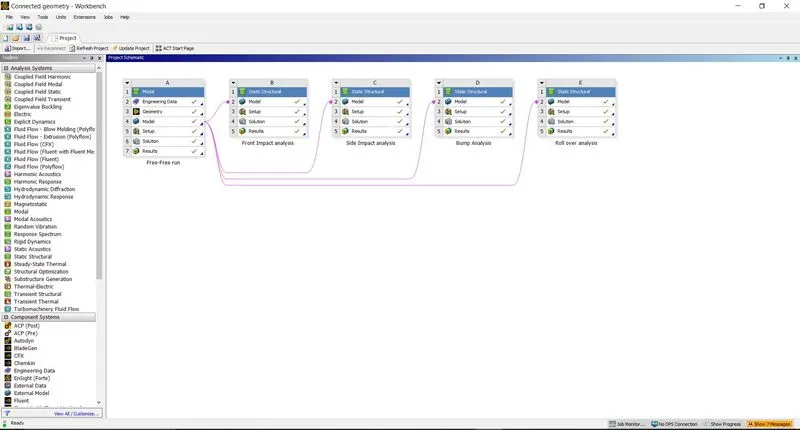
Free-Free Run Analysis to check connectivity of CAD model :-
- Free – Free Run :-
Free – Free Run is a sub type of Modal Analysis which is used to find the connectivity of model / Geometry.
- Why we need to find whether the Geometry / Model is Connected or not ?
we need to find whether the Geometry / Model is connected or not so that if we apply load and constraints then we should get the results.
Result of modal analysis :-
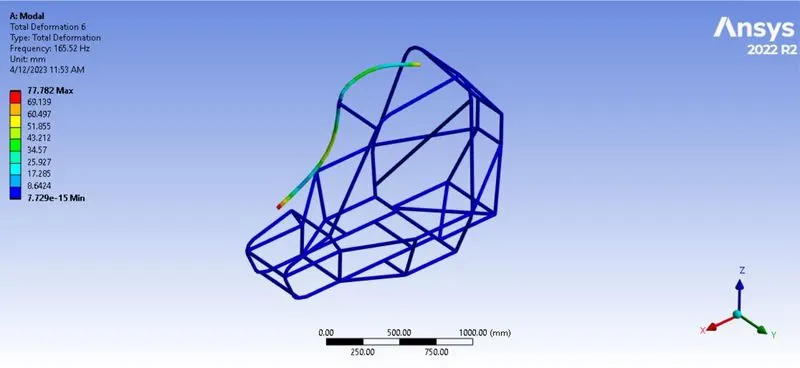
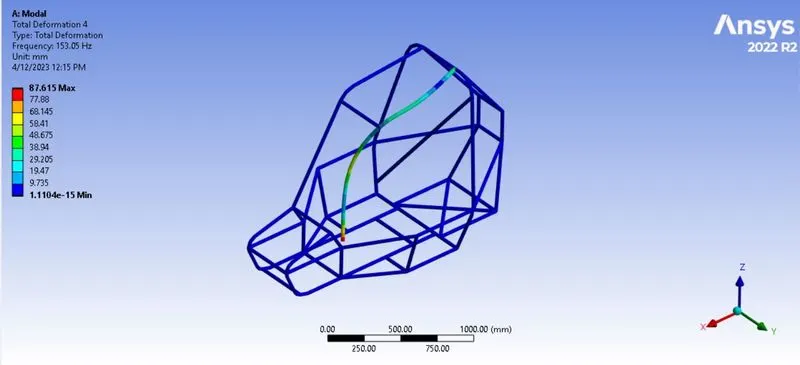
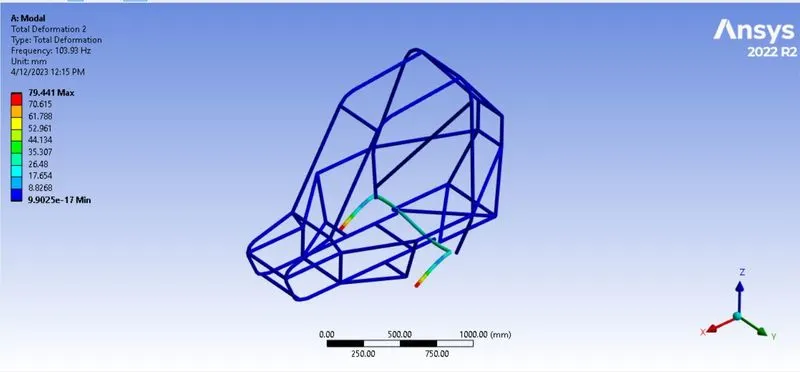
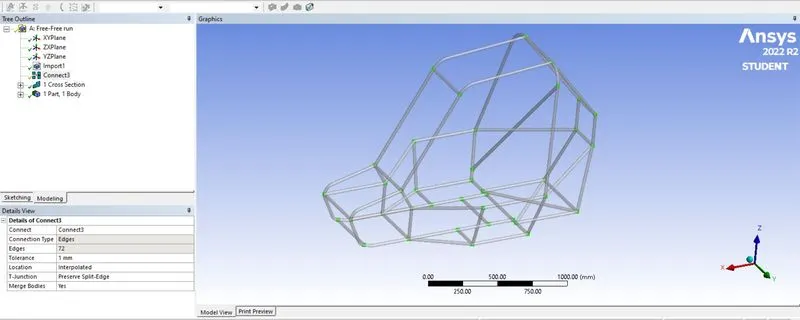
- From Free-Free run analysis it is seen that geometry was not connected properly.
- To connect geometry we used connect option from design modeler window
Result after using connect option :-
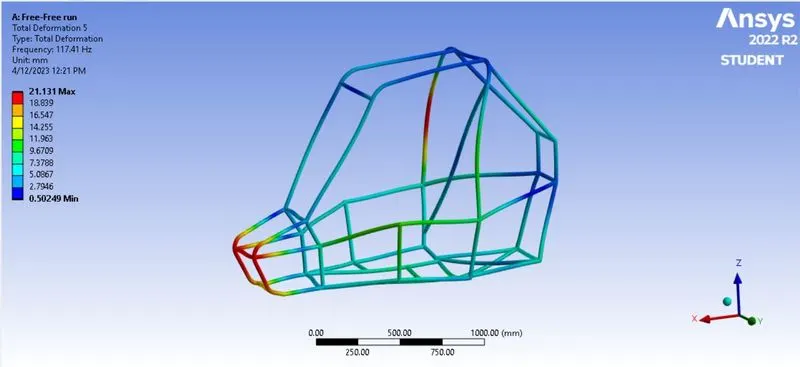
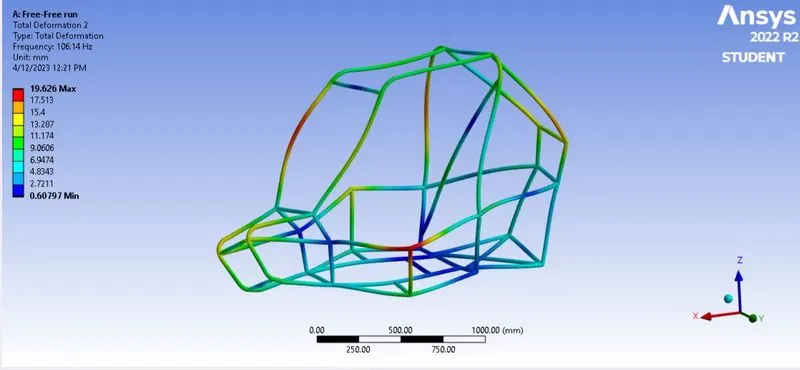
- Roll-Cage move as single body, means now geometry is connected and ready for analysis
Define Cross section and material fir roll-cage :-
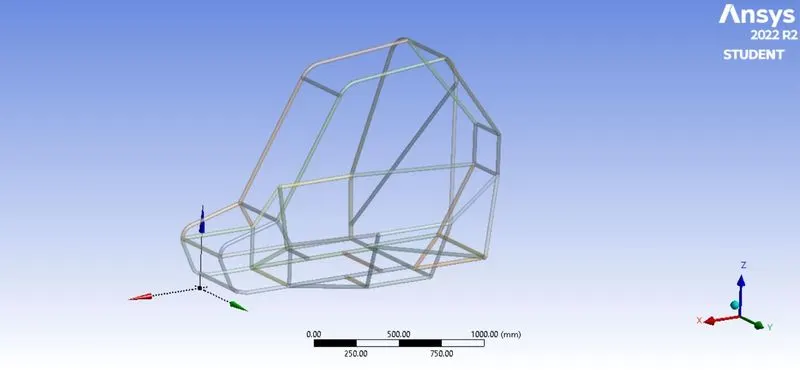
Cross Section :- Circular tube
Dimension :- 25.4 x 1.66 thk (mm)
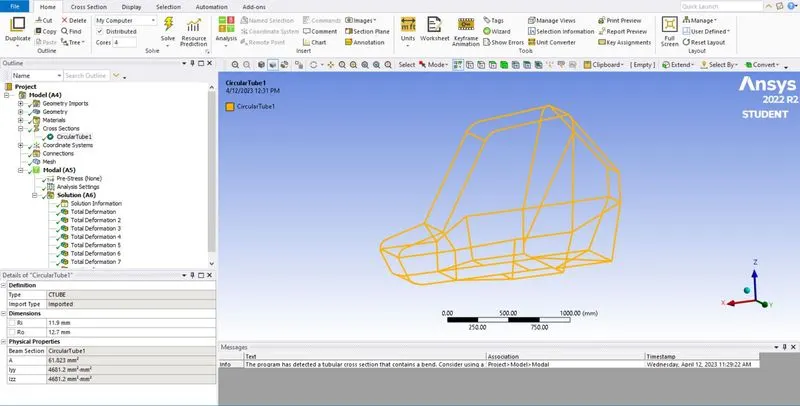
Geometry after define coress section :-
Define Material :-
Mesh Generation of Model
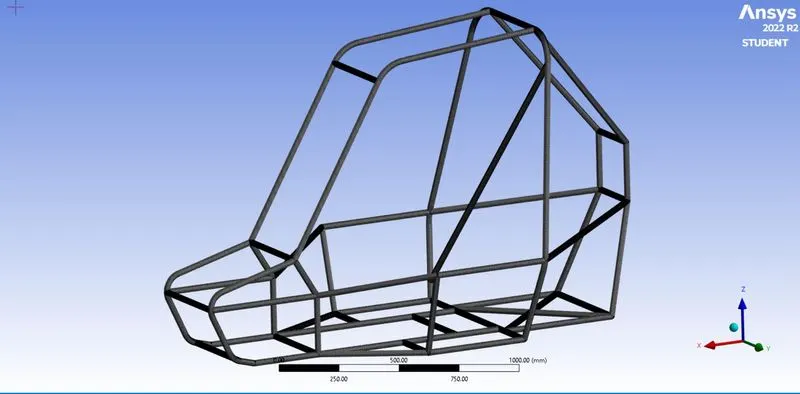
Type of Mesh :- 1D mesh (Beam element)
Mesh Size :-5 mm
- Front Impact Analysis :-
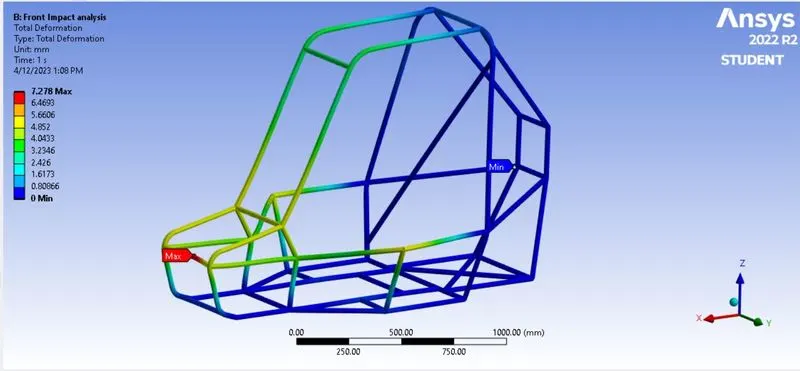
Front Impact Analysis is done in order to study the deformation and stresses developed in the vehicle when there is either a sudden impact on the front side of the vehicle or it collides with some other vehicle or something else. The frame is designed so as to have least possible failure and prevent the driver from injuries.
Front impact or the static front impact analysis, Deceleration of 3g‟s was assumed for the loading which is equivalent to a static force of 1962 N load on the vehicle, assuming the weight of the vehicle is 200kg (with including 60 kg driver weight). We apply 1962 N from the front for the test of front impact of the roll cage structure of the vehicle for determining strength at the time of front collision.
F=m*a = 200*3*9.81 = 7848 N
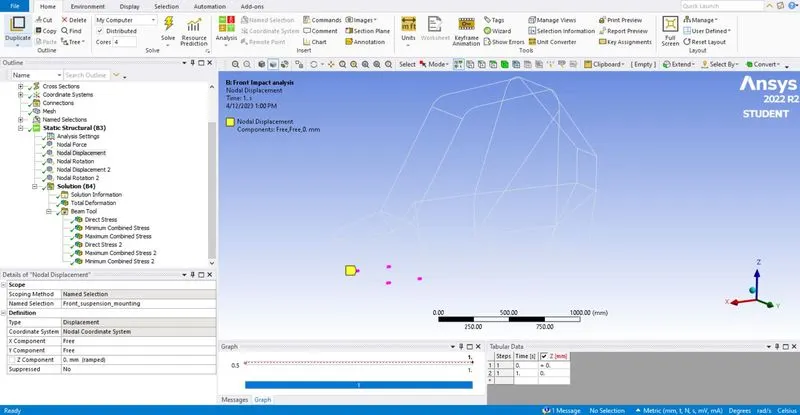
- boundary conditions :- Suspension Mounting points of ATV (Named selection)
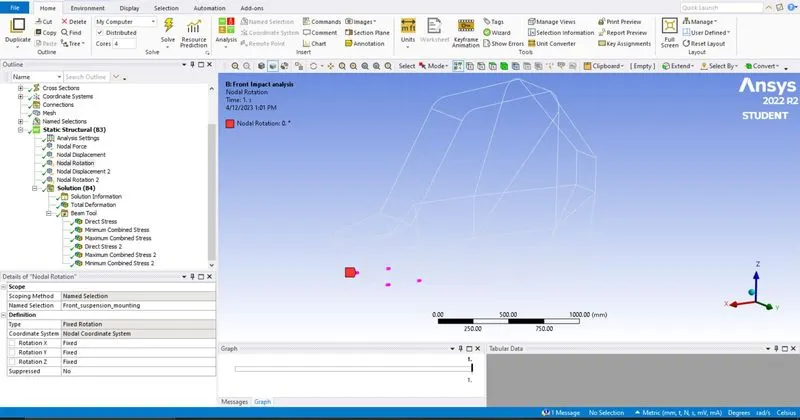
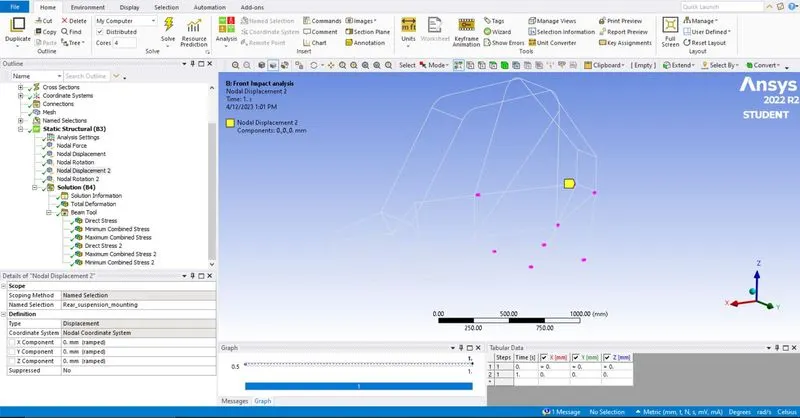
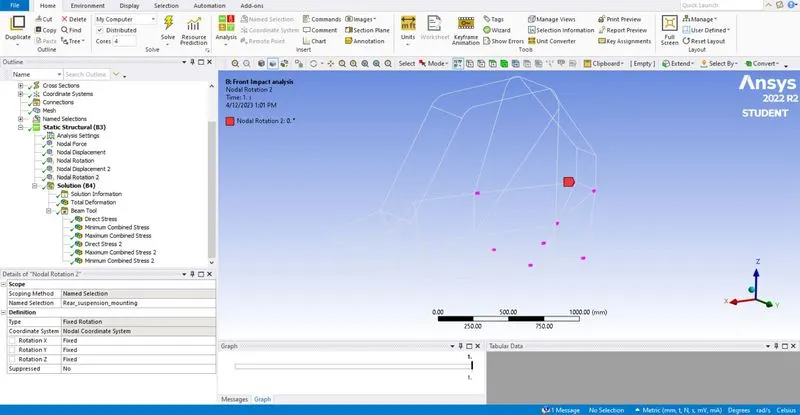
- Nodal Force :- At front member of roll cage (7848 N )
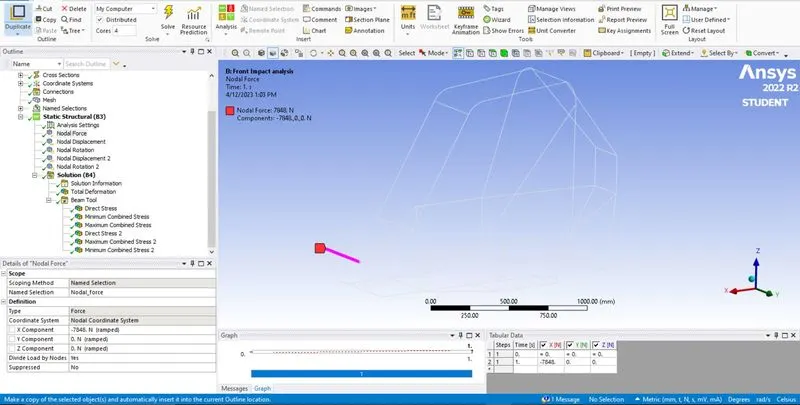
Result of Front Impact Analysis :-
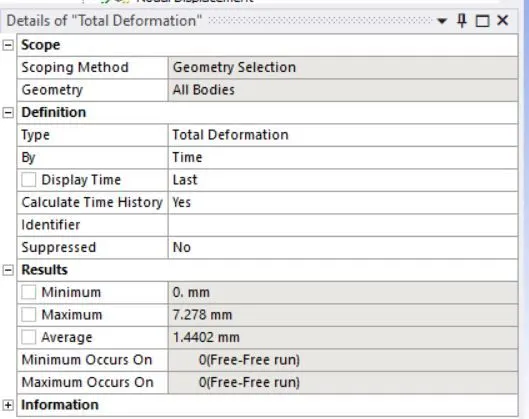
Deformation :-
Max Combined Stress :-
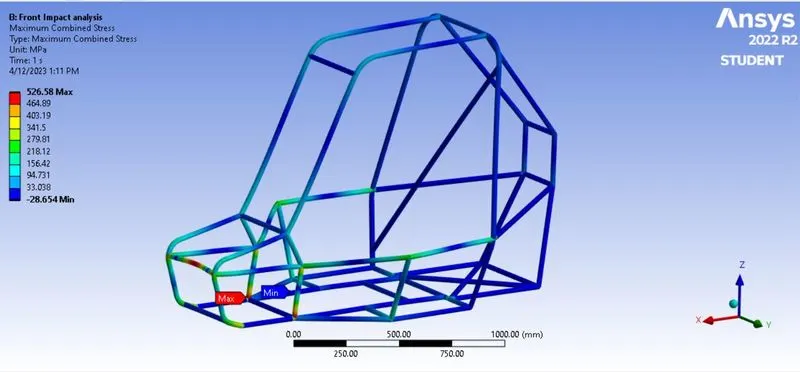
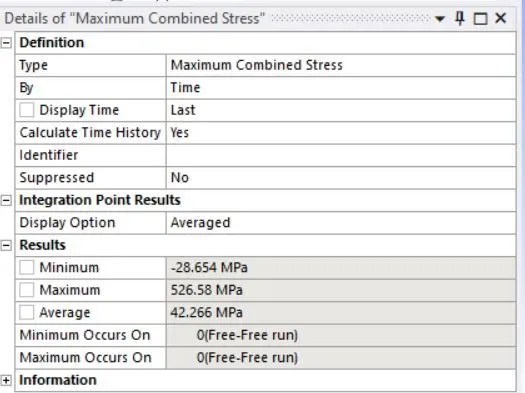
Max combined Stress :- 526.58 MPA
FOS :-650/ 526.58 :- 1.23
Remark :- Roll cage in safe in Impact analysis.
Side Impact Analysis :-
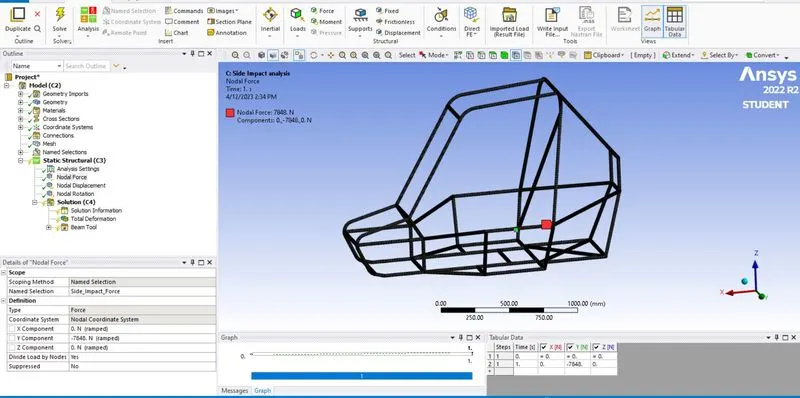
Side impact or the static side impact analysis, Deceleration of 5g‟s was assumed for the loading which is equivalent to a static force of 9810 N load on the vehicle, assuming the weight of the vehicle is 200kg (with including 60 kg driver weight). We apply 9810 N from the side for the test of side impact of the roll cage structure of the vehicle for determining strength at the time of side collision.
F=m*a = 200*5*9.81 = 9810 N
- boundary conditions :- Suspension Mounting points of ATV (Named selection)
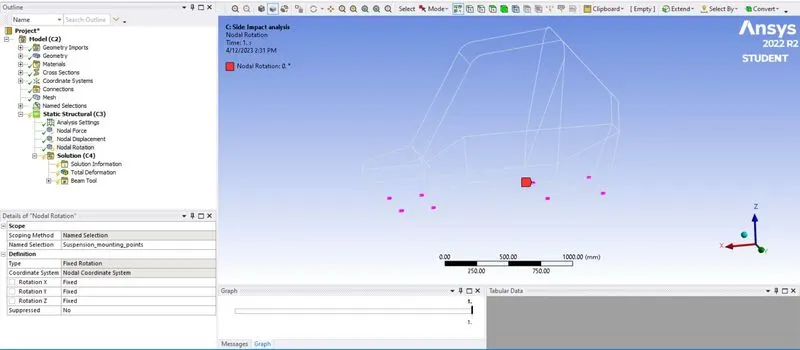
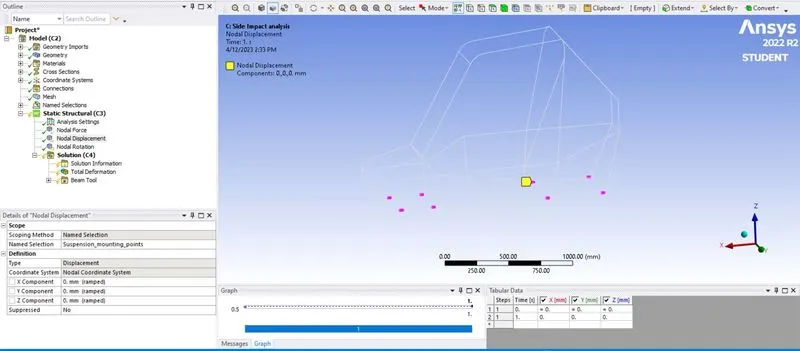
- Nodal Force :- At Side member of roll cage (7848 N )
Result of Side Impact Analysis :-
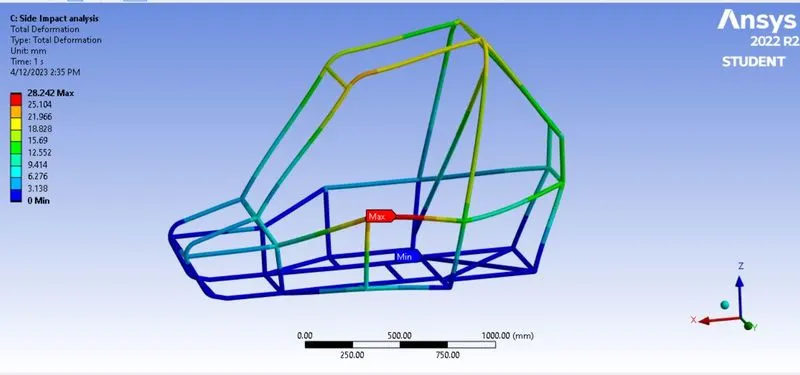
Total Deformation :-
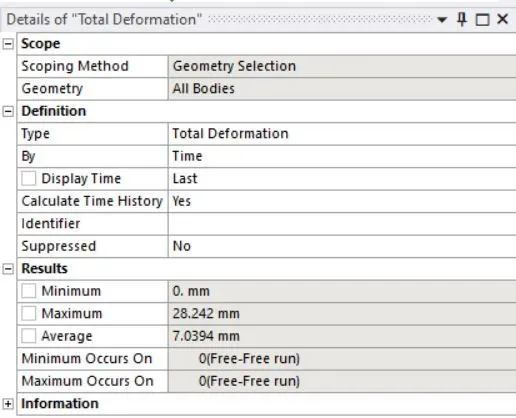
Max. Combined Stress :-
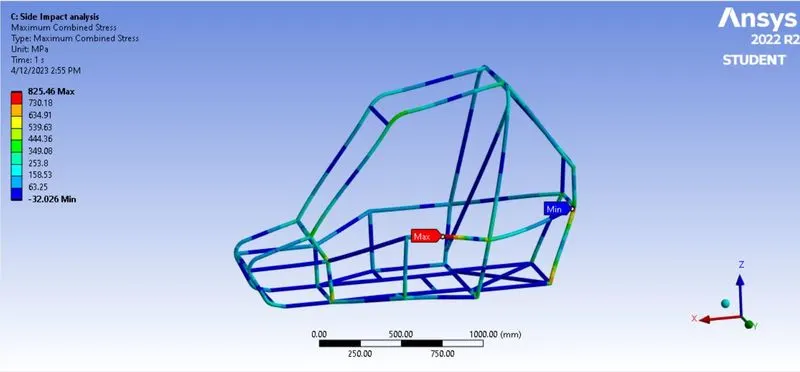
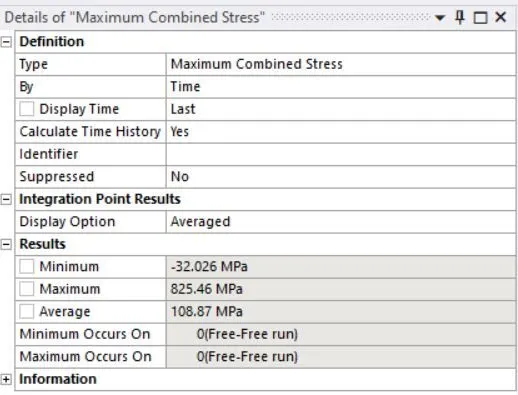
Max combined Stress :- 825.46 MPA
FOS :-650/825.46 :- 0.78
Remark :-
Roll cage is failed in side impact test so to imporove design roll cage design need to modify or add more members in side of rollcage.
Front Bump Analysis :-
The vehicle may experience a bump force on either of its side. This might happen when there is heavy reaction force and the damper is not able to sustain it. Greater forces may lead to side flip of the vehicle. The general weight distribution of the vehicle is assumed to be 40% - 60% (Front: Rear). Hence, the forces are also considered in the same proportion.
Force acting on front members of roll-cage :-
Force on front suspension mounting :- 200 x 40/100 x 9.81 :- 785 N
- boundary conditions :- Fixed rear Suspension Mounting points of ATV (Named selection)
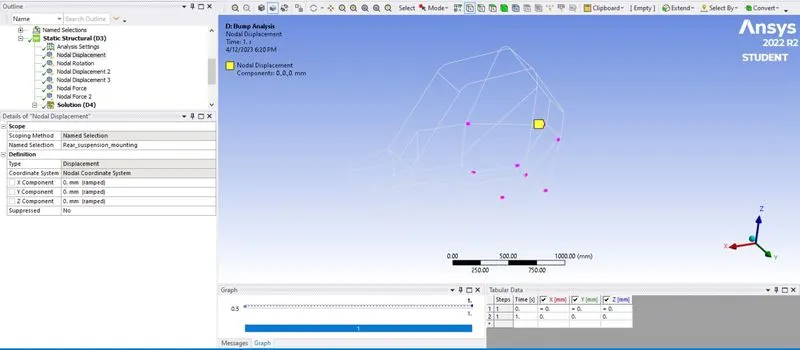
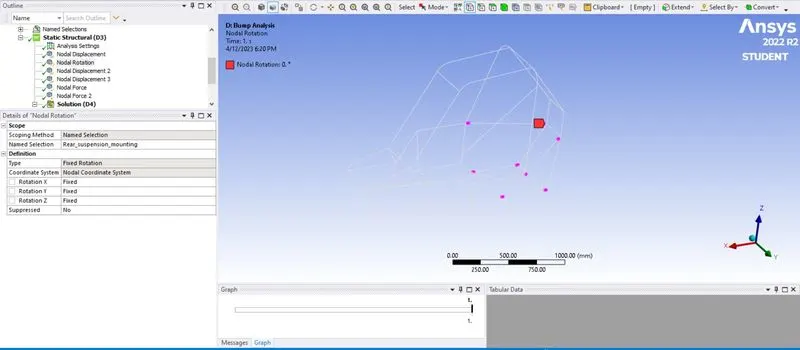
For front suspension mounting DOF in Z directional is free :
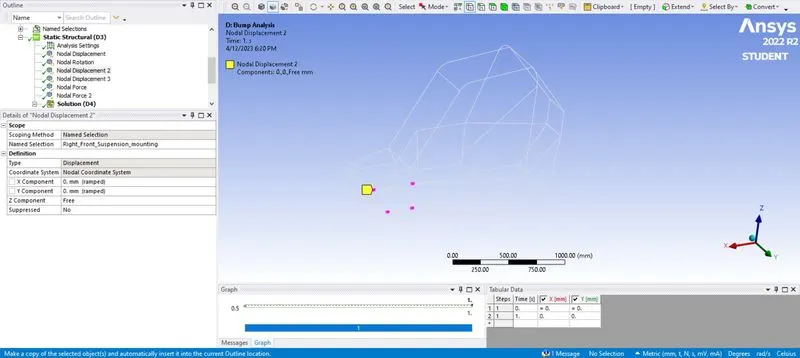
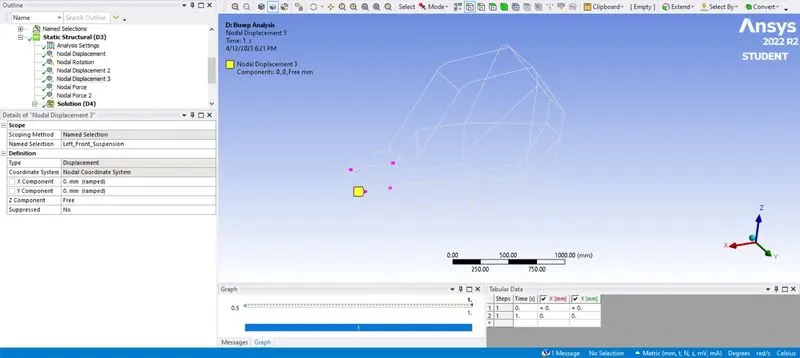
Nodal force applied at front suspension mounting :-
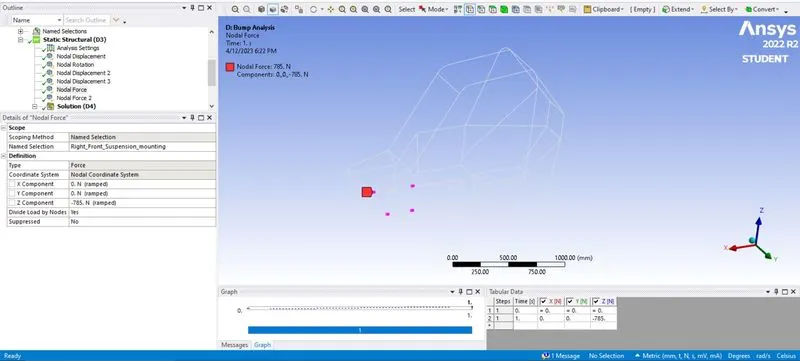
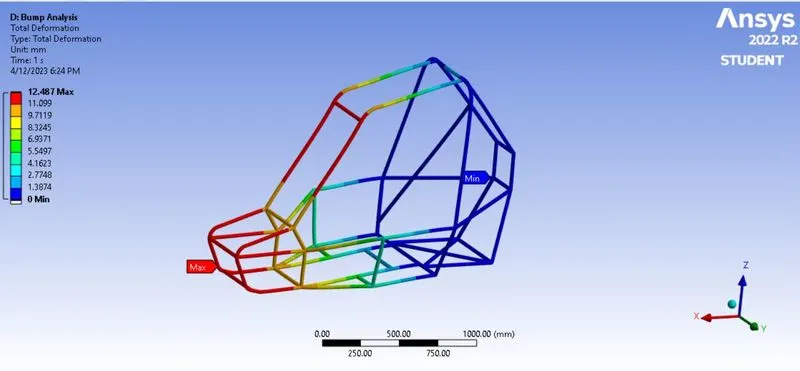
Result of Front bump analysis :-
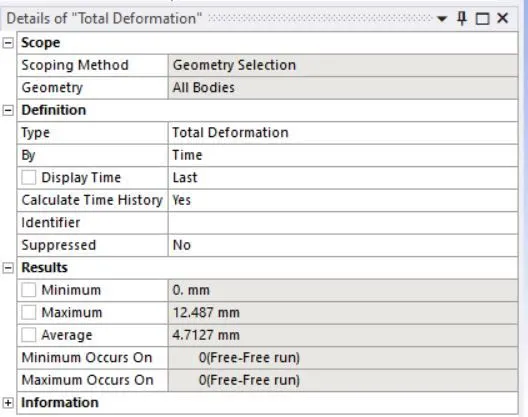
Total deformation :-
Max. Conbined Stress:-
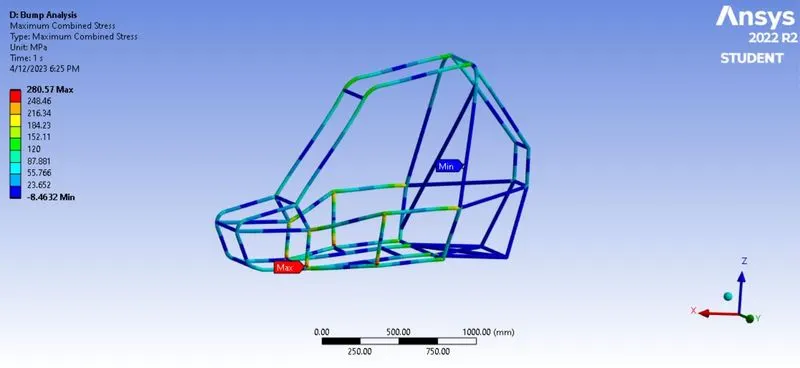
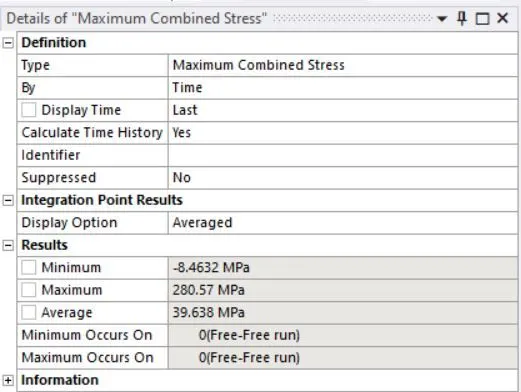
FOS :-650/280.57 :- 2.31
Remark :- Roll cage in safe in front bump analysis.
Roll over Analysis :-
The vehicle needs to be designed and validated for the most extreme off-road conditions including a complete roll-over. The chances of a roll-over is very high during the suspension and traction event, rock crawl or during the Final Endurance Race. This test needs to be performed with utmost care, since the driver should be safe in this extreme condition.
Force acting on roll-cage member during roll over :-
F :- M x a
a = (v_f - v_i) / t
a = (0 - 16 m/s) / 0.5 s
a = -32 m/s^2
F = m * a
F = 200 kg * (-32 m/s^2)
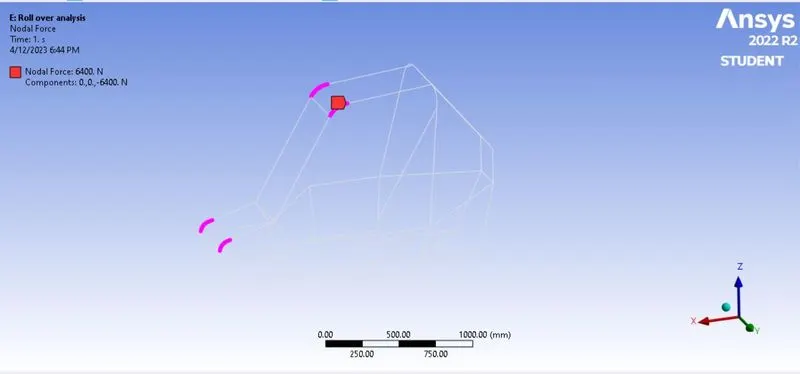
F = -6400 N
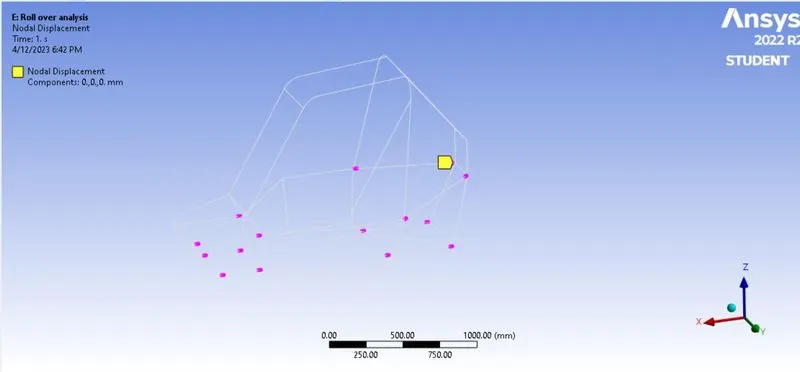
- boundary conditions :- Fixed Front and rear Suspension Mounting points of ATV (Named selection)
Nodal force applied at front members of roll cage :-
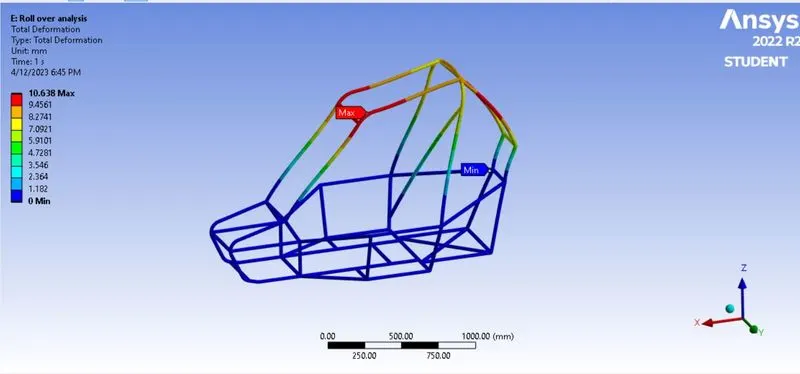
Result of Roll over analysis :-
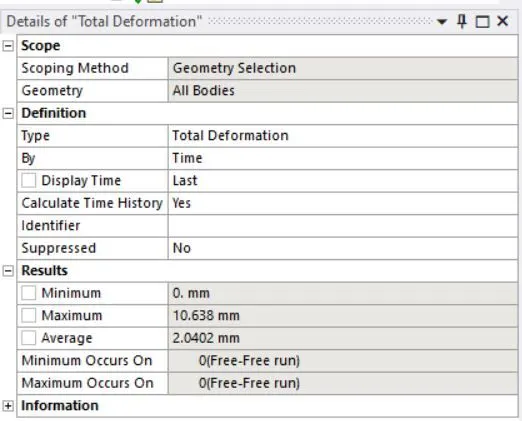
Total deformation :-
Max. Combined stress :-
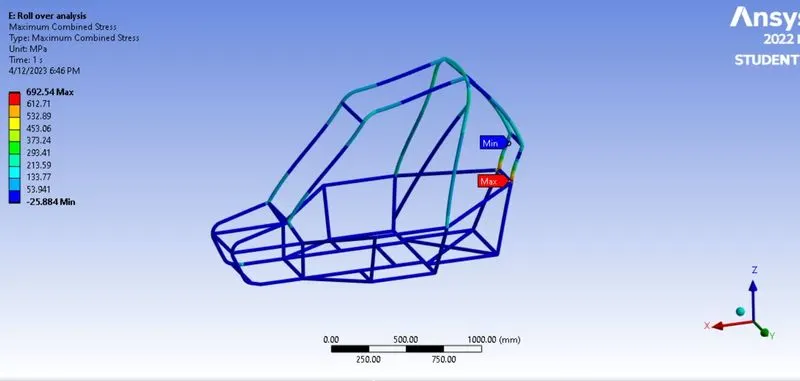
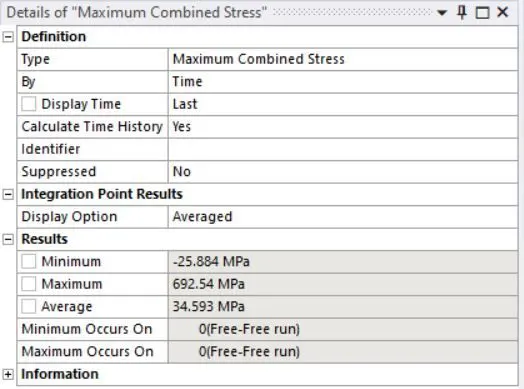
FOS :-650/692.54 :- 0.93
Remark :-
Roll cage is failed in roll over test so to imporove design roll cage design need to modify or add more members in rollcage.
Result table :-
| Test | Total deformation (mm) | Max. Combined stress (Mpa) | FOS |
| Front Impct | 7.2 | 526 | 1.23 |
|
Side Impact test |
28 | 825 | 0.75 |
| Front Bump test | 12.87 | 287 | 2.31 |
| Roll over test | 10.68 | 692 | 0.93 |
Overvirew on project :-
This is a report on the design and analysis of a SAE Baja Vehicle. The objective is to perform various impact analyses, such as free-free run analysis, front impact analysis, side impact analysis, front bump analysis, and roll-over analysis. The aim is to determine the stress generated during impact, strain value, and factor of safety of the vehicle during impact.
The report emphasizes the importance of the roll cage as the skeleton of the vehicle, providing safety to the driver and absorbing static and dynamic loads. The design of the roll cage started with an ergonomic and driver comfort study, and after analyzing different materials, Chromoly steel 4130 was chosen for its stiffness and strength.
The report includes a CAD model of the vehicle and a free-free run analysis to check the connectivity of the model. The result showed that the geometry was not connected properly, but after using the connect option from the design modeler window, the geometry was connected and ready for analysis.
The report then describes the front impact analysis, where a deceleration of 3g's was assumed for the loading, equivalent to a static force of 1962 N load on the vehicle. The result of the analysis showed that the roll cage was safe, with a factor of safety of 1.23.
Similarly, the side impact analysis was performed with a deceleration of 5g's, equivalent to a static force of 9810 N load on the vehicle. The result showed that the roll cage was safe.
Finally, the report discusses the importance of considering the requirements of the vehicle, such as cost, endurance, speed, acceleration, maneuverability, aesthetics, ergonomics, driver comfort, and safety. The report concludes that the analysis performed on the SAE Baja Vehicle provided valuable insights into the stresses generated during impact and the factor of safety of the roll cage.
Conclusion :-
The design and analysis of the SAE Baja Vehicle presented in this report provided a thorough understanding of the impact stresses generated during various scenarios and the safety of the roll cage. The report demonstrated the significance of the roll cage as the skeleton of the vehicle and highlighted the importance of selecting the appropriate materials for its construction. The report's detailed analysis of various impact scenarios and the resulting factor of safety provided valuable insights into the vehicle's durability and driver safety. Moreover, the report emphasized the importance of considering various requirements of the vehicle while designing it. Overall, the report's findings can be used to optimize the design of the SAE Baja Vehicle to ensure its durability, performance, and driver safety.