Identification of Cracks
1a)
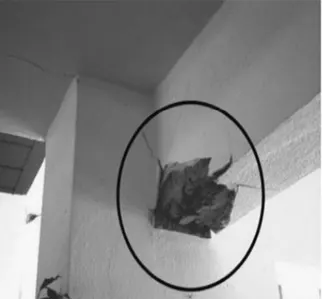
The beam-column joints are very restricted areas in which the internal forces, generated by boundary elements, act on the concrete core and reinforcing bars with a very high gradient. They are the link between horizontal and vertical structural elements, and therefore, they are directly involved in the transfer of seismic forces. Thus, they are crucial to study the seismic behavior of reinforced concrete (RC) structures. To fully understand the seismic performances and failure modes of beam-column joints in RC buildings, a simplified analytical model of joint behavior is proposed and theoretical simulations are performed.
- it may also be caused due to insufficient vibration of concrete as there will be hinderence of the reinforcement while vibration. it can be repairable.
- the repair can be done by providing proper cover and reinforcement at the joint.
1b)
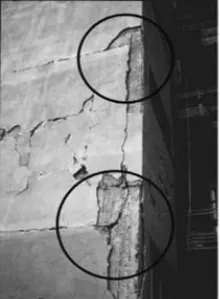
Failure is due to insufficient bond strength and improper curing.
This kind of problem will occurs due to construction errors. Columns could fail due to the construction defects. For example, improperly treated honeycomb in a column could lead to a failure when the loads are applied. These types of column failure can be avoided if attended with much care. Cavities inside the column that were not filled properly with construction ground reduce the compressive area of the column. As a result it axial capacity will be reduced.
The damage is reparable, although the original deficiency namely the poor anchorage of beams bars in the joint cannot be corrected easily.
1c)

Failure is due to beam column joint connection in the reinforced concrete frame.
Beam-column joint (BCJ) of reinforced concrete is an area of critical which must be carefully designed to absorb the seismic energy. Inability to absorb seismic energy will cause serious damage to structural failure. It will lead to shear failure, i.e. brittle and endanger users of the building if the BCJ area is not designed properly. In order to get a building structure is safe and resistant to disasters, mainly due to the earthquake, the structure must be designed in accordance to the rules of standard construction (eligible detailing). In general, the anchorages (detailing) reinforcement beams to the column is pointing downwards, however, what if the steel anchoring beams are pointing upwards. Different anchoring will result in the behavior of different structures, such as fracturing pattern.
2a)
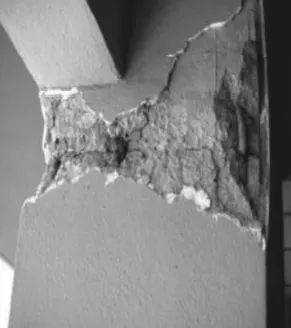
failure is due to the flexural damage.
A flexural compression failure is a common failing type in RC especially high rise RC building columns. A RC column that subjected combined axial load and bending moment reaches capacity when concrete reaches the ultimate deformation level as about 0.003~0.0035. If concrete reaches the deformation capacity before yielding of longitudinal reinforcement bars in tension region, the failure mode is called as compression dominant flexure failure. The main parameter of the deformation type under combined axial load and bending moment are; section area of column, concrete compressive strength, axial forces level and amount of longitudinal and lateral reinforcement bars.
2b)
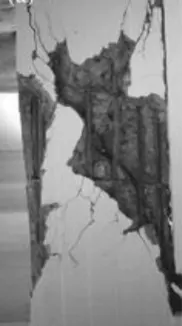
This kind of defects can occurs due to Shear failures of columns. Lateral loads in a structure are carrying by vertical elements such as columns and shear walls.When there are no shear walls, columns carry these lateral loads. Lateral loads are generated by winds, earthquake loads, from retaining structures, etc. Shear links are provided to columns based on the shear forces excreted on them. Further, the size of the columns is increased in the direction of shear to increase the shear capacity. In general, failure of columns due to shear can be identified as the failure of design. Designers should have provided adequate shear links or sections to carry the shear forces.
this very difficult to repair.
2c)
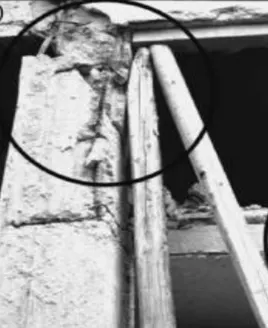
This kind of defects can occurs due Short column failure. Short Columns, failure takes place due to yielding and we define this phenomenon as CRUSHING. Short Columns are classified based upon Slenderness Ratio which is the ratio of the effective length (Length between point of zero moments) and least lateral dimension of the column. To know whether column is short or long, we find its critical slenderness ratio using Euler’s formula and putting values of Yield strength, Modulus of Elasticity etc in this formula we get, Cc (Critical slenderness ratio).
Solution:
1) In existing buildings with short columns, different retrofit solutions can be employed to avoid damage in future earthquakes. Where walls of partial height are present, th
: the simplest solution is to close the openings by building a wall of full height – this will eliminate the short column effect.
2) If that is not possible, short columns need to be strengthened using one of the well established retrofit techniques