Hood design-Week 2
DESIGN A HOOD USING NX CAD:
OBJECTIVE:
- Project is about to Design a Hood that satisfies the manufacturing requirements, functional requirements as per Euro NCAP standards.
- The Body in white (BIW) Inner panel and Outer panel of the hood must be designed and assembled with the Hinge Assembly, Latch and Striker with their reinforcements.
INTRODUCTION:
The Hood is an opening body panel that covers the engine in a front-engine vehicle in some cases like rear engine vehicles it acts as the cover of the boot space. The hood is also considered as another type of door in a vehicle as it consists of an outer panel and inner panel. The inner panel provides strength while the outer panel functions as the metal cover Hoods also play a major role in the aerodynamics of the car, thereby reducing the drag and increasing the downforce of the car. Hood also helps to direct impact of the any head-on collisions away from the passenger cabin there-by reducing the damages to the passengers. These Hoods are designed in such a way that less damages are caused to the pedestrians during accident
Designing
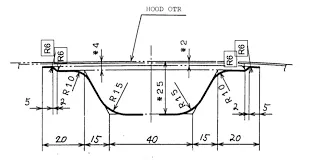
For each region there is a master sketch that can be adopted for different situations and gives us the dimensions of the part to be designed. The inner panel including all embossments, is designed by offsetting the outer . The maximum gap between the inner and outer panel in the master sketch is 25 mm, under which the engine compartment is located. This specification is made taking into account pedestrian safety: the deep drawing process is used in the manufacture of the inner panel and the design considerations are taken into account.
DESIGN CONSIDERATIONS TO BE FOLLOWED:
- Passenger safety
- Pedestrian Safety
- Manufacturing Feasibility.
- Positioning the striker along the Trajectory of the Centre of Hinge axis
- Joining techniques of inner and outer panel
Passenger safty
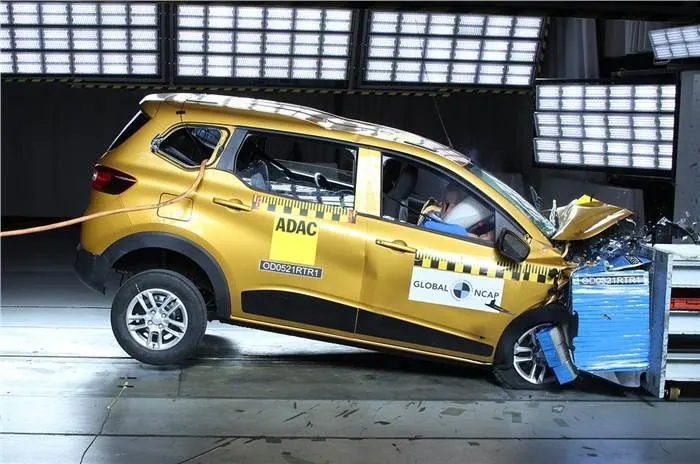
In a head-on collision in a car, the first part to be affected is the hood. Therefore, the hood must be designed so that it does not detach from the body, but absorbs the energy as much as possible and dissipates the force toward the side wall of the vehicle, so that the force acting on the interior is less since the force is less, the passengers will experience less force so that the safety of the passengers is guaranteed.
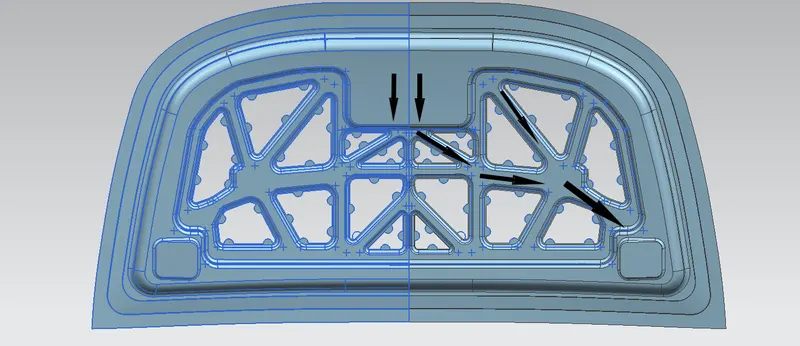
Hood inner panel plays major role in dissipating the force away from the passengers. It completely depending upon the emboss which is created in the inner panel. A typical emboss is shown below. The force will completely move along the direction shown abo minimising the force exerted towards the cabin.
Pedestrian safty
Collisions between pedestrians and road vehicles present a major challenge for public health, trauma medicine, and traffic safety professionals. More than a third of the 1.2 million people killed and the 10 million injured annually in road traffic crashes worldwide are pedestrians.1 Compared with injured vehicle occupants, pedestrians sustain more multisystem injuries, with concomitantly higher injury severity scores and mortality.2 Although a disproportionately large number of these crashes occur in developing and transitional countries, pedestrian casualties also represent a huge societal cost in industrialised nations.
The most important safety requirement to be considered while designing the Bonnet is the Pedestrian Safety from a frontal collision
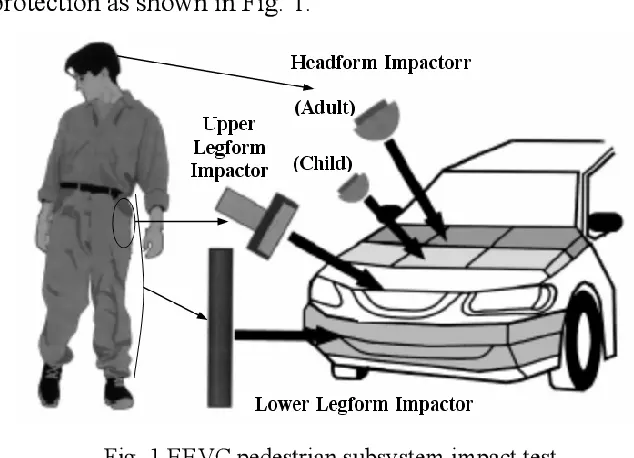
The European New Car Assessment Program (Euro NCAP) is a European motor vehicle safety assessment program that has developed test specifications and rating systems for evaluating pedestrian injuries in frontal vehicle impacts. These tests include a series of tests with impactors designed to simulate an impact at a speed of 40 km/h. They describe a situation in which a pedestrian is sideways and a car first hits one of his or her legs. The tests are performed on the leg, the thigh, and especially the head, since head injuries are most often responsible for accidents.
Manufacturing Feasibility:
While designing a component a design engineer must make sure that the component can produced by any means of manufacturing methods with least amount of time, material manpower and power. So that we can reduce the overall cost of car. When the hood is considered it is manufactured by deep drawing at most of the time Deep drawing is the process where the single sheet of metal is place over a die which has the desired shape of the final output and the sheet is pressed against it with a tool. For the tool to come out from the part usually pressing relief of 5° to 9° will be provided during modelling itself. In NX draft analysis can be done after modelling so that we can verify whether the product is manufactured by pressing or not.
Positioning the striker along the Trajectory of the Centre of Hinge axis:
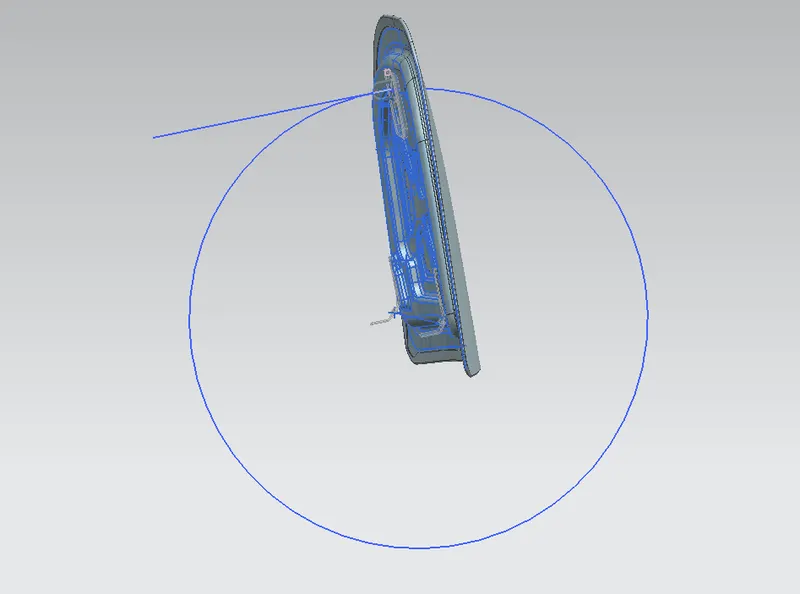
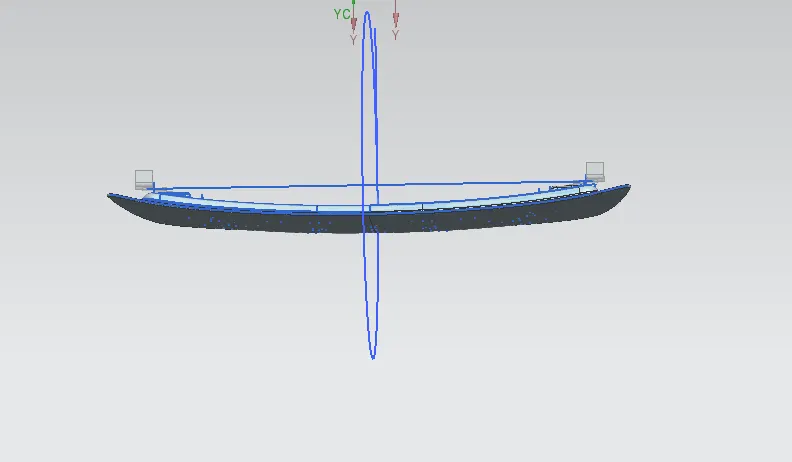
The striker needs to be place on the trajectory of the centre point of the hinge axis to ensure that it fix perfectly on the latch if not locking will not be smooth and affects the comfort and also it will create NVH problems.
The striker is aligned using following steps:
- Drawing the line along the axis of the hinge
- Creating the point on the mid-point of the line
- Drawing the circle from the mid-point of the line to the latch where the mounted
- Drawing the line from centre point to the midpoint of the striker rod 5. Aligning the line's end point and the mid-point of the striker to the circle.
- Angle need to aligned so that the angle of the striker is perpendicular to the line drawn from mid point of the axis line to the mid-point of the striker
Hemming:
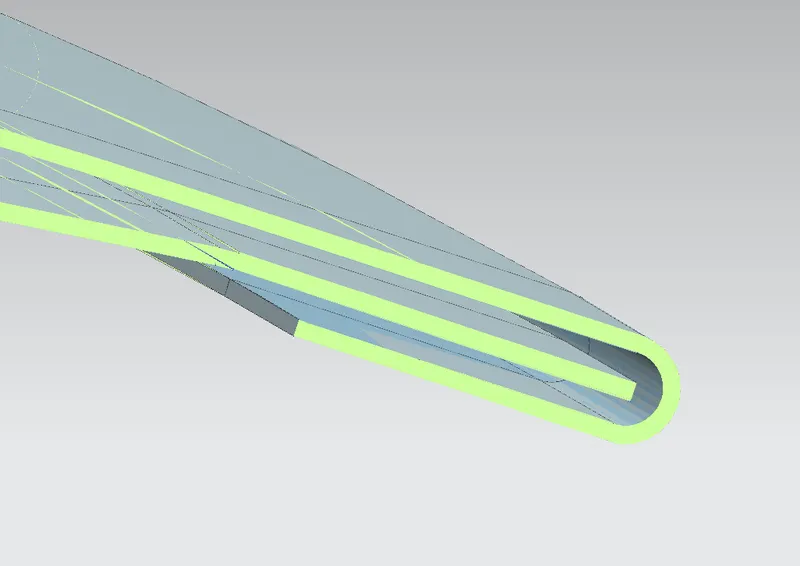
Hemming is the process of wrapping the flange of the outer panel te the flange of the Inner panel so that they are fitting rigidly. After hemming process, the sealants were applied along the edge of the flange of outer panel so that water tightness is achieved. The below image shows the cross-section of the inner and outer panel joined by hemming process.
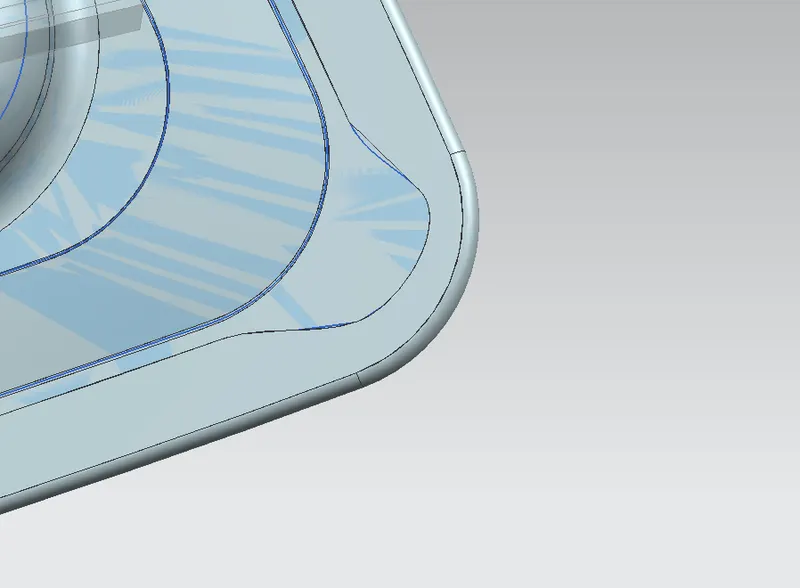
Usually, the reliefs were provided at the corner of the hemming flange to avoid the Hemming relif to avoid stress developed while hemming. Stress developed during the hemming process.
Mastic Points:
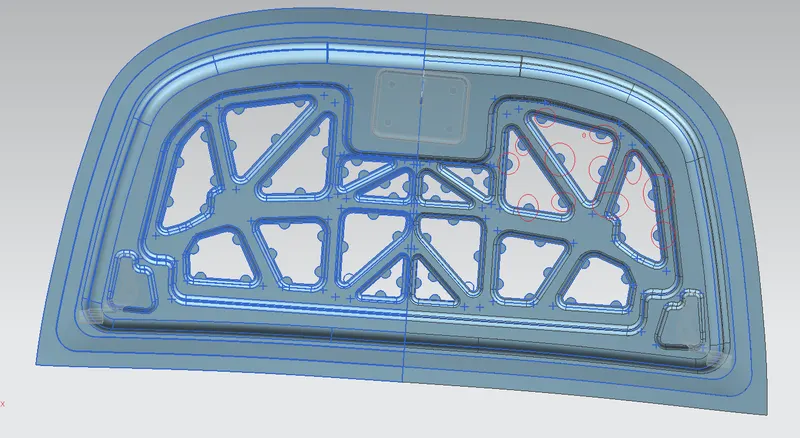
Mastic points were the gluing points where the paste is applied between the inner and outer panel to join the panels Each mastic point will stiffness up to 80mm surrounding. So mastics to be added in such a way that it covers entire surface of the hood. If the gap is less than 5mm between the outer and the Inner panel without mastic points it will cause vibration resulting in NVH problem. Below image shows the mastic points where the paste is applied, and it will get hardened in further processes resulting in a rigia joint
Conclutiion
Thus the hood is designed that satisfies the manufacturing requirements.