Hood design-Week 2
Introduction:
The engineering design of structural components is often a compromise or trade-off in order to satisfy all design requirements during various operating condi- tions over the lifetime of the product. One way to improve specific structural performance is by the inte- gration of sensors, processing systems, and actuators, to intelligently adapt the structural behavior to the cur- rent or expected load conditions. The combination of stimuli-responsive ‘‘smart’’ materials with electronic measurement or control systems has resulted in the development of a wide variety of structures of multi- functional material structures with so-called ‘‘smart’’ or ‘‘intelligent’’ behavior Such smart materials have applications in sensors and actuators, or can enable structures to respond to varying external environments or operating environments.
Automotive hood design:
Car manufacturers are constantly striving to improve the safety, efficiency, and cost aspects of their vehicles. The application of composite materials has contributed to design concept improvements with respect to weight reduction and vehicle safety. There is a wide variety of innovative applications of composites in automotive passive structural safety components such as bumper beams , crash boxes , car body structures , and other components . Besides improvements in passive safety and structural performance, the last decades have also seen the intro- duction of sensor-assisted safety systems such as anti- lock brake system (ABS), airbags, and various elec- tronic driving assistance systems, up to recent develop- ments toward autonomous driving. In more recent years, trade-offs between functionality and lightweight design were exploited by the development of intelligent and smart material systems for automotive applica- tions, for example, suspension systems , damage identification and monitoring vibration and noise control of structural thin-walled structures.
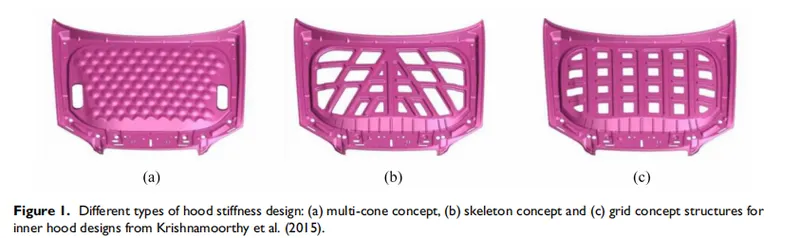
> The multi-cone design is generally the heaviest option of the three and is recommended for smaller hoods.
>The skeleton structure concept design is recommended for larger hoods.
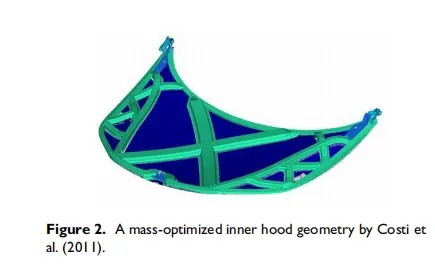
HOOD THICKNESS INFORMATION
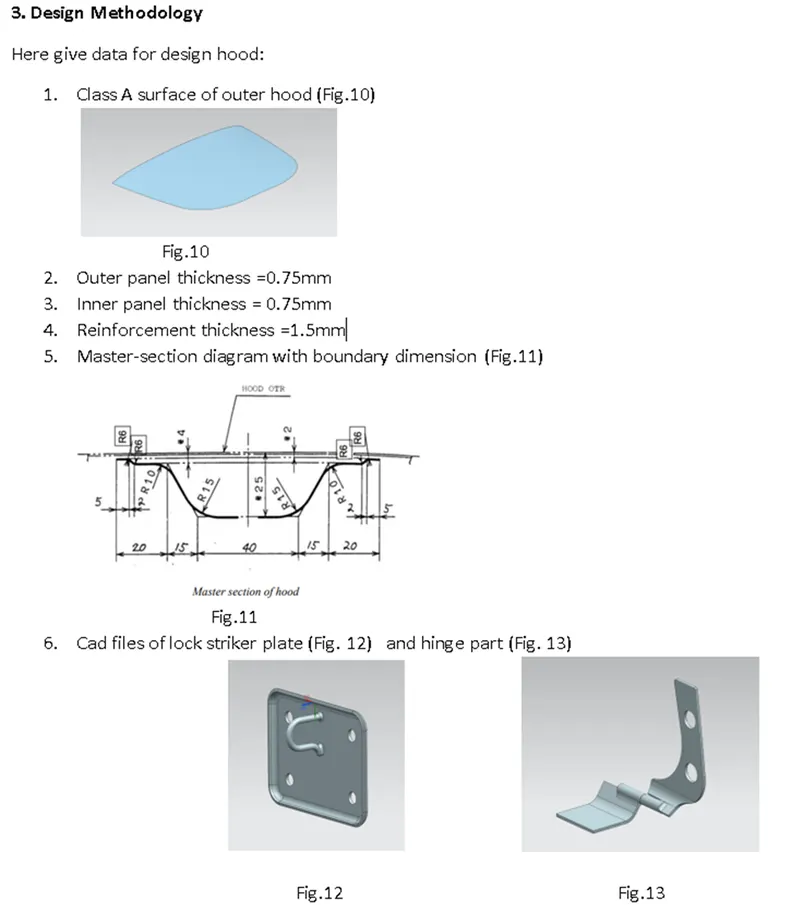
- Outer Panel Thickness = 0.75mm
- Inner Panel Thickness = 0.75mm
- Reinforcement Thickness = 1.5mm
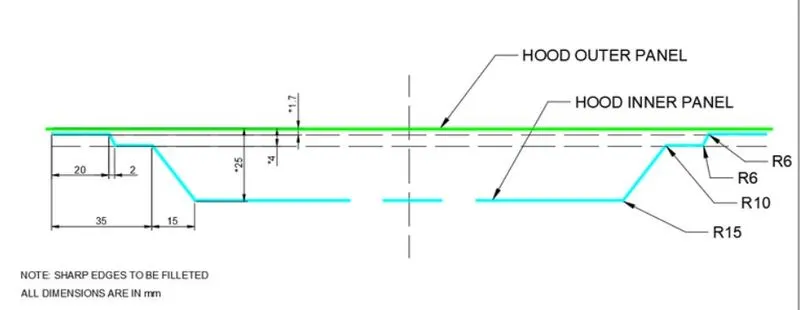
MASTER SECTION USED
FUNCTIONAL AND SAFETY REQUIREMENTS :
1. The most important safety requirement to be considered while designing the Bonnet is the frontal collision requirements.
The design intention of the hood according to the frontal collision requirement is that the hood ccrushes and dissipates forces in the upward direction and to the hard points on the hood thereby deflecting the force on the body and not to the passengers.
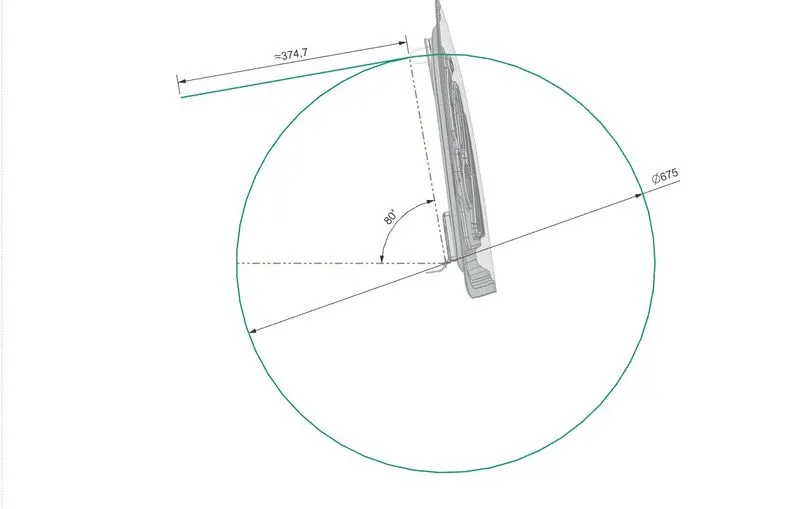
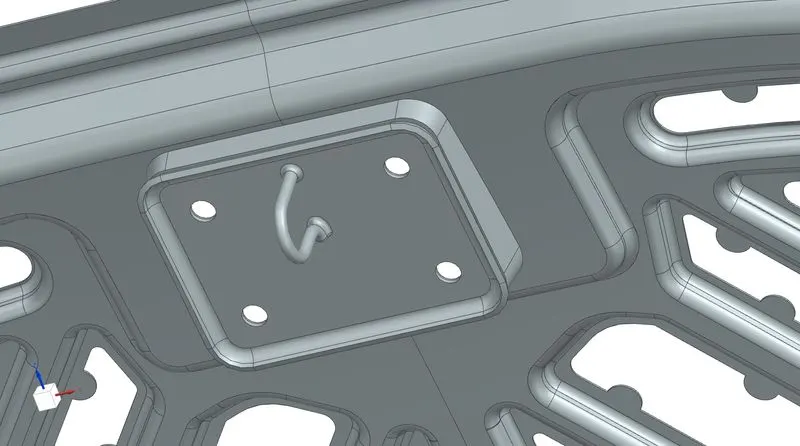
2. The second major function of the hood is the opening and closing of the hood. This is done with the help of the latch and striker. The hood pivot axis should align with hinge axis.
The latch and striker trajectory for inner panel is shown below
The processes involved in designing hood as a sheet metal operation are
- Blanking
- hemming
- Punch cutting or piercing
- Deep drawing
- Embossing
Designing of Hood:
Inner panel
- The hood inner panel is required to have a high initial reaction force against the impact exerted on the hood to enhance the energy absorption capacity. The hood is further required to minimize a reduction of a reaction force by deformation in a collision.
- It is an object of the present invention to provide a hood inner panel capable of reduction of a reaction force of the hood inner panel even if a level of deformation of a hood of a vehicle increases, and ensuring a sufficient energy absorption capacity.
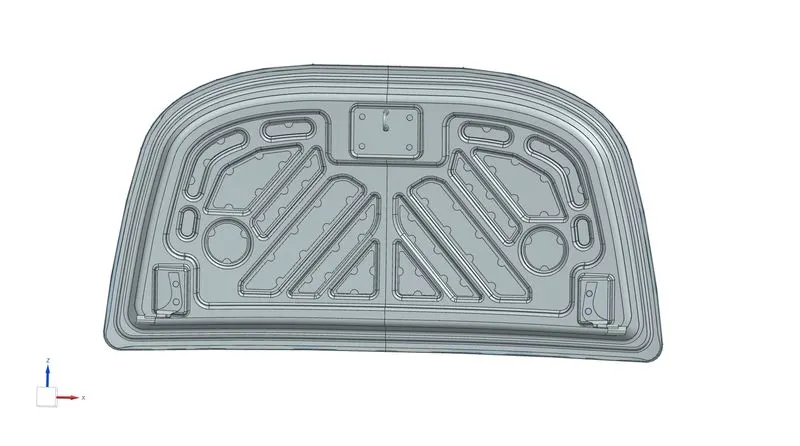
- In the inner panel only we can research and implement the safety of pedestrians and as well as the driver. In this panel only we can attach the striker & hinge reinforcements, emboss, mastic points, etc.
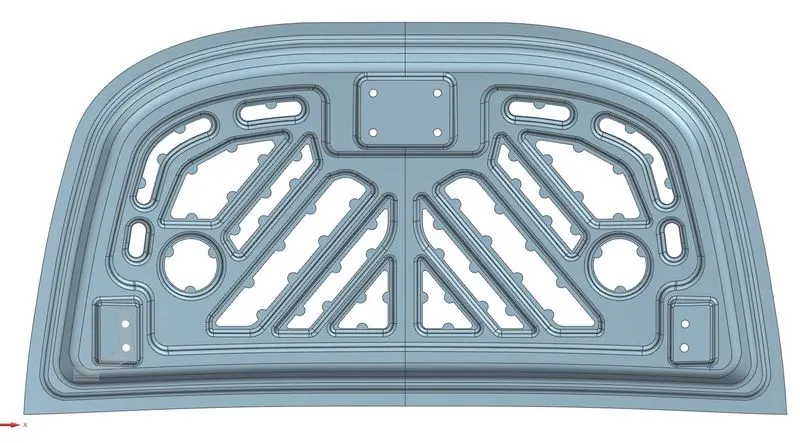
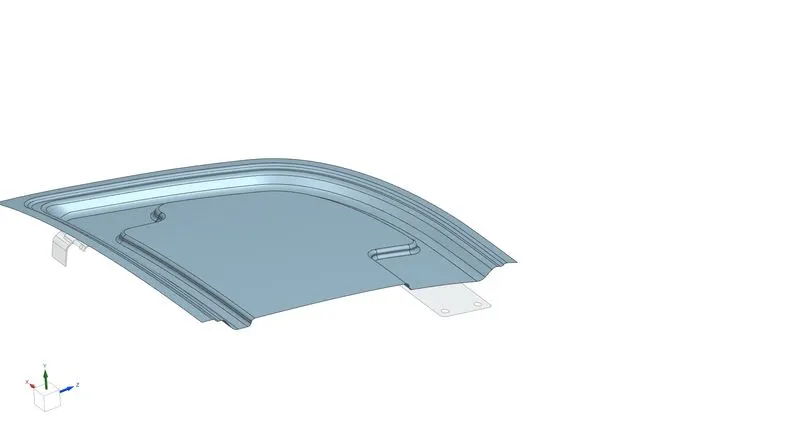
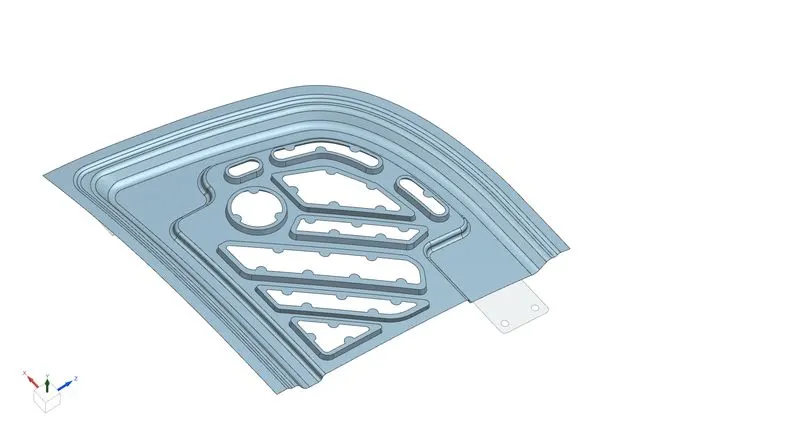
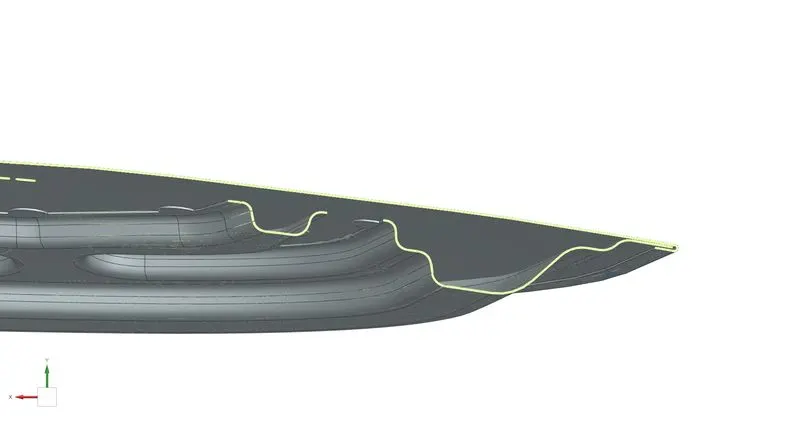
The below Figure showing Hinge placement emboss
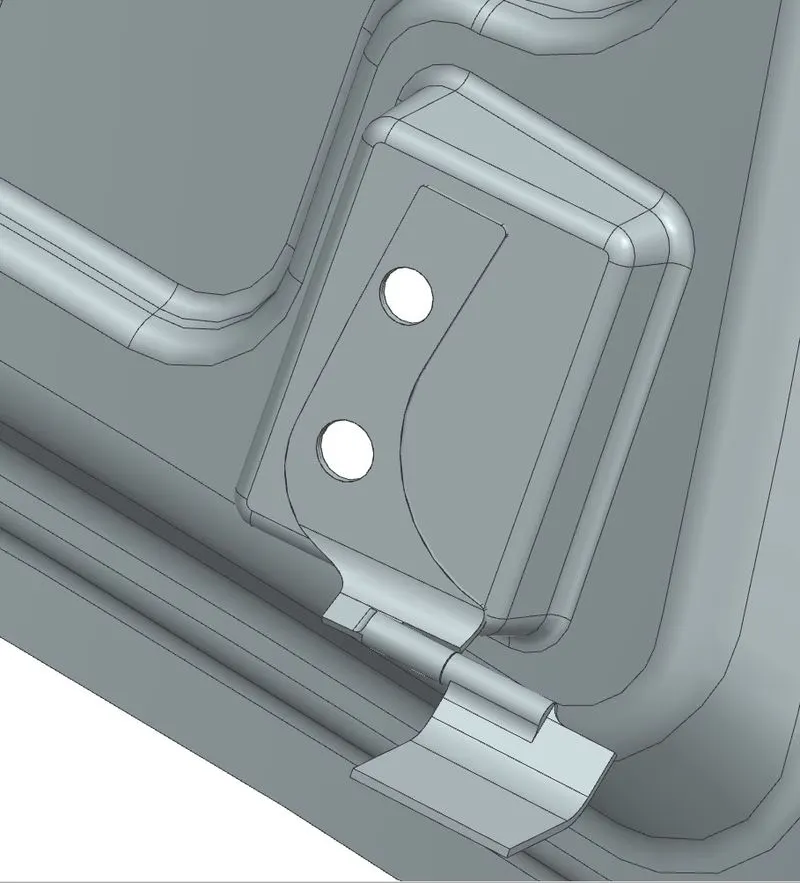
The below Figure showing Striker and latch placement emboss
Hemming in sheet metals
- Hemming is a sheet metal forming process in which sheets are joined by bending it usually to 180°. Automotive body panels and automotive parts such as deck-lids, trunk-lids, doors, hoods, and tailgates are formed by hemming processes.
-
Conventional die hemming is suitable for mass production. In die hemming, the flange is folded over the entire length with a hemming tool. Normally the actual hemming is a result of a forming operation in which the flange is formed with a hemming tool after the drawing and trimming operations have been completed
- Roll hemming is carried out incrementally with a hemming roller. An industrial robot guides the hemming roller and forms the flange. Roll hemming operation can also be divided into several pre-hemming and final hemming process steps.
- If weld or bolts were used to join the hood panels then the design and the aerodynamic features would get damaged so hemming is more significant to use.
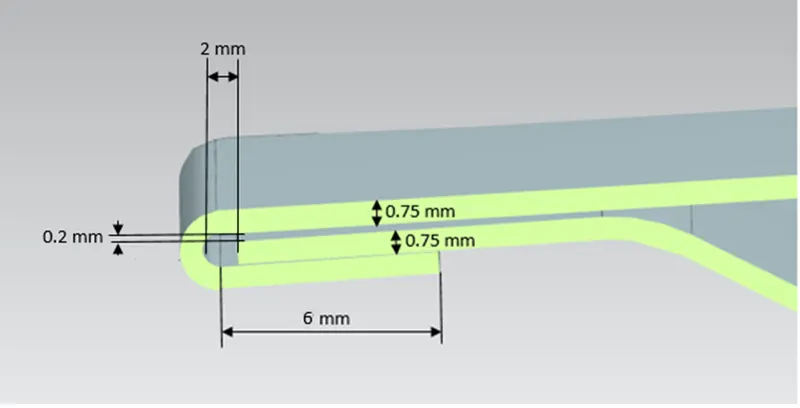
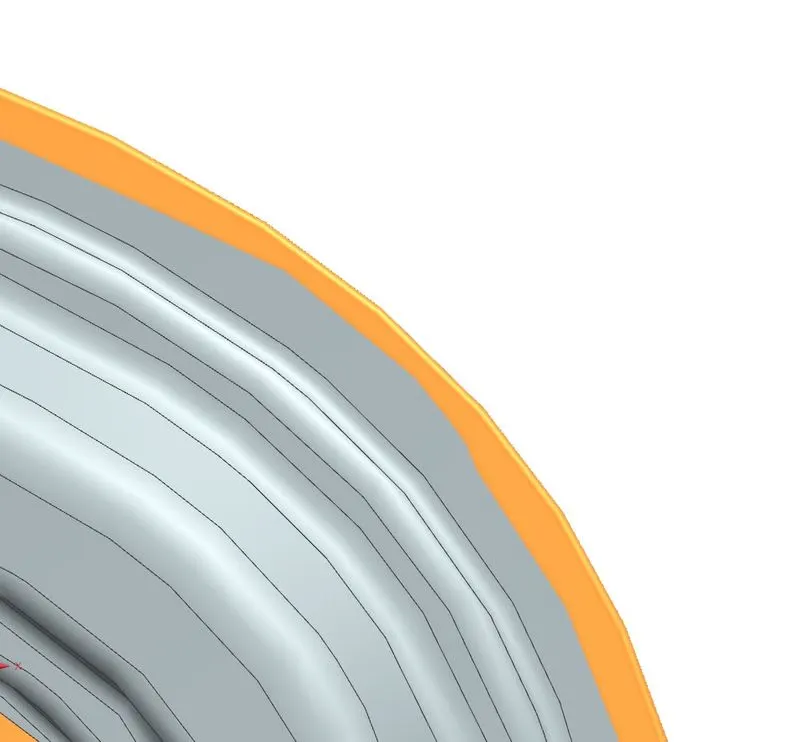
Fig Rear Corner relief
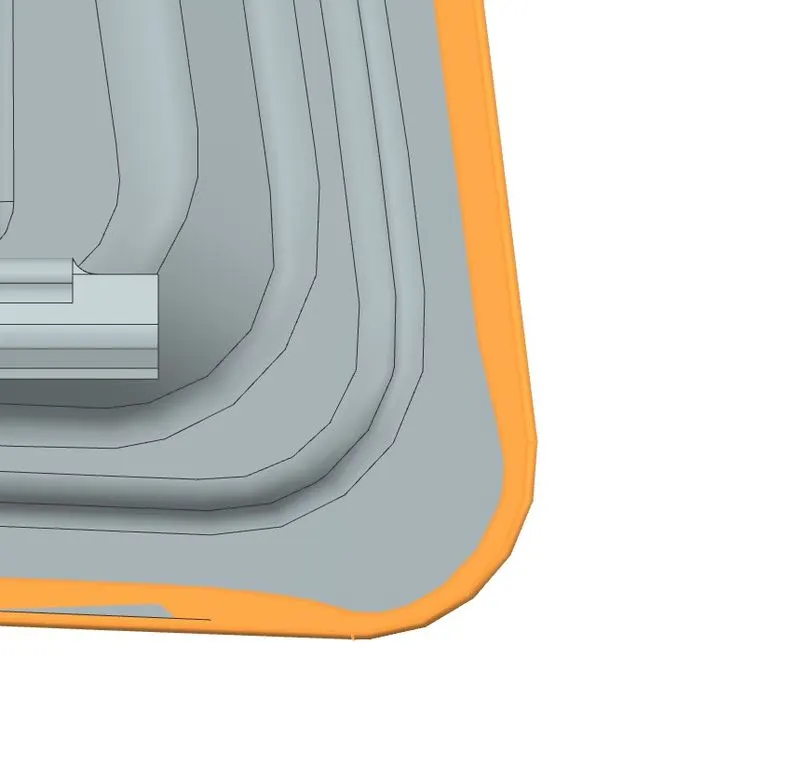
Fig Front Corner relief
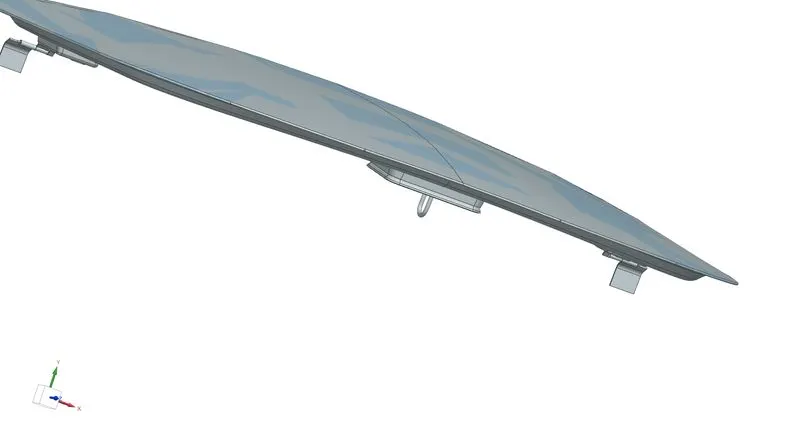
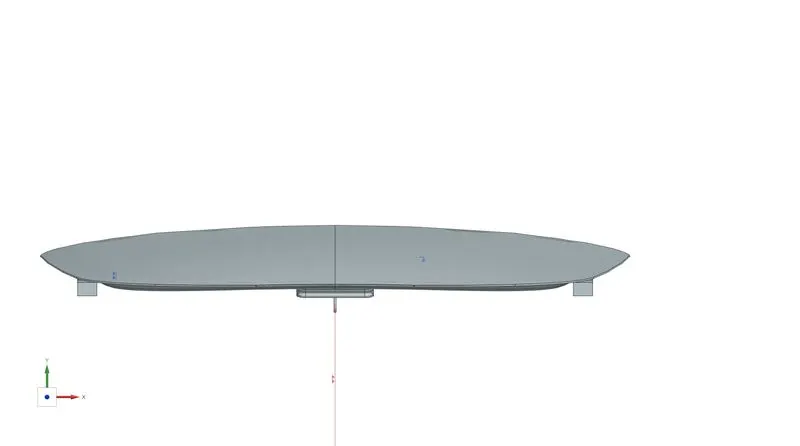
Assembly design:
Hood clearance criteria:
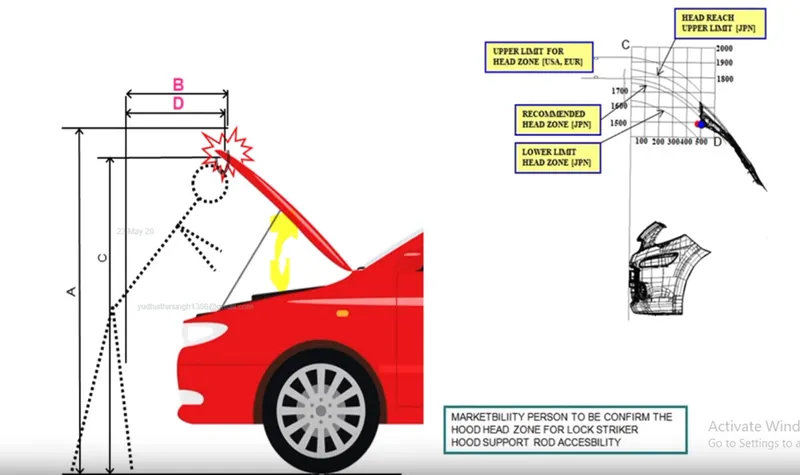
Hood clearance is decided upon the zone or country. So same car if it is made for a different country will have different openings angles depending on the country or region.
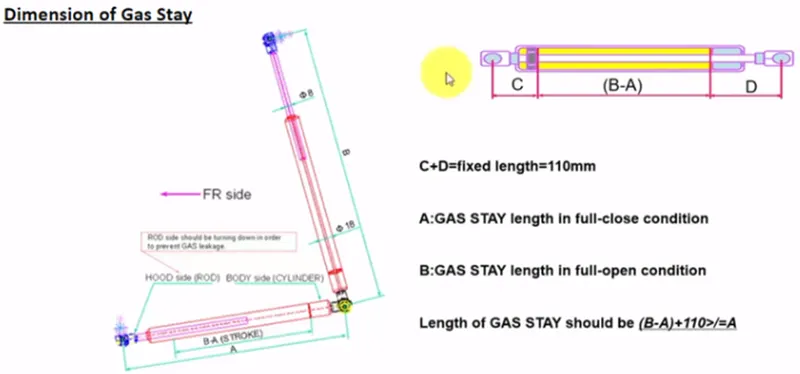
The distance C and D show in the images is represented as a graph in the upper right corner of the image. Choosing the right head zone position will decide upon the angle of the hood opening.
Product engineers will also get input from the marketing team for deciding the head zone.

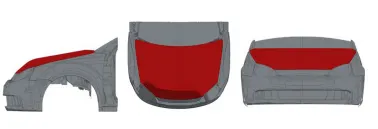
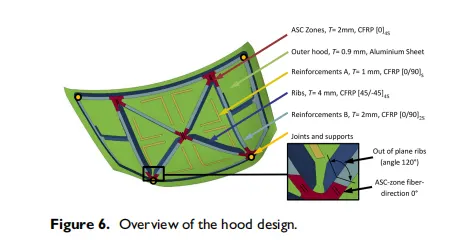
Simuation-based evaluation of the hood design:
:
The static stiffness and dynamic head impact design criteria for the hood concept were evaluated using finite element method (FEM)-based simulations. The geometry of the hood design was represented by a FEM model with a nominal shell element size of 5 mm. The aluminum outer hood was represented by an elasto plastic material model. The ASC was modeled as a linear elastic laminate, in accordance with the respective material state (stiff or soft). For the static load cases, the stiff state was used, while for the dynamic head impact load cases, both stiff and soft states were evaluated. The following subsections provide a brief summary of the simulation results and the performance of the hood design.
1.Static stiffness analysis:
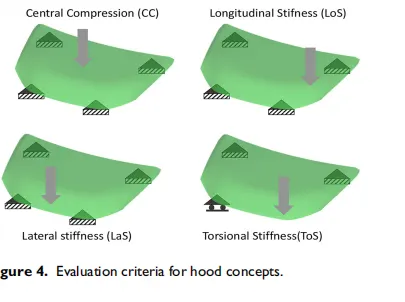
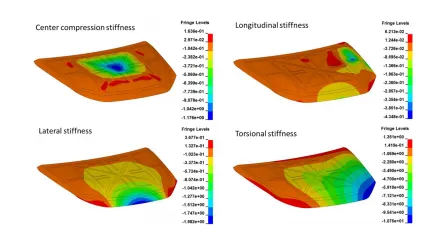
The quasi-static load cases of the global stiffness requirements described in section 3 were evaluated by means of the implicit FEM solver of LSTC LS-DYNA In all load cases, loads of 100 N are applied in vertical direction, while applying the boundary conditions of the respective load cases as described in the previous section. For the four global stiffness criteria load cases, the contour plots of the out-of-plane deformations (in mm) for the final hood design are presented in Figure 7. Note that the contour plots look similar between the stiff and soft states for all load cases, while only the magnitudes of deformation vary.For this reason, only the contour plots of the stiff state are shown. The overall results of the simulation of the global stiffness performance of the hood design are summarized in Table 2 by the stiffness values of each load case.For each of them, the stiffness is calculated using thedisplacements at the point where the force is applied.The results show that the effect of the ASC material, on the static stiffness depends on the load case. The stiffness-reduction effect for the CC and ToS is between 15% and 25%, while for the lateral and LoS, the stiffness reduction difference is between 1% and 5%. The main stiffness reduction occurs in the central area with the x-shape construction, where the ASC design was targeted. Similar differences in local stiffness-reduction effects can be seen in the dynamic head impact simulation results in the following section.
2.Dynamic head impacet performance:
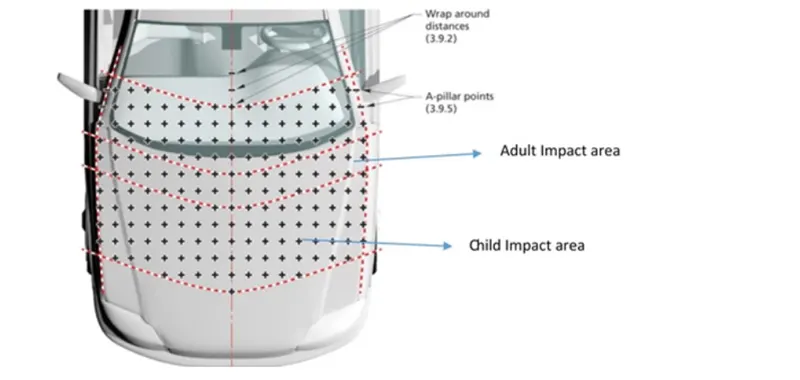
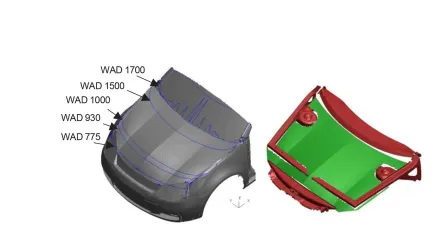
The performance of the hood in the dynamic head impact test according to the Euro NCAP (2015b)pedestrian protection protocol is evaluated by means of FEM simulation using the explicit LS-DYNA solver.The different WADs which are important for the assessment of the hood following Euro NCAP regulations. For the Euro NCAP test, the area of the hood between the WAD of 1000 mm and the WAD of 1700 mm defines the area of child head impact. For a realistic evaluation of the hood in terms of under-the-hood clearance, the structural parts underneath the hood are represented by a dummy package (green in Figure 8). This dummy package is modeled as rigid and has a distance of 100 mm to the hood in vertical direction. Other structural parts adjacent to the perimeter of the hood structure are also modeled as rigid and have a minimum clearance of 20 mm. Although the 100 mm clearance of the green package is too large to represent atypical deformation space for cars powered by conventional combustion engines, for electric vehicles, however, such a deformation space is not unrealistic.
Types of hoods support:
There are two types of support available of the hood support-
- Gas Stay
- Support Rod
Gas Stay:
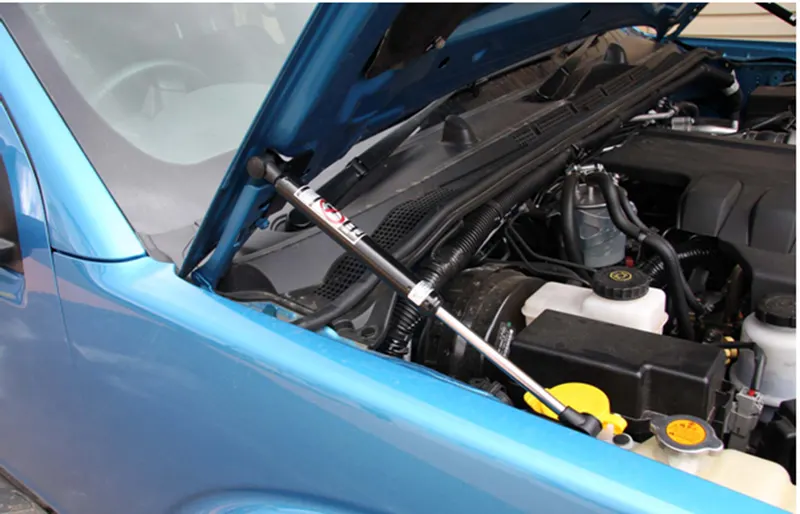
Gas stay is the device for supporting the engine hood of a motor vehicle in its open position by means of an actuator which is activated by gas. This is mostly used when the car hood is heavy. In this no men power is required. Spring stays are designed to be used on upward lifting doors, once the door is open n slightly the spring will push the door to the fully open position. Euro fits stock various size spring depending on the door size requirement.
Support rod:
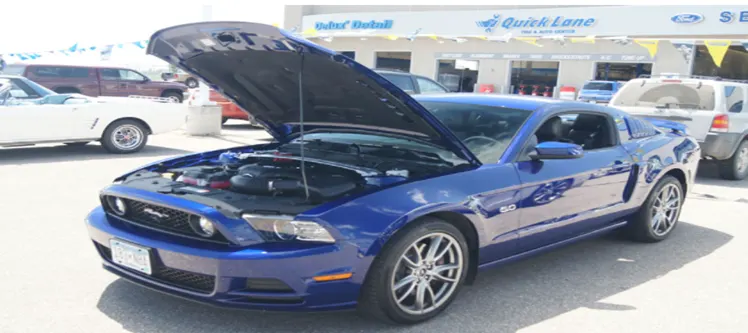
Support Rod is a device for supporting the engine hood of a car in its open position by means of a rod. We have to lift hood by ourselves and place the support provided either in the hood or engine component. This is mostly used where the car bonnet weight is small.
Passenger Safety:
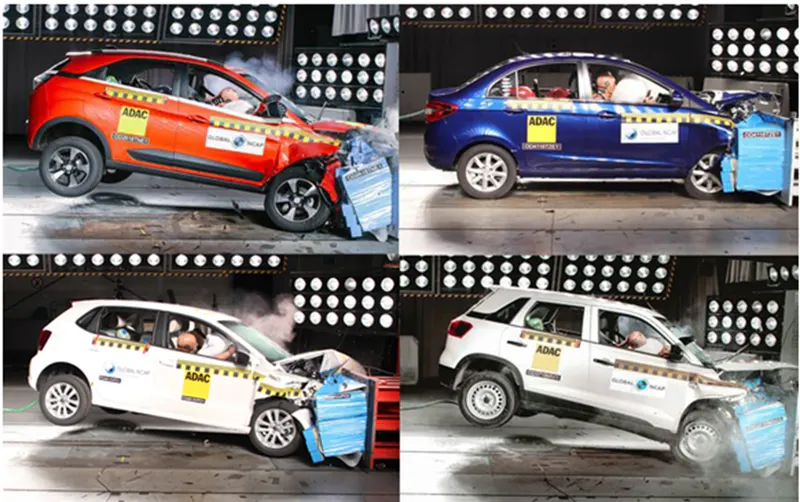
Whenever the frontal crash takes place in car the first part which will got effected will be hood. So must be designed in such a way that it should not come of from the body from the car and must absorbs the energy as far as possible ad diverting the force towards the side panel of the car so that the amount of force which is sent to the cabin is lesser since the force lesser the passenger will experience less amount of force so that passenger safety is ensured.
Pedestrian Safety:
Safety of the pedestrians need to be considered during the design as per the NCAP Euro assessment. Hood is of two types based on the side reference line. Side reference line is an imaginary line drawn from ground at angle of 45degree.If this line falls on the fender, then the hood is inlaid hood and if the line falls on the hood, then hood is wrap around hood
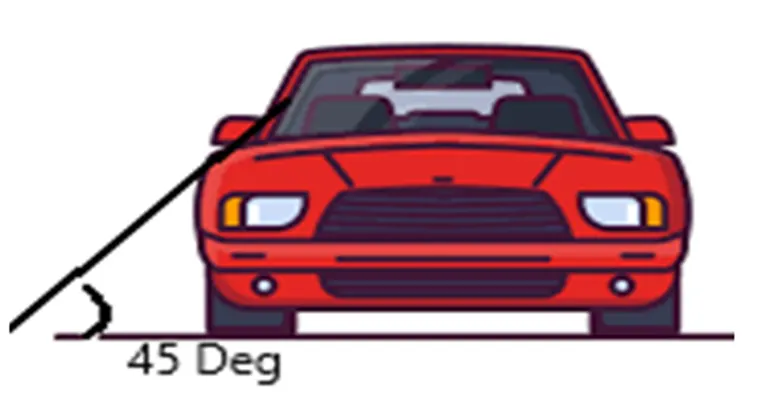
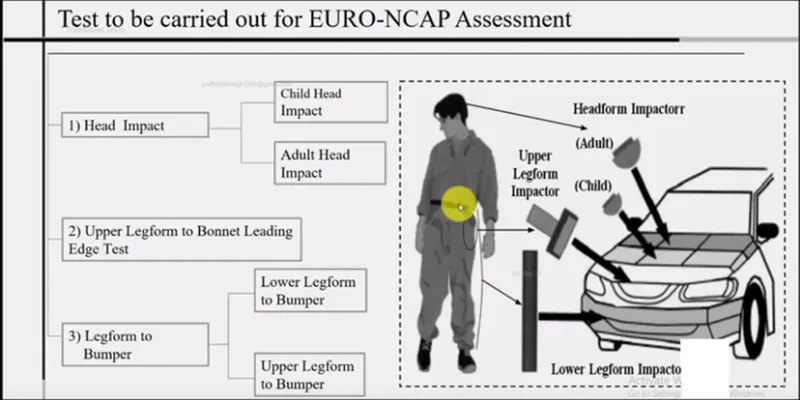
Child and adult impact area on the hood are defined by wrap around distance. Area between the wrap around distance 1000-1500mm in child head impact zone and from 1500-2100 WAD is the adult head impact zone. We now the zone where the pedestrian going to hit, as a design engineer, we must make sure that they are exercising the least force such that they were not getting any serve injury without compromising the strength of hood so that passenger safety must be assured. For this reason, the inner panel kept 25mm from the outer panel and creating the embosses to improve the strength of the hood.
Conclusion and result:
The hood is designed considering passenger and pedestrian safety as per the master section. We were sufficiently set up to plane the inner panel of the hood with assistance with given master sketch and different assessments. Organized the way of hood design by NCAP rules feasibly amassed the hood inner panel, hood outer panel, hinge assembly. we gain more knowledge and industrial requirement while designing the hood design.
Is it possible to make a lighter car hood in a composite material? Probably with the energy absorption properties, the over all stiffness and the easy shaping of a sandwich compostive with the new chosen material, it seems very likely that it is possible for it work as a functional hood in a car. The toughness and elongation properties of the SAN will give the hood a good energy absorption and with the aluminum as face material, the hood i able to deform plastically and not break with hlep from the foam core. I can see a future with lost of more environmentally friendly lighter cars with a hood made of a sandwich structure.