Hood design-Week 2
AIM
To design the hood of a car with the given input Outer panel and its dimensions.
HOOD INTRODUCTION
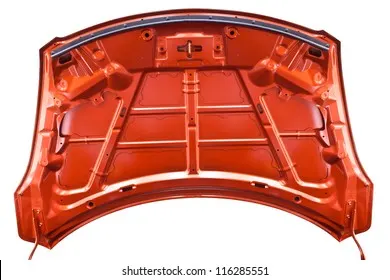
Hood or bonnet is the hinged cover over the engine of motor vehicles that allows access to the engine compartment for maintainence and repair.In generally for passenger cars, hood may be held down by a concealed latch.But in race cars or cars with aftermarket hoods (not use the factory latch system), the hood may be held down by hood pins.A hood may sometimes contain a hood ornament, hood scoop, and/ or wiper jets.Hood are typically made out of steel or aluminium,although aftermarket manufacturers may manufacture hoods out of fiber glass, carbon fiber, or dry carbon.Apart from this,the hood or bonnet are also designed to meet several requirements.They serve as a great deal of purpose in protecting the passengers inside the car and the pedestrains in the event of an accident.

Parts of hood-
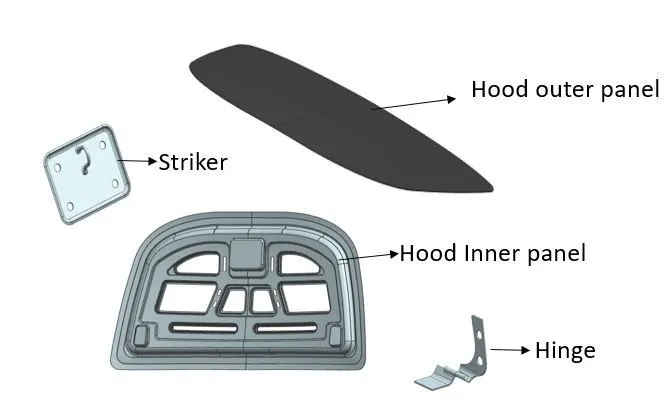
- Hood outer panel
- Hood inner panel
- Hinge and its reinforcement
- Striker and its reinforcement.
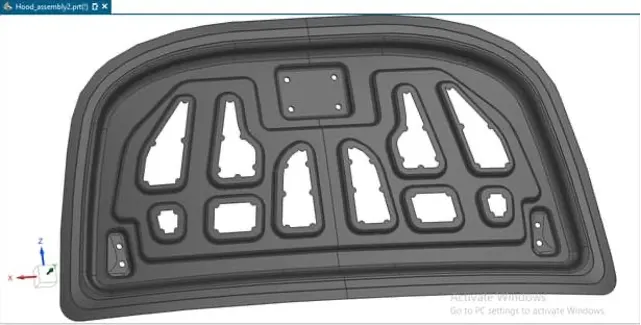
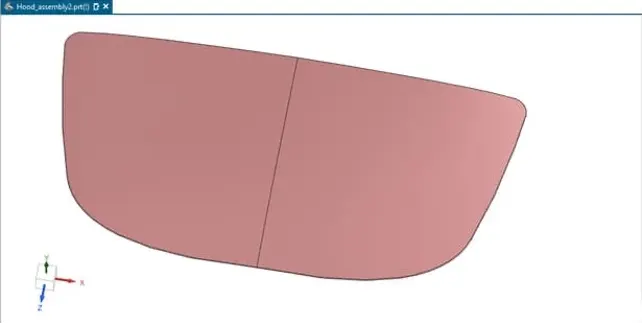
The inner panel provides the strength while the outer panel is the styling metal cover mounted on inner panel.Instead of any welding process,these two panels are connected by applying the master sealents in between them and hemming operation is performed on the outer panel which holds the inner panel.The underside of hood is often covered with stiffening pads which arrest the sounds in between them.
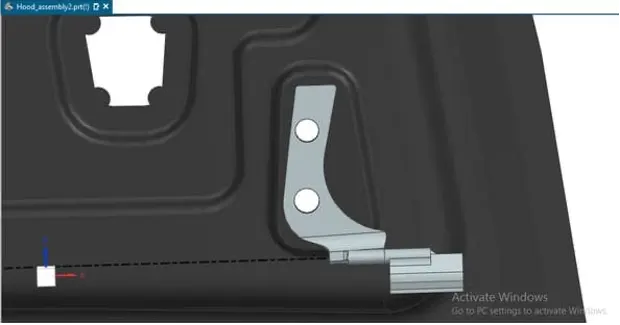
While the hinges are used to for opening or closing the hood.Striker is used for locking the hood in closed position.So mating these components with hood,it losses its strength locally.So the hinge and striker reinforcements are used to improve the strength.
 INER PANEL
 OUTER PANEL
Gas stay:
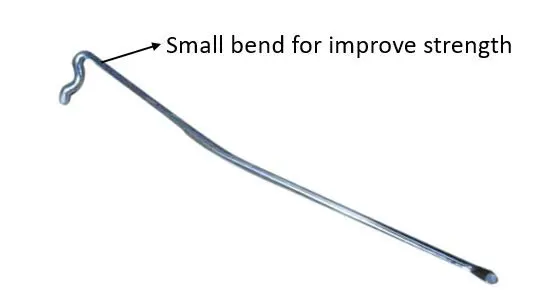
Gas stay is also as similar to support rod used to lift the hood but instead of manually it can lift the hood by using the gas pressure.It can be typically designed where the hood or bonnet weight is more and unable to lift hood manually.The cost of gas stay is more than the manual support rods.
Pedestrain safety-
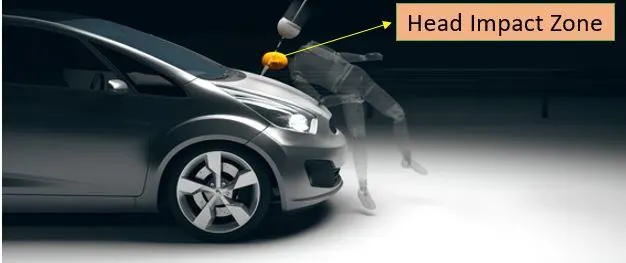
Euro NCAP or European New CAR Assessment programme is a european voluntary car safety performance assessment programme which provides the consumer information on the safety of cars.Due to the steadily increasing number of vehicles equipped with active bonnets, Euro NCAP developed test procedures for active pedestrain protection systems of passive vehicle safety.
HEMMING OPERATION :
Hemming is a forming operation in which the edges of the sheet are folded or folded over another part in order to achieve a tight fit. Normally hemming operations are used to connect parts together, to improve the appearance of a part and to reinforce part edges.
In car part production, hemming is used in assembly as a secondary operation after deep drawing, trimming and flanging operations to join two sheet metal parts (outer and inner) together. Typical parts for this type of assembly are hoods, doors, trunk lids and fenders.
The accuracy of the hemming operation is very important since it affects the appearance of the surface and surface quality. Material deformations, which occur during the hemming process, can lead to dimensional variations and other defects in parts. Typical hemming defects are splits or wrinkles in the flange, material overlaps in the corner areas or material roll-in. This is why it is important to use simulation tools in order to, on the one hand, better understand the hemming process and, on the other hand, significantly reduce the number of “trial and error” loops during tryout und production.
There are various types of hemming operations:
- Conventional die hemming
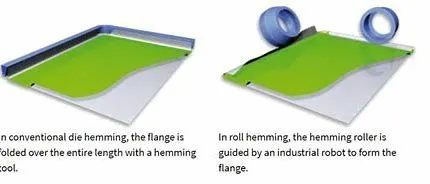
- Roll hemming