Hood design-Week 2
| Hood Assembly Design |
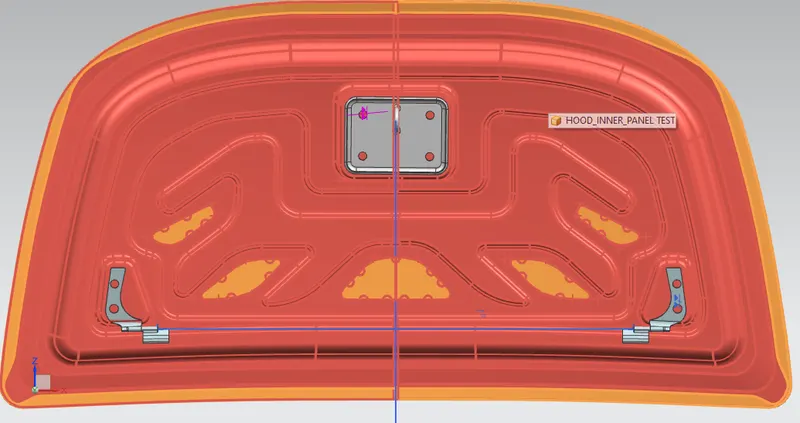 |
#Objective: Our main objective of this challenge is to create a hood assembly from a given hood outer panel skin using the master section as a reference.
#Introduction:
The hood or bonnet is the hinged cover over the engine of motor vehicles. Hoods can open to allow access to the engine compartment or trunk on rear-engine and some mid-engine vehicles for maintenance and repair.
Hoods are typically made out of the same material as the rest of the bodywork. This may include steel, aluminum, fiberglass, or carbon fiber. However, some aftermarket companies produce replacements for steel hoods in fiberglass or carbon fiber to make the vehicle lighter.
A hood assembly for a vehicle includes a hood having a Hood outer panel (top side) and a Hood inner panel (underside). Also included is a hood latch-striker reinforcement plate operably coupled to the underside of the hood and having a retaining recess. Further included is at least a portion of a centering tool removably disposed within the retaining recess and extending downwardly away from the underside of the hood. Yet further included is a centering bracket operably coupled to a top support member of a positioning and reinforcement structure and having an aperture configured to receive the centering tool therein for locating the positioning and reinforcement structure to the hood.
#Components:
1. Hood Outer panel:
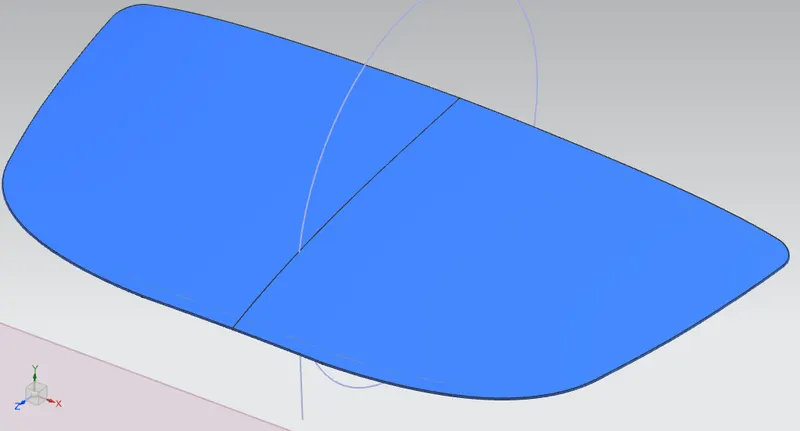
The outer panel is the part that is at the uppermost layer. The hood must be designed in such a way that it ensures the safety of pedestrians along with the person inside the cabin.
2. Hood inner panel:
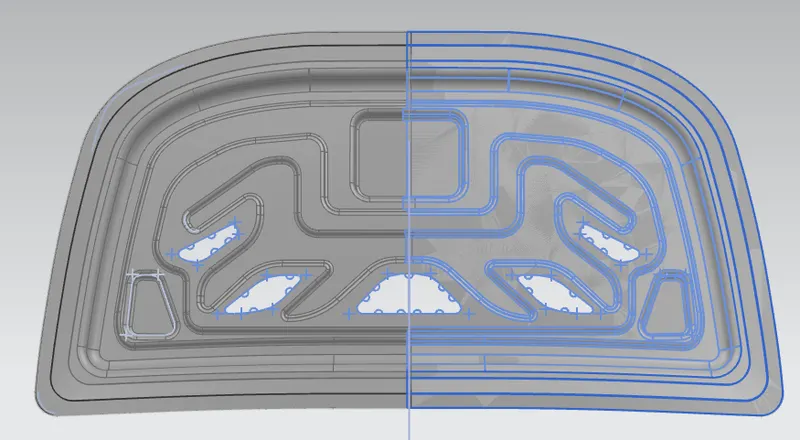
The inner panel gives rigidity and strength to the outer panel. We provide spaces for mastic sealants as other joining techniques might spoil the look of the panel. We provide respective embosses for the striker and the hinge assembly.
Mastic Sealant:
Mastic is commonly used on construction projects as an adhesive and sealant. It is a popular choice where one surface needs to adhere to another in a durable bond, or where the area needs to be protected.
The most common types of material that mastic sealant can be adhered to include timber, aluminum, steel, marble, glass, and various types of board, although it can be used on nearly all materials.
3. Emboss:
Embossing and engraving have similar effects–a raised surface. But embossing pushes the paper or metal up, working from behind, while engraving actually cuts into the surface, cutting away a bit of the media as it makes its mark.
4. Hemming:
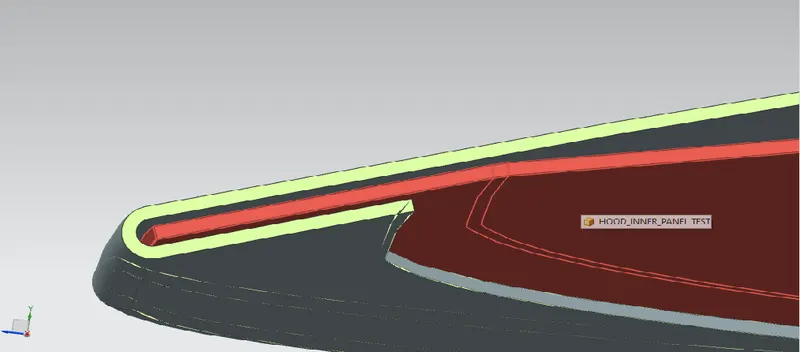
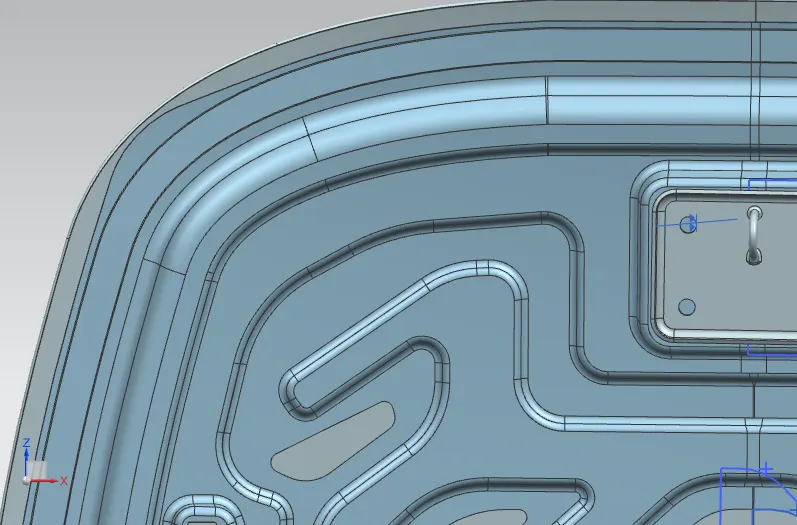
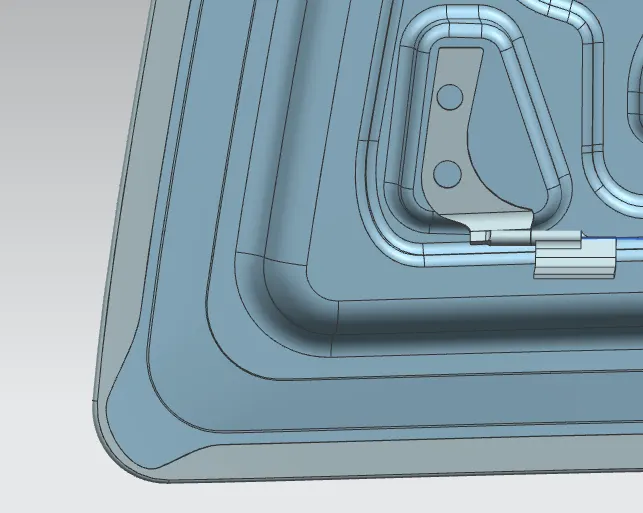
Hemming is the process in which the edge is rolled flush to itself. Hemming is a sheet metal forming operation in which the edge of the sheet is folded back on itself. It serves several purposes: to fasten two sheet metal parts, to improve the appearance of edges (remove burrs and rough edges), and to increase the part stiffness.
5. Deep Drawing:
Deep drawing is a sheet metal forming process in which a sheet metal blank is radially drawn into a forming die by the mechanical action of a punch. It is thus a shape transformation process with material retention. The process is considered "deep" drawing when the depth of the drawn part exceeds its diameter. This is achieved by redrawing the part through a series of dies. The flange region (sheet metal in the die shoulder area) experiences radial drawing stress and tangential compressive stress due to the material retention property. These compressive stresses result in flange wrinkles (wrinkles of the first order). Wrinkles can be prevented by using a blank holder, the function of which is to facilitate controlled material flow into the die radius.
6. Front and Rear reliefs for Hemming:
7. Latch Trajectory and Final Hood Assembly
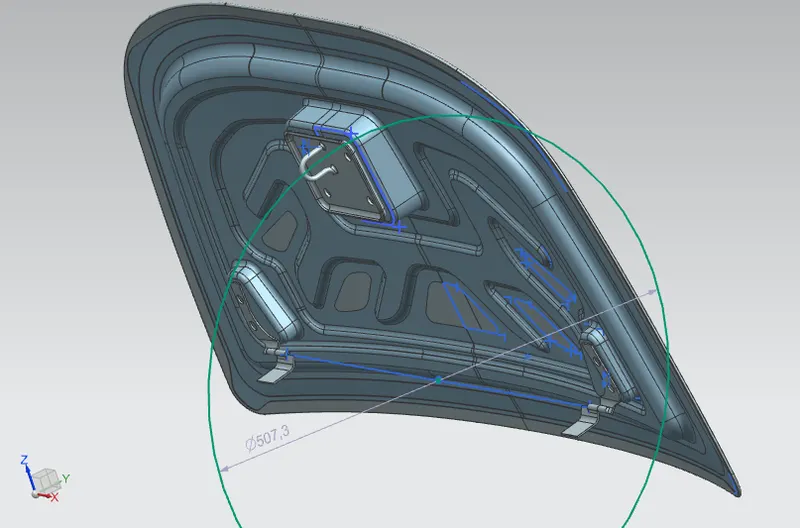
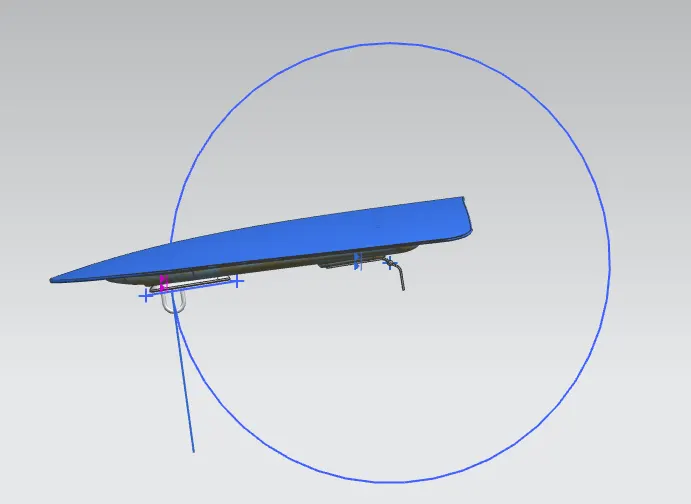
A latch or catch (called sneck in Northern England and Scotland) is a type of mechanical fastener that joins two (or more) objects or surfaces while allowing for their regular separation. A latch typically engages another piece of hardware on the other mounting surface. The Latch-Striker Trajectory represents the path or curve travelled by the hood to lock the engine compartment.
Below I have attached the Assembly file of the Hood design Assembly.