Hood design-Week 2
HOOD DESIGN
HOOD:
The hood is made by reinforecing inner panel,outer panel,sticker and hinge.The inner panel provides stength ,while the outer panel is just a metal cover.The underside of the hood is often covered with a sound absorbing material .The hood is cover over the engine of motor vehicle that allows access to the engine compartment for maintenance and repair.Hood is made of steel or aluminium
uses of HOOD
- Cover all the engine and neccessary component
- provide acess to engine maintenence
- Absorbs most of the impact forces when a frontal crash occurs
- Reduce engine noise
- Reduce air effect due to aerodynamic shape design
- Provide safety of the passenger
Manufacturing of car hood:
It is manufactured by considering the fallowing criterias
Head clearance criteria:
Head clearance is decided upon the country because different regions have different average heights ,By choosing the right head zone position will decide upon the angle of hood opening
Wrap around distance(WAD):
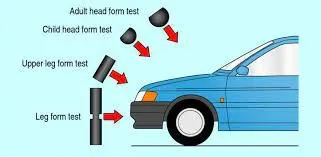
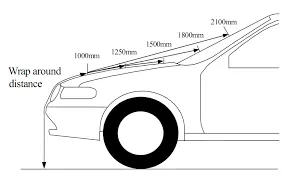
The distance on which the head impact on the car from the ground level is called wrap around distance.It is measurement of distance from the ground to the head impact zone over outer surface of the car.It plays an important role in the safety measurement of the pedestaian.During crash analysis ,two test areas will be created namely child head impact zone and adult head impact zone.The child head impact zone is 1000 to 1700mm and the adult head impact ranges from 1700 to 2100 mm WAP
Pedestrain safety measures:
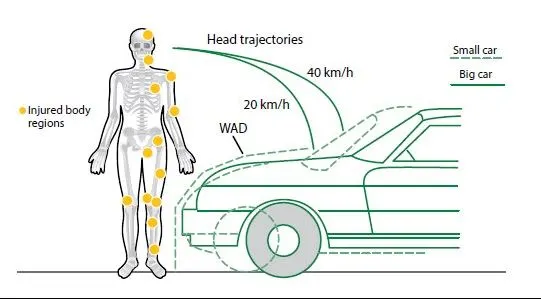
Euro NCAP the European car assessment program publish reports in new car and awards star rating based upon the performance of the vehicle in a variety crash test including front side and pole impacts with pedestain,so here we seperate the whole hood into several small part during frontal crash.Hood is the major portion of the person is going to come in contact with ,so Euro NCAP specified some guideslines under which we distribute hood region in to several parts and try to get more green region.This region is distributed in relation to the height of children and adults who come in contact from front wheel accidents.So here the main moto is to achieve greener region and for that we provide splits in embosses so that during head impact the concequences of collision come less effective.
By fallowing the above considerations the hood is designed and manufactured
Hemming process:
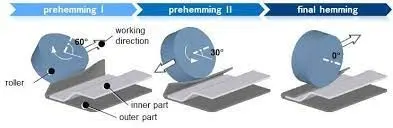
Hemming is a former in which edges of the sheet are folded over another part in order to achieve a tight fit .Normally hemming operations are used to connect parts together .in the car production ,Hemming is used in assembly as a secondary operation after deep drawing ,trimming and flanging operation to join outer and inner panel together .The accuracy of the hemming process is very important since it effects the apperance of the surface and surface quality
Emboss:
Emboss provides an extra strengh to inner panel and also plays a major role in force dissipation and if any object hit from front most of the force will get dissapated by its designed towards the upper left and right corner so that less force reaches at occupants end
Mastic points:
Mastic point are areas where the inner hood panel is joined with the outer panel hem using a mastic glue.This mastic glue keeps the inner panel stuck to the outer panel,we cannot use bolt or welding to join outer and inner panel as it loses its stylish look .This has to be done with the help of hemming and mastic sealants.mastic sealents are elastic components that behaves like rubber ,intially it is paste but after the hot furnance bath it gets hardened thus joining the outer and inner panel
Mastic data:
mastic are points given on embosses for applying mastic sealent to joint inner and outer panel .One spot of mastic sealent provides strength locally around 80mm
Trajectory for hood opening and closing:
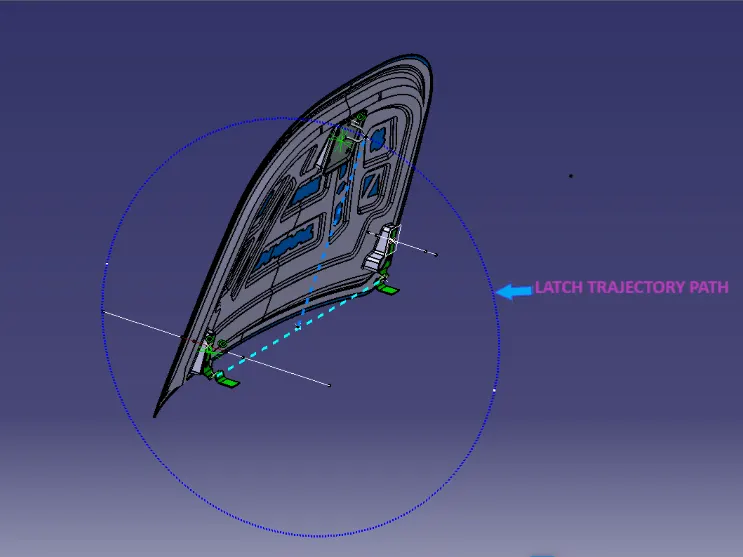
for the proper opening and closing of the hood the sticker should be positioned at a correct posion . The stricker should be perpendicular to the trajectory of the hood.The flanges are positioned at the their respective positions.now the trajectory is derived from the hinge axis