Hood design-Week 2
HOOD
Scope of Documents:
The purpose of this document is for to understand the function, design requirement of the Hood.
Also for to understand the design factor & various load act on that.
Introduction:
The hood is nothing but the outer cover for the engine compartment. It is also called as Bonnet. Hoods can open to allow access to the engine compartment.
Design consideration of Hood:
- Opening Angle.
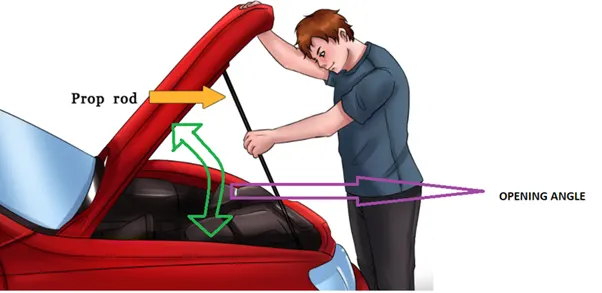
FIF. 1.1 : OPENING ANGLE
The opening factor is very important factor in hood design. While accessing the engine compartment hood will be open at desirable angle.it did not strike with the driver head. Opening angle is varying with region to region. Person from the Japan region having small height and person from USA is having longer in height. Opening angle is considering in the early stage of the project.
- Required Space for access for secondary latch.
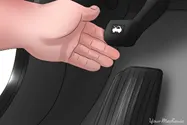
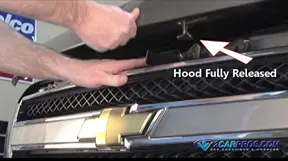
Fig: 1.2: Primary Switch for hood Fig: 1.3: Secondary Switch for hood
Opening Inside the car
Opening of hood there are two latch are provided in the car. One is primary latch is provided inside the car and second is secondary latch is provided outside of car.
After pushing the primary latch hood is unlocking partially and for full unlocking for accessing the secondary latch minimum 10 to 15mm gap is required between hood and bumper.
Applicable document or norms:
FMVSS:
- FMVSS 113: HOOD LATCH SYSTEM
This standard establishes the requirement for providing a hood latch system or hood latch systems. The purpose of this standard is to prevent the front-opening hood from flying open and obstructing the driver’s view while the vehicle is moving forward.
European standard:
- Euro NCAP Pedestrian safety:
This standard covers all the Pedestrian safety points while collision on vehicles.
Construction:
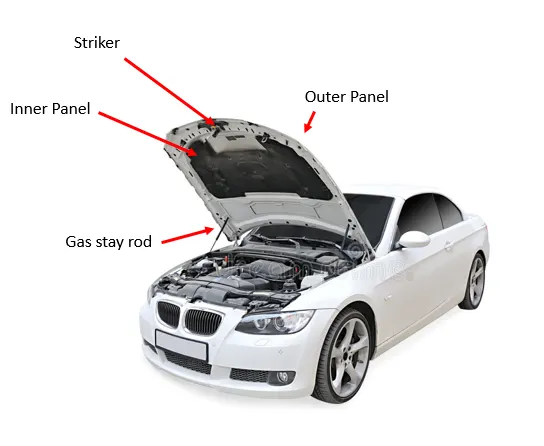
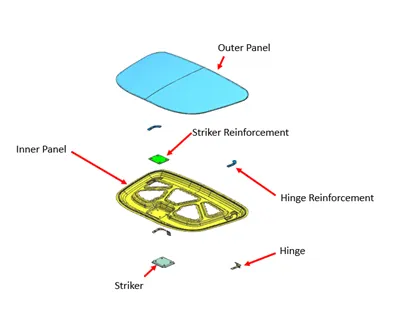
Fig: 1.4: Nomenclature of Hood Fig 1.3: Nomenclature of Hood
Hood Outer Panel:
Fig 1.4: Hood Outer panel
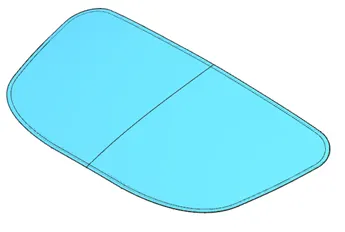
Hood Outer cover is nothing but the door for the engine compartment.
Material:
Aluminium Alloy, Steel
Thickness:
0.6 to 0.75mm
Manufacturing method:
Blank, Draw, Trim
Outer Panel Relief:
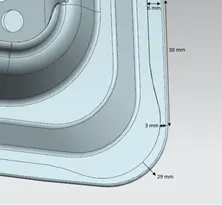
Relief is provided at the corner for the reducing the spring back effect while doing the hemming operation.
Striker reinforcement
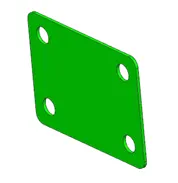
Material: Steel
Thickness: 1.5mm
Manufacturing process: Blank or laser cut
Hinge Reinforcement:
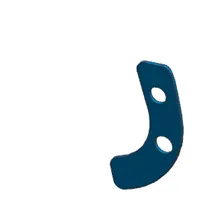
Material: Steel
Thickness: 1.5 to 2mm
Manufacturing process: Blank or laser cut
Hood Inner panel:
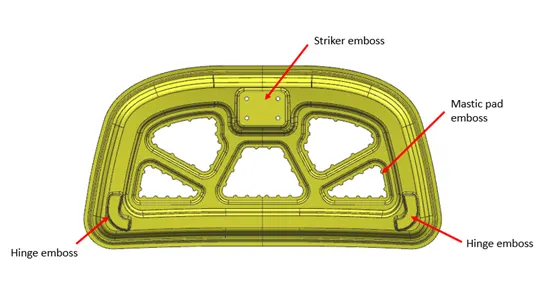
Material:
Aluminium Alloy, Steel
Thickness:
0.6 to 0.75mm
Manufacturing method:
Blank, Deep Draw, Trim, Restrike
Mastic pad Emboss:
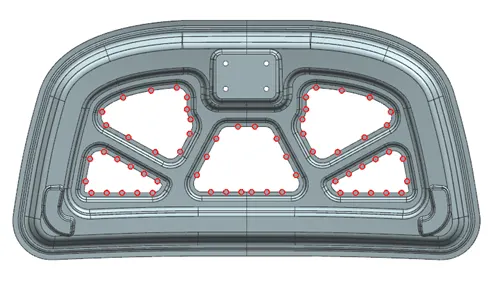
In above image red in highlighted is the mastic pad emboss on which mastic pad are mounted. Mastic pad is nothing but the rubber pad which are introduced in-between inner & outer panel for NVH purpose.
Please see the below image for the location of the mastic pad in hood assembly.
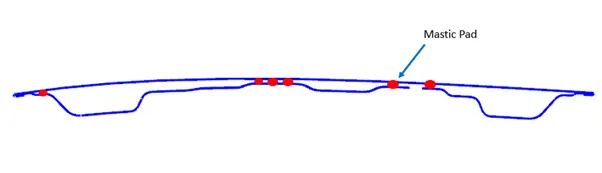
While vehicle is moving condition there is some noise & vibration happen. The rubber pad is reduced the noise & vibration between inner & outer panel. Mastic pad are 80 mm in diam. and there is interference between two. It is act as joinery element between the two.
Hinge position/Emboss on inner panel:
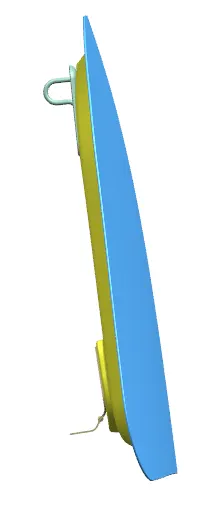
Hinge is always parallel to the X axis & always mounted on the flat face for proper fitting.
Striker position/Emboss on inner panel:
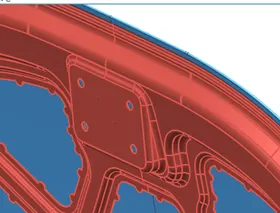
Striker is always perpendicular to the latch. If these condition is not meet, then hood is not lock properly due to which NVH criteria is not meet.
Validation method of Striker position:
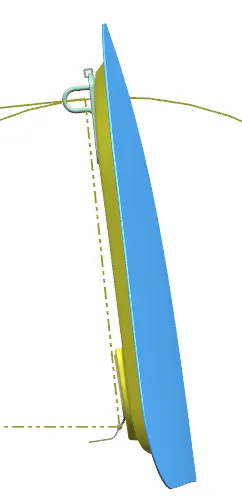
Mating point of striker & latch should be perpendicular to the hinge axis lines. For that the circle is created on the hinge axis and target line is created on the striker middle of striker. This target line is always perpendicular to the that circle then our condition is satisfied that striker is perpendicular to the latch.
Pedestrian safety points improvement:
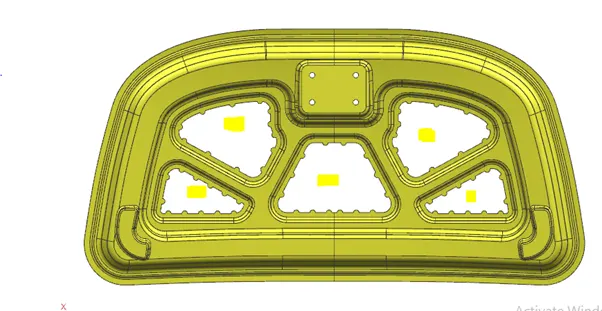
While better pedestrian safety rating inner panel and all the assembly are move down by 90mm in engine compartment for checking the interference between hood and engine.
On that interference they decide the different zone like red, yellow and green zone. For the green zone we removed the material from inner panel for minimum interference.
Joining Method:
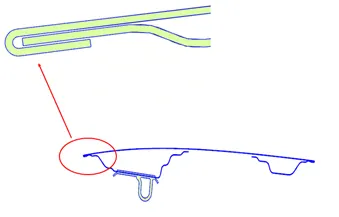
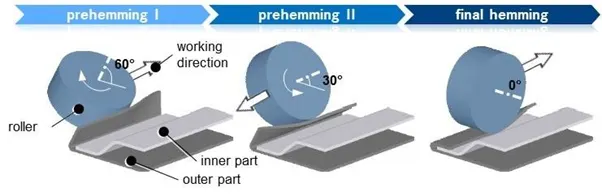
Hemming is a forming operation in which the edges of the sheet are folded or folded over another part in order to achieve a tight fit. Normally hemming operations are used to connect parts together, to improve the appearance of a part and to reinforce part edges.
Deep Draw process :
Deep drawing is a sheet metal forming process in which a sheet metal blank is radially drawn into a forming die by the mechanical action of a punch.
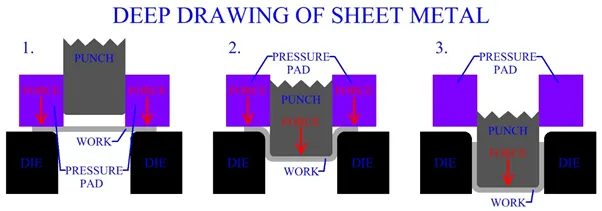
The process is considered "deep" drawing when the depth of the drawn part exceeds its diameter.
h>d/2
when deep draw is used.This is achieved by redrawing the part through a series of dies. The flange experiences a radial drawing stress and a tangential compressive stress due to the material retention property. These compressive stresses result in flange wrinkles (wrinkles of the first order). Wrinkles can be prevented by using a blank holder, the function of which is to facilitate controlled material flow into the die radius.
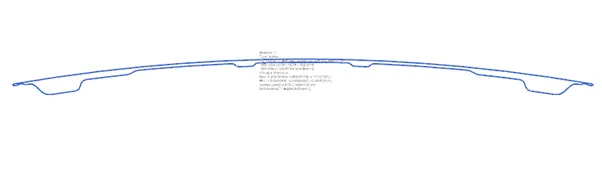
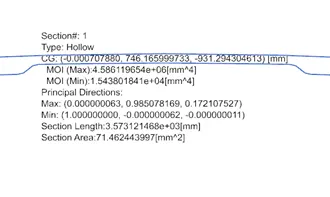
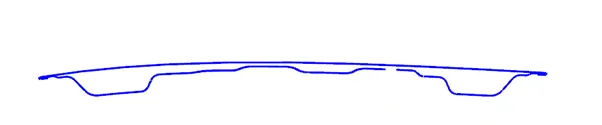
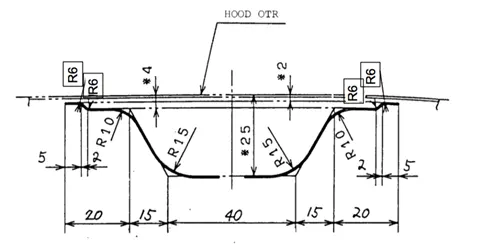
Master section:
Vehicle Interference:
- Hood Mounting:
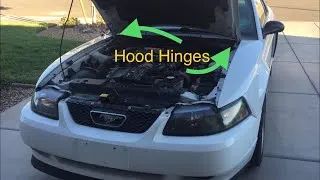
- Hood is mounted on hinge. For opening & closing of hood hinge act as swiveling member. Hinge is mounted on hood as well as engine compartment.
- Hood balancer:
- Support Rod:
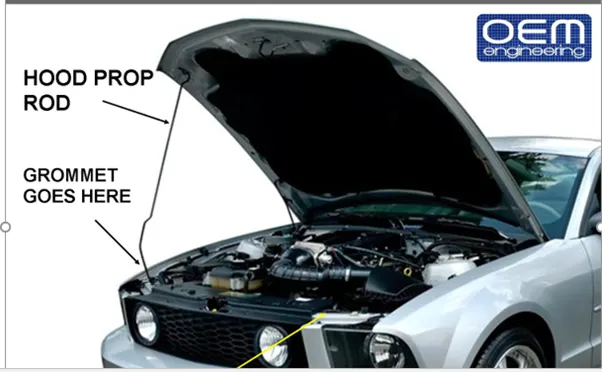
To keep hood in open condition support rod is used. The support rod is mounted on engine compartment or on hood. It will on engine compartment when it is close condition & it is fixed on hood in open condition when it is mounting on engine compartment. It is always opposite to the battery compartment for easily installation of battery.
The support rod is always having some bends for more rigidity. But the bend value did not more than 35mm. grommet Is provided for the locking purpose when hood is in open and close condition. support rod design should be in such a way that there is no any interference between the engine compartment and rod.
For the support rod more energy is required for the opening the hood.
2.Gas stay rod:
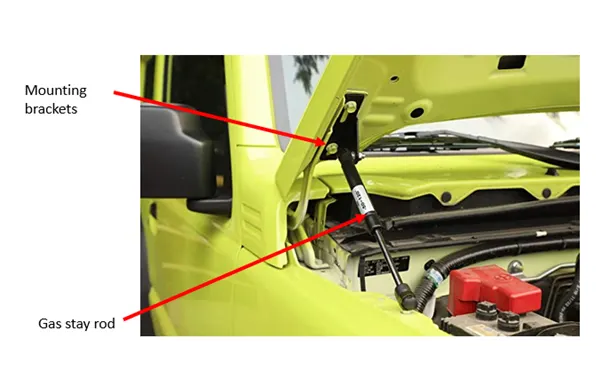
Gas stay rod is used when the hood assembly weight is more then it will be helpful for opening of hood. Gas stay rod required minimum force for opening of hood.
For gas stay rod mounting addition bracket is used which act as a reinforcement.
Testing:
Pedestrian head Protection performance tests:
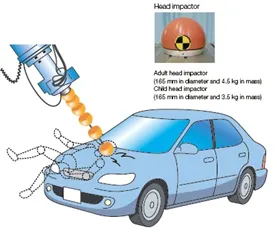
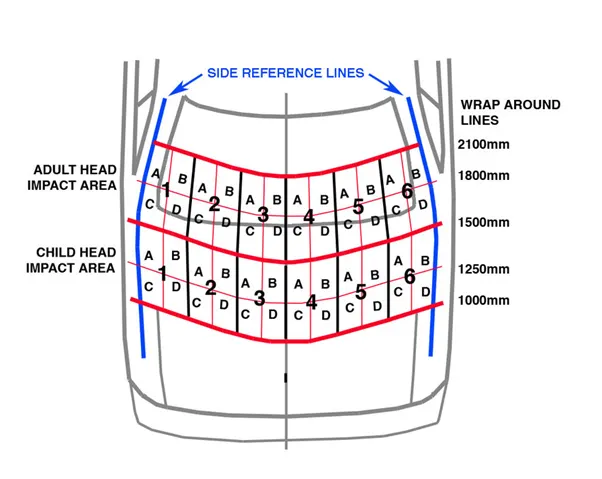
Car accidents in which pedestrians are hit by cars moving at a certain speed and their heads collided against car bonnets or front windshield are assumed. An adult or a child pedestrian’s head simulated impactor (head impactor) are projected toward the car bonnet, etc., from the testing machine. The impact received by the head impactors is measured and then evaluated using head injury criterion (HIC).
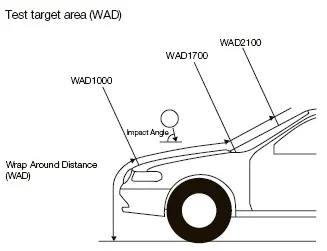
As per the previous test data Euro NCAP make the child impact zone & Adult impact zone as shown in below image.
For better pedestrian rating the hood is move down by 90mm and check how much area is interfering with engine compartment. According to that interfering the following zone is made as shown in below image.
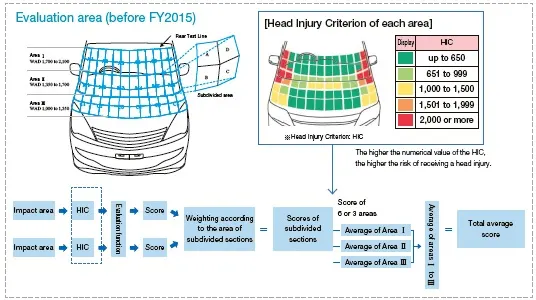
The main focus of hood engineer is that to achieved the greener zone on hoods so rating is more for the car, for that they remove more material from the inner panel.
Analysis Report:
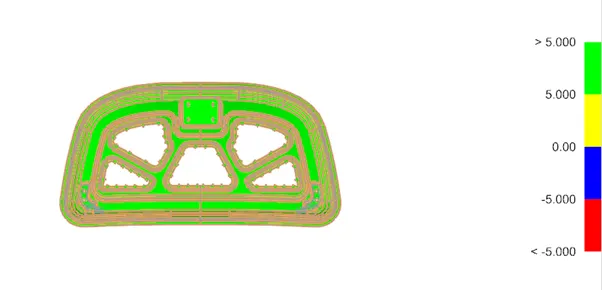
Draft Analysis result:
Sectional Modules: