Hood design-Week 2
Objective
To design the hood of a car from the data given, considering maximum safety feature for everyone in and around the vehicle.
Introduction
Hood :
- The hood is an opening body panel that covers the engine in a front-engine vehicle. The hood is also considered as another type of door.
- The hood comprises of inner hood panel, outer hood panel, hinge, latch and reinforcements.
- The inner panel provides strength for the structure and the outer panel functions as the metal cover. Hence both these components are designed according to standards, and once the components are designed, they are united to form one component.
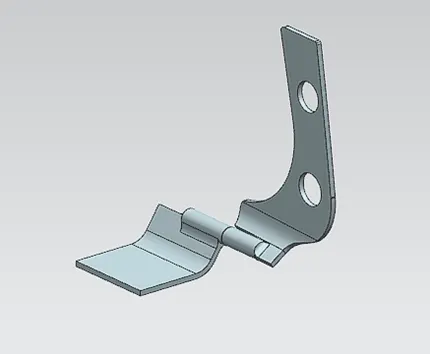
- Hinge: These are the guiding elements used for opening and closing of the hood and acts as the connection between hood and engine compartment of the car.
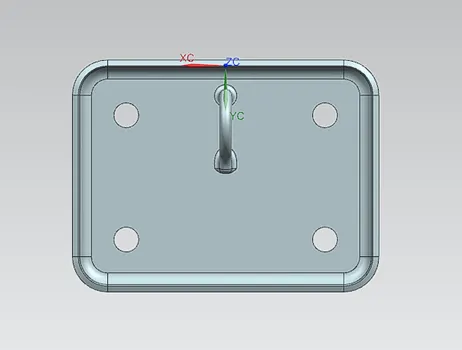
- Latch: It’s a striker placed over the hood and get attached to the space provided in the engine compartment for locking purpose of hood with engine compartment.
Design Considerations
The main design considerations for designing a car hood are shown in the fig below.
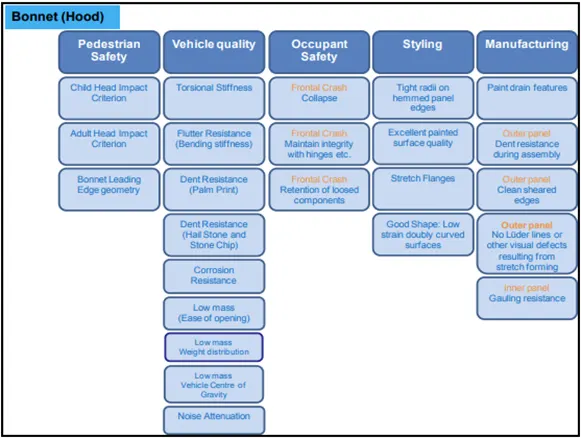
*Among these design considerations pedestrian safety is the one should be given more attention.
Pedestrian safety
When a pedestrian is hit by a car ,Pedestrian impact energy is absorbed by a sequence of different mechanisms. In most cases, the leg of the pedestrian is first impacted by the bumper system (lower leg impact is a safety critical load case for the pedestrian that is entirely managed by the bumper system). Initial contact with the pedestrian is therefore at a point below the centre of gravity of the head and torso causing rotation. At relatively low velocity impacts the tendency is for the head to impact the bonnet or the lower part of the windscreen.
The height, weight and age of the pedestrian all play a role in the kinematics of the event and in his ability to survive. Most fatalities for the younger population are related to brain damage caused by head impact on the bonnet. For older people additional risks include rupture of arteries in the lower limbs and pelvis from bumper and bonnet leading edges.
Evaluation of pedestrian safety for a bonnet must be carried out in the context of its surrounding elements:
- Vehicle styling, wrap around distance (WAD) and under bonnet clearance to other elements (considered as hard points).
- Wrap Around Distance (WAD):
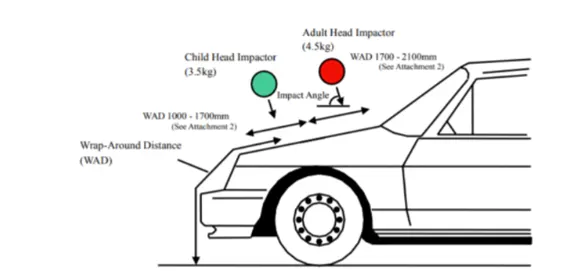
When a car crashes on the pedestrian, the whole human body wraps around the front shape of the car and the head impacts on the bonnet or the wind screen. The distance on which the head impacts on the car from the ground is called as the wrap around distance.
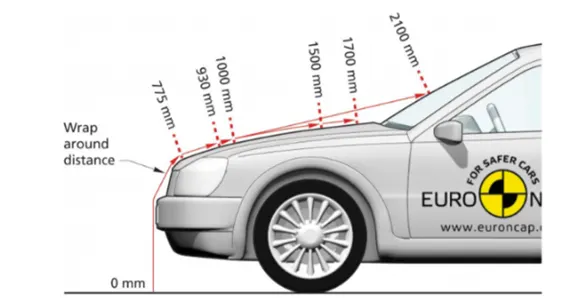
WAD is mainly used during crash analysis. That it classifies two zones as child head impact zone and adult head impact zone. The child head impact zone is in between 1000 to 1700mm WAD and the adult head impact zone ranges between 1700 to 2100mm WAD.
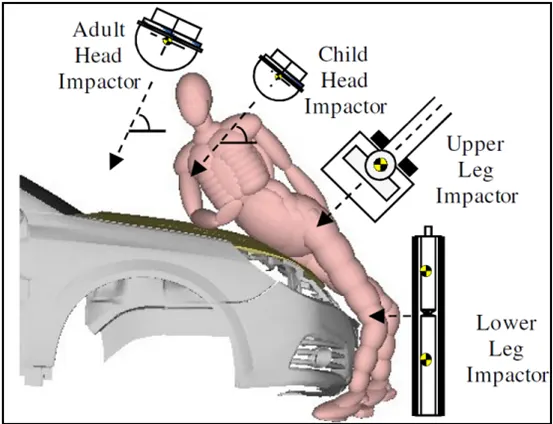
- Local bonnet stiffness is influenced by mounting point stiffness such as hinges, bump stops and latches.
- This is better understood by superimposing the kinematics of a dummy onto the test conditions.
Machining Process
There are several machining process the one we selected and most commonly used one is deep drawing.
Deep Drawing
The deep drawing process is a forming process which occurs under a combination of tensile and compressive conditions. A flat sheet metal blank is formed into a hollow body open on one side or a hollow body is formed into a hollow body with a smaller cross-section.
Deep drawing processes are divided into three types:
- Deep drawing with tools
- Deep drawing with active means
- Deep drawing with active energy
In the automotive industry, deep drawing is usually carried out using rigid tools.
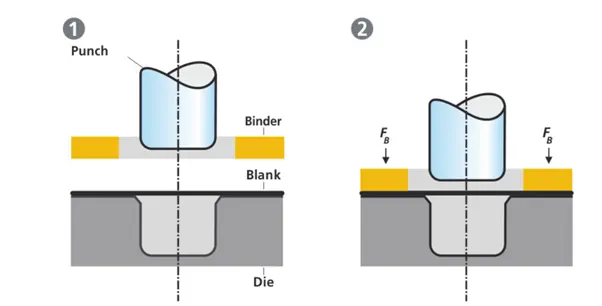
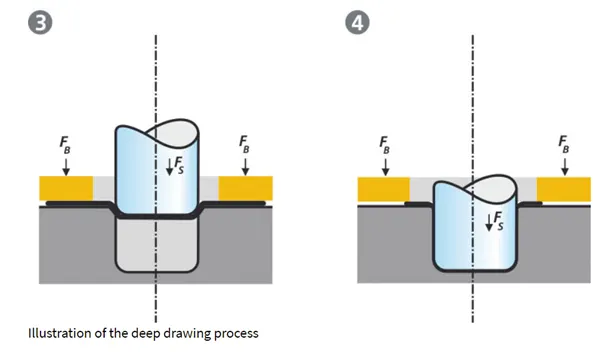
The figure illustrates the deep drawing process. The rigid tools consist of a punch, die and binder. In deep drawing, the plate holder closes after the metal sheet blank has been inserted.
Next the sheet is clamped between the die and the binder. This process slows down the flow of the sheet while it is being drawn and thereby prevents wrinkles from forming under the binder. The punch stretches the sheet over the die radius and forms it in the die. The amount of punch force necessary for forming is thereby continually increased up to the lower dead centre of the punch.
Whereas in pure deep drawing there is no reduction of sheet metal thickness, forming is achieved in stretch forming purely as a result of a decrease in sheet metal thickness. Stretch forming is extensively used for the forming of only slightly curved parts with low depth of draw (e.g., roofs, doors).
When drawing complex car body parts in practice, there is usually a combination of stretch and deep drawing involved. It is necessary that the sheet metal is stretched as well as possible without reaching the material’s limits.
Designing of Car Hood using NX CAD
For designing the hood of the car certain input geometries and design considerations were provide to design the hood based on the input.
The inputs are:
- Master Sketch
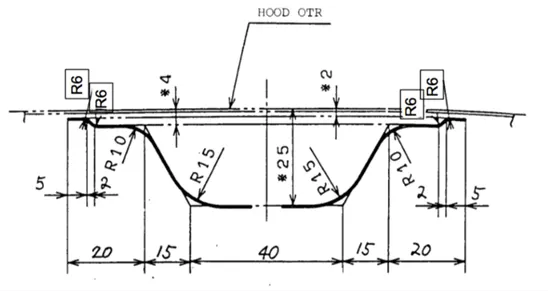
Given Hood thickness
Outer Panel Thickness : 0.75mm
Inner Panel Thickness : 0.75mm
Reinforcment Thickness : 1.5mm
- Hemming Data
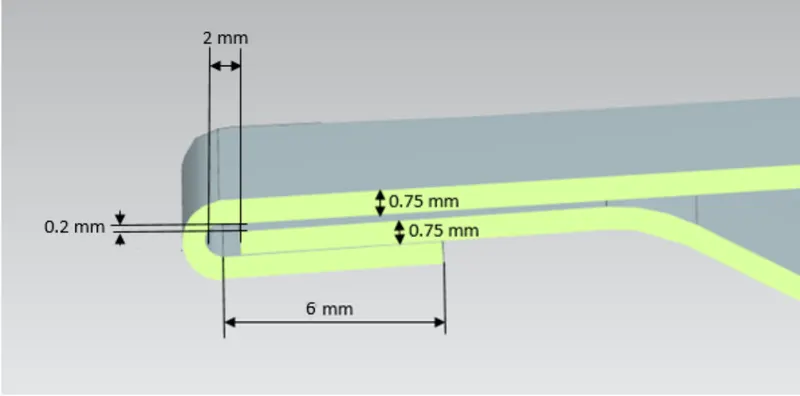
- Relief Sections
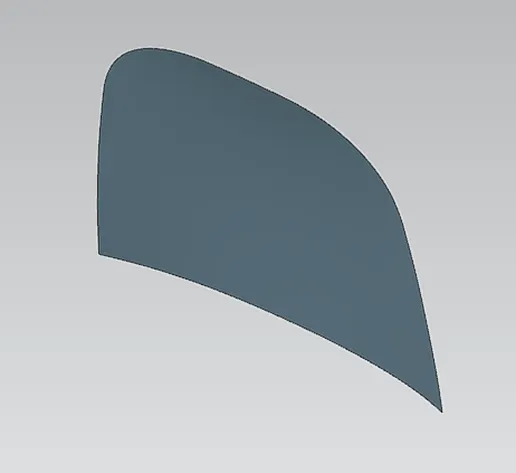
- Outer panel
- Hinge Assembly
- Striker
1.Based on the inputs the first objective was to design the hood inner panel:
- Following the master section and ofsetting the outer panel intial parts of the inner panel was created and certain emboss definitions were given.
- After that the hinge assebly and striker was fixed in the inner panel and given proper emboss definitions.
For fixing the striker to the inner panel, latch trajectory of striker was to be followed as the stricker should be positioned properly for the opening and closing of the hood. After positioning the hinge assemblies using the centeral axis of the hinge assembly a trajectory as shown in the figure is drawn and the exact position of the sriker is positioned.
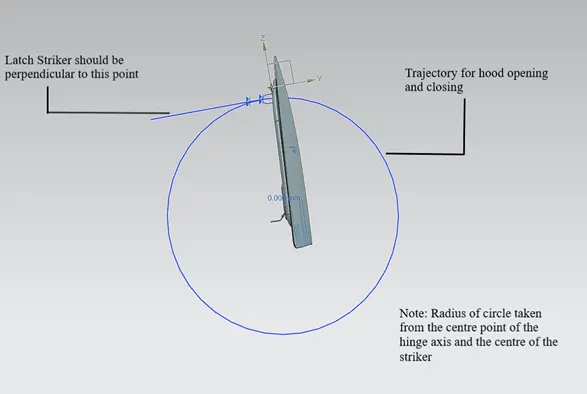
Fig : Latch Trajectory
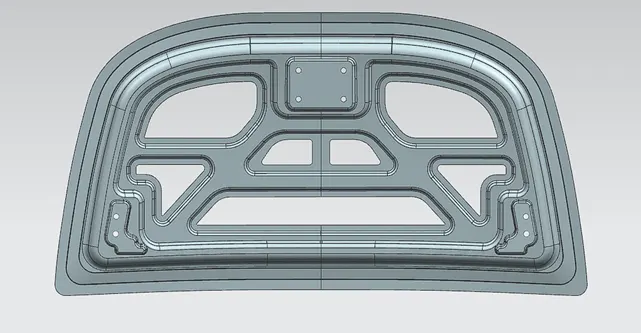
Based on all the inner pannel was designed as given below:
Notes:
Emboss : Emboss structures are given to the inner panel to create extra streangth for the material along with safety. The embosses are given in such a way that if the object hits in the front the force descipates towards the upper left and right corners so that less force reaches the passengers side.
Mastic Data : The main purpose of the outer panel is for the aesthetic looks. Thus we cannot use bolts or welding. This has to be done with the help of the hemming and mastic sealents. Mastic sealents are elastic compound that behaves like rubber. It is placed between the outer and inner panels. Initially it is in paste form, but after the hot furnace bath , it gets hardened thus joining the outer and inner panel. Mastic sealents also increase the streangth of the material.
- Based on the inner pannel created a outer pannel was to be created:
We already have the skin data for the outer pannel we just needed to give some additional features like providing a Hem, Relief, thickening.
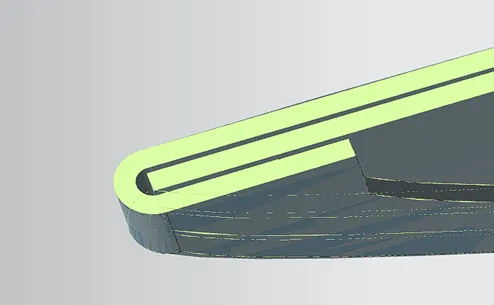
- Hemming : It is the process in which the edge of the sheet is rolled to itself, while a seam joins the edges of two materials. Hemming operations are normally done to put connect different parts or to improve the appearance of the part. In hood design, hemming is used in assembly to join two sheet metal parts the outer pannel and inner panel.
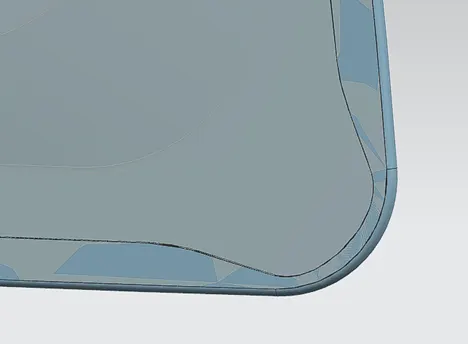
- Relief Data: Relief is provided to the outer panel or any component in order to remove any stress developed in sharp corners that take place during the hemming process. Thus this corners are rounded or chamfered.
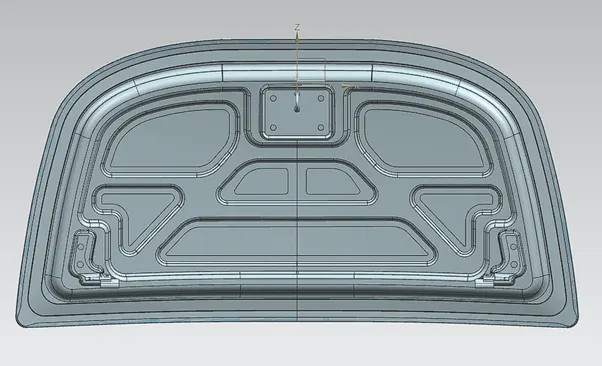
Hence the outer pannel and inner pannel was designed and the hinge assembly and striker were postioned properly. The assembly of hood was completed.
Conclusion
The hood was designed considering the safety features and also the design parameters.