Hood design-Week 2
HOOD DESIGN
Aim: - The main objective of this project is to learn the essential tools, commands, and surface modelling of Hood designing using Siemens NX Cad. This project is to develop a design idea for hood BIW that satisfies the manufacturing requirements, functional requirements, and EURO NCAP standards.
Introduction: - Hood is the engine cover hinged to the car's body (front-engine automobile). It gives you access to the vehicle's engine and is also vital for the safety against the frontal impact of the car.
The hood or bonnet is the hinged cover over the engine of motor vehicles. Hoods can open to allow access to the engine compartment or trunk on rear-engine and some mid-engine vehicles for maintenance and repair. Generally, the passenger car hood may be held down by concealed Latch. But in a race car or car in aftermarket, the hoods may be held down hoods pin. Hoods sometimes also contain a hood scoop, wiper jets, power bulge, and/or hood ornament. Car hoods are typically constructed from steel and sometimes from aluminium. Aftermarket car hoods may be formed from other materials, including carbon fibre, fibreglass, or dry carbon. The hood design may vary from one make and model to another SUV. The hood is also designed for several requirements. A car hood is meant to protect the performance parts of your vehicle, including the engine, while also providing easy access for repairs and maintenance. They serve a great deal of purpose in protecting the passenger inside the car and the pedestrian in the event of an accident. The hood can incur damage as well.
Types of hoods support
There are two types of support available for the hood support
- Gas Stay
- Support Rod
Gas Stay
Gas Stay Gas stay is the device for supporting the engine hood of a motor vehicle in its open position using an actuator activated by gas. This is mainly used when the car hood is heavy. In this, no men's power is required. Spring stays are designed to be used on upward-lifting doors; once the door is open n slightly, the spring will push the entrance to the fully open position. Euro fits stock various size springs depending on the door size requirement.
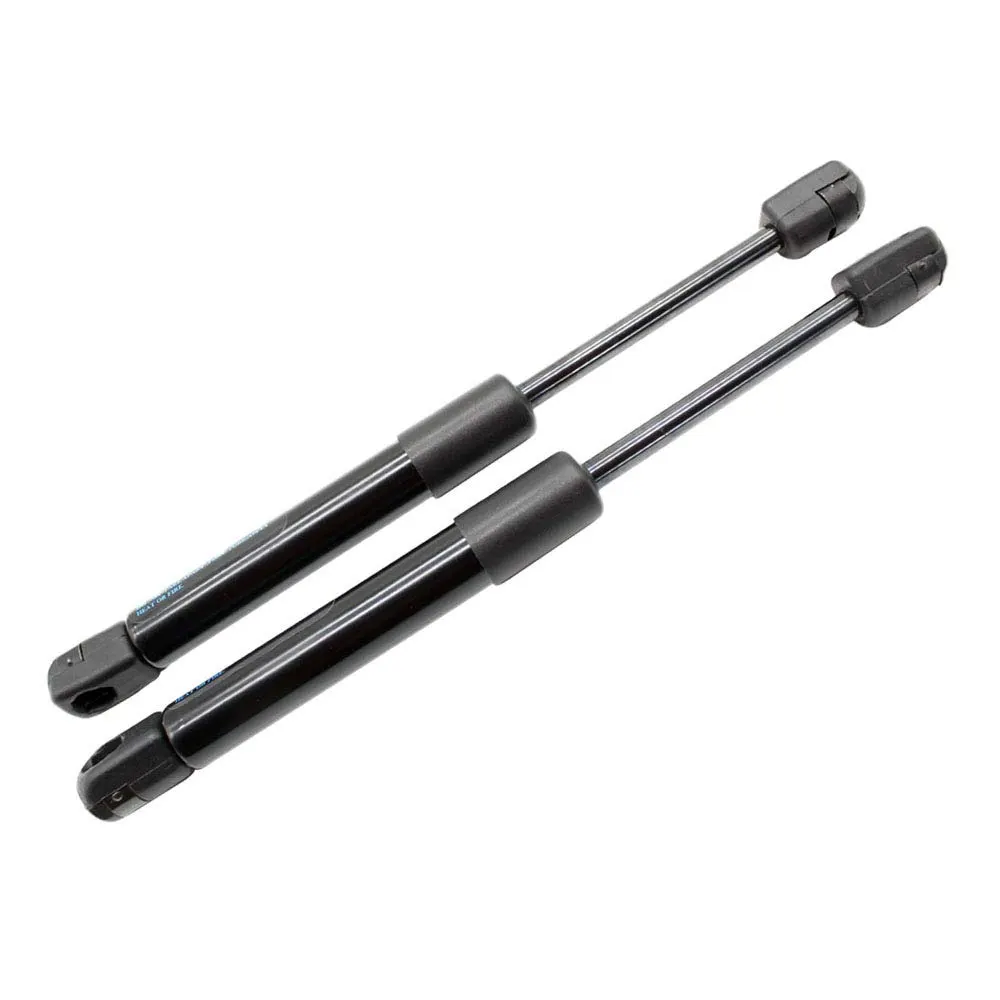
Support Rod
A support rod is a device for supporting the engine hood of a car in its open position using a rod. This is mainly used where the car bonnet weight is negligible. We have to lift the hood ourselves and place the support provided either in the hood or the engine component.
Design constraints to be followed: -
- Passenger safety
- Pedestrian safety
- Manufacturing feasibility
- Position the striker along the Trajectory of the centre of the hinge axis.
- Joining techniques of the inner and outer panel.
Passenger Safety Whenever a frontal crash occurs in the car, the first part affected will be the hood. So must be designed in such a way that it should not come from the body of the vehicle and must absorb the energy as far as possible ad divert the force towards the side panel of the car so that the amount of force which is sent to the cabin is lesser since the force lesser the passenger will experience less amount of force so that passenger safety is ensured.
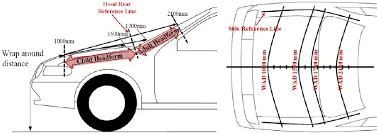
Pedestrian Safety Safety of the pedestrians needs to be considered during the design as per the NCAP Euro assessment. Hood is of two types based on the side reference line. The side reference line is an imaginary line drawn from the ground at an angle of 45degree. If this line falls on the fender, then the hood is inlaid, and if the line falls on the hood, the hood is wrapped around the hood.
Components of Hood
1. Outer Panel
2. Inner Panel
3. Hinge
4. Latch
5. Reinforcement
Outer Panel - A car hood panel is one of the most important components of the BIW (body in white), it is considered the closure sheet-metal component. The outer panel has the aesthetic look to it but on its own is very weak and not capable of handling force during impact. Most automobile hood outer panels are made of traditional steel plates, and their quality does not meet the needs of lightweight development. For this reason, it is necessary to obtain lightweight effects through the application of automotive aluminium sheets. The most widely used car aluminium alloys in the market are deformed aluminium alloys of 6111, 6016, and 5182. The production process of the outer panel of the hood mainly includes blanking, deep drawing, trimming, turnup, and side turnup. Among them, deep drawing is a key process to ensure the quality of parts.