Hood design-Week 2
Ojective:
To Design hood outer panel, inner panel and reinforcements with the given outer hood skin, master section and design parameters.
Introduction:
The hood or bonnet is the hinged cover over the engine of motor vehicles. Hoods can open to allow access to the engine compartment (or trunk on rear-engine and some mid-engine vehicles) for maintenance and repair. In design perspective hood should meet some specific conditions like pedestrian safety, hood head zone for the lock striker, force distribution when subjected to frontal collision (occupant safety), manufacturability etc.
Components:
Latch Trajectory:
The latch trajectory is the path which the striker will follow when the hood is open/closed while pivoting on the hinge axis. The latch trajectory is taken as a circle with the hinge axis as the center of the circle. The striker is placed 90 degree such that it is tangent to the circle.
Mastic Data:
Mastic is an adhesive that, along with thin-set mortar, is used to stick tile to wall or floor surfaces before grouting. While mastic does have strong points, such as great adhesive properties and adaptability to many substrata, high performance in wet areas is not one of its high points.
Mastic point are areas where the inner hood panel is joined with the outer panel hem using a mastic glue. This mastic glue keeps the inner panel stuck to the outer panel.
Emboss:
Embossing is the process of creating a raised image, design, or text on a material, such as paper, leather, or metal sheets. Embossing can be found on cards, and stamps, leather notebooks, paper cups, stamps, etc, and is a popular technique in DIY crafts and activities.
Manufacturing process
Deep-Drawing:
Deep drawing is a sheet metal forming process in which a sheet metal blank is radially drawn into a forming die by the mechanical action of a punch. It is thus a shape transformation process with material retention. The process is considered "deep" drawing when the depth of the drawn part exceeds its diameter. This is achieved by redrawing the part through a series of dies.
Hemming:
Hemming is a forming operation in which the edges of the sheet are folded or folded over another part in order to achieve a tight fit. Normally hemming operations are used to connect parts together, to improve the appearance of a part and to reinforce part edges.
Hood Assembly Image
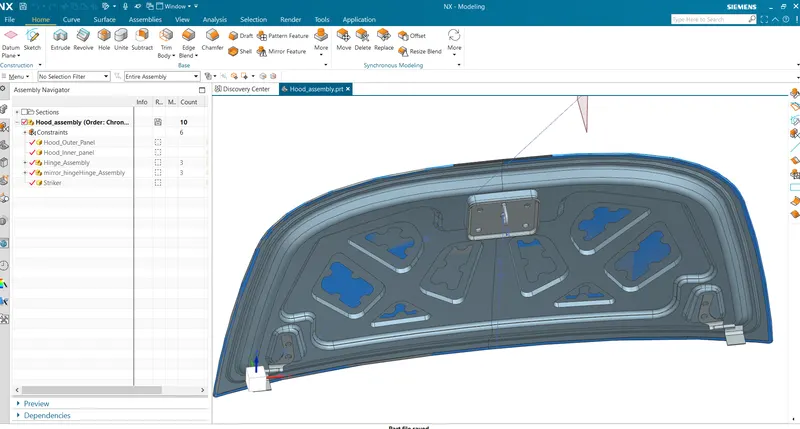
Complete assembly file is in attached below