Hood design-Week 2
REPORT ON HOOD DESIGN :-
AIM- To Design Hood outer panel, inner panel and the necessary reinforcements by following the Master section mentioned with the design parameter, (Hinge,Striker) included.
Design Methodology
1. Develop the inner panel with
- Embossing (with minimum 7 Degrees Draft)
- Mastic Points
2. Develop the Outer Panel with
- Hemming
3. Positioning the reinforcements
- Hinges
- Striker for Latch
Given data for Hood Creation
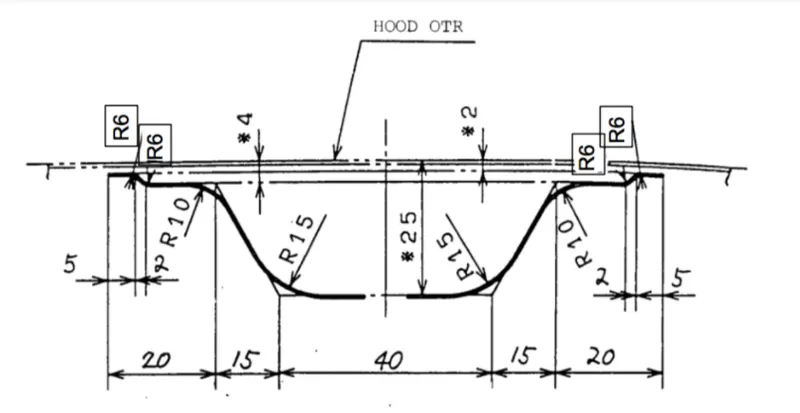
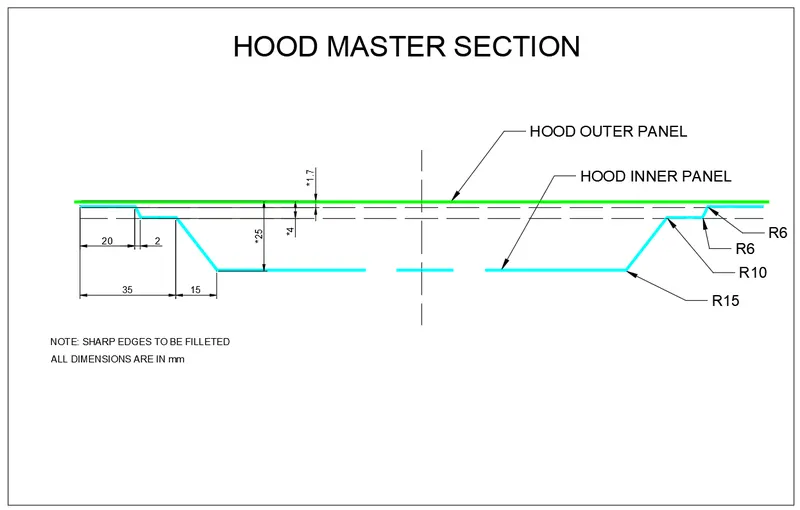
MasterSection
It has played very important role as it has every general design information considered for a hood. It shows general dimensions and structural shape of general hood design.
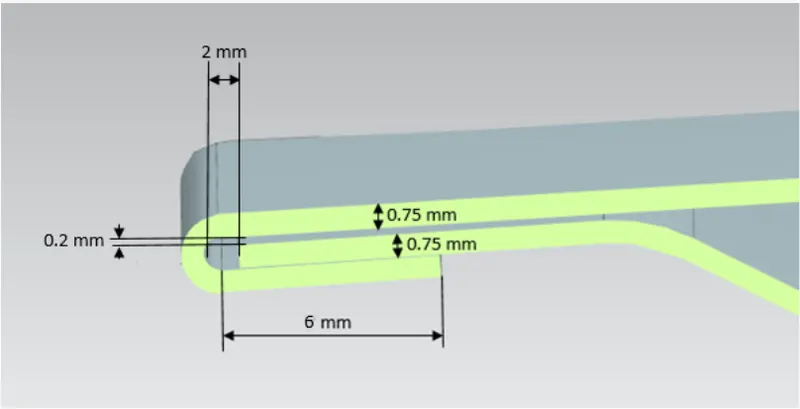
Hemming Data:
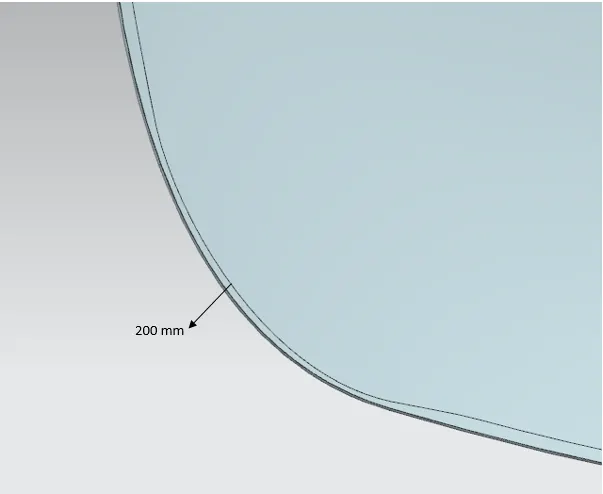
Relief rear section:
Front relief:
Data To be used
Outer Panel Thickness 0.75mm
Inner Panel Thickness 0.75mm
Reinforcement Thickness 1.5mm
Hood Introduction
The hood (North American English) or bonnet (Commonwealth English) is the hinges cover over the engine of the motor vehicles. Hoods can open to allow access to the engine compartment, or trunk (boot in Commonwealth English) on rear-engine and some mid-engine vehicles) for maintenance and repair.
Hood Design Facilitates
- Hood Covers all engine components
- Easy access in engine compartment
- Frontal Crash impact forces absorption
- Reduce Engine Noise
- Aerodynamic Shape
- Safety of Pedestrain
- Good Aesthetic appearence
Hood Types
Front Hood
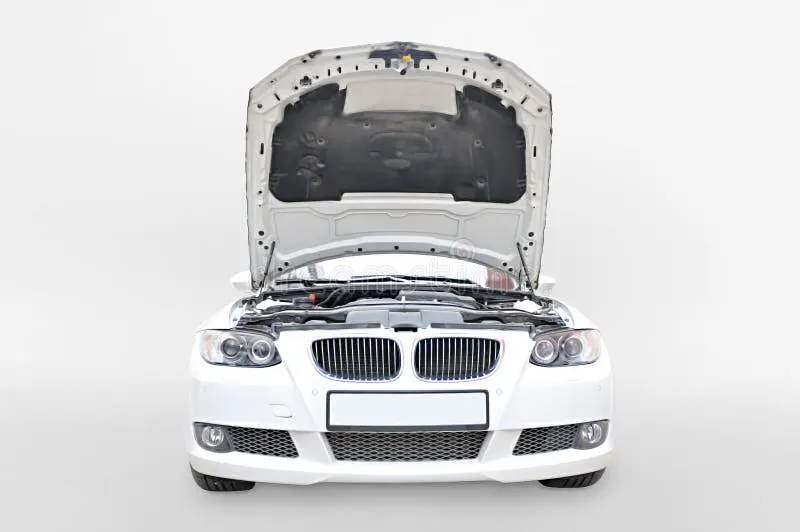
For Hood Design Considered points
- Opening Angle of Hood
- NCAP Crash Test Ratings For Strength
- Wrap Around Distance (WAD) for Pedestrian Safety
- NVH (Noise, Vibration, Harshness) For Consumer/Customer/User/Buyer
Opening Angle of Hood
This is one of the main criteria in designing of hood. This opening angle varies from person to person and country to country. In India, the average height of a person is 5.8 feet/ 177 cm (Current data) whereas in the European countries the average height is 6 feet, these points refers variation in opening angle of hood.
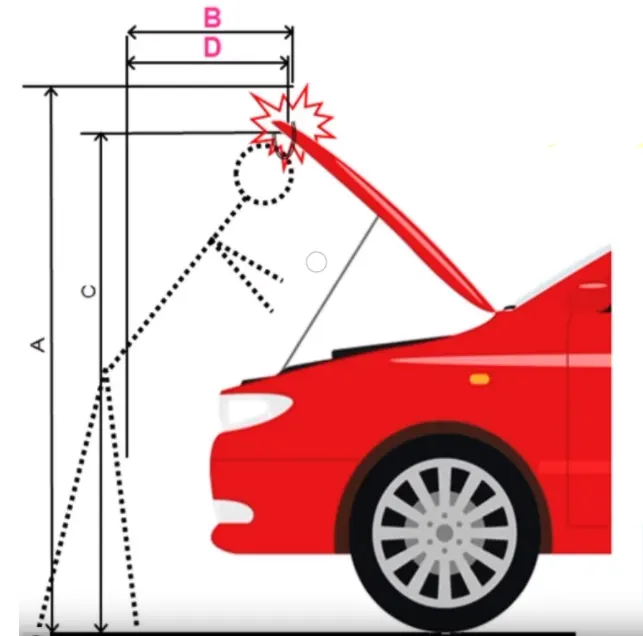
Opening angle is considered as an important criteria, when the opening angle is less than required there are possibilities of human head injury.
Types of Hood Support
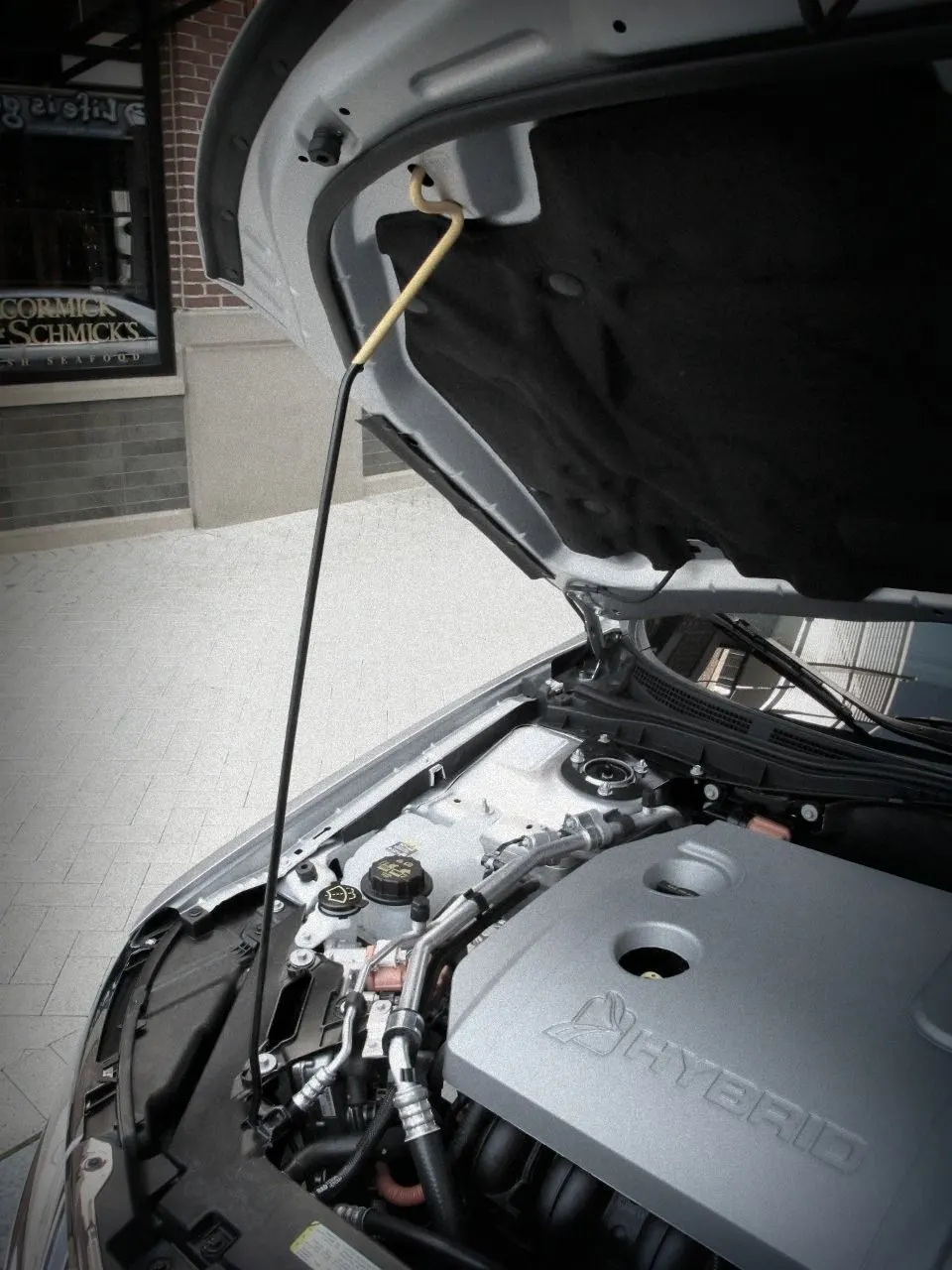
- Support Rod- These support rods are widely used in cars to support the hood in open Position. These support rods are cost effective compare to gas stay. In this type of hood support the hood opens manually. The support rod is fixed on the hood or the engine compartment, to hold hood (in Open Position) the support rod needs to positioned(manually) on the supporting rod point which is opposite to the support rod position. Generally these support rods are used only in the lighter weight hood Vehicles.
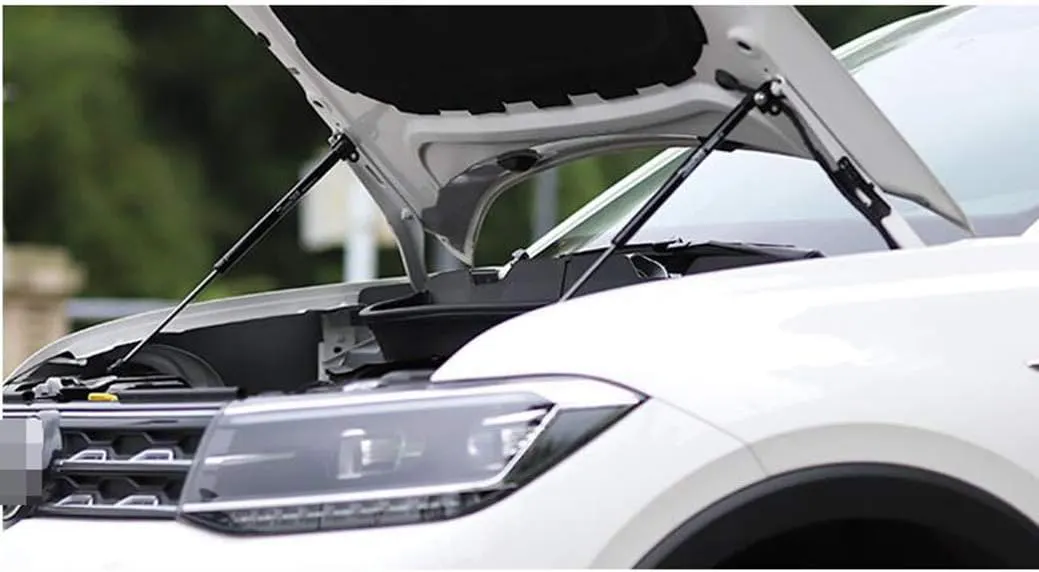
- Gas Stay - These Gas stay are type of support rods which is used for heavy weight hoods. In these gas stay rods, pressurized gas is filled which helps to hold the hood in open position. Gas stay just needs the initial force to open the hood. Gas stays are convient to use but these are expensive when compared to support rods.
Gas stay Holding Hood Open
NCAP Crash Test
Euro NCAP, or the European New Car Assessment Programme to give it its full name, is an independent crash-test safety body, which rigorously assesses the safety of cars, and helps to further the advancement of car safety technology. With safety at the forefront of all car makers minds, and many firms and organisations signing up to the ‘Vision Zero’ initiative – which aims to eliminate all deaths and serious injuries from our roads – Euro NCAP’s test programme is an ever-evolving one, with its architects periodically updating crash-test regimes to ensure cars are assessed using the most stringent criteria possible. The current Euro NCAP safety regime includes a dual rating, with cars tested both with and without various high-tech safety features. This means some cars may get five stars if they are configured with autonomous emergency braking, for example, but drop to four stars for the second rating if this feature is not standard.
The European New Car Assessment Programme (Euro NCAP) is a European voluntary car safety performance assessment programme (i.e. a New Car Assessment Program) based in Leuven (Belgium) formed in 1996, with the first results released in February 1997. It was originally started by the Transport Research Laboratory for the UK Department for Transport, but later backed by several European governments, as well as by the European Union. Their slogan is "For Safer Cars".
Pedestrian safety
In Japan and Europe, regulations have come into effect that place a limit on the severity of pedestrian head injury when struck by a motor vehicle. This is leading to more advanced hood designs, as evidenced by multicone hood inner panel designs as found on the Mazda RX-8 and other vehicles. Other changes are being made to use the hood as an active structure and push its surface several centimeters away from the hard motor components during a pedestrian crash.
Protecting the Head
The hood of most vehicles is usually fabricated from sheet metal, which is a compliant energy absorbing structure which poses a comparatively small threat. Most serious head injuries occur when there is insufficient clearance between the hood and the stiff underlying engine components. A gap of approximately 10 cm is usually enough to allow the pedestrian’s head to have a controlled deceleration and a significantly reduced risk of death. Creating room under the hood is not always easy because usually there are other design constraints, such as aerodynamics and styling. In some regions of the hood it can be impossible. These include along the edges on which the hood is mounted and the cowl, where the hood meets the windshield. Engineers have attempted to overcome this problem by using deformable mounts, and by developing more ambitious solutions such as airbags that are activated during the crash and cover the stiff regions of the hood. Some models, like the Citroën C6 and Jaguar XK feature a novel pop-up bonnet design, which adds 6.5 cm (2.5", C6) extra clearance over the engine block if the bumper senses a hit. In 2012 and 2015, the Volvo V40 and the Land Rover Discovery Sport have an under-the hood airbag designed to operate if the hood senses a hit. The airbag is also designed to cover the windshield pillars to help protect the pedestrian's head.
HEMMING PROCESS:-
- Hemming is a technology used to join inner and outer closure panels together.
- It is the process of bending/folding the flange of the outer panel over the inner panel.
- Hemming is performed to achieve a better final geometry in the vehicle part.
- Allow safe handling of the part.
- Add resistance and rigidity to the part.
- We are using the roller hemming operation for the hood to get the desired final shape of the product of the sheet.
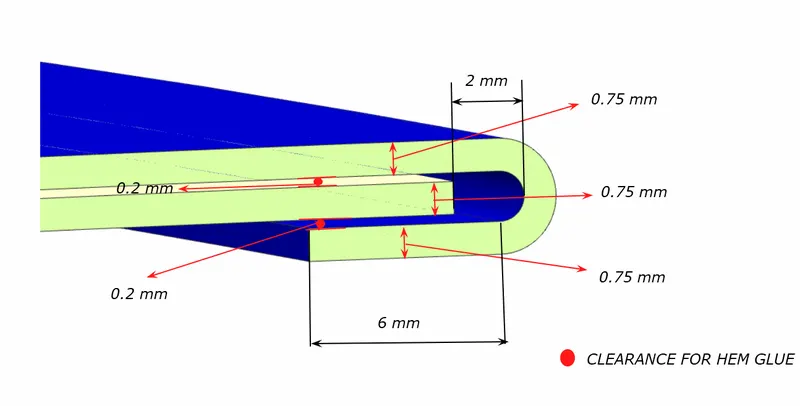
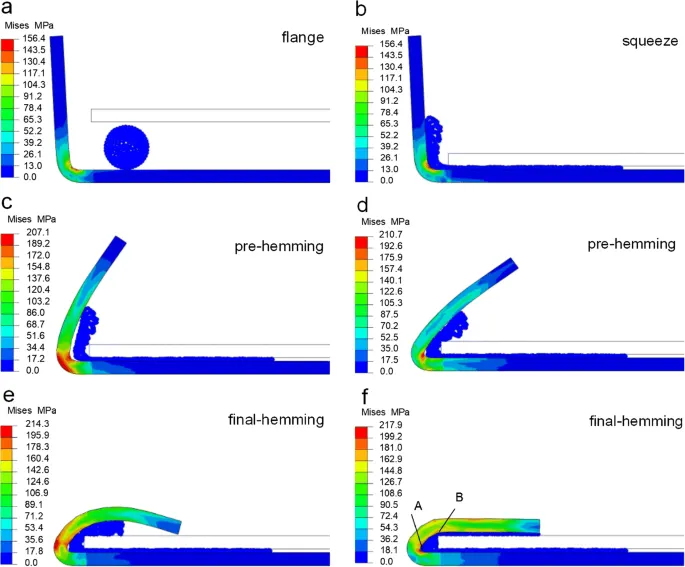
- Numerical quantification of model and experiment of external
- To prevent the formation of buckling during hemming make the corner relief at the sharp corners.
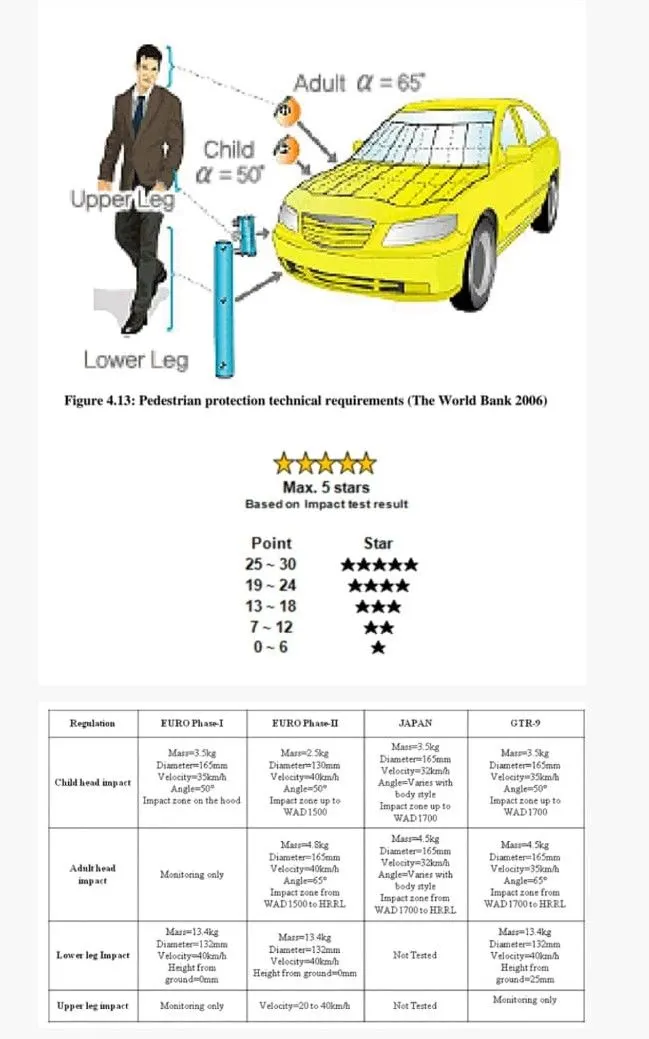
PEDESTRIAN SAFETY:-
- The term pedestrian generally refers to a person walking, running, skating, skateboarding, and other similar devices.
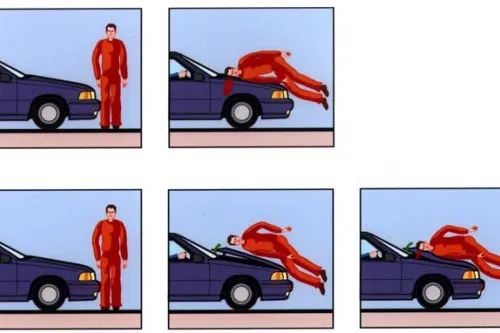
Kinematics of pedestrians in an impact
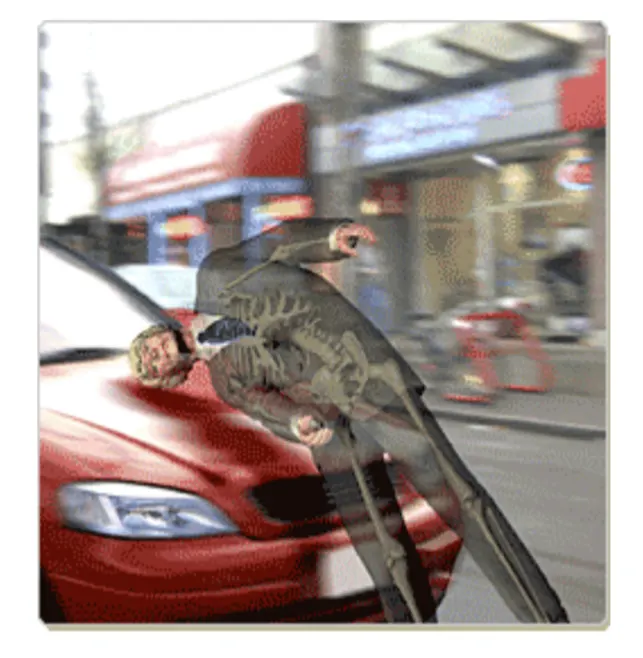
- It describes when a passenger car collides with an adult pedestrian standing erect.
- The contact between the leading edge of the hood and the upper legs/pelvis of the pedestrian.
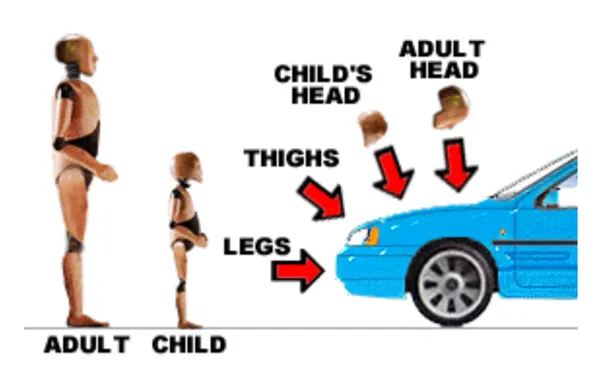
Adult and child head impact
- The impact area for the child's head is between 1000WAD- 1700WAD.
- The adult head impact area is between the 1700WAD-2100WAD. The impact area does not include the windscreen.
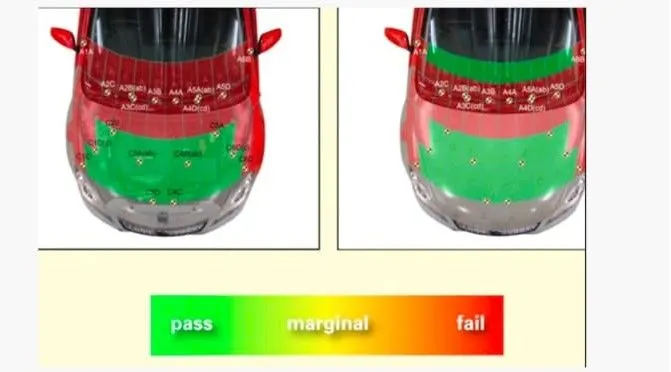
Virtual crash simulation
Requiring factors of the virtual crash test
- Creating the three-dimensional geometric models of all the required components to replicate structure as accurately as possible.
- Converting the geometric models into FE models.
- Implement the mass properties and representative materials properties.
- Constraining the components together.
- Post-processing to analyze the crash results.
Contour plot of hood displacement using hyper view
HOOD COMPONENTS:-
- Hood outer panel
- Hood inner panel
- Latch and striker
- Reinforcements
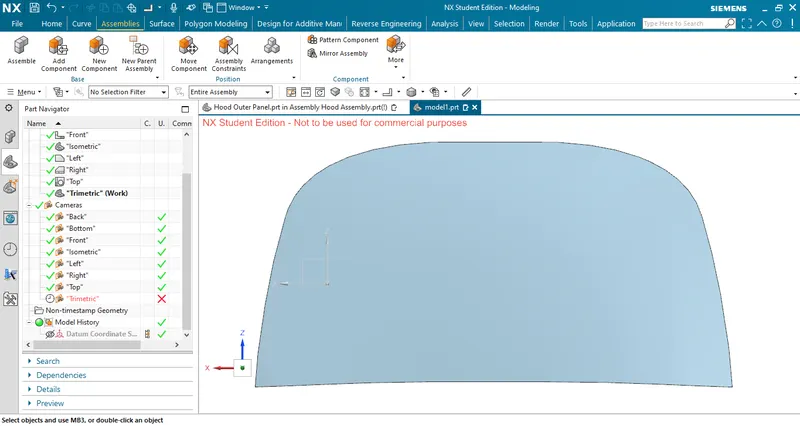
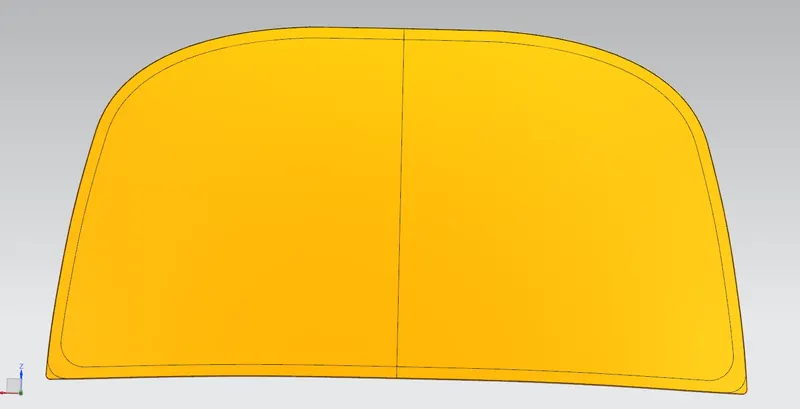
OUTER PANEL:-
- The outer panel has an aesthetic look to it but on its own is very weak and not capable of handling force during impact.
- It is installed over the inner panel and made up of aluminum alloy.
- Aluminium alloy has excellent corrosion resistance and it possesses high strength and excellent stretch forming and lightweight characteristics.
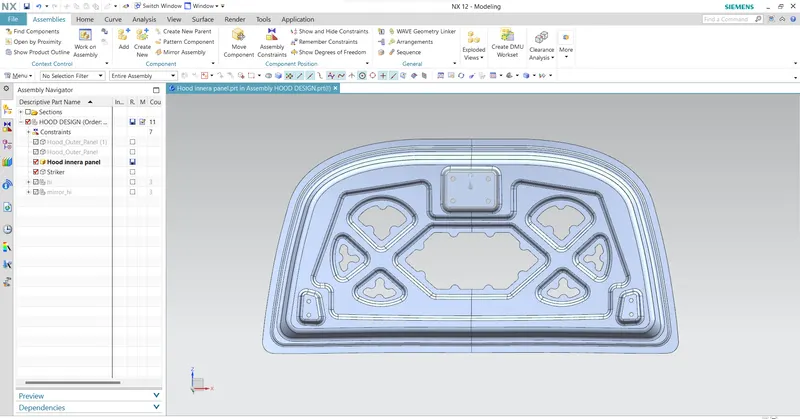
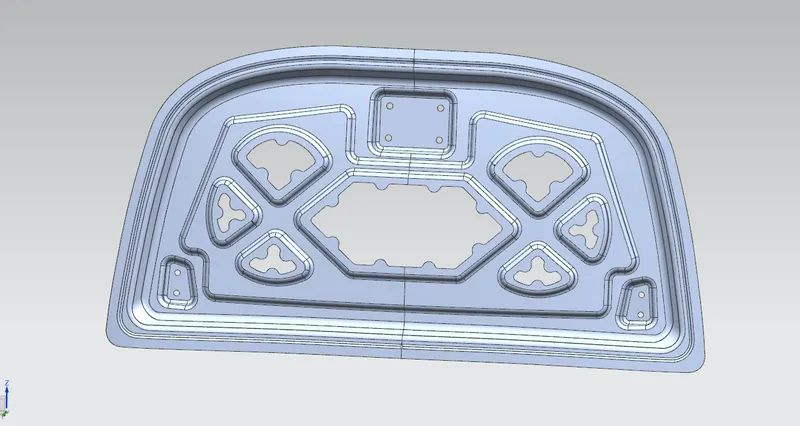
INNER PANEL:-
- The inner panel is mounted under the outer panel.
- It has been designed and modeled with overlapping flange connected.
- The mess is created under the manufacturing process of sheet metal stamping dies.
- The purpose of the hood inner panel is providing to improve rigidity, durability, and pedestrian protecting performance by compressing a composite structure.
- The inner hood panel also protects the engine compartments during the collision.
- Generally the hood inner panel has a multi-cone structure.
HINGE:-
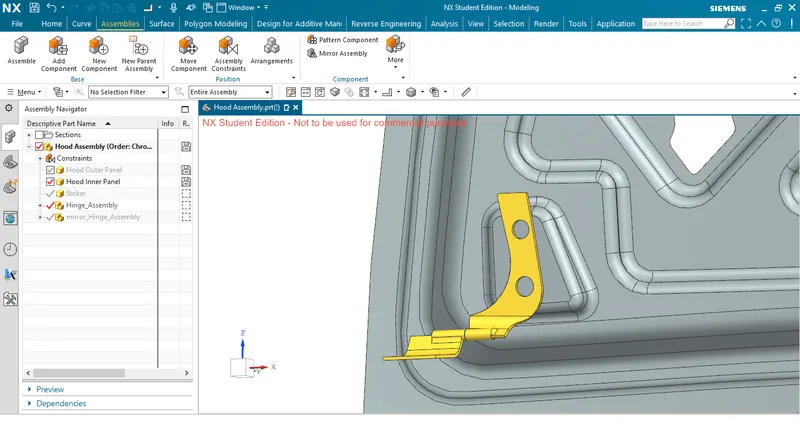
- The working system of the hood is completely based on its hinges.
- The hinge mechanism is provided that allows a lawn and garden tractor hood to be pivoted between closed and open positions.
- The construction of hinges to allow easy separation or connection of parts at the hinge axis in a radial direction requiring a specific angular position the pin having a non- circular cross-section
- The hinges are properly aligned on a single reference axis path.
To assemble the hinges, two constraints are used.
- Touch constraint
- Parallel constraint.
STRIKER:-
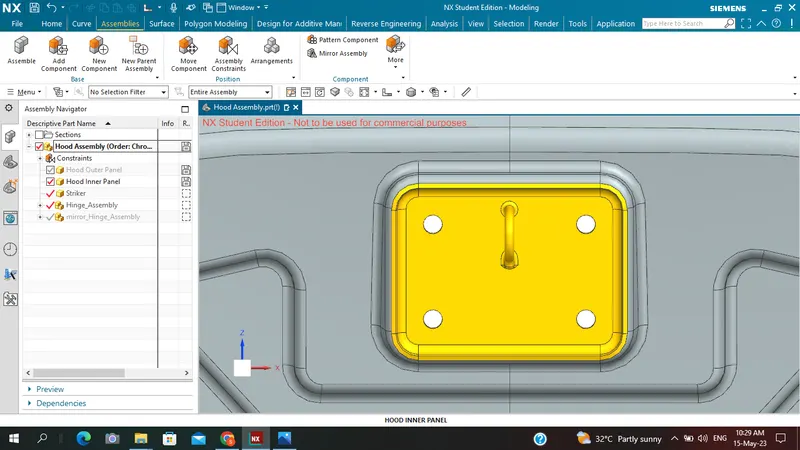
- A vehicle hood latch and release mechanism are latched when the hood striker engages the latch portion of the mechanism as the hood is moved to its closed position.
- The mechanism is actuated to release the hood striker by pushing action on the cable.
- When the latching mode of the hood latching and releasing mechanism latches the hood striker holds the hood closed.
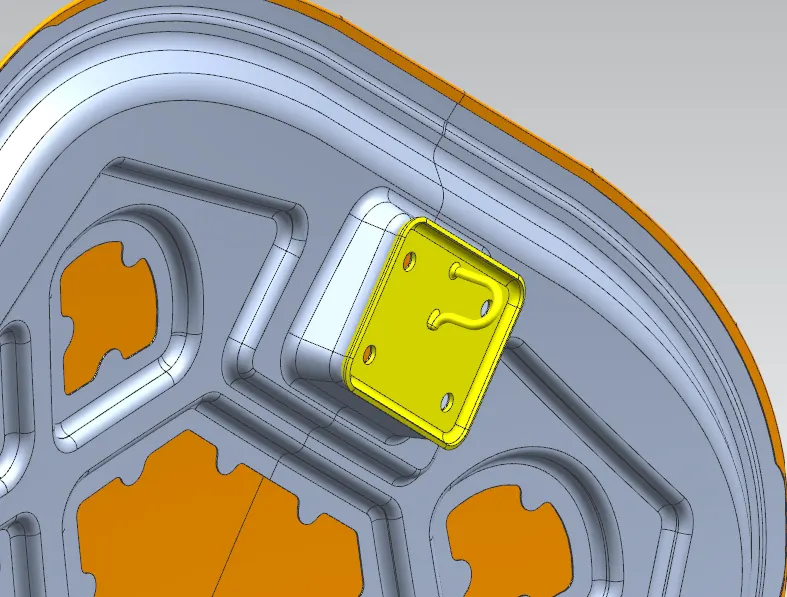
REINFORCEMENTS:-
- The striker reinforcements material that can enhance strength and rigidity in the vicinity of the striker and secure pedestrian protection performance.
- The reinforcement is included for the less thickness of material where the deformation occurs at the time of the collision to protect pedestrians.
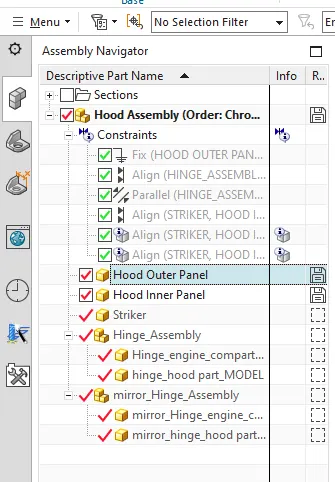
ASSEMBLY TREE OF HOOD:-
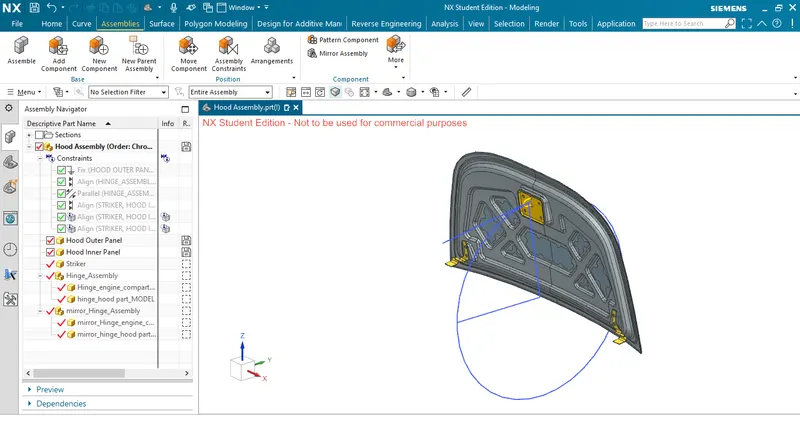
LATCH TRAJECTORY MOTION:-
- The significance of the trajectory concept is open and close the hood along the curved path to its motion concerning gravity.
- The circle is sketched at the center section of the hood using the datum plane and the line is drawn tangent to the circle.
- A perpendicular line is drawn at the center of the striker using the datum plane.
- By using the align constraint, coincident the tangent line and perpendicular line of striker.
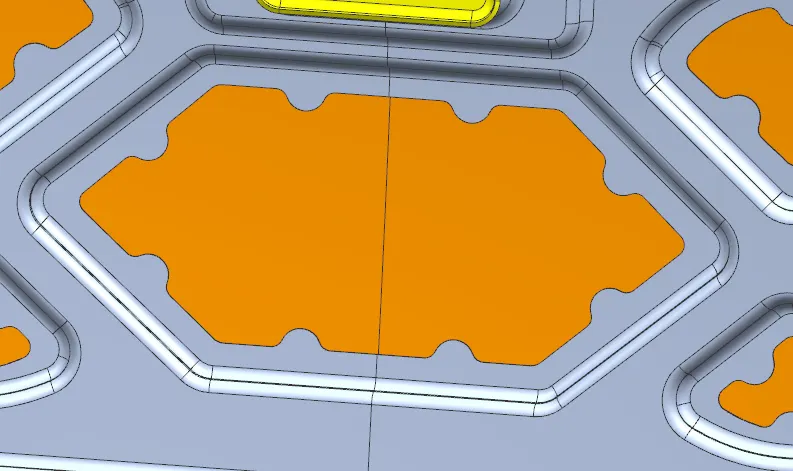
MASTIC DATA:-
- The mastic sealants are in the form of paste.
- The mastic sealants either join one surface to another or adheres to nearly any material.
- The mastic sealants are applied in between the outer panel and inner panel to join with each other.
- The mastic data are applied on the hood and it solidified fills the gap of 5mm between the outer panel and inner panel.
- Hood commonly possess large surface area and hemming can only be provided through its boundary.
- Mastic sealants are elastic compound that behave like rubber.
- It is applied between the inner and outer panels at specified spots.
- Each spot of mastic sealants has its effect around a circular region from 50-80mm diameter.
- Thus, the mastic points are arranged in such a way that it covers the areas away from the hemming which are more vulnerable to vibrate.
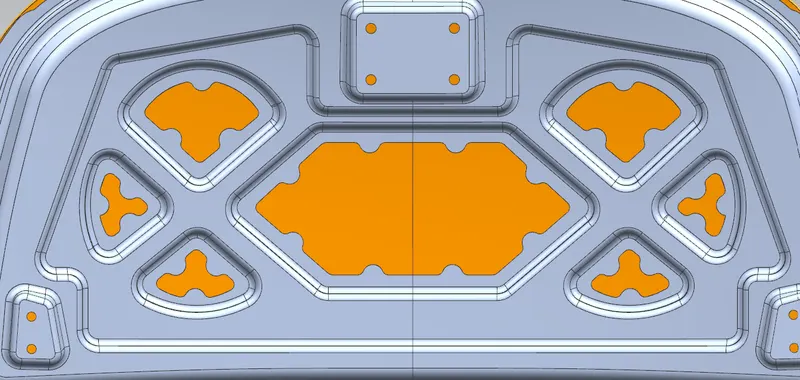
EMBOSS:-
- This command enables modifying the sheet body by adding faces of a solid body.
- The target sheet body intersects with tool bodies when pressed.
- The shape of the tool bodies is to be transferred onto the sheet body.
- It increased the metal panels and stiffness and rigidity.
- Increase the surface area for heat transfer or acoustic applications and improve the traction.
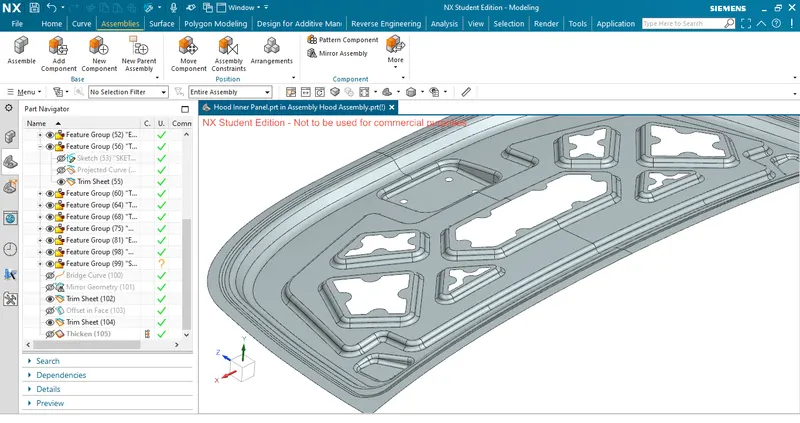
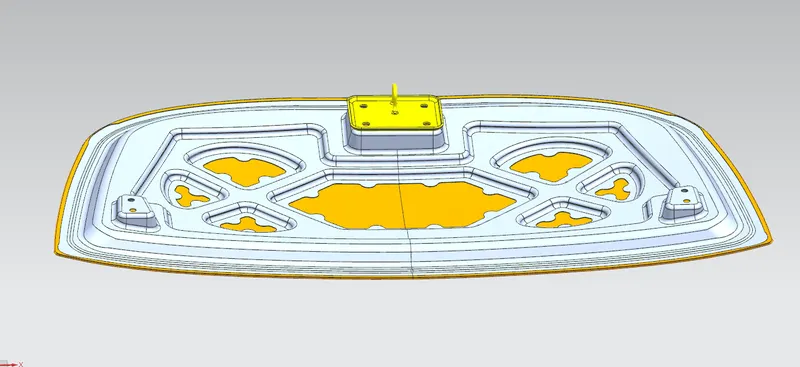
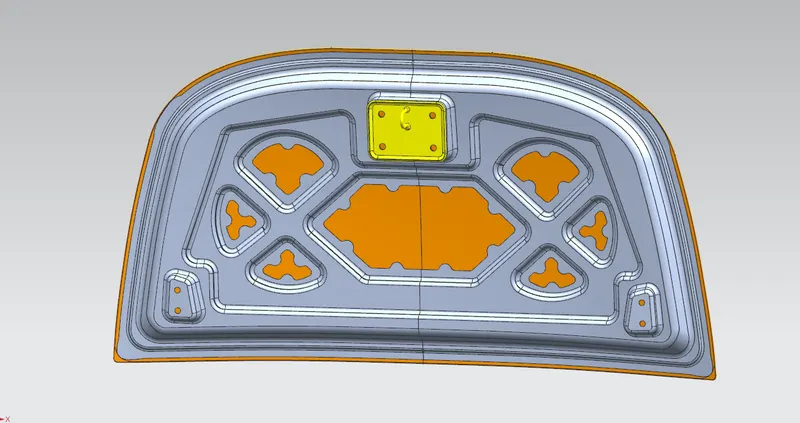
VIEWS :-
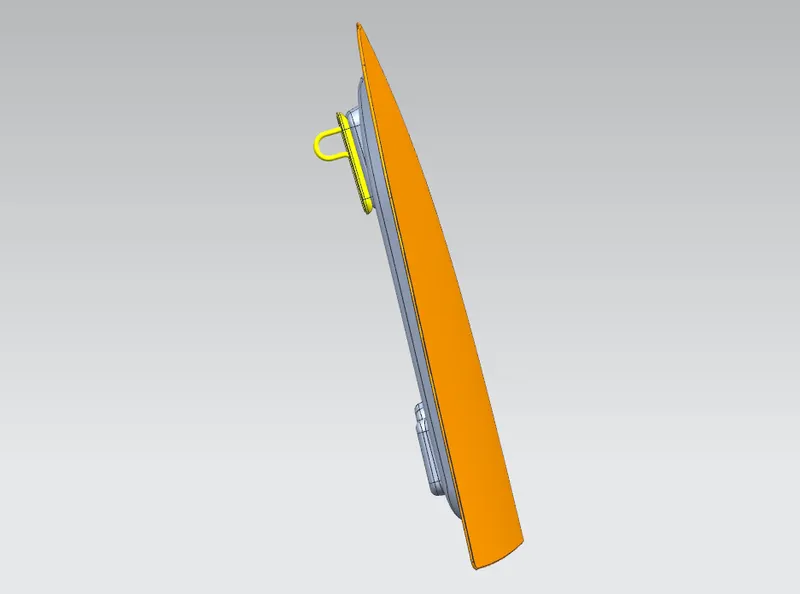
MASTER SECTION:-
Conclusion:-
Designed and modeled the hood panel using Siemens NX CAD as per the design parameters.