Hood design-Week 2
OBJECTIVES:-
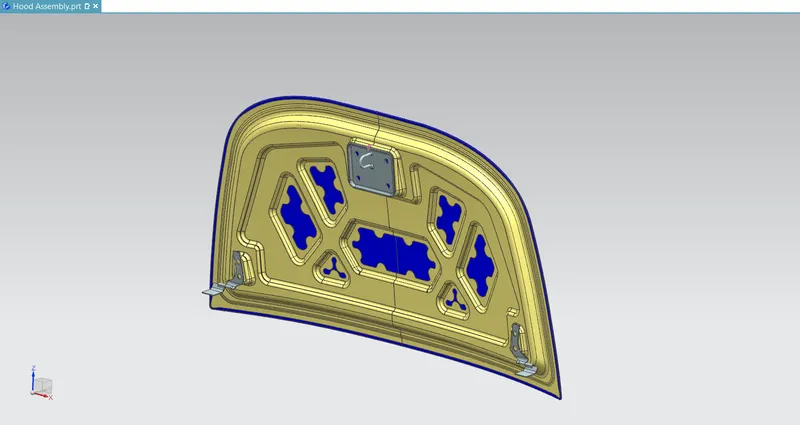
- Designing and modeling the hood concerning its parameters and requirements.
DESIGN OF A HOOD:-
- The hood of a car is the metal panel that covers the engine. it is usaually located at the front of the car, and it opens to provide access to the engine compartment. The hood is an important safety feature, as it helps to protect passengers from being injured by the engine in the event of a collision.
INTRODUCTION:-
- Hood is an automobile component and it is called the bonnet in british countries.
- It is assembled in a tapered position to the windscreen of the car it has enclosed around the engine compartment.
- A hood is meant to protect the vehicle's performance parts like the engine or battery.
- They also provide easy access to car repair and maintenance.
- The Hood is made up of aluminum materials.
- They serve a great deal of purpose in protecting the passengers inside the car and pedestrians in event of an accident.
COMPONENTS OF HOOD:-
- Hood outer panel
- Hood inner panel
- Latch and Striker Mechanism
- Hinges
OUTER PANEL:-
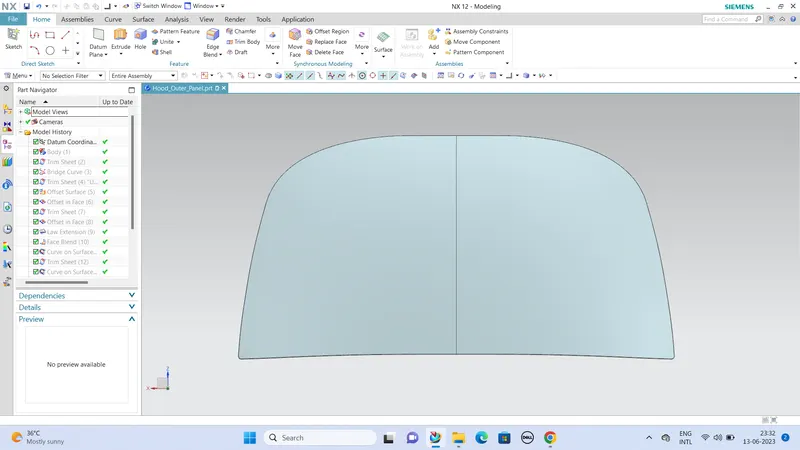
- Outer panels are the aesthetic elements of a car.
- It look to it but on its own is very weak and not capable of handling force during impact.
- The shape, position and size of the hood should satisfy the safety norms. So while designing the hood we should give more importance to pedestrian safety.
- It is installed over the inner panel and made up of aluminium alloy.
- Aluminium alloy has excellent corrosion resistance and it possesses high strength and excellent stretch forming and lightweight characteristics.
INNER PANEL:-
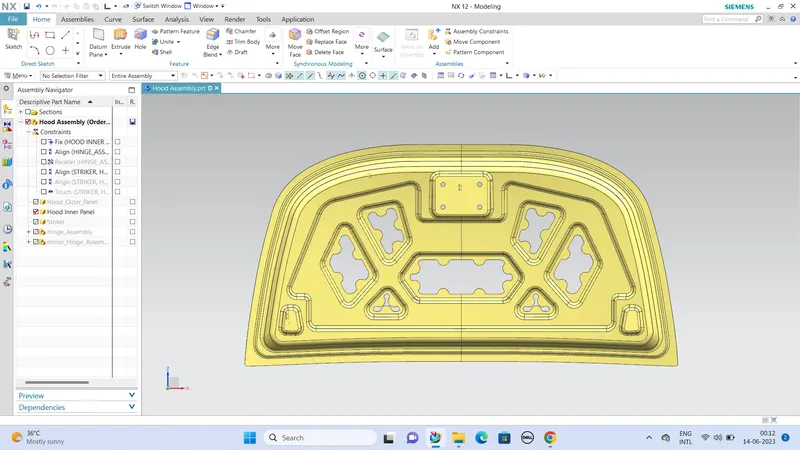
- The inner panel is mounted under the outer panel.
- Inner panel is the part that gives strength and rigidity to the outer panel.
- The master section represents the intial emboss shape and size. Then we provide the emboss for the latch and hinge elements after fixing the location.
- It has been designed and modeled with overlapping flange connected.
- The mess is created under the manufacturing process of sheet metal stamping dies.
- The inner hood panel also protects the engine compartments during the collision.
- Generally the hood inner panel has a multi-cone structure.
- The purpose of the hood inner panel is providing to improve rigidity, durability, and pedestrian protecting performance by compressing a composite structure.
HINGE:-
- The working system of the hood is completely based on its hinges.
- The hinge mechanisam is provided that allows a lawn and garden tractor hood to be pivoted between closed and open positions.
- The construction of hinges to allow easy separation or connection of parts at the hinge axis in a radial direction requiring a specific angular position the pin having a non-circular cross-section
- The hinges are properly aligned on a single reference axis path.
To assemble the hinges, two constraints are used.
- Touch constraint
- Parallel constraint
STRIKER:-
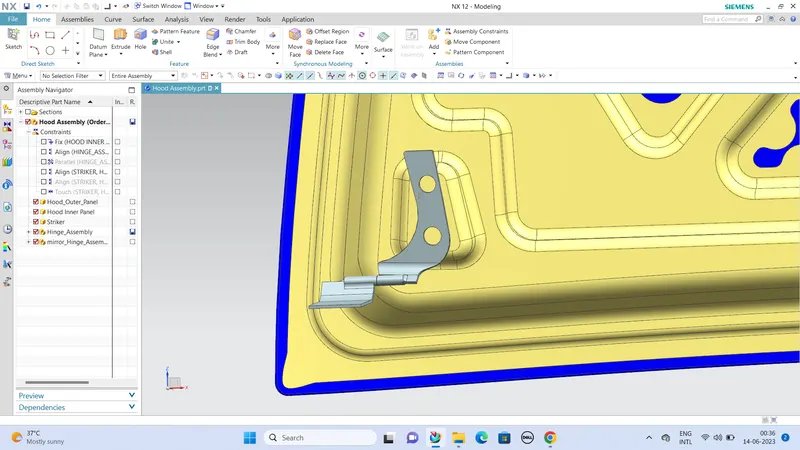
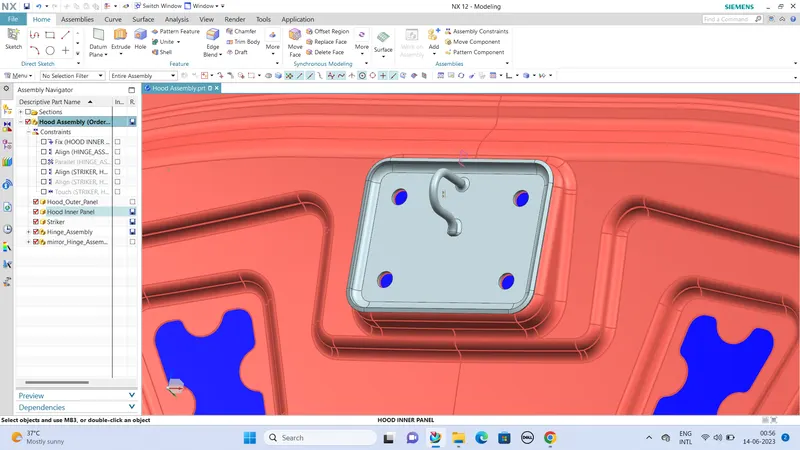
- a vehicale hood latch and release mechanism are latched when the hood striker engages the latch portion of the mechanism as the hood is moved to its closed position.
- The mechanism is actuated to release the hood striker by pushing action on the cable.
- When the latching mode of the hood latching and releasing mechanism latches the hood striker holds the hood closed.
REINFORCEMENTS:-
- The striker reinforcements material that can enhance strength and rigidity in the vicinity of the striker and secure pedestrian protection performance.
- The reinforcement is included for the less thickness of material where the deformation occurs at the time of the collision to protect pedestrians.
LATCH TRAJECTORY MOTION:-
-
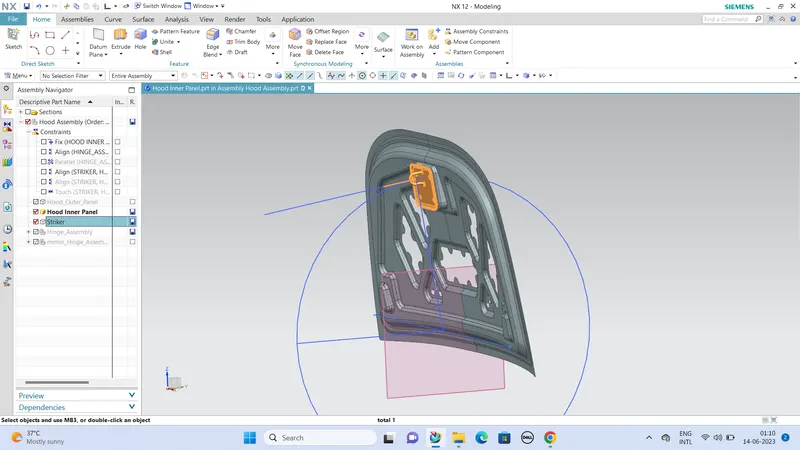
The significance of the trajectory concept is open and close the hood along the curved path to its motion concerning gravity.
-
The circle is sketched at the center section of the hood using the datum plane and theline is drawn tangent to the circle.
-
A perpendicular line is drawn at the centerof the striker using the datum plane.
-
By using the align constraint, coincident the tangent line and perpendicular line of striker.
MASTIC DATA:-
- The mastic sealants are in the form of paste.
- The mastic sealants either join one surface to another or adheres to nearly any material.
- The mastic sealants are applied in between the outer panel and inner panel to join with each other.
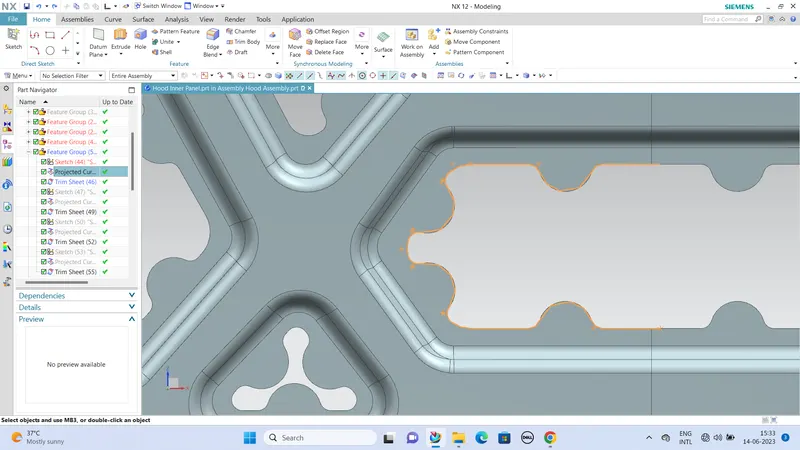
- The mastic data are applied on the hood and it solidified fills the gap of 5mm between the outer panel and inner panel.
- Hood commonly possess large surface area and hemming can only be provided through its boundary.
- Mastic sealants are elastic compound that behave like rubber.
- It is applied between the inner and outer panels at specified spots.
- Each spot of mastic sealants has its effect around a circular region from 50-80mm diameter.
- Thus, the mastic points are arranged in such a way that it covers the areas away from the hemming which are more vulnerable to vibrate.
EMBOSS:-
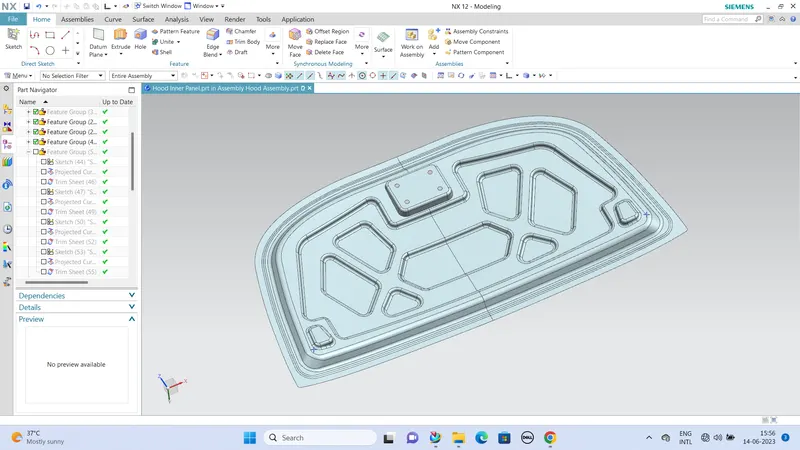
- This command enables modifying the sheet body by adding faces of a solidbody.
- The target sheet body intersects with tool bodies when pressed.
- The shape of the tool bodies is to be transferred onto the sheet body.
- It increased the metal panels and stiffness and rigidity.
- Increase the surface area for heat transfer or acoustic applications and improve the traction.
HEMMING PROCESS:-
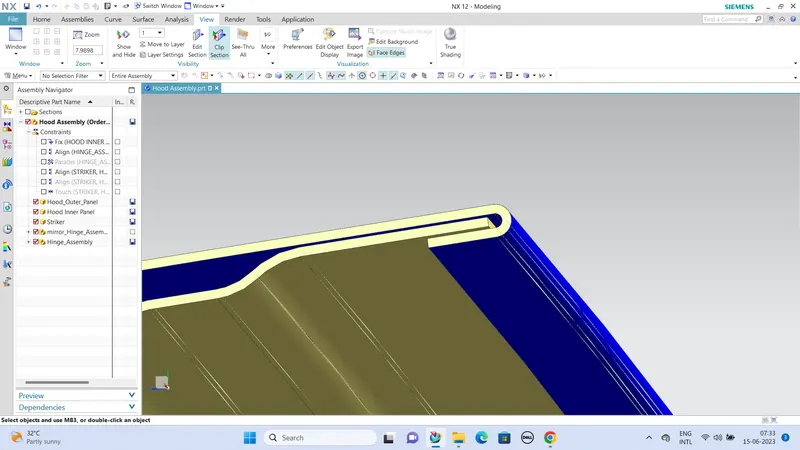
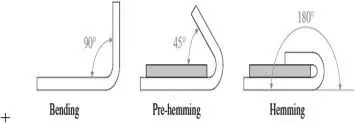
- Hemming is a technology used to join inner and outer closure panels together.
- It is the process of bending/folding the flange of the outer panel over the inner panel.
- Hemming is performed to achieve a better final geometry in the vehicle part. • Allow safe handling of the part.
- Add resistance and rigidity to the part.
- We are using the roller hemming operation for the hood to get the desired final shape of the product of the sheet.
CONCLUSION:-
Designed and modeled the hood panel using Siemens NX CAD as per the design parameters.
FINAL ASSEMBLY:-