Hood design-Week 2
Design and development of Hood and its respective components
Introduction
The hood (American English) or bonnet (Commonwealth English) is the hinged cover over the engine of motor vehicles. Hoods can open to allow access to the engine compartment, or trunk (boot in Commonwealth English) on rear-engine and some mid-engine vehicles) for maintenance and repair.
Design of Hood outer panel, inner panel, and the necessary reinforcements by following the given Master section and with the design parameters.
Methodology:
Creating Hood Inner Panel.
Creating Hood Outer Panel.
Creating Embossment for Hinge.
Creating Embossment for Striker.
Creating Reinforcements.
Assembling the components.
Performing Draft Analysis on CAD Model.
Major Parts of Hood.
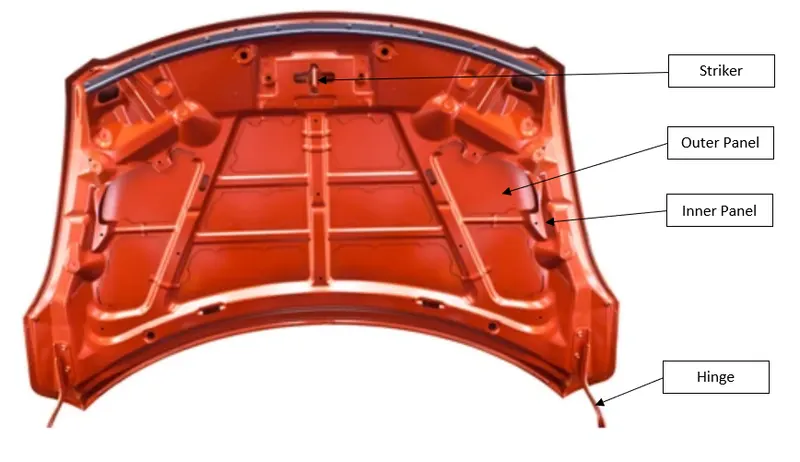
Design Parameters
Head Clearance
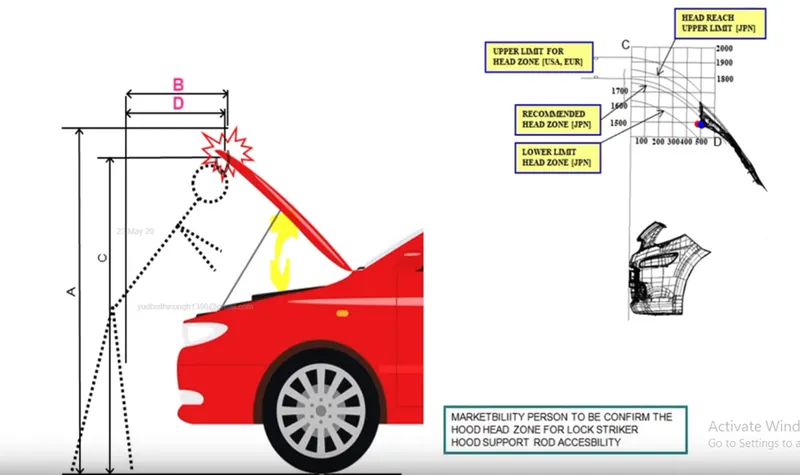
Head clearance is decided upon the zone or country. So same car if it is made for a different country will have different opening angles depending on the country or region.
The distance C and D shown in the image is represented as a graph in the upper right corner of the image. Choosing the right head zone position will decide upon the angle of the hood opening.
Product engineers will also get input from the marketing team for deciding the head zone.
Hood Stay
A hood stay is a part of car, which can safely keep an engine hood in an open state even if an external force is abruptly generated due to vibration, wind, and can felicitate an opening/closing operation of the engine hood.
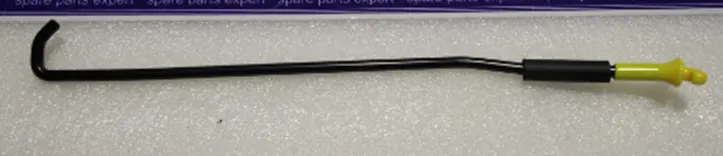
Support Rod
Support rod is mounted with grommet side on the engine compartment of body and rod locking hole on the hood or vice versa.
The shape of the rod is not made uniform, because to reduce the force acting on the rod should be less.
Gas Stay
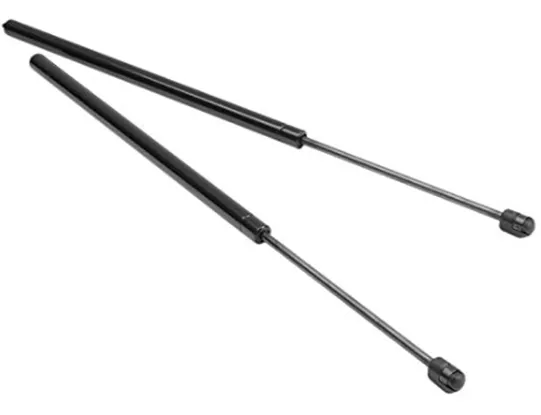
Gas stay will assist in opening and closing of the hood in position.
Gas stay is used in high performance car, in such cars bonnet length and its weight will be more.
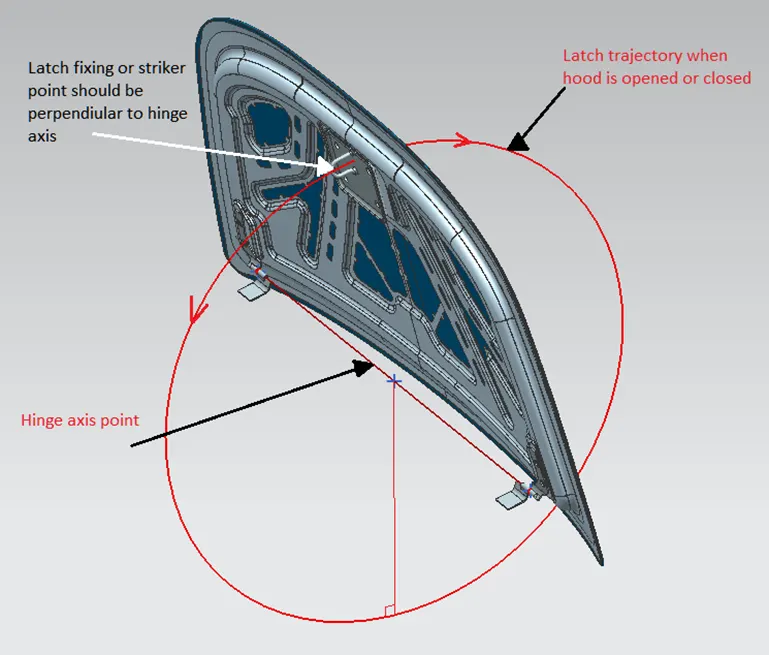
Latch Trajectory
The latch trajectory is the path which the striker will follow when the hood is open/closed while pivoting on the hinge axis. The latch trajectory is taken as a circle with the hinge axis as the center of the circle. The striker is placed 90 degree such that it is tangent to the circle.
Mastic Joint
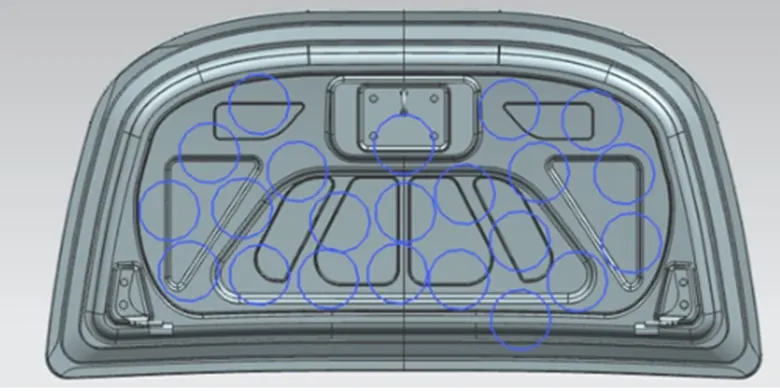
Mastic joint is an adhesive part used to joint the inner panel and outer panel of the hood, it is placed at the specified location.
As per standard the mastic area should be 80mm in dia.
Input Data for design:
Hood Thickness Information
- Outer panel thickness = 0.75mm
- Inner panel Thickness =0.75mm
- Reinforcement Thickness =1.5mm
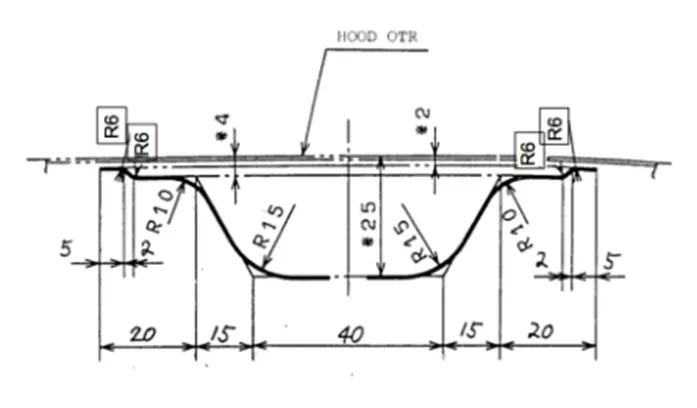
Master Section
NVH
Noise, vibration and harshness
Noise, vibration and harshness, also known as noise and vibration, abbreviated to NVH and N&V respectively, is the name given to the field of measuring and modifying the noise and vibration characteristics of vehicles, particularly cars and trucks.
The car is also specified on NVH value, lesser the value rating is more.
To reduce the NVH value, fallowing parameters are taken care and keep on improving it.
*Thickness of the panel sheet should be less.
*Embosses are made on the inner panel.
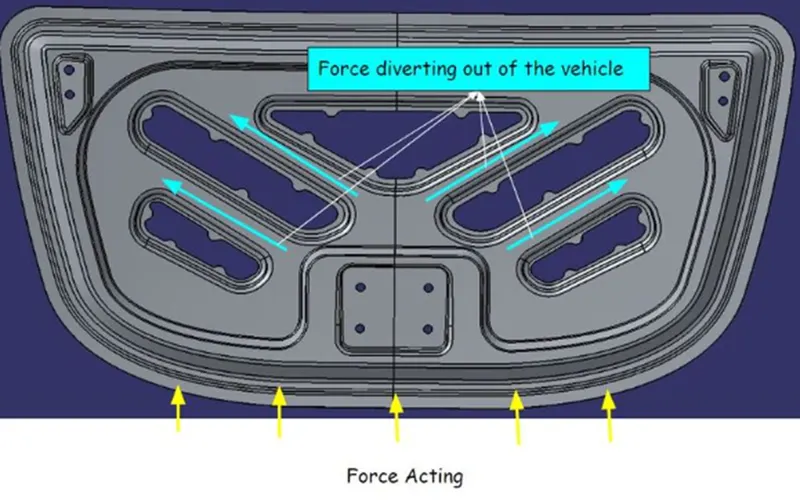
While driving the car force acting on the hood results damage, to reduce it embosses are made to divert the force direction.
*To assemble the inner and outer panel, hemming, gluing is used instead of spot welding, which doesn’t damage the look of car.
Hood for better pedestrian rating
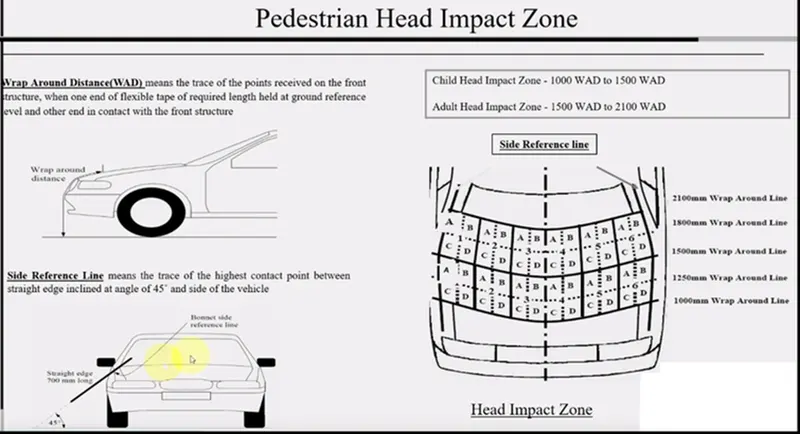
Inlaid Hood: The line which is drawn 45 deg. from the ground to the Side Reference of the car and which is a meeting point on the fender is called Inlaid Hood.
Wrap Around Hood: The line which is drawn 45 deg. from the ground to the front surface of the Hood and which is the meeting point on the outer panel is called Inlaid Hood.
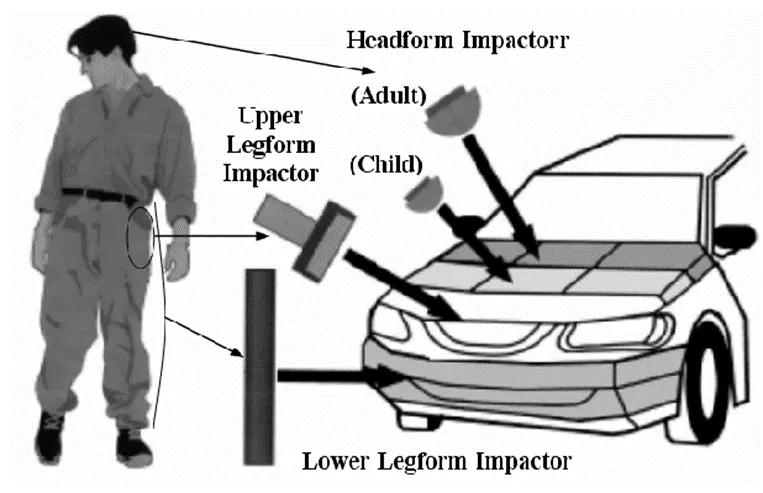
Depending on the Inlaid Hood & Wrap Around Hood, we can design a hood for head impact in the fig shown position of the head impactor.
Manufacturing Process
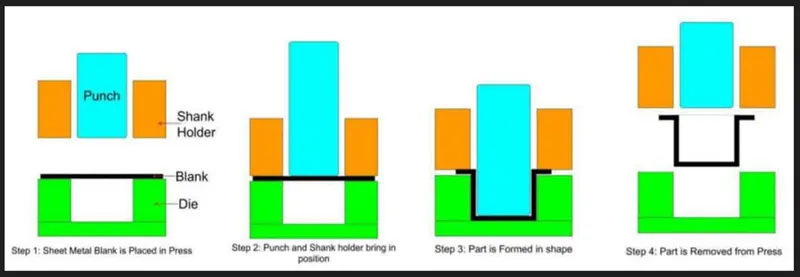
Deep Drawing:
It is a sheet metal forming process in which a sheet metal blank is radially drawn into a forming die by the mechanical action of a punch. The process is considered deep drawing when the depth of the drawn part exceeds its diameter.
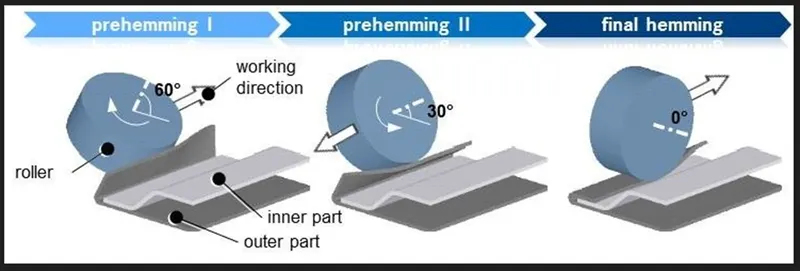
Hemming:
Hemming is a forming operation in which the edges of the sheet are folded over other part or simply folded in order to achieve a tight fit. In car part production, hemming is used in assembly as a secondary operation after deep drawing, trimming and flanging operations to join two sheet metal parts (outer and inner) together.
Embossing:
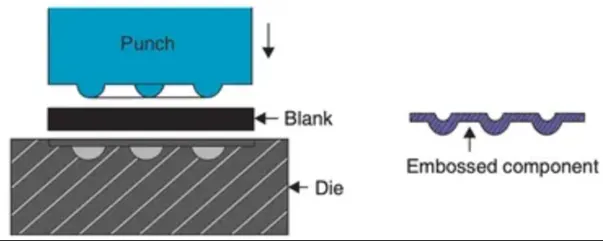
Sheet metal embossing is a stamping process for producing raised or sunken designs or relief in sheet metal. This process is carried out by means of matched male and female roller dies, or by passing the sheet or rolls of metal between rolls of desired pattern.