Hood design-Week 2
HOOD DESIGNING
Here we are going to understand the designing of the Hood and its required components with its manufacturing process in the manufacturing industry in detailed.
INTRODUCTION:
The Hood or the Bonnet of a car is considered as the Frontal BIW enclosure component. Bonnets are designed to reduce air resistance as the air flows around the car. It is used to decorate the car and add the luxurious look. The shape of the bonnet is made aerodynamic in order to minimize the air effect.

Hoods are typically made of the same material as the rest of the body work. This may include steel, aluminum, fiberglass or carbon fiber. Some aftermarket companies produce replacements for steel hoods in fiberglass or carbon fiber to reduce vehicle weight.
Importance of HOOD:-
Cover all engine parts and radiators. Reduce the air effect due to design aerodynamic shape. Provide access to the engine for repair and maintenance. Reduces engine noise, providing you with a quieter drive.
Design consideration of HOOD:-
1. Head striker zone
2. Wrap around distance
3. Pedestrian Safety
4. Mastic Data
Head Striker Zone:
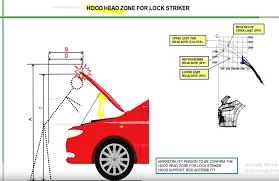
This is the most important point for considering the head striker zone while designing the hood of the car and also it comes under the safety measures of the buyers. So when we creating the hood design we must know the average height of the person in the respective country, because the average height may vary. While working in the front-engine compartment when the hood is in the open condition, it does not collide with his head.
Follow the below mentioned datas for designing the hood,
Wrap around distance:
The shortest line of the lines that connects the reference plane with any point on the vehicle, which passes through the vehicle's front and front's upper-surface within the vertical plane that includes the vehicle's fore-aft axis.
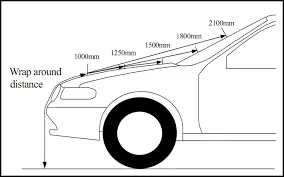
It means the geometric trace described on the outer surface of the vehicle front structure by one end of a flexible tape, when it is held in a vertical longitudinal plane of the vehicle and traversed across the front structure. The tape is held taut throughout the operation with one end held at the same level as the ground reference plane, vertically below the front face of the bumper and the other end held in contact with the front structure. This procedure shall be followed, using alternative tapes of appropriate lengths, to decribe wrap around distances of 1000mm (WAD1000) of 1800 mm (WAD1800) and of 2100mm (WAD2100)
Pedestrian Safety:
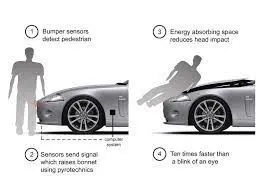
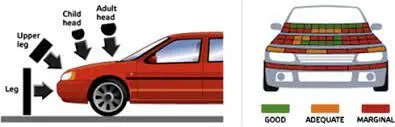
Many pedestrian crashes involve a forward moving car as opposed to buses and other vehicles with a vertical hood/bonnet. In such a crash, a standing or walking pedestrian is struck and accelerated to the speed of the car and then continues forward as the car brakes to a halt. The pedestrian is impacted twice, first by the car and then by the ground, but most of the fatal injuries occur due to interaction with the car. Vehicle designers usually focus on understanding the car-pedestrian interaction.
Mastic Data:
For your ductwork, you must use duct mastic. This is a gooey material that seals joints once gaps have been reinforced with sheet-metal screws and fiberglass mesh tape.
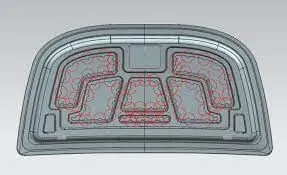
It creates a strong, flexible and waterproof seal, making it ideal for sealing gaps and joints in places where it will need to resist some movement, such a shower screen or a window frame. Because exterior mastic sealant is weatherproof, it is also perfect for outdoor projects.
Hood input data:
- Thickness of outer panel: 0.75mm
- Thickness of inner panel: 0.75mm
- Reinforcement thickness: 1.5mm
This thickness is to be followed throughout the hood design
Master section:
This data is used for the design of our hood inner panel it gives all the information about the standard dimensions to be followed for the inner panel also information about radius values, maximum height of the hood inner panel from the top.
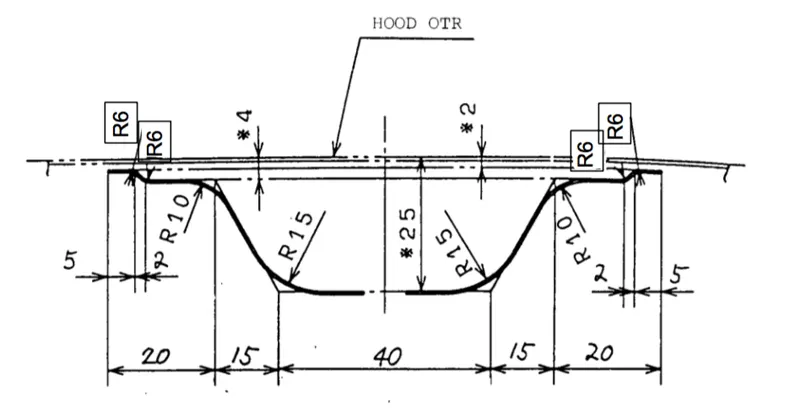
From the given master section data, the hood design to be designed as,
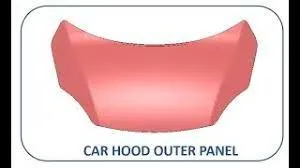
OUTER PANEL
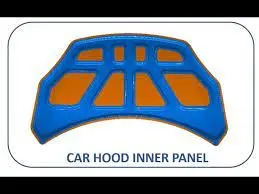
INNER PANEL
Manufacturing process of hood:
1.DEEP DRAWING:
The deep drawing process is a forming process which occurs under a combination of tensile and compressive conditions. A flat sheet metal blank is formed into a hollow body open on one side or a hollow body is formed into a hollow body with a smaller cross-section.
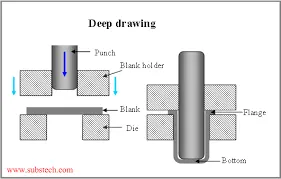
The term deep drawing refers specifically to the depth of the item that is created, which is equal to or greater than its diameter. The deep drawing process involves a single metal blank and forming it into a 3D round, square, or rectangular shape called a case or enclosure.
2.HEMMING PROCESS:
Hemming is a technology used in the automotive industry to join inner and outer closure panels together (hoods, doors, tailgates, etc.). It is the process of bending/folding the flange of the outer panel over the inner one. The accuracy of the operation significantly affects the appearance of the cars outer surfaces and is therefore a critical factor in the final quality of a finished vehicle.
Press hemming
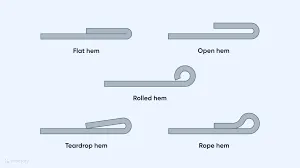
Hemming presses are widely used in automotive manufacturing for hemming of sheet-metal body components. The process uses traditional hydraulically operated ‘stamping presses’ to hem closure parts, and, being the last forming process in stamping, it largely determines the external quality of such automotive parts as doors, hood and trunk lid.
Hemming press features and benefits
- Die storage systems
- Fully automatic die-changing systems with parameters that change with each die
- Pressing capacity typically 60 to 180 tons
- Large panel-size capacity
- More than one part can be produced on same line
- Electric hemmers do not need hydraulic oil, are quiet and eco-friendly
Hemming press limitations
- Restricted to flat, uncomplicated panel profiles
- High cost
Table top hemming
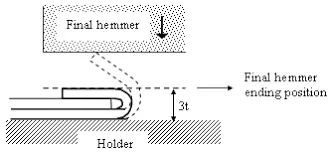
Tabletop hemming machines are utilised for the manufacture of medium to high production volumes, with the ability to achieve cycle times as low as 15 seconds.
Table top features and benefits
- Optimum panel quality guaranteed through the hemming principle of the closed ring
Table top limitations
- Dedicated to one panel
- Relatively high cost
- Cost lower than press hem, but higher than robot roller hem
Robot (roller hemming)
Robot hemming is utilized for the manufacture of Low to medium production volumes. It uses a standard industrial robot integrated with a roller hemming head to provide a flexible method for forming closures. The flange of the outer panel is bent over the inner panel in progressive steps, by means of a roller-hemming head.
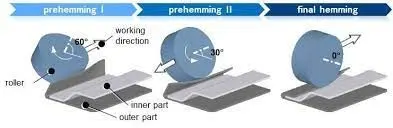
One advantage of this process is that it can use the robot-controlled hemming head to hem several different components within a single cell. Another is that minor changes or fluctuations in panel-hemming conditions can be quickly and cost-effectively accommodated. If equipped with a tool-changing system, the robot could serve a variety of additional functions within the same assembly cell, such as operating dispensing equipment for adhesives and sealants, or carrying out panel manipulations, using a gripper unit.
Robot hemming features and benefits
- The ideal solution for all volume production demands, via multiple robots and split operations
- Overall quality better than press or tabletop with MBE hemming technologies implemented
- Flexibility:
- Robot can hem various panel shapes that press and tabletop can't achieve due to flange attack angles and physical accessibility
- Can perform panel shape changes via quick program changes, while saving the original programs for future recall
- Can perform other tasks by changing the hemming tool with another tool such as a dispensing nozzle
- Low cost, simple and quiet in operation when used with standard industrial robot
- Reduced mechanical effort for tryout
METHODOLOGY OF HOOD DESIGN:-
1. Creating Hood inner panel
2. Creating Hood outer panel
3. Creating embossment for Latch
4. Creating embossment for Hinge
5. Creating the reinforcements
6. Assembling the components
7. Performing Draft Analysis on CAD model.
HOOD OUTER PANEL:
A car hood panel is one of the most important components of the BIW (body in white), it is considered as the closure sheet-metal component. A hood panel consists of two panels that are hemmed together to form the automotive hood assembly.
In general, the hood panel is installed in the front of the vehicle so as to protect parts in the engine compartment and the engine compartment and at the same time open and close the hood panel for replacement and repair of components in the engine compartment.
HOOD INNER PANEL:
A kind of automobile hood inner panel being provided with multiple strengthening rib extended along overall width direction in order to energy absorption when improving collision is recorded in patent documentation.
LATCH:
Latch used to catch that holds the hood of a car shut, In simple words a fastener that fastens or locks a door or hood
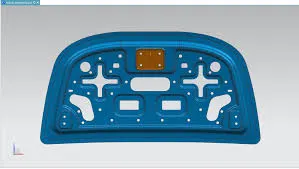
Hood latches are mechanical latching systems for hoods. Most vehicles, of course, have a hood. Hoods are square- or rectangular-shaped panels that lie flat across the front-end of a vehicle. They are designed to cover equipment like the vehicle’s motor, transmission, radiator, alternator, battery and other components. If you need to access any of these components, though, you’ll have to open the hood.
LATCH TRAJECTORY:
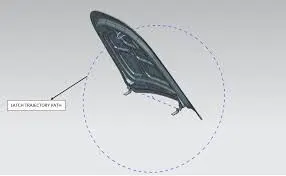
The latch trajectory is the path which the striker will follow when the hood is open/closed while pivoting on the hinge axis. The latch trajectory is taken as a circle with the hinge axis as the center of the circle. The striker is placed 90 degree such that it is tangent to the circle.
HINGE:
A hood hinge mechanism having a pivot pin having a D-shaped cross sectional shape positioned within a recess. The hood and pin are pivotal to a position whereat the D-shaped cross section is oriented to pass through a slotted opening to the recess to thereby allow the hood to be removed or installed on the vehicle.
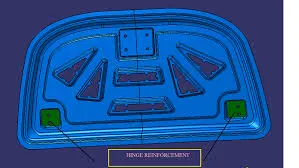
Hinges is the assembly of components connected to the door and body of the vehicle, linked to each other and capable of rotating around the same axis. Conventional system consists of two hinges for each door, an upper hinge and a lower hinge.
EMBOSSING:
Embossing is a metal stamping process for producing raised or sunken designs or reliefs by passing metal sheet or strip between rolls of the desired pattern. The process enables repeated production without variation and does not change the metal's wall thicknesses.
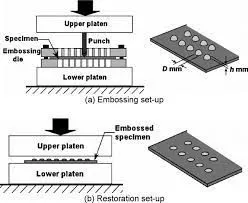
In sheet metal forming, the embossing technique can be used to strengthen sheet metal materials and to improve their properties.
Hood Movement:-
The movement of a Hood can be controlled in two ways,
1. Gas rod
2. Supporting rod
1.Gas Rod:
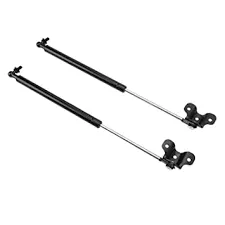
Gas rod are also known as gas springs or gas stays, provide support for lifting, positioning, lowering and counterbalancing weights in a safe manner. Stabilus gas struts work by forcing, under pressure, gas into a cylinder. Also note that the name gas strut can be applied to a group of different products.
Function of GAS Rod:
The basic principle of a gas spring is the same as for a mechanical coil spring; it is a device for storing energy. However, rather than straining the material that makes up the coil spring, a gas spring stores energy by compressing the Nitrogen gas contained inside.
Life of a GAS Rod:
The test is carried out using a hydraulic machine that goes back and forth in one direction. This test is suitable for gas struts' shut and open function. In this test, we are seeing if the gas strut can operate up to 40,000 cycles, or 10 years average of usage. This is an average lifespan of gas struts.
SUPPORTING ROD:
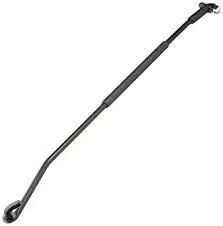
The hood struts act as a prop rod to hold the hood up when fully extended. Initial bends are been provided to the support rod to provide stiffness. Support rod is basically long cylindrical rod. It safely keep an engine hood in an open state even if external forces are abruptly generated due to vibration & wind.
CONCLUSION:
From the above we understood the process behind the car hood designing and manufacturing. And also successfully completed the manufacturing process like hemming, deep drawing.