Hood design-Week 2
AIM: Design Hood Outer Panel, Inner Panel and the necessary reinforcements by following the Master Section mentioned with the Design parameters explained in the videos.
What is Hood in a Car?
The hood or bonnet is the hinged cover over the engine of vehicle. Hoods can open to allow access to the engine compartment, or trunk on rear-engine and some mid-engine vehicles) for maintenance and repair.
In British terminology, hood refers to a fabric cover over the passenger compartment of the car (known as the 'roof' or 'top' in the US). In many motor vehicles built in the 1930s and 1940s, the resemblance to an actual Hood is clear when open and viewed head-on; in modern vehicles it continues to serve the same purpose but no longer resembles a head covering.
Rules and regulation standards for designing the hood:
- A perfect hood design means it should have a great impact distribution angled outside the car.
- In Japan and Europe, regulations have come into effect that places a limit on the severity of pedestrian head injury when struck by a motor vehicle. This is leading to more advanced hood designs, as evidenced by multicore hood inner panel designs.
- European Enhanced Vehicle-Safety Committee (EEVC), European New Car Assessment Program (euro NCAP)
Pedestrian -Vehicle Collision
- India, however, ranks 1 in the number of road accident deaths across the 199 countries reported in the World Road Statistics, 2018 followed by China and the US. As per the WHO Global Report on Road Safety 2018, India accounts for almost 11% of the accident-related deaths in the World.
- Road transport remains the most favored mode of transport for both freight and passenger movement in India. The fast-growing population, exceptional rate of motorization coupled with the ever-growing urbanization has made people vulnerable to frequent road accidents resulting in fatalities, injuries/disabilities.
- the sequence of injuries and events in a pedestrian collision images are mentioned below.
According to the traffic accident data, it is well known that pedestrian fatal accident is caused by head injury (See
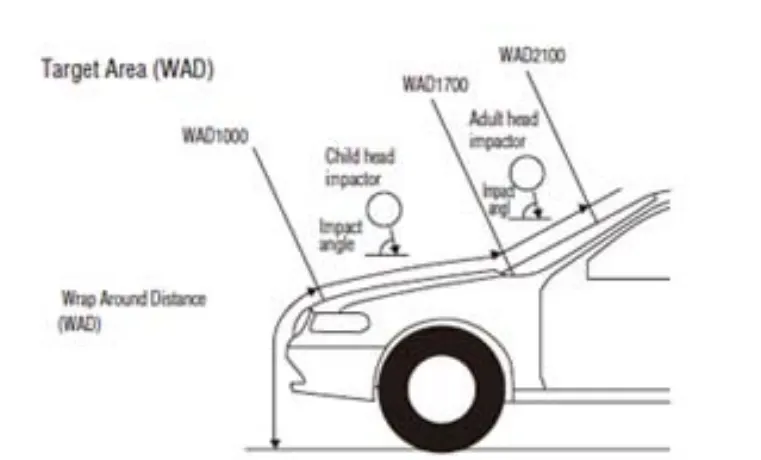
Figure 1). Based on this accident data, the third-party assessment organization define WAD (Wrap Around
Distance) and validate pedestrian protection performance using a head impactor (See Figure 2). Because mostly test
area is on the bonnet hood, it is important to design hood construction to improve head protection performance. As
the hood construction depends on styling, it is one of the difficult parts to divert the structure developed in the past.
Therefore, it takes a long time to design so that the structure can satisfy the pedestrian safety and other performance.
In order to solve this issue, the authors studied the method to design efficiently using optimization techniques in past
study [1]. However, the conventional method is required to define the design variables when the styling is changed.
For that reason, we could not establish the design method such as to investigate the structure in a short time by using
the response surface like.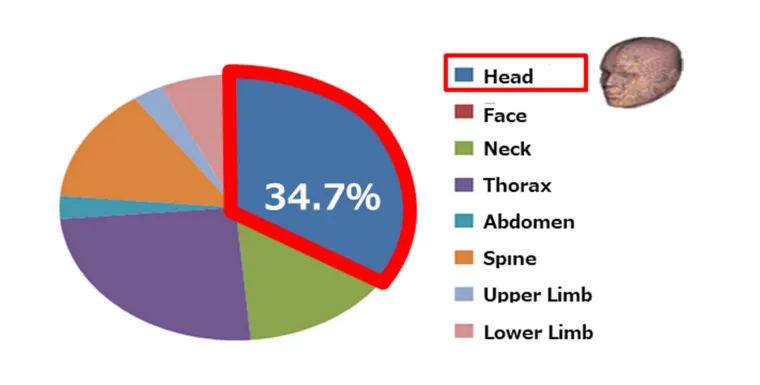
Design parameters:
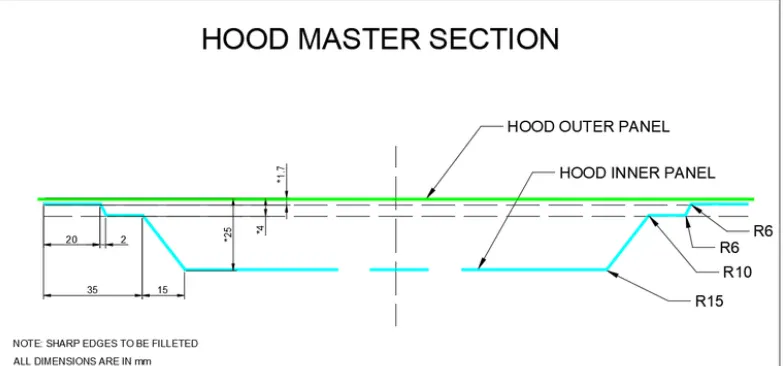
Hood Thickness Information
- Outer Panel Thickness = 0.75mm
- Inner Panel Thickness = 0.75mm
- Reinforcement Thickness = 1.5m
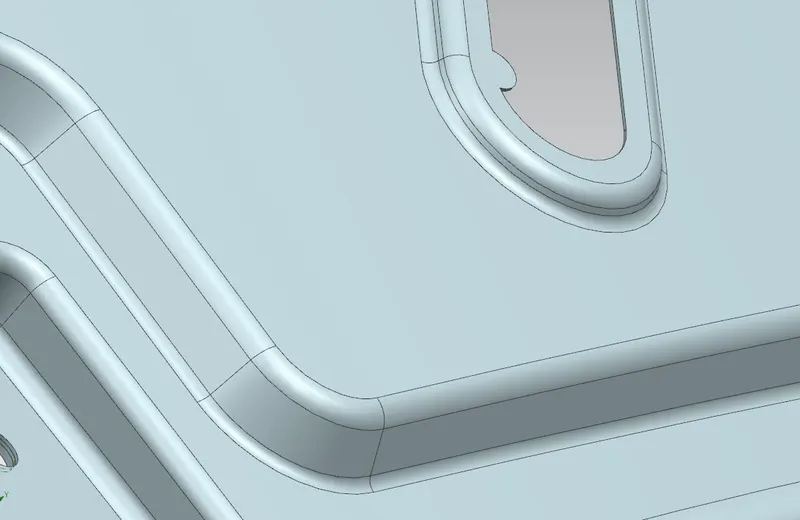
Embossing in sheet metals:
- The metal sheet embossing operation is commonly accomplished with a combination of heat and pressure on the sheet metal, depending on what type of embossing is required. Theoretically, with any of these procedures, the metal thickness is changed in its composition.
- A metal sheet is drawn through the male and female roller dies, producing a pattern or design on the metal sheet. Depending on the roller dies used, different patterns can be produced on the metal sheet. The pressure and a combination of heat actually "irons" while raising the level of the image higher than the substrate to make it smooth. The term "impressing" refers to an image lowered into the surface of a material, in distinction to an image raised out of the surface of a material.
Hemming in sheet metals:
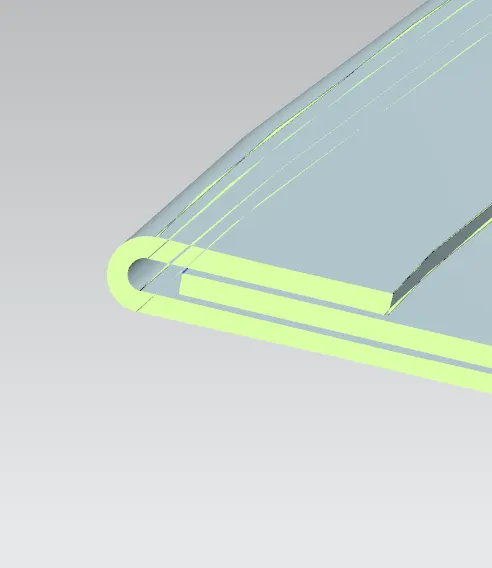
- Hemming is a sheet metal forming process in which sheets are joined by bending it usually to 180°. Automotive body panels and automotive parts such as deck-lids, trunk-lids, doors, hoods, and tailgates are formed by hemming processes.
-
Conventional die hemming is suitable for mass production. In die hemming, the flange is folded over the entire length with a hemming tool. Normally the actual hemming is a result of a forming operation in which the flange is formed with a hemming tool after the drawing and trimming operations have been completed
- Roll hemming is carried out incrementally with a hemming roller. An industrial robot guides the hemming roller and forms the flange. Roll hemming operation can also be divided into several pre-hemming and final hemming process steps.
- If weld or bolts were used to join the hood panels then the design and the aerodynamic features would get damaged so hemming is more significant to use.
Mastic data:
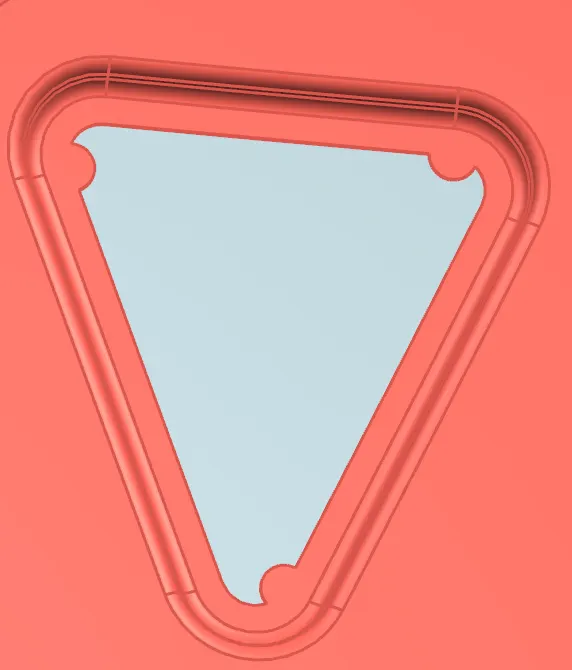
A mastic sealant data is used to fix or combine the hood outer panel and hood inner panel.
- They can provide thermal and acoustical insulation, and may serve as fire barriers. They may have electrical properties, as well. Sealants can also be used for simple smoothing or filling. They are often called upon to perform several of these functions at once.
- A sealant has three basic functions: It fills a gap between two or more substrates; it forms a barrier through the physical properties of the sealant itself and by adhesion to the substrate; and, it maintains sealing properties for the expected lifetime, service conditions, and environments. The sealant performs these functions by way of correct formulation to achieve specific application and performance properties.
Hood Componets
Latch and striker:
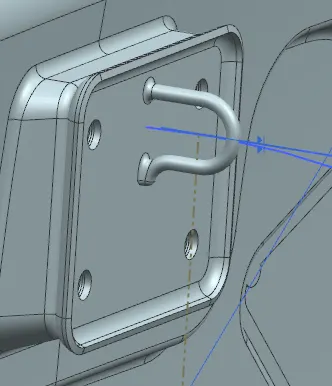
A hood latch is a very simple component. It's basically the fastener that keeps your hood closed shut. This latch ensures that your hood is securely connected to your vehicle and that it doesn't pop open unexpectedly
When tension is applied to the cable from the hood release handle, it pivots the secondary latch, which pulls away from a retaining seat located under the hood. By design, the secondary latch then releases the hood a few inches before a safety latch takes over.
Hinge:
Hinge is a component that fixes the hood to the fenders of the car. The latch must be fixed perpendicular to the hinge axis so that the hood opens or closes properly.
Latch trajectory motion:
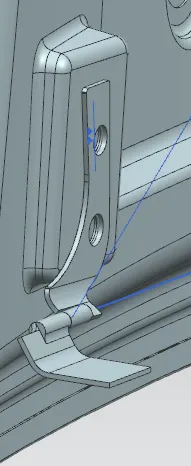
while opening or closing the hood, the latch must be perfectly aligned to the fixing or striker point. For that, the latches trajectory must be perpendicular to the hinge axis.
Draft Analysis:
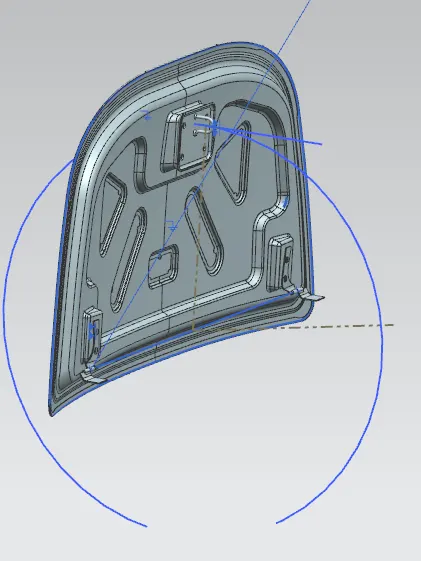
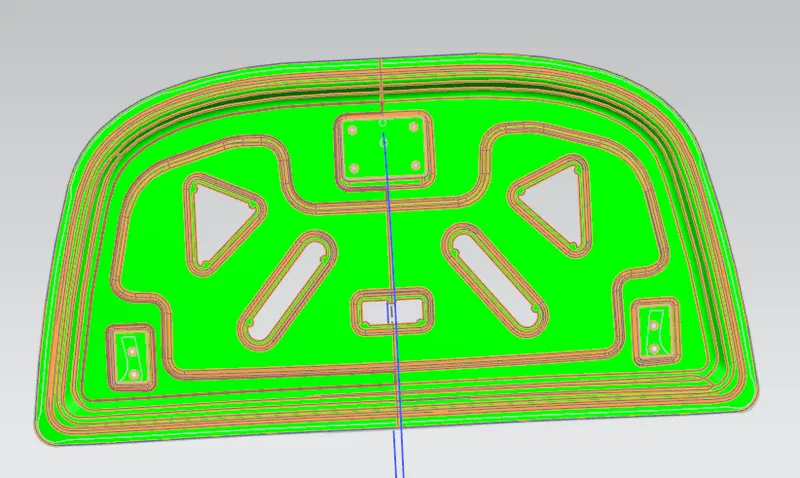
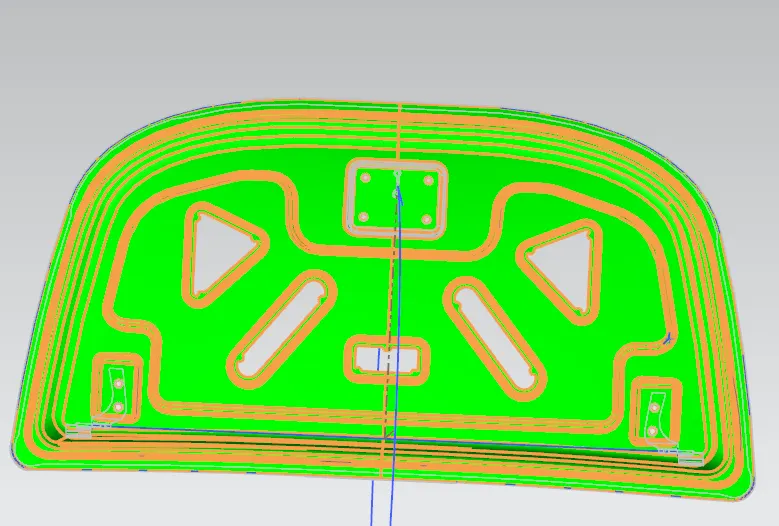
- 5 degrees of draft analysis is made to the inner panel to find any negative draft. this process is done because we need to develop and submit a positive design to the manufacturers.
- we can see that there are no negative drafts by the inner panel, hence the design is positive and ready to manufactured.
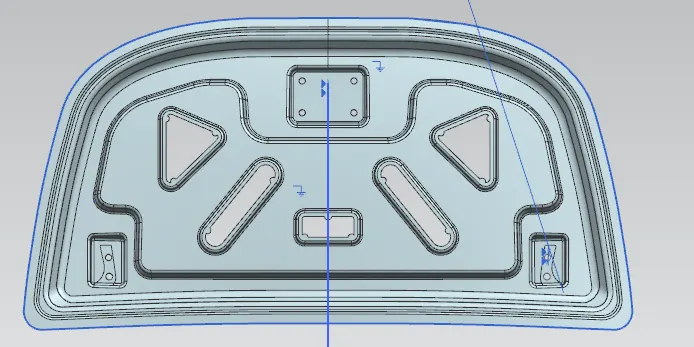
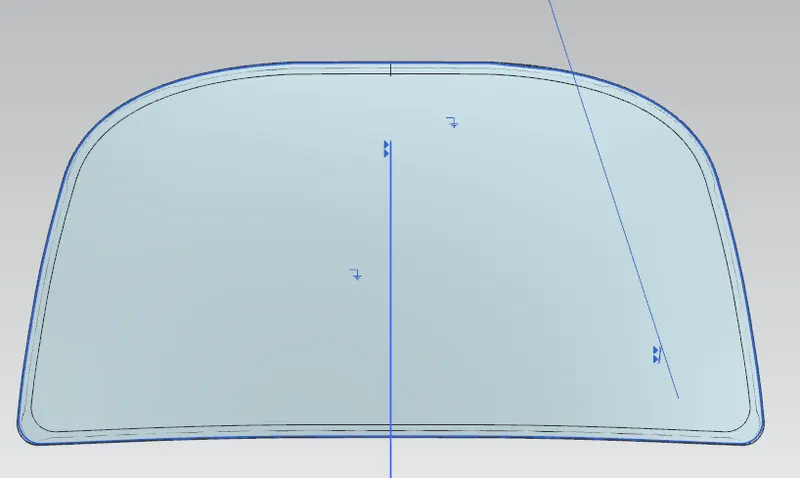
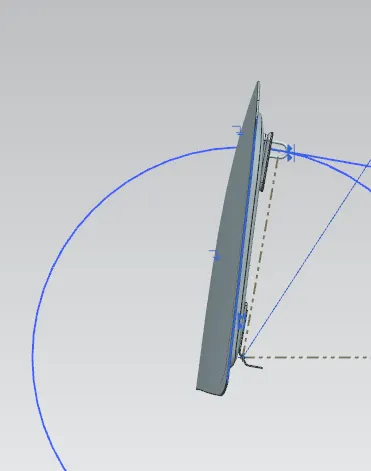
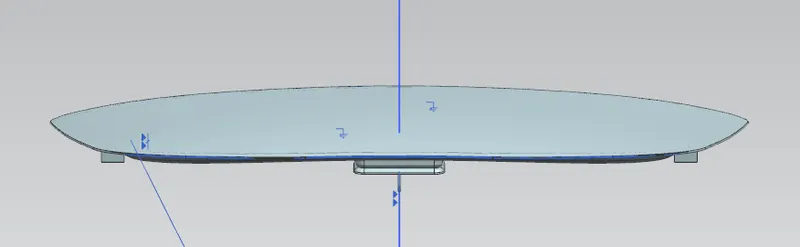
Deisgn of hood: