Hood design-Week 2
HOOD DESIGN
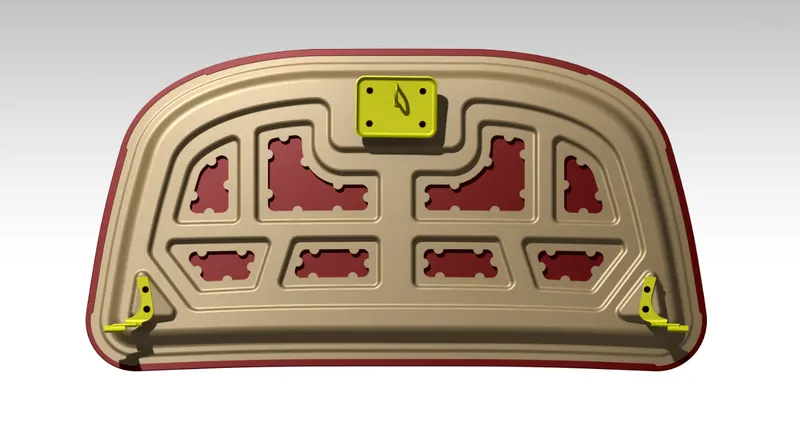
- In this Hood, Design provided the outer hood skin, master section, design criteria, design of the hood's outside panel, inner panel, and reinforcements.
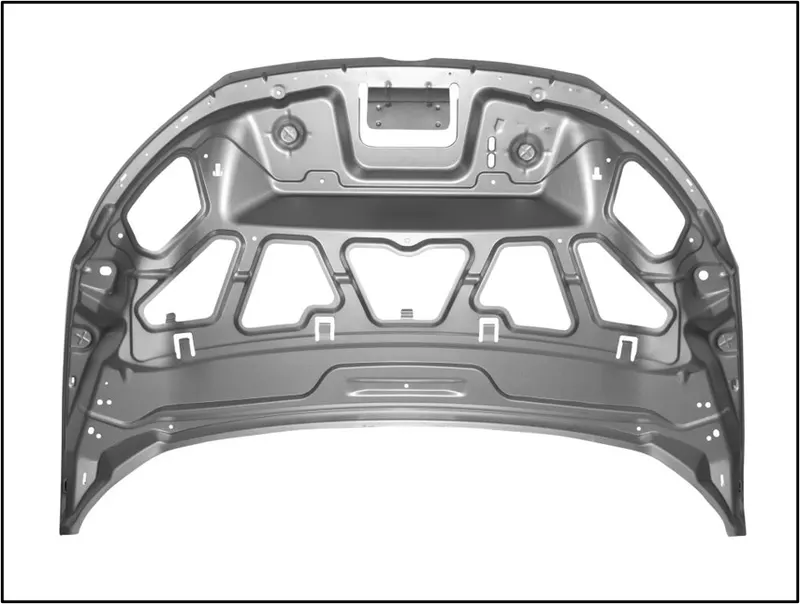
- A front-engine vehicle's engine bay is covered by a hinged hood, sometimes known as a "bonnet" in certain other nations.
- The car hood provides convenient access for repairs and maintenance while shielding the engine and other components from the outdoors.
-
Objective:
- Use the provided outer hood panel, master section, and design parameters to create the hood's an outside panel, inner panel, and reinforcements.
- In the Hood Design, all the criteria were taken into consideration along with a thorough explanation of the hood and its components, Latch Trajectory, Mastic Data, Emboss Definitions, and Manufacturing Processes like Deep-Drawing and Hemming, etc.
Introduction:
- The hinged cover above a car's engine is called the hood or bonnet. For maintenance and repairs, hoods can be opened to access the engine compartment (or trunk on vehicles with a rear engine and some with a mid-engine). From a design standpoint, the hood must satisfy a number of requirements, including those related to pedestrian safety, the hood head zone for the lock striker, force distribution in the event of a frontal accident (occupant safety), and manufacturability.
- Hood outer and inner panels, striker, hinge, and the hood stays make up a conventional hood assembly.
- A hood stay is a device that holds the open engine hood of a motorcycle in place.
- When the engine hood is opened, the engine room may be inspected, cooling water and engine oil can be refilled, parts can be changed, repairs can be made, etc.
Design Parameters:
1.) Hood Thickness Information
- Outer Panel Thickness = 0.75mm
- Inner Panel Thickness = 0.75mm
- Reinforcement Thickness = 1.5mm
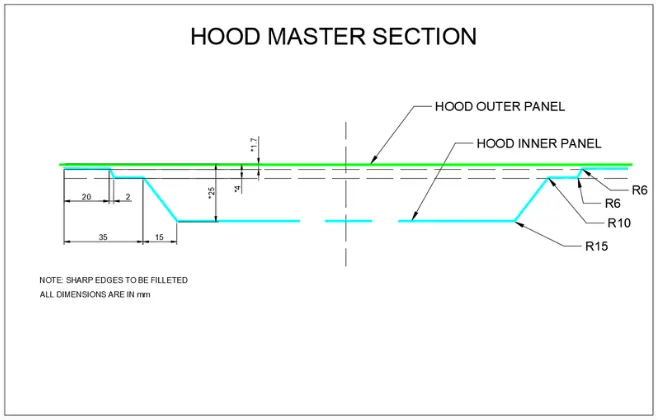
2.) Hood-Master_Sections:
Class.A_Hood:
Hood Outer Panel:
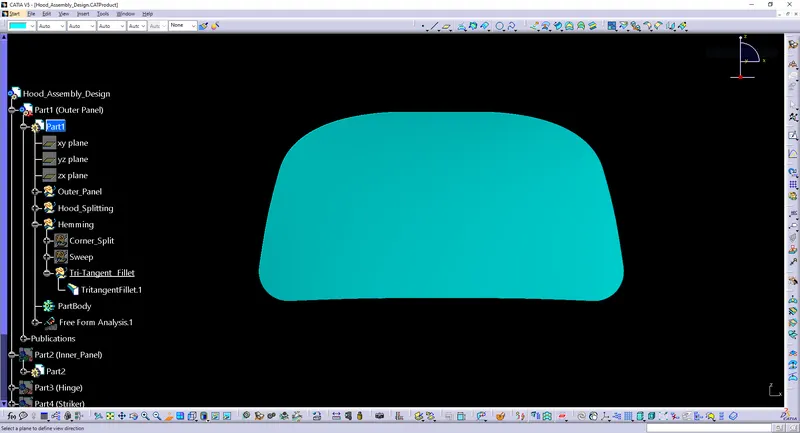
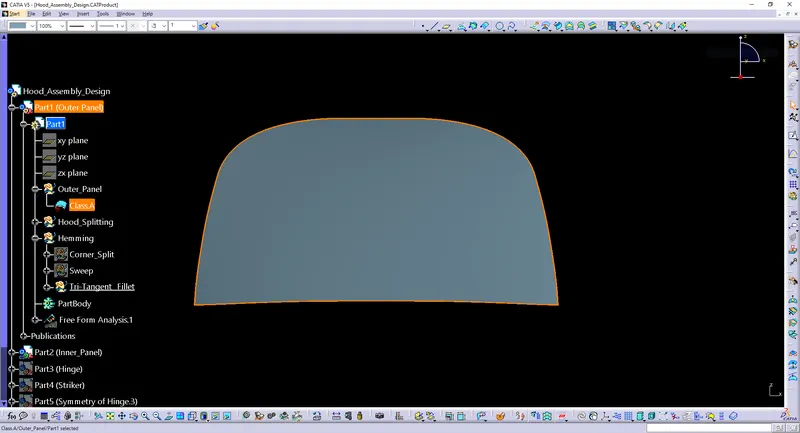
- The outside panel of a car is its decorative components. The skin for the outside panel is supplied by the styling team.
- The hood's size, position, and shape should all adhere to safety standards.
- Therefore, pedestrian safety should be given more consideration while constructing the hood. Hemming is used to joining the outer panel to the inner panel.
- Therefore, the requisite hemming flange and reliefs must be provided for the hemming operation. To lessen vibration, we also offer mastic sealants between the outer and interior panels.
Hood Inner Panel:
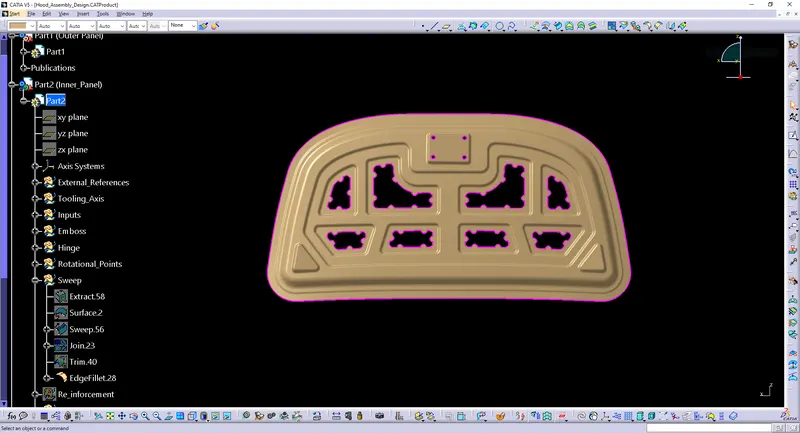
- The inner panel is what gives the outer panel strength and stiffness.
- The major portion of the hood supports the automobile's outer panel and, with the use of embossed shapes, distributes force during collisions so that the men inside the car are not hurt.
Reinforcement:
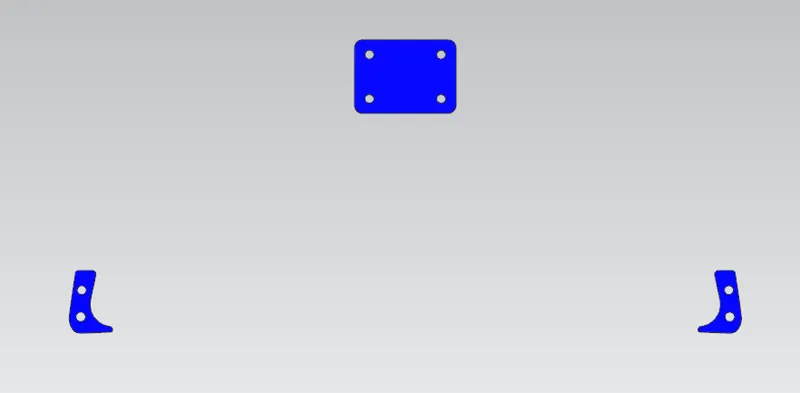
- According to the requirements of the design, reinforcements are offered.
- It is primarily offered at the hinge and latch locations to increase local strength.
- Reinforcements typically have a thickness that is more than that of the inner panels, and their value varies depending on cost and demand.
- The hinge and latch reinforcements are given a 1.5mm thickness here in accordance with the design specification.
Trajectory Method:
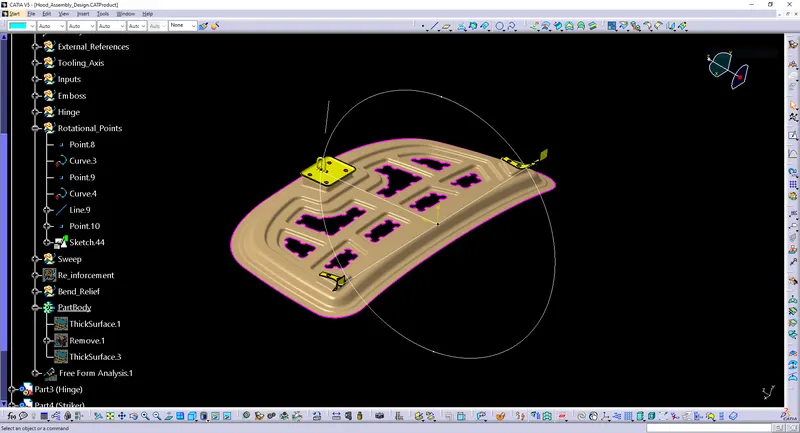
- The circle formed by the hinge axis point provides the latch trajectory.
- The center of the hinge axis is known as the hinge axis point.
- Either the Striker or the Hinge can be fixed first.
- If the hinge location has been fixed, the trajectory circle for the latch should be plotted.
- The striker axis through the tip of the striker should be tangential to the latch trajectory for optimum mating conditions.
Creation Of Emboss:
- The inside panel features a variety of embosses.
- These emboss enable us to increase the inner panel's rigidity.
- The size and shape of the emboss also affect how the force distribution from a frontal collision is distributed.
- Always distribute the force away from the passengers.
- The embosses in this illustration are constructed so that the force is applied to the car's flanks.
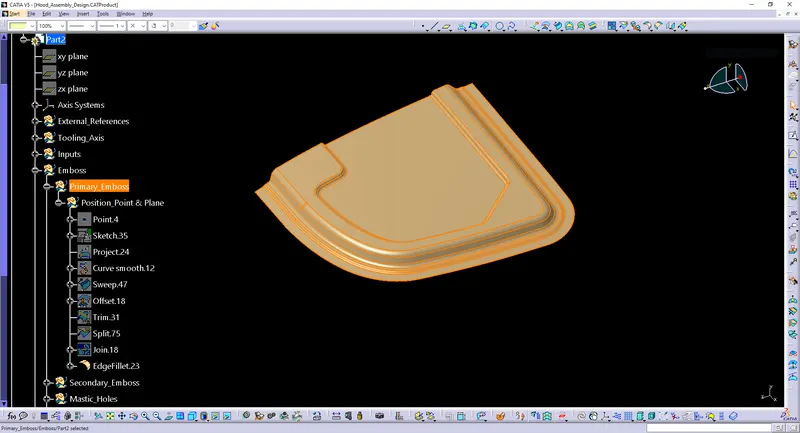
1.) Primary Emboss:
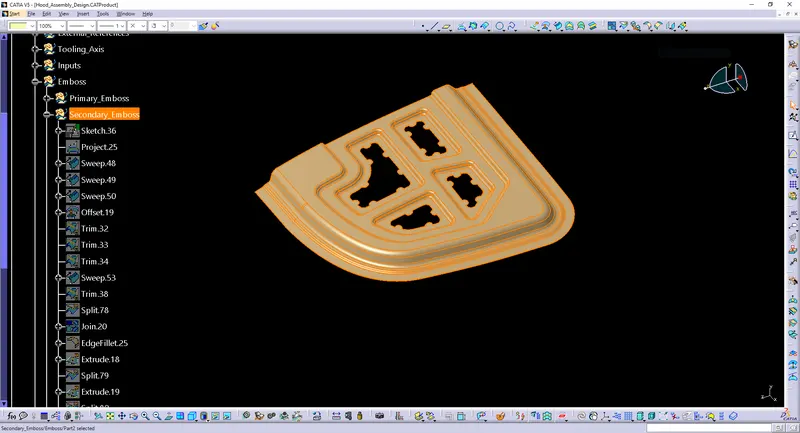
2.) Secondary Emboss:
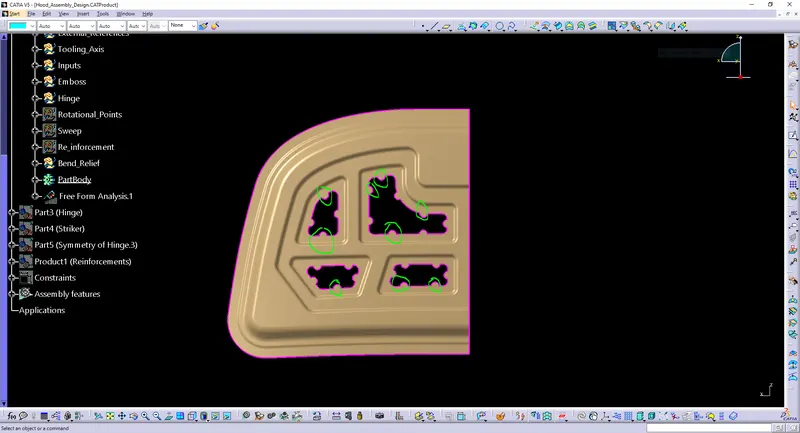
Mastic Data:
- Hoods frequently have enormous surfaces, and the only way to hem one of them is through the boundary other joining methods, like welding and riveting, produce traces on the outside panel that detracts from its visual appeal, thus we are unable to use them.
- Therefore, the inner surfaces of the outer panel and inner panel are adhered to using mastic sealants.
- Mastic sealants are rubber-like elastic compounds.
- At predetermined locations, it is applied between the inner and outer panels.
- Each mastic sealant area has a 60mm diameter sphere that it affects.
- As a result, the mastic points are positioned so that they cover the more vibration-sensitive parts away from the hemming.
Deep Drawing Process:
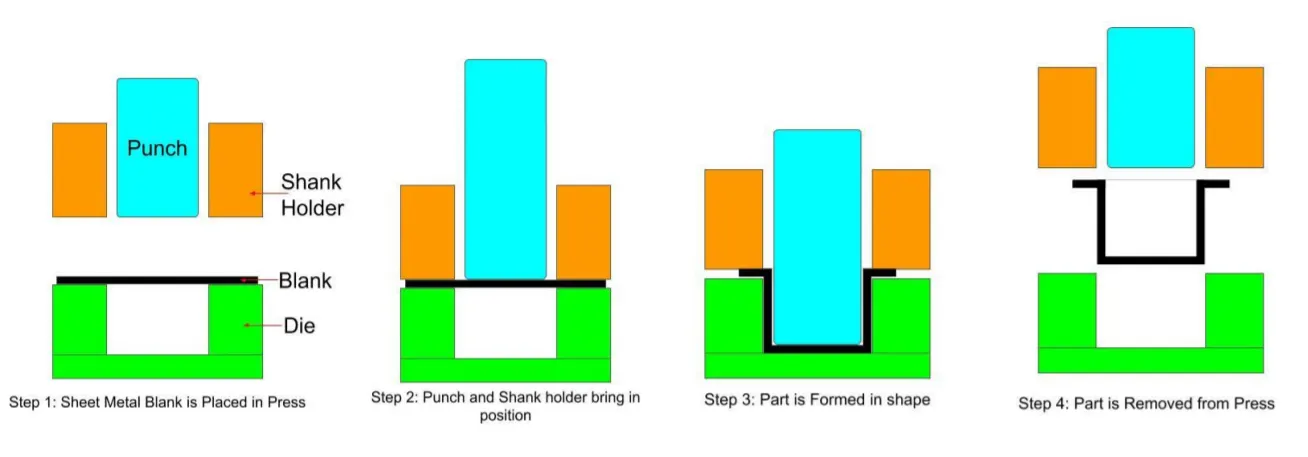
- One of the most used methods for sheet metal forging is deep drawing.
- In addition to being used in many other industries, it is also used in the production of auto body parts.
- The deep drawing process is a shaping procedure that takes place in a setting that combines compressive and tensile forces.
- The mechanical impact of a punch causes a sheet metal blank to be radially dragged into a forming die. Thus, it is a shape-change process that keeps the material.
- When the drawn part's depth is more than its diameter, the procedure is referred to as a "deep" drawing.
- This is accomplished by redrawing the component using a number of dies.
Hemming Data:
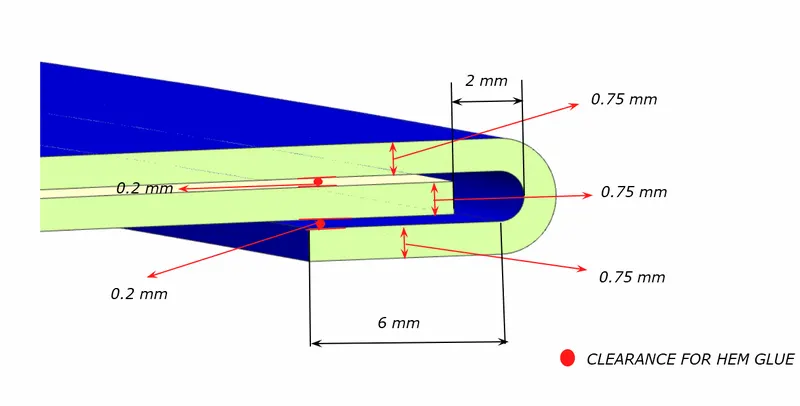
Hemming Process:
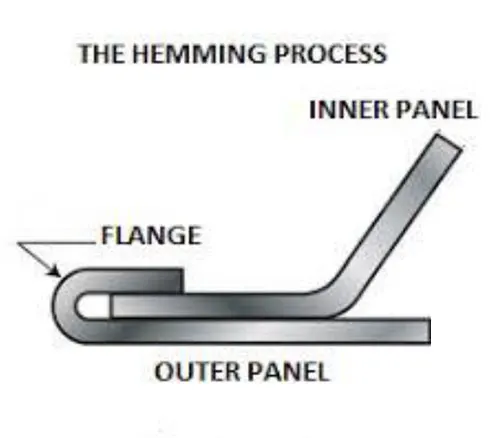
- In order to obtain a tight fit, the sheet's edges are folded or folded over another area during the hemming process.
- Hemming procedures are typically used to join components together, enhance a part's appearance, and reinforce part edges.
- Hemming is a secondary technique used in the assembly of automotive parts to link two sheet metal sections (the outer and inner) together after deep drawing, trimming, and flanging operations.
- In this kind of assembly, hoods, doors, trunk lids, and fenders are typical components.
- Since the hemming operation has an impact on the surface's look and surface quality, precision is crucial.
- During the hemming process, material deformations can result in dimensional variances.
Corner-Bend Relief Data:
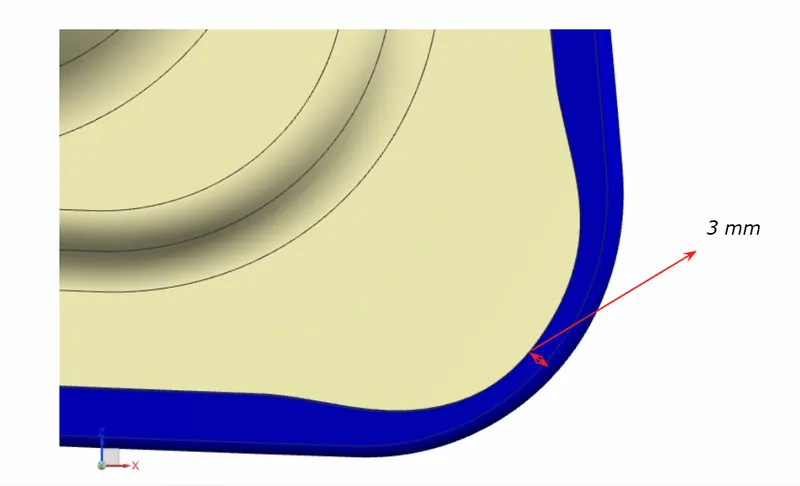
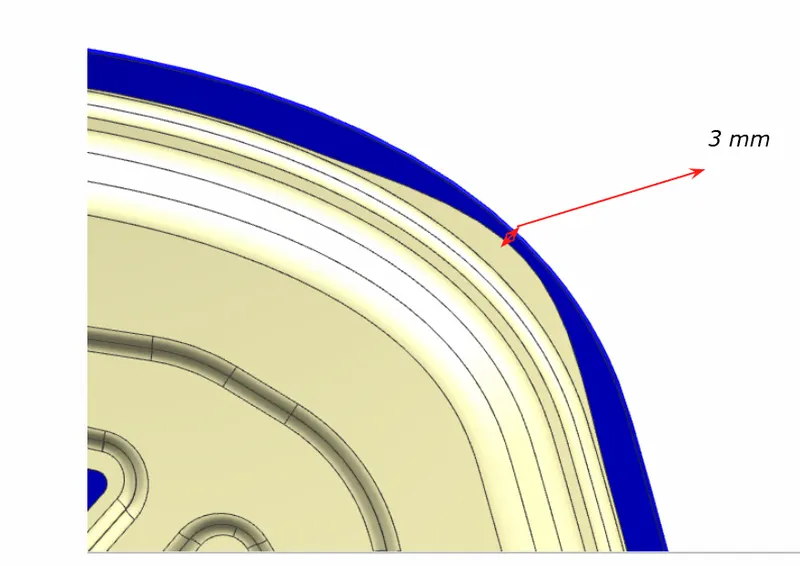
Corner-Bend Relief:
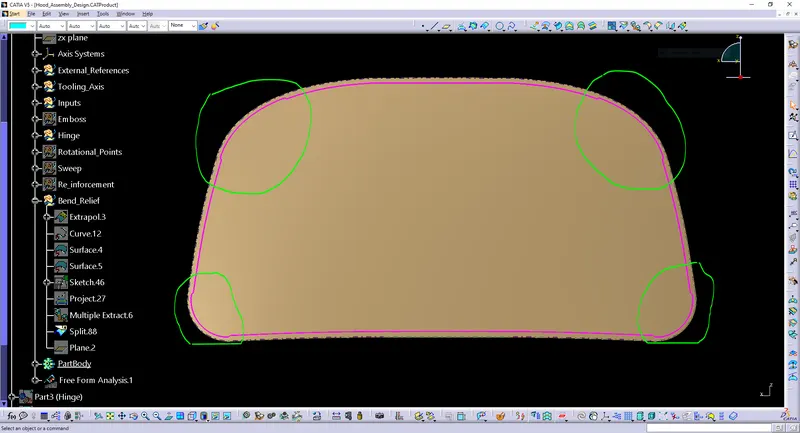
- A bend relief is just two tiny slits cut into a sheet of metal to release the metal between them.
- It divides the component's rest from the material you wish to be able to fold.
- Only when there is material on either side of a bend do you need it.
Final Assembly:
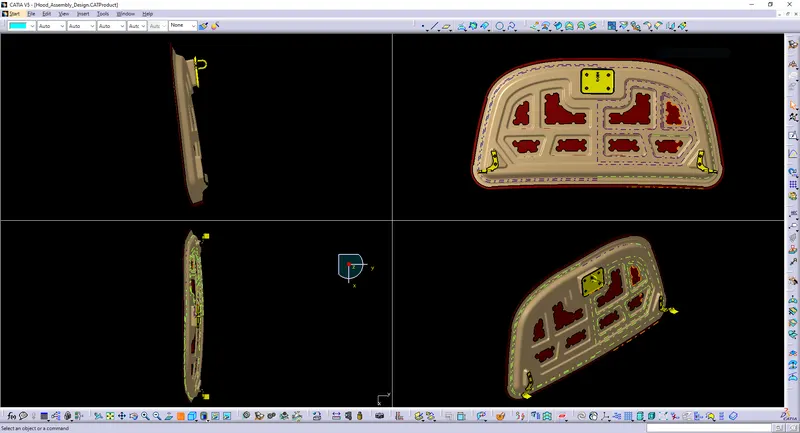
Conclusion:
- The hood assembly design, along with the addition of the striker and hinges, ought to be successful.